The practical uses of AI in healthcare are not distributed evenly across medicine. In 2026, the best-supported tools still cluster around bounded visual and signal-processing tasks: detecting a suspected finding on an image, quantifying a cardiac measurement, screening retinal photographs, or prioritizing a study for specialist review. That is a very different claim from saying that AI is ready to perform general diagnostic reasoning across primary care, emergency medicine, and inpatient medicine.
This distinction matters because hospital adoption can make the field look more mature than the clinical evidence really is. Roughly 80% of hospitals use AI somewhere, but fewer than 20% of institutions report sustained high-success use in core clinical diagnosis, according to 2026 survey reporting summarized by Wolters Kluwer.[1] An AI tool used for documentation, scheduling, coding, denials, or imaging worklist prioritization may be useful. It does not prove that a diagnostic chatbot, sepsis model, or broad primary care assistant is ready to carry clinical uncertainty at the bedside.
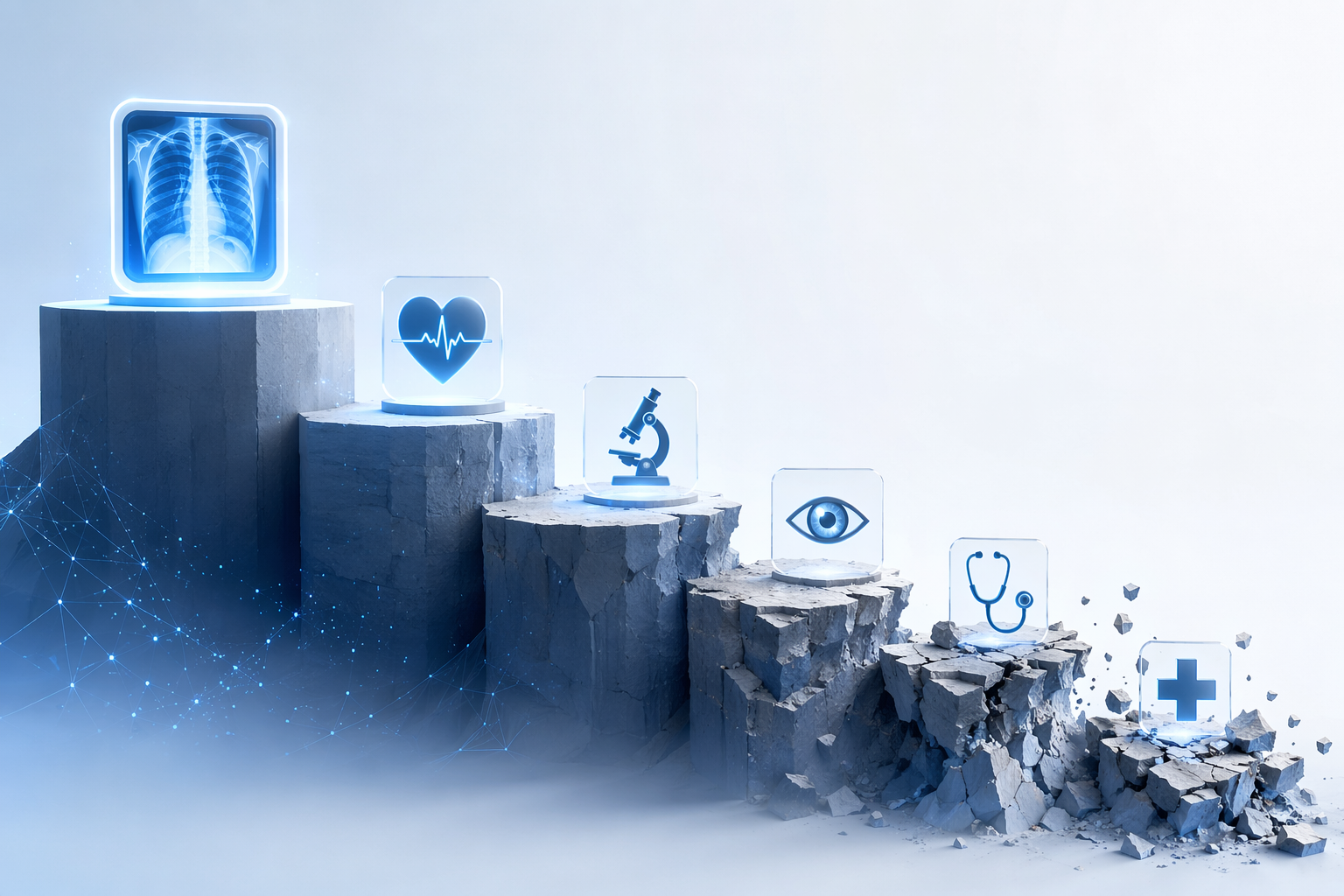
A Specialty Readiness Map
A useful evaluation starts with the intended use. The same procurement label — “AI platform” — can hide very different clinical burdens. A mammography triage model may ask a radiologist to review a prioritized exam sooner. A primary care diagnostic assistant may influence an uncertain differential diagnosis in a 15-minute visit. An emergency department sepsis alert may page a nurse, trigger a protocol, and create a chart artifact that someone must later explain. The readiness question changes with the specialty, the task, and the person who inherits the output.
| Specialty | Best-supported uses of AI in healthcare | Evidence and deployment maturity | Main caveat |
|---|---|---|---|
| Radiology | Image triage, detection support, mammography assistance, workflow prioritization | Most mature clinical AI category; radiology accounts for about 76% of FDA-cleared AI/ML medical devices in recent 2026 reporting.[2][3] | Clearance and accuracy do not automatically prove outcome benefit; many studies remain retrospective, single-center, or limited in real-world validation.[2] |
| Cardiology | Echocardiography measurements, left ventricular ejection fraction estimation, ECG interpretation, atrial fibrillation detection | Plausible second tier with cleared tools and clear measurement tasks | Evidence is still less prospectively proven than radiology, especially for patient outcomes rather than measurement agreement. |
| Ophthalmology | Autonomous diabetic retinopathy screening from retinal images | Narrow screening AI can reach high reported trial accuracy; IDx-DR, now LumineticsCore, became the first FDA-cleared autonomous AI diagnostic system.[2] | The strength is in a defined screening use case, not general ophthalmic diagnosis. |
| Pathology | Whole-slide image analysis, cancer detection support, region-of-interest flagging | Meta-analytic performance can exceed 90% pooled sensitivity and specificity in selected settings, with only a small number of FDA-cleared WSI algorithms as of mid-2026.[2] | High risk of bias and workflow integration limits make broad deployment harder than headline accuracy suggests. |
| Primary care | Documentation support, inbox assistance, risk prompts, limited decision support | Operational uses may be valuable; diagnostic evidence remains thin, with only a small share of FDA-cleared devices targeting primary care.[2] | Multi-problem visits, uncertainty, longitudinal context, and low-prevalence diagnoses expose weaknesses in current diagnostic AI. |
| Emergency medicine | Triage support, stroke workflow support, sepsis prediction, operational prioritization | Some deployed models exist, especially for time-sensitive workflows | Impact evidence is mixed; false alerts and missed deterioration land directly on real-time clinical teams. |
Radiology Is the Strongest Case, and the Easiest to Overstate
Radiology is where the evidence-supported story of AI in healthcare is most convincing. The task boundaries are unusually favorable: digital images are already structured, specialist labels can be generated from clinical reads or adjudicated review, and many use cases involve detection, segmentation, measurement, or triage rather than open-ended clinical reasoning. Recent 2026 tracking reported roughly 1,163 radiology-focused FDA-cleared algorithms as of March 2026, representing about 76% of all AI medical devices.[3] Other counts place the total number of FDA-cleared AI/ML devices in the roughly 1,250 to 1,400-plus range, depending on cutoff date and inclusion criteria.[2][3][4]

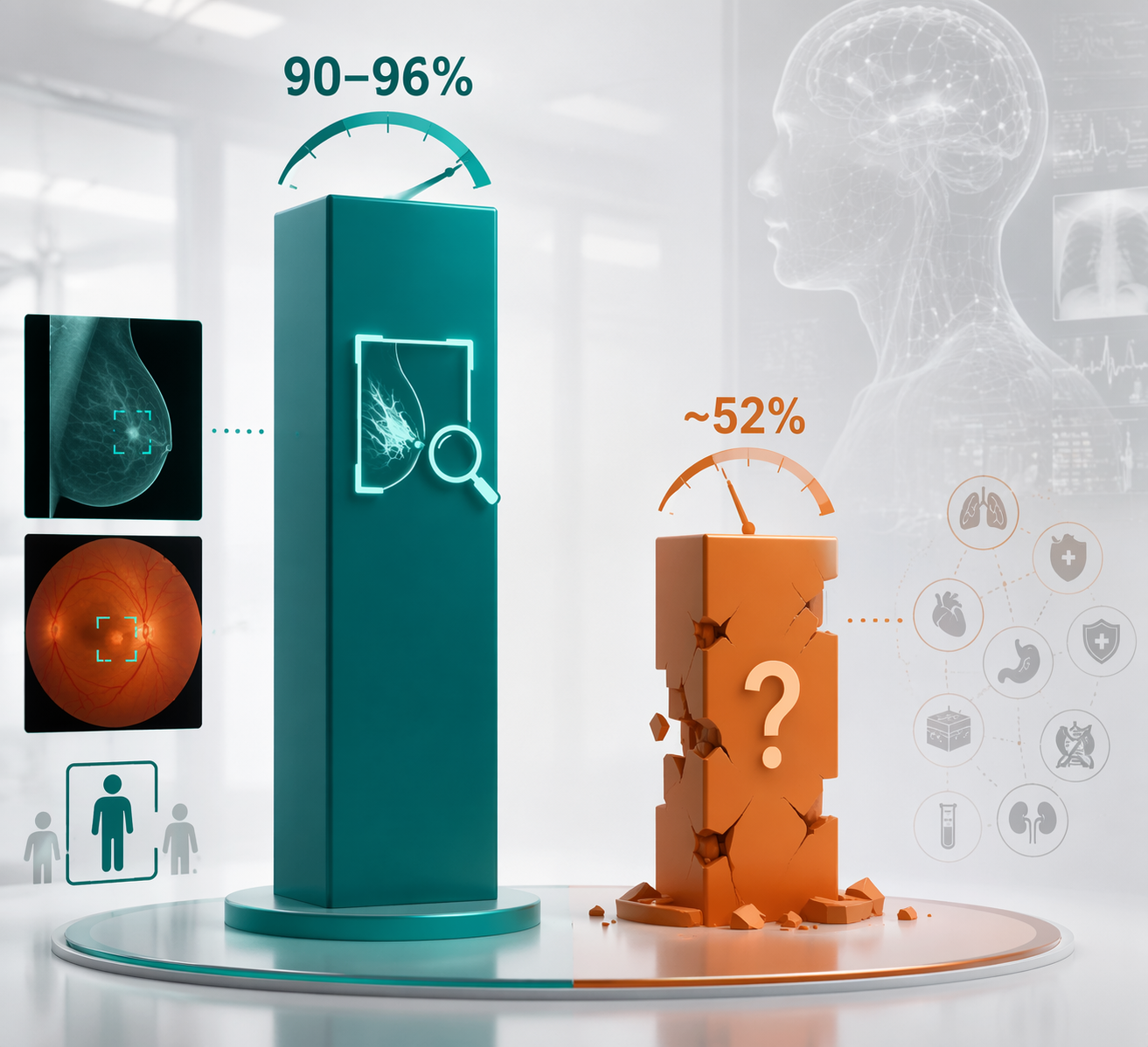
Mammography shows why radiology became the lead specialty. AI-assisted mammography has been reported at 90–92% sensitivity for breast cancer detection, with a 20–25% reduction in false positives in trial data summarized in the 2026 clinical AI evidence base.[2] For a radiology service line, that is not an abstract benchmark. Fewer false positives can mean fewer unnecessary callbacks, fewer anxious patient conversations, and less downstream diagnostic work generated by an avoidable alarm. Sensitivity and false-positive rate are still not the whole patient outcome, but they are clinically legible measures.
Triage is another radiology use case that fits current AI well. When a model flags a suspected intracranial hemorrhage, pulmonary embolism, pneumothorax, or stroke-related imaging finding, the clinical value is not that the machine “diagnoses the patient” in a general sense. The value is that a time-sensitive study may move higher on a worklist. Reported triage deployments have claimed 25–30% radiologist throughput increases in some settings.[2] That kind of gain is plausible when the AI output changes ordering, routing, or prioritization rather than replacing the radiologist’s interpretive responsibility.
The caution is that radiology’s regulatory lead can be mistaken for radiology’s outcomes proof. FDA clearance usually establishes that a device met its cleared intended use requirements; it does not automatically show lower mortality, fewer missed cancers, reduced malpractice exposure, or better population outcomes after deployment. The Stanford-Harvard ARISE report and related 2026 evidence discussions emphasized the “EVAL” gap: across more than 500 AI studies reviewed, only 5% used real patient data, while many studies remained retrospective, single-center, or industry-affiliated.[2]
That does not make radiology AI weak. It means the strongest domain still needs disciplined governance. A radiology department evaluating an AI product should know whether the tool is cleared for triage, concurrent reading, second-read support, quantification, or autonomous detection; whether the validation set resembles its scanners and patient mix; who sees the alert; how discrepant AI outputs are documented; and whether the expected benefit is turnaround time, sensitivity, workload, or a patient outcome. Without that specificity, the clearance count becomes a marketing number rather than a deployment plan.
Cardiology Has Clear Targets, but Less Outcome Evidence
Cardiology is a credible second tier because several tasks resemble the bounded measurement problems that made radiology fertile ground. Echocardiography AI can estimate left ventricular ejection fraction, assist wall-motion assessment, or standardize measurements. ECG algorithms can flag atrial fibrillation and other rhythm abnormalities. These are not trivial tasks, but they are narrower than asking a model to explain a patient’s fatigue, edema, chest discomfort, renal function, medications, and social context in one diagnostic pass.
The operational appeal is obvious. A sonographer, cardiologist, or reading physician may spend less time on repetitive quantification. A health system may get more consistent measurements across sites. A rhythm detection model may draw attention to a finding that otherwise waits in a queue. These are service-line problems AI can plausibly improve, especially when the output is reviewed by a cardiology clinician and embedded into an existing read workflow.
The evidence bar still changes once the claim moves from measurement accuracy to patient benefit. Retrospective agreement with expert readers is useful. Prospective multicenter evidence showing changed management, fewer adverse events, better anticoagulation decisions, or improved heart failure care is stronger. Cardiology AI sits in the middle of the readiness map: more concrete than general diagnostic AI, less mature than radiology’s largest imaging categories.
Ophthalmology Shows What Narrow Autonomous AI Can Do
Diabetic retinopathy screening is one of the cleanest examples of a bounded AI diagnostic use case. The input is a retinal image. The clinical question is defined. The output is not a general ophthalmology opinion; it is a screening result for a specific disease category and referral threshold. IDx-DR, now LumineticsCore, became the first FDA-cleared autonomous AI diagnostic system, and diabetic retinopathy screening models have reported about 96% accuracy in trial data summarized in 2026 evidence reviews.[2]
This is a meaningful use of AI in healthcare because it can move screening closer to patients who might not otherwise complete an eye exam. In a primary care clinic or diabetes care setting, the model’s value is not that it replaces ophthalmologists across eye disease. It is that it may identify patients who need referral and reduce the number of unscreened patients in a defined population.
That narrowness should be protected, not apologized for. The more precise the intended use, the easier it is to validate the tool, train staff, explain the result, and monitor drift. Problems begin when a successful autonomous screening example is used rhetorically to imply that autonomous diagnosis is broadly ready across medicine.
Pathology Is Promising, but Deployment Is Not Just Accuracy
Pathology has many of the ingredients that should favor AI: image-rich workflows, pattern-recognition tasks, high-volume review, and opportunities to flag regions of interest on whole-slide images. Reported whole-slide imaging AI performance can exceed 90% pooled sensitivity and specificity in meta-analyses, but the evidence base also carries a high risk of bias in many studies.[2] As of mid-2026, only four FDA-cleared whole-slide imaging AI algorithms were identified in the available evidence.[2]
The constraint is not only model performance. Digital pathology requires scanner infrastructure, storage, image management, pathologist workflow redesign, quality control, and integration with laboratory information systems. A model that performs well on curated slides may still fail to deliver practical value if slide preparation differs, artifacts are common, turnaround time does not improve, or pathologists must spend extra time reconciling unclear overlays.
For now, pathology AI is best treated as a narrow high-potential domain rather than a mature broad diagnostic replacement. The strongest near-term uses are likely assistive: finding suspicious areas, supporting quantification, reducing search burden, or standardizing selected reads under specialist oversight.
Primary Care Is Where Diagnostic AI Meets Real Ambiguity
Primary care is often where AI proposals sound most attractive and become hardest to validate. The work is broad, longitudinal, and interruption-heavy. One visit may include hypertension, medication reconciliation, depression, a new symptom, a vaccine gap, a portal message, a prior authorization problem, and a family member’s concern. A model that performs well on a clean medical benchmark may not know which problem is clinically active, which result is stale, which symptom changed this morning, or which recommendation will create work the patient cannot complete.
That does not mean AI has no place in primary care. Documentation assistance, inbox routing, visit summarization, preventive care gap identification, medication list cleanup, and administrative support may reduce some of the work that currently crowds out clinical thinking. Those uses should be judged on their own terms: time saved, error rates, clinician burden, patient communication quality, and whether the tool creates new after-hours cleanup.
Diagnostic decision support is a different standard. The ARISE report documented AI accuracy drops of more than one-third when test formats were modified to include uncertainty or multi-step reasoning.[2] The primary care evidence base also remains small relative to the size of the specialty: 73 empirical studies, 39 AI randomized controlled trials, and only about 3% of FDA-approved devices targeting primary care.[2] Those figures are not enough to support broad diagnostic delegation in the setting where undifferentiated symptoms first appear.
Emergency Medicine Exposes the Cost of a Bad Alert
Emergency medicine is a tempting AI target because the pain points are visible: crowding, triage, time-sensitive diagnoses, sepsis, stroke, imaging queues, and incomplete information. It is also one of the least forgiving environments for weak evidence. The patient is unstable, the history is partial, the team is multitasking, and a false positive alert can consume scarce nursing and physician attention at exactly the wrong time.
Sepsis prediction illustrates the problem. Multiple sepsis models have been deployed, but clinical impact evidence remains mixed. Epic’s Sepsis Model showed no mortality benefit in a 2024 JAMA study cited in the available evidence.[2] A model may identify higher-risk patients by retrospective association and still fail to improve outcomes if it fires too often, fires too late, lacks actionable specificity, or adds work without changing treatment decisions.
Emergency AI can still be useful when the task is concrete: stroke image routing, radiology prioritization, operational forecasting, or checklist support for a defined protocol. The risk rises when the model becomes a general urgency signal. In that case, the clinical question is not only “How accurate is it?” but “Who stops what they are doing when it fires, and what happens next?”
General-Purpose Diagnostic AI Complicates the Story, but Does Not Reverse It
Large language models have made the specialty map less tidy. A June 2026 Nature Medicine study reported that general-purpose large language models outperformed specialized clinical AI tools on medical benchmarks.[5] That finding is important because it challenges the assumption that narrowly trained clinical models will always win on every formal test.
The result still should not be read as deployment clearance for front-line diagnosis. Benchmark performance is not the same as safe clinical operation. General-purpose generative AI models average about 52% diagnostic accuracy in meta-analytic summaries cited in the research brief, a level described as comparable to non-expert clinicians and below specialists.[5] That may be interesting for education, drafting, differential diagnosis expansion, or second-look reasoning. It is not a specialist replacement standard.
The failure mode is different from an imaging model. A mammography algorithm may miss or overcall a visible lesion within a defined task. A diagnostic language model may produce a plausible explanation that blends correct facts, irrelevant context, and unjustified confidence. The clinician then has to decide whether to trust it, ignore it, document around it, or explain to a patient why the machine suggested something alarming. That cognitive and medicolegal handoff is part of the evidence question.
What to Ask Before Treating an AI Tool as Clinically Ready
A specialty-by-specialty map is more useful than a generic AI maturity score because it forces the intended use into view. For a real procurement or governance decision, the basic questions are not glamorous, but they are the ones that prevent category slippage.
- What exact clinical task is the model cleared or validated to perform?
- Is the tool assistive, autonomous, triage-only, measurement-only, or diagnostic?
- Was validation prospective, multicenter, and performed on patients resembling the local population?
- Does the evidence measure patient outcomes, workflow outcomes, reader agreement, or only benchmark accuracy?
- Who receives the alert, who reviews it, and who is responsible when the output is wrong?
- What monitoring will detect drift, alert fatigue, inequitable performance, or workflow workarounds after go-live?
The Nature Medicine editorial “Show us the evidence for the value of medical AI” made the same larger point in 2026: medical AI needs outcome-focused evaluation, not only technical performance claims.[6] That is especially important when AI is moved from retrospective datasets into clinics where staffing, patient mix, documentation practices, device settings, and local protocols differ from the development environment.
Where the Evidence Supports Use Today
The evidence-supported uses of AI in healthcare are strongest when the model is narrow, the input is structured, the intended use is explicit, and a specialist workflow can absorb the output. Radiology is the clearest example, especially image triage, mammography assistance, and selected detection or quantification tasks. Ophthalmology’s diabetic retinopathy screening shows that autonomous AI can be clinically credible when the disease target, image input, and referral decision are tightly defined. Cardiology and pathology have plausible, clinically meaningful use cases, but their readiness depends heavily on whether the claim is measurement support, workflow assistance, or improved patient outcomes.
The case is much weaker for broad diagnostic reasoning in primary care and emergency medicine. Those settings are not merely “harder datasets.” They are environments where uncertainty, time pressure, incomplete information, patient heterogeneity, and downstream accountability dominate. AI may help with documentation, routing, prioritization, and selected protocolized tasks, but current evidence does not support treating general-purpose diagnostic AI as equivalent to specialist judgment.
The disciplined conclusion is not that AI in healthcare works or does not work. It is that AI works best today in bounded specialty tasks, especially imaging and selected autonomous screening, while general diagnostic reasoning and front-line decision support remain clinically underproven.
References
- Wolters Kluwer Future Ready Healthcare Survey 2026 — Wolters Kluwer — 2026
- ARISE State of Clinical AI Report 2026 — Stanford-Harvard ARISE — 2026
- MedTech Dive AI Device Tracker — MedTech Dive
- AI in Healthcare Statistics 2026: 80+ Key Data Points — Uvik — 2026
- General-purpose large language models outperform specialized clinical AI tools on medical benchmarks — Nature Medicine — June 2026
- Show us the evidence for the value of medical AI — Nature Medicine — April 2026
Comments
Join the discussion with an anonymous comment.