
The most important development in AI in healthcare fraud detection and enforcement in 2026 is not that federal agencies are buying better software. It is that DOJ analysts now have cloud computing capacity inside CMS’s Integrated Data Repository, with direct AI-enabled access to Medicare claims data. That June 2026 DOJ-CMS arrangement moves the government closer to finding its own fraud theories inside the claims stream, rather than waiting for a whistleblower, a contractor referral, or a retrospective rules-based outlier report to mature into a case.[1]
That distinction matters in the hospital billing office, the physician group compliance meeting, and the first uneasy call with counsel after a subpoena arrives. A data-generated theory does not arrive with a human narrator who can be interviewed, impeached, or tested for motive. It arrives as a pattern: billing by place of service, patient mix, timing, provider identity, travel records, consumer complaints, prior authorization behavior, or some combination the agency may not explain at the front end.

There is a reason this has happened. The enforcement agencies are not operating in a vacuum. The FBI has estimated fraud at up to 10% of all Medicare billings, the National Health Care Anti-Fraud Association has estimated annual Medicare fraud at more than $100 billion, and GAO estimated $521 billion in improper payments across federal programs in 2024.[2] Those numbers do not all measure the same thing. The NHCAA figure is an estimate, not a ledger total. “Improper payments” are not synonymous with fraud. Still, the political and budgetary pressure is obvious enough: claims data is enormous, losses are believed to be large, and the government wants earlier detection.
The recovery figures add momentum. DOJ recovered a record $6.8 billion under the False Claims Act in fiscal year 2025, with healthcare accounting for $5.7 billion, or 83%, of that total.[2] The government also charged 455 defendants in the 2026 nationwide healthcare fraud takedown.[2] Those are enforcement outcomes, not proof that every algorithmic lead will be sound. But they explain why agencies are willing to build infrastructure around faster case generation.
The New Enforcement Stack
The 2026 architecture is best understood as a stack, not a single AI tool. At the center is CMS claims data. DOJ’s National Fraud Enforcement Division now has cloud computing capacity inside CMS’s Integrated Data Repository, allowing AI analysis to be run directly against Medicare claims rather than waiting for data extracts to travel through slower channels.[1]
Around that claims core, agencies are adding data that used to sit outside the ordinary Medicare fraud frame. The June 2026 measures described DHS travel data being used to identify off-premises billing patterns and FTC consumer complaint data being incorporated for telemedicine schemes.[1] That does not mean a plane ticket proves a false claim, or that a consumer complaint proves medical necessity failed. It means the first government question may now be generated by the collision of datasets that a provider never sees in ordinary revenue-cycle review.
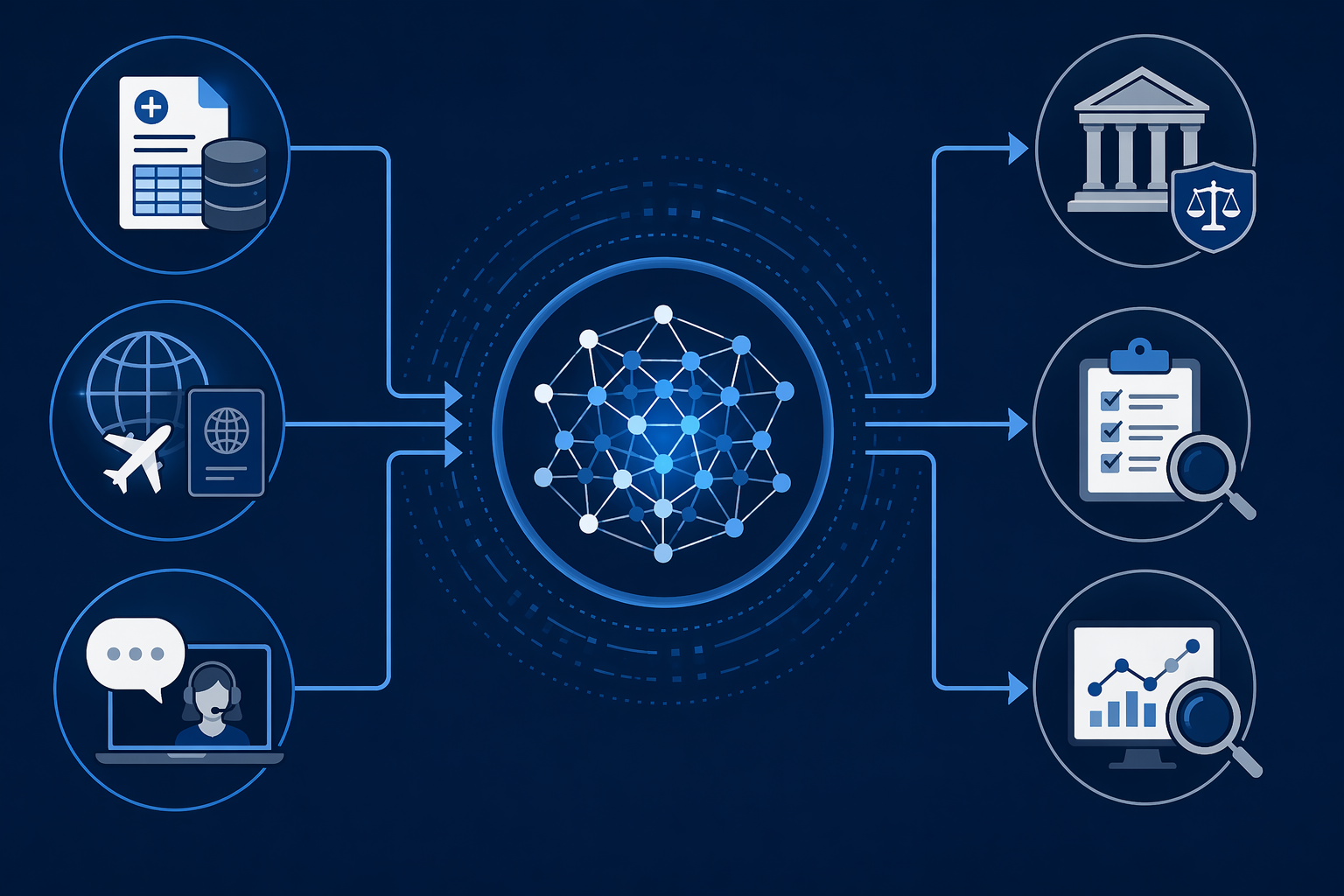
HHS is building a parallel lane through the AERO program, announced in May 2026. AERO uses AI to audit five years of state and grantee compliance data and carries authority to withhold or suspend funds for unaddressed deficiencies.[3] That is not the same as a Medicare provider fraud case, but it is part of the same institutional move: AI is being placed upstream in oversight work, where it can select the first targets for human review.
CMS’s WISeR Model belongs in the same conversation because it shows the prepayment side of the enforcement turn. WISeR is an AI-driven prior authorization framework aimed at reducing improper payments before money leaves the program, rather than recovering funds after disbursement.[4] Post-payment fraud detection asks whether already-paid claims suggest misconduct. Prepayment review asks whether the government should stop or slow payment before the provider receives it. Operationally, both can put the provider in the position of responding to an automated theory before the basis of that theory is fully visible.
| Agency or Program | Data or Function | Operational Consequence |
|---|---|---|
| DOJ National Fraud Enforcement Division and CMS | AI analysis inside CMS’s Integrated Data Repository | Claims patterns can become enforcement leads without a whistleblower-first path |
| DHS data sharing | Travel records linked to billing patterns | Location and timing discrepancies may trigger scrutiny before medical records are reviewed |
| FTC data sharing | Consumer complaints involving telemedicine schemes | Complaint clusters can be matched against claims behavior |
| HHS AERO | AI review of state and grantee compliance data | Funding consequences may follow unresolved deficiencies |
| CMS WISeR | AI-supported prior authorization review | Payment may be delayed or denied before a traditional post-payment audit |
How a Pattern Becomes a Case
Traditional healthcare fraud cases have never been as tidy as the public press release makes them sound. Some start with qui tam relators. Some begin with contractor audits, beneficiary complaints, data anomalies, state Medicaid referrals, or agents who know exactly which billing code is being abused in a region. Rules-based analytics have been part of that mix for years.
What changed in 2026 is the government’s ability to generate and refine leads at scale from inside the federal claims environment. A rules-based review may ask whether a provider exceeded a threshold for a code, billed impossible days, or departed from a known coverage requirement. A machine learning model can be trained to surface combinations that are harder to reduce to one published rule: a provider’s billing trajectory after acquisition, ordering patterns tied to telehealth complaints, services billed while a clinician appears to be elsewhere, or a cluster of suppliers whose claims move together.
That can be useful. It can also be procedurally messy. A model may identify correlation before anyone has established a legally meaningful misrepresentation. It may elevate a provider because its patient population, staffing model, rural referral pattern, or documentation workflow looks unlike the comparison group. It may also be right. Compliance teams have to prepare for both possibilities, because the subpoena does not wait for the model governance debate to finish.
DOJ officials’ warning that “your next whistleblower could be your data” captures the direction of travel.[1] The phrase is memorable, but the procedural consequence is more important than the slogan. If the data is the first accuser, then the first defense task is not witness assessment. It is reconstruction: what claims were submitted, what rules applied at the time, what documentation existed, what edits were in place, which vendor tools touched the claim, and whether the government’s comparison set is fair.
The record qui tam volume makes the shift more complicated, not less. There were 1,297 qui tam actions filed in fiscal year 2025, the highest ever.[2] Whistleblower litigation is not disappearing. Instead, providers now face two lead-generation systems at once: human insiders bringing allegations and government systems mining claims and external data for patterns that may mature into investigations without a relator.
What Providers Will Feel First
The first operational effect is earlier scrutiny. When analytics run closer to the claims source, the government does not need to wait for years of paid claims to accumulate before deciding that a billing pattern deserves attention. That may reduce losses in genuine fraud cases. It may also mean a lawful but unusual practice model is flagged before the provider has any reason to know it looks unusual to the government.
The second effect is broader evidence assembly. A response team may have to explain not only medical necessity and coding, but also geography, call-center workflow, telemedicine intake scripts, enrollment records, ordering-provider relationships, and the behavior of billing or clinical decision-support software. If DHS travel records or FTC complaint data helped select the target, counsel will want to know whether those data sources are accurate, complete, and actually connected to the billed services at issue.[1]
The third effect is a heavier burden on internal documentation. AI-generated leads tend to punish missing context. A hospital may be able to explain a spike in a service line because of a physician recruitment, a payer policy change, a coding education initiative, or a regional access problem. But if that explanation lives only in memories, meeting chatter, or disconnected spreadsheets, it will not help much when the government asks for records two years later.
For health systems using AI-assisted billing or coding tools, the risk runs in both directions. Agencies are using AI to find suspect claims, while providers are using automation to create, code, review, or submit claims. Legal commentary in 2026 has warned that AI-assisted billing can create False Claims Act exposure where automation contributes to unsupported coding, inadequate review, or recurring claim errors.[5] The uncomfortable question in an investigation will be whether the provider understood how its own tool behaved before the government’s tool found the pattern.
The response file has to change
A conventional audit response file often centers on the sampled claims, the coverage rule, the medical records, and the coding rationale. Those remain essential. But an AI-initiated inquiry requires a wider chronology. Providers should be able to identify when billing rules changed, when templates changed, when a vendor model was deployed or updated, when coders received education, when internal audits found error rates, and when corrective action actually occurred.
- Preserve the version history for billing, coding, documentation, and claim-scrubbing tools that touched the claims under review.
- Keep a defensible map of who reviewed AI-assisted outputs before claim submission and what exceptions required human escalation.
- Document the business and clinical reasons for abrupt changes in claim volume, code mix, referral source, location, or modality.
- Separate known overpayment work from speculative pattern review, so repayment decisions are not confused with admissions about the government’s broader theory.
- Track vendor representations carefully; a compliance team cannot defend a black box by repeating sales language.
None of that guarantees a favorable outcome. It does make the difference between answering with records and answering with recollection. In an algorithm-initiated matter, that difference can determine whether the provider can narrow the inquiry before it becomes a full-blown enforcement case.
The Hard Part Is Contesting the Machine’s Premise
The legal problem is not simply that the government may use AI. Agencies have always used tools, consultants, contractors, and statistical methods. The harder question is how a provider contests a case theory that began inside a model the provider did not see, using data sources the provider may not possess, with assumptions the agency may treat as investigative rather than evidentiary.
Discovery will become one of the main battlegrounds. If the government alleges false claims based on a pattern first identified by AI, defendants will ask what model was used, what data trained or prompted it, what variables mattered, what false positives were known, and whether similar providers were treated differently. The government will likely resist some of that as privileged, law enforcement sensitive, proprietary, or irrelevant once human investigators have developed separate evidence.
Vendor transparency is another weak point. If a commercial model or contractor-supported system contributed to targeting, the provider may need information from an entity that is not a party to the case. If the provider’s own billing AI is involved, the same problem can cut against the provider: counsel may have to obtain logs, training materials, model documentation, change notes, and exception reports from a vendor whose contract was never drafted with a federal fraud investigation in mind.
There is also a quality-of-proof issue. A model can be excellent at prioritizing investigative leads and still be insufficient to prove falsity, knowledge, materiality, or damages under the False Claims Act. Lead generation and liability are different acts. Providers should press that distinction early, because once an algorithmic pattern is translated into a narrative of intent, it becomes much harder to pull apart.
The government’s side of this is not frivolous. Fraud schemes adapt quickly, especially in telemedicine, durable medical equipment, laboratory billing, and enrollment-based models. Static rules miss things. Human tips are uneven. A program paying millions of claims cannot rely only on after-the-fact manual review. But a faster targeting system still needs a fair way to be challenged.
Oversight Is Already Trying to Catch Up
The most telling fact may be that HHS-OIG announced an audit of HHS governance of artificial intelligence on July 2, 2026. The audit focuses on transparency, fairness, accountability, and cybersecurity of AI tools deployed for fraud detection.[6] That is not a minor administrative footnote. It is an acknowledgment that the enforcement infrastructure is moving while the guardrails are still being examined.
Transparency matters because providers need to understand the case they are answering. Fairness matters because models can elevate outliers without understanding why the outlier exists. Accountability matters because an agency cannot avoid responsibility for a targeting decision by pointing to a tool. Cybersecurity matters because the new enforcement stack depends on concentrated access to sensitive claims, complaint, travel, and compliance data.
The timing is awkward. The DOJ-CMS cloud arrangement was described in June 2026.[1] AERO was launched in May 2026.[3] The OIG audit was announced in early July 2026.[6] That sequence suggests oversight is not absent, but it is not comfortably ahead of deployment either. Providers should not assume the accountability framework is settled just because the enforcement tools are already being used.
Where the Threshold Shift Leaves Compliance Teams
For compliance officers, the practical answer is not to build a theatrical “AI fraud defense program.” It is to make existing revenue-cycle compliance work more traceable. The government’s systems are becoming better at asking why a pattern exists. Providers need to be able to answer that question without reconstructing three years of operational history under subpoena pressure.
That means internal audits should not only identify error rates; they should record why errors occurred, who corrected them, and whether the same logic appears in adjacent service lines. Vendor governance should not only ask whether a tool improves productivity; it should ask what evidence will exist if the tool contributes to disputed claims. Board and compliance committee reporting should not only show repayment totals; it should show whether management can explain material shifts in claim behavior.
Counsel should also prepare for earlier fights over scope. If the government’s first request is built around a model-generated pattern, the provider may need to ask what time period, codes, locations, providers, or entities actually relate to the concern. Narrowing the inquiry is not obstruction; it is how a provider avoids turning an unexplained anomaly into an enterprise-wide excavation.
The 2026 shift is real, but it should be described precisely. DOJ and CMS have created direct analytical capacity inside the Medicare claims environment. HHS has launched AI-backed grant and state compliance auditing with funding consequences. CMS is testing AI-supported prepayment review through WISeR. HHS-OIG is now auditing AI governance. What has not yet been measured is the operational accuracy, false-positive burden, discovery treatment, or courtroom durability of cases that begin this way. That is the warning: the federal healthcare enforcement system is now being built to generate its own leads from claims and related data, while the rules for contesting those leads remain unsettled.
References
- Enhanced AI, Data-Sharing Measures Reinforce DOJ Focus on Data-Driven Healthcare Fraud Enforcement, Morgan Lewis, June 2026
- Healthcare Fraud Enforcement Trends to Expect in 2026, AGG
- HHS launches AI-backed health fraud crackdown, Healthcare Dive, May 2026
- From Innovation to Regulation: Health Care Enforcement Related to AI, Mintz, January 2026
- AI-Assisted Billing Could Create FCA Pitfalls, Subject to Inquiry, June 2026
- Audit of HHS Governance of Artificial Intelligence, OIG HHS, July 2026
Comments
Join the discussion with an anonymous comment.