The phrase “examples of AI in healthcare” covers too much territory unless it is sorted by clinical task, evidence standard, and deployment setting. A hospital may use AI for scheduling, documentation, coding, imaging triage, sepsis alerts, or patient messaging and still have very little sustained success with AI in core diagnosis. That mismatch is visible in current adoption data: roughly 80% of hospitals are reported to use AI somewhere, while fewer than 20% report sustained high-success use in core clinical diagnosis.[1]
So the useful question is narrower: which clinical applications have crossed from demonstration into regulated, studied, or deployed use? On that measure, the map is uneven. Radiology dominates the FDA-cleared device landscape, ophthalmology has the cleanest autonomous diagnostic example, cardiology and emergency medicine are strong decision-support domains, and oncology, pathology, and generative AI remain more mixed.
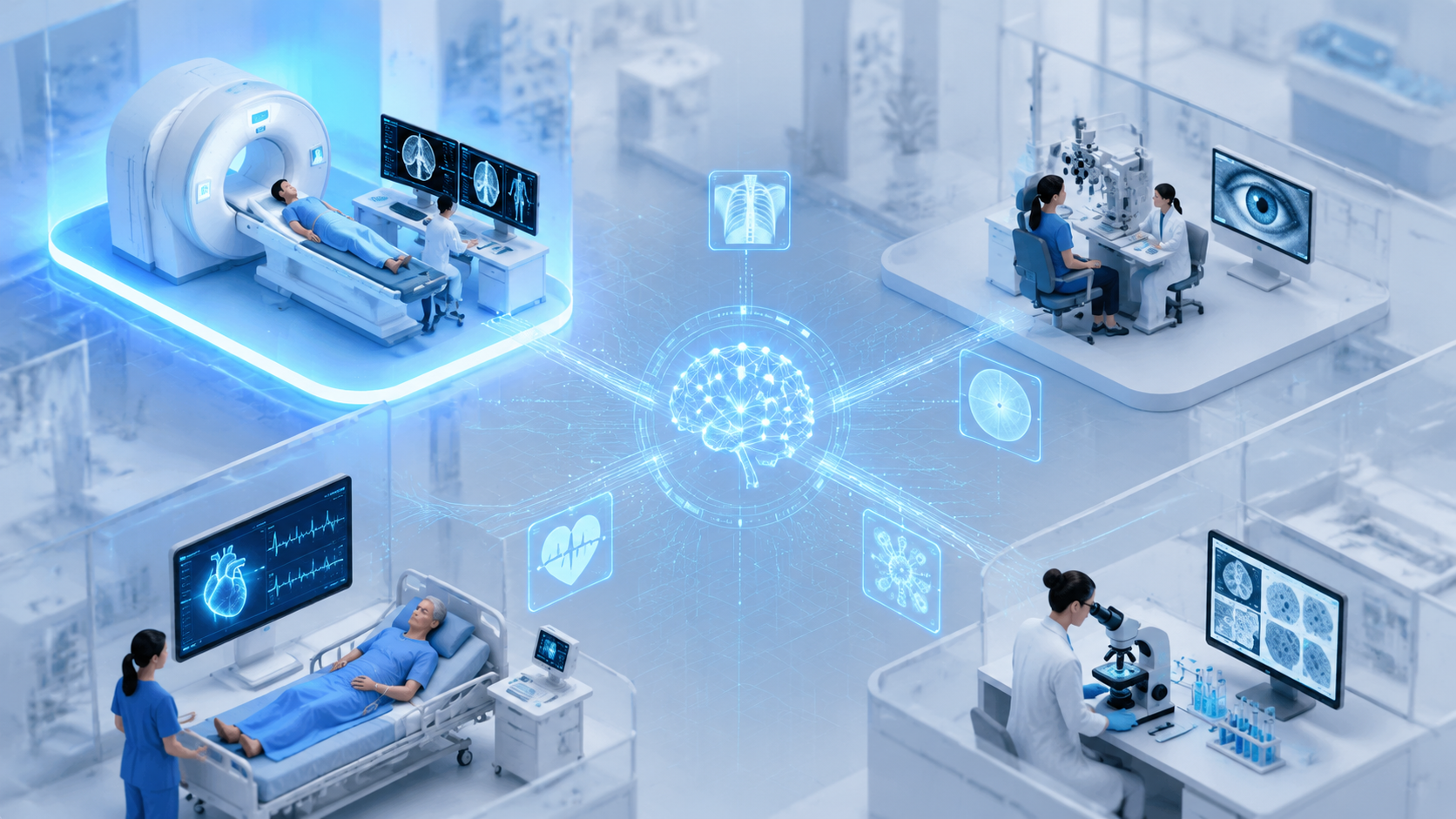
| Specialty or domain | Maturity signal | Representative AI use | What the evidence supports |
|---|---|---|---|
| Radiology | Largest regulated footprint | Stroke triage, lung nodule detection, mammography support | Many cleared devices; task-specific tools can improve detection or workflow, but clearance is not the same as clinical benefit.[2][3] |
| Ophthalmology | Autonomous diagnostic maturity | Diabetic retinopathy screening | A narrow screening task can be performed without requiring a specialist to interpret every image.[3] |
| Cardiology | Workflow-dependent decision support | AI-ECG and coronary artery disease analysis | Useful when the result enters a defined care pathway rather than sitting outside clinical review.[3] |
| Emergency medicine | Time-sensitive alerting | Cardiac arrest call detection, sepsis warning, ED diagnostic support | Performance depends heavily on who receives the alert and what response capacity exists.[3] |
| Oncology and pathology | Promising but less settled | Colorectal lesion detection, lymph-node metastasis screening | Strong task-level results exist, but they do not yet add up to broad specialty transformation.[3] |
| Generative AI | Early clinical maturity | Diagnostic chatbots and general reasoning tools | Accuracy remains too inconsistent for unsupervised diagnostic use.[3] |
Radiology Is the Regulatory Baseline
Radiology appears first for a simple reason: it carries the strongest regulatory signal. The FDA’s public list of AI-enabled medical devices included about 1,250 devices as of May 2025, and radiology accounted for approximately 76% of them.[2] That number should not be overread. The FDA list is a regulatory inventory, not a registry of improved patient outcomes, and the agency notes that the list is based primarily on AI-related terms in device summaries rather than a complete census of all AI software in medicine.[2]
Still, the radiology concentration matters. Imaging produces structured digital inputs, radiologists already work through queues, and many AI tools can be inserted as triage, detection, or prioritization layers rather than as broad diagnostic agents. A stroke-triage model does not need to understand the entire patient; it needs to identify a defined imaging pattern quickly enough to change which case a team opens next.
Stroke triage is the cleanest workflow example. In a vendor-reported case study, Lexington Medical Center used an AI stroke-triage system that generated notifications in less than 60 seconds.[4] The important part is not the number alone. A sub-minute alert only matters if someone is assigned to receive it, if the alert routes to the right team, and if the downstream process can move from image acquisition to vascular neurology, interventional radiology, or transfer decision without creating a parallel inbox that clinicians learn to ignore.
Detection tools show a different kind of value. A broad review reported that AI assistance for lung nodule detection found 29% more missed nodules, while AI-assisted mammography reached 90% to 92% sensitivity with a 20% to 25% reduction in false positives.[3] Those are meaningful figures because they attach the model to a specific reading task. They do not imply that AI “does radiology.” They imply that, under defined conditions, software may help readers notice findings, prioritize cases, or reduce unnecessary recalls.
Radiology also shows why the difference between adoption and effectiveness matters. A cleared device can be technically available, contractually purchased, and clinically unused if it does not fit the worklist, fails to match the institution’s imaging protocols, or produces alerts that are too frequent for the staffing model. The mature version of radiology AI is not the impressive demo. It is a narrow tool whose output appears where the radiologist, stroke coordinator, or emergency physician already has to make a decision.
Ophthalmology Has the Clearest Autonomous Diagnostic Example
Ophthalmology deserves separate treatment because diabetic retinopathy screening is one of the few areas where AI has moved beyond “assistant to a specialist” into autonomous diagnostic use for a narrow task. IDx-DR was described as the first autonomous FDA-approved diagnostic AI system, and reviewed performance data report about 96% accuracy for diabetic retinopathy detection, outperforming specialists by more than 10 percentage points in some trials.[3]
That example is often cited because the task is unusually well shaped for automation. The question is not whether a patient has every possible retinal disease. The immediate screening question is whether diabetic retinopathy is present at a level that requires referral or follow-up. The input is standardized retinal imaging, and the clinical action is clear enough to build into a primary care or diabetes clinic workflow.
The autonomy matters operationally. In many AI deployments, the model produces a suggestion that a specialist must review before it becomes clinically usable. In autonomous diabetic retinopathy screening, the intended value is different: patients can be screened in settings where an eye specialist is not reading every image in real time. That changes referral patterns, staffing assumptions, and responsibility for follow-up. The output is not merely an annotation; it is a clinical decision support result that may determine who needs ophthalmology evaluation.
This is why ophthalmology is a stronger example than many more technically glamorous applications. The model is not trying to solve medicine in general. It is designed around a defined disease, image type, threshold, and next step. That makes it easier to validate, easier to audit, and easier to explain to a clinic deciding whether the tool belongs inside its patient flow.
Cardiology: Useful Signals, Still Dependent on the Care Pathway
Cardiology AI is compelling because the signals are abundant: electrocardiograms, rhythm monitoring, echocardiography, CT angiography, and longitudinal EHR data. But the strongest examples are still decision-support tools, not autonomous cardiologists. AI-ECG systems for atrial fibrillation detection and HeartFlow FFRct for coronary artery disease analysis are representative of where the field has become clinically useful.[3]
AI-ECG applications are attractive because the test is common, inexpensive, and already embedded in acute care, outpatient clinics, and remote monitoring. The practical question is what happens after the model flags risk. A signal for possible atrial fibrillation has different implications in a symptomatic emergency department patient, a post-stroke evaluation, or a low-risk outpatient screening context. Without a defined follow-up pathway, the output can become another abnormal result waiting for someone to own it.
HeartFlow FFRct illustrates a more bounded model of use. It analyzes coronary CT data to support assessment of coronary artery disease, and its deployment across hundreds of hospitals has been reported in the reviewed literature.[3] The appeal is not that AI replaces coronary decision-making. It is that computational analysis can add physiologic information to an anatomic imaging pathway, potentially affecting which patients move toward invasive angiography, medical therapy, or further evaluation.
Emergency Medicine: Alerts Only Help When Someone Can Act
Emergency medicine is a natural home for AI because the work is time-sensitive, information is incomplete, and missed deterioration is expensive for patients and staff. It is also a difficult place to deploy AI well. An alert that arrives into a crowded emergency department must compete with triage queues, boarding, handoffs, alarms, consultant delays, and EHR task lists.
Cardiac arrest detection from emergency calls is one of the more concrete examples. Corti has been reported to detect cardiac arrest from emergency calls with 95% accuracy.[3] The relevant clinical feature is speed before arrival: the system listens for patterns in caller language and audio context that may help dispatchers recognize cardiac arrest earlier. Even there, the AI is not the endpoint. The endpoint is whether recognition changes dispatcher instructions, bystander CPR, EMS prioritization, or time to appropriate response.
Sepsis warning systems show the harder side of emergency AI. The Epic Sepsis Model is integrated into the EHR for early warning, but integration by itself does not establish benefit.[3] A sepsis alert has to be calibrated to the local population, timed early enough to matter, and specific enough that clinicians do not treat it as noise. It also has to respect the reality that sepsis care is not a single click; it involves reassessment, labs, cultures, antibiotics, fluids, source control, and judgment about competing diagnoses.
The same caution applies to broader ED diagnostic support. Reviewed data report that AI tools reduced emergency department misdiagnosis rates by about 33%.[3] That is the kind of outcome worth attention, but it needs context before procurement teams treat it as portable. Was the tool used for differential diagnosis, imaging triage, lab interpretation, or risk stratification? Was it interruptive or passive? Did residents, attendings, nurses, or case managers act on it? Emergency AI is mature only when the model output is matched to a real decision point.
Oncology and Pathology Are Strong at Narrow Tasks, Not Yet Broadly Settled
Oncology and pathology contain some of the most scientifically interesting AI work, but they should not be grouped with radiology as if deployment maturity were the same. The strongest examples are task-specific: lesion detection, slide review assistance, metastasis screening, image segmentation, or risk stratification in defined populations.
In colorectal cancer detection, Yamada and colleagues reported 97.3% sensitivity for an AI-based detection approach.[3] That is an impressive task-level metric, especially in a cancer where missed lesions can have major consequences. It does not automatically mean oncology AI is broadly mature. Sensitivity for one detection task is not the same as treatment selection, prognosis, multidisciplinary planning, or longitudinal survivorship care.
Pathology has a similar pattern. LYNA, a lymph node assistant for breast cancer metastasis screening, is a useful example because it targets a recognizable workload problem: finding metastatic disease on pathology slides.[3] The clinical question is discrete enough to validate, and the consequence of missing disease is clear. But pathology deployment also depends on slide digitization, scanner quality, laboratory information system integration, pathologist review practices, and regulatory expectations around final sign-out.
The conservative reading is not that oncology or pathology AI is weak. It is that the evidence supports narrower claims than the headlines usually make. A model can perform well on polyp detection or lymph-node metastasis screening while the specialty as a whole remains early in routine, auditable AI deployment.
Generative AI Is the Calibration Point
Generative AI belongs late in this discussion because it is not where the strongest clinical evidence currently sits. Large language models may help with drafting, summarization, patient instructions, inbox work, and education, but diagnostic use is less mature. A reviewed synthesis reported that generative AI averaged about 50% diagnostic accuracy in meta-analyses.[3]
That figure should reset expectations. A chatbot can sound coherent while being wrong, and clinical diagnosis is not only a text completion problem. It requires knowing which facts are missing, when a patient is unstable, which result is unreliable, how local resources constrain care, and when the safest action is escalation rather than explanation. Those are not reasons to dismiss generative AI; they are reasons to separate administrative and educational utility from unsupervised diagnostic authority.
What Counts as an Evidence-Based Example
The most defensible examples of AI in healthcare share a few traits. They are narrow enough to validate, tied to a clinical action, and placed inside a workflow where someone knows what to do with the output. The model may be technically complex, but the clinical question is usually simple: prioritize this scan, detect this lesion, identify this screening result, flag this deterioration risk, or quantify this coronary finding.
- Regulatory status matters, but it does not prove improved outcomes by itself.
- Published accuracy matters, but only when the task, validation setting, and comparator are clear.
- Deployment claims matter, but vendor-originated case studies should be treated as setting-specific unless independently replicated.
- Workflow fit matters because alerts, scores, and annotations only help if a clinician or team can act on them.
- Specialty maturity varies; evidence from radiology or ophthalmology should not be generalized across medicine.
On current evidence, radiology and ophthalmology provide the strongest examples of AI in healthcare because they combine defined inputs, narrow tasks, regulatory pathways, and measurable outputs. Cardiology and emergency medicine show meaningful decision-support use, especially when the tool is embedded in a specific care pathway. Oncology, pathology, and generative AI remain important, but the claims need to stay closer to the actual evidence: promising performance on selected tasks, not general diagnostic transformation.
References
- AI in Healthcare Statistics 2026 — Uvik Software.
- Artificial Intelligence-Enabled Medical Devices — U.S. Food and Drug Administration.
- Artificial intelligence in healthcare and medicine — PMC, 2025.
- AI in the Medical Field: 5 Real-World Examples — Aidoc.
Comments
Join the discussion with an anonymous comment.