The phrase “AI in healthy aging tips” sounds as if the answer should be a list of apps, sensors, and reminders. In geriatric care, that is the wrong starting point. A tool is useful only if it changes a decision that matters to an older adult: whether atrial fibrillation is detected early enough to alter stroke prevention, whether a medication review becomes safer, whether cognitive decline is recognized before a crisis, or whether a fall risk signal reaches someone who can actually intervene.
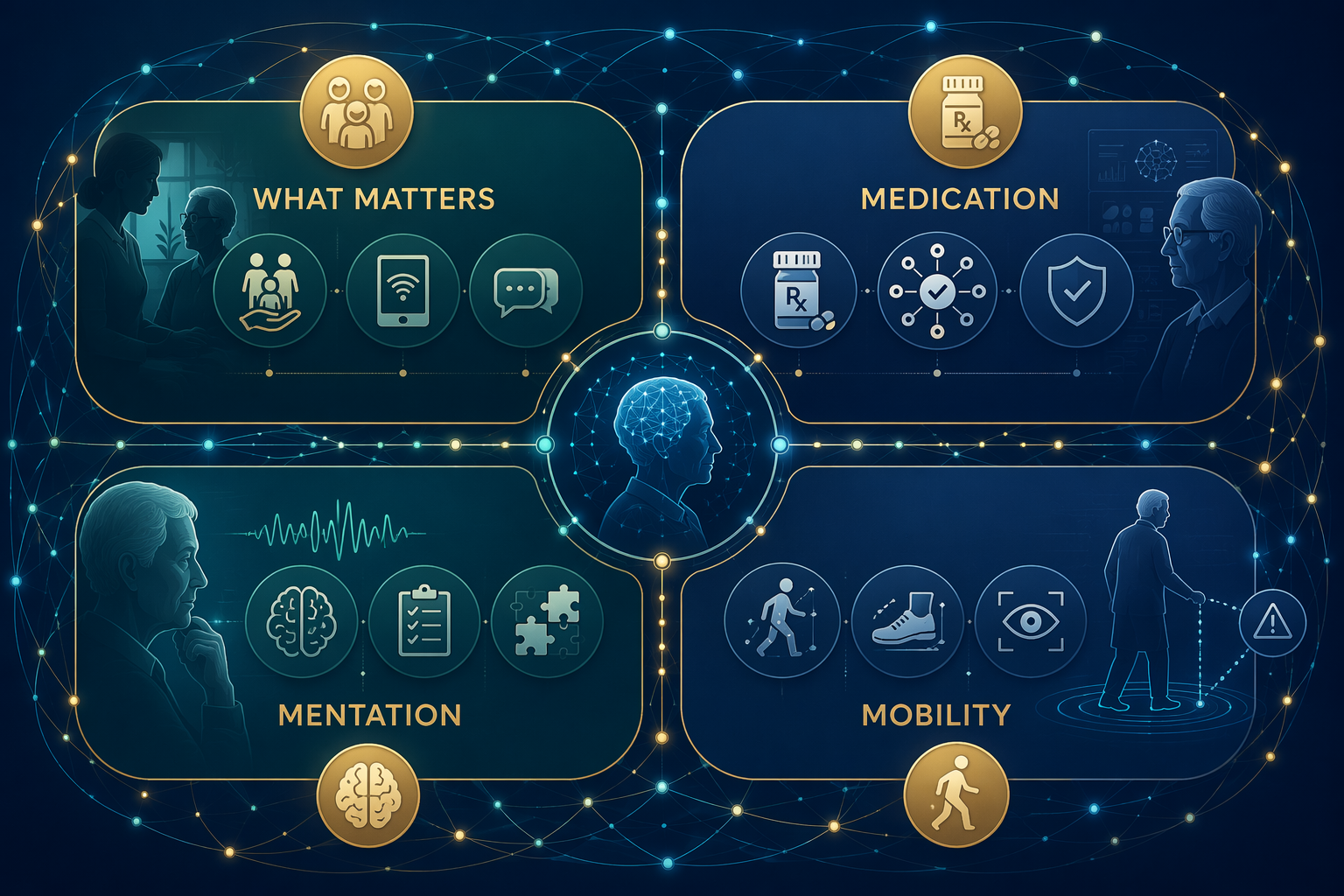
The 4Ms framework gives clinicians a better sorting device than the consumer technology aisle: What Matters, Medication, Mentation, and Mobility. Across those domains, the current evidence supports a cautious but real conclusion. AI is no longer only experimental in geriatric care. Its strongest evidence is in narrow detection, prediction, and decision-support tasks. Its weakest link is still implementation: older adults represented in the data, workflows prepared for the alerts, and clinical teams staffed to respond.
The 4Ms Reframe the Question
A wearable dashboard may show steps, sleep, heart rate, or an arrhythmia flag. A geriatric care plan asks a different set of questions. Does the result match the older adult’s goals? Does it reduce medication harm? Does it identify cognitive or sensory decline in time to preserve function? Does it prevent immobility, falls, hospitalization, or loss of independence?
That distinction matters because many AI studies still stop at model performance. An AUROC can be impressive and still leave unanswered the questions that dominate discharge planning and family meetings: who receives the alert, who has authority to act, what happens if the patient has limited digital access, and whether the evidence includes the frailest adults most likely to experience the consequence.
| 4Ms domain | AI tasks with current clinical relevance | Main evidence caution |
|---|---|---|
| What Matters | Matching AI-enabled care to patient priorities, family support, digital access, and workflow fit | Access and usability can determine whether technically valid tools become usable care |
| Medication | LLM-assisted deprescribing prompts, medication review support, polypharmacy risk assessment | Recommendation variability is clinically important but not prescribing authority |
| Mentation | Speech-based cognitive prediction, Alzheimer’s screening, AI-supported cardiovascular detection relevant to brain health | Prediction accuracy must be tied to follow-up pathways and longitudinal outcomes |
| Mobility | Fall prediction, functional-risk models, vision applications such as AMD detection | Device-level accuracy does not automatically mean fewer falls or preserved independence |
What Matters: AI Is Only Useful If the Care Path Can Carry It
The “What Matters” domain is easy to undervalue in AI reviews because it rarely comes with a clean performance statistic. It should not be treated as soft background. In older adults, usability, family support, digital literacy, and clinical workflow decide whether a validated model becomes a care improvement or another unreviewed signal in the record.
A risk score that asks an older adult to manage an app alone is different from one routed to a nurse, pharmacist, or primary care team. An algorithm that assumes continuous monitoring is different from one used after a hospital discharge, when medication changes, functional decline, caregiver fatigue, and transportation barriers all arrive at once. The model may be the same; the clinical meaning is not.
This is where broad “access” language can become misleading. AI can extend reach only when the older adult can use the interface, the family or caregiver network can support it when needed, and the receiving clinician has time and role clarity. Implementation gaps are not administrative footnotes in geriatric care. They are part of the evidence question.
Medication: Deprescribing Support Is Promising, Not Autonomous
Medication review is one of the more plausible near-term uses for AI in healthy aging because the task is bounded and the harm is common: polypharmacy, drug-drug interactions, sedating medications, anticholinergic burden, renal dosing problems, and therapeutic duplication. A tool that helps clinicians notice these patterns faster could be useful, especially when pharmacists and primary care teams are already working through complex lists under time pressure.
The evidence to date supports interest, not delegation. In reported polypharmacy scenarios, ChatGPT 3.5 recommended deprescribing between 2.67 and 3.67 of 7 medications, with recommendations varying by functional status.[1] That variability is not automatically a flaw. Functional status should affect medication decisions in older adults. But it also shows why a large language model cannot be treated as a prescribing authority.
Deprescribing is not a generic optimization problem. Stopping a medication can trigger withdrawal, symptom recurrence, blood pressure destabilization, family concern, or a specialist disagreement. Continuing a medication can contribute to falls, delirium, anorexia, or hospitalization. A useful AI tool in this domain should surface candidates, explain the rationale, show uncertainty, and leave the final decision with clinicians who know the patient’s goals and recent clinical trajectory.
That makes validation more demanding than asking whether the model can name potentially inappropriate drugs. The better test is whether medication review becomes safer, whether adverse drug events decrease, whether patients understand the change, and whether clinicians can integrate the output without creating a second reconciliation burden.
Mentation: Strong Signals, Harder Consequences
Mentation is where AI evidence becomes more concrete, especially in speech, cognition, and adjacent cardiovascular risks that affect brain health. The strongest use cases are not broad claims about “brain wellness.” They are narrower tasks: predicting conversion from mild cognitive impairment to Alzheimer’s disease, supporting screening, and detecting conditions such as atrial fibrillation that can change stroke prevention decisions.
Speech-based AI has been reported to predict conversion from mild cognitive impairment to Alzheimer’s disease within 6 years with 78.5% accuracy.[1] The same review described a Spanish-language cognitive screening application with an AUC of 0.93.[1] Those are clinically interesting signals because speech can be collected with relatively low burden compared with some imaging or specialty testing pathways.
Still, prediction is not the same as improved care. A cognitive risk flag has value only if it leads to an appropriate next step: diagnostic evaluation, medication review, hearing and vision assessment, caregiver planning, safety counseling, or monitoring for delirium and functional decline. Without that pathway, an AI prediction can become anxiety with a score attached.
Atrial fibrillation detection shows the same distinction between technical performance and clinical consequence. One AI-enabled ECG application for atrial fibrillation reported an AUC of 0.90, sensitivity of 82.3%, and specificity of 83.4%; atrial fibrillation affects roughly 10% of adults aged 80 and older.[2] In the right setting, that kind of tool can matter because AF detection may change anticoagulation decisions and stroke prevention. In the wrong setting, it creates a handoff problem: a flag arrives, but no one owns confirmation, bleeding-risk assessment, medication selection, or follow-up.
Cardiovascular prediction models raise similar implementation questions. A machine-learning model for heart failure mortality prediction reportedly achieved an AUC of 0.88 using 8 routine clinical variables and outperformed traditional risk scores.[3] A model built on routine variables is attractive because it does not require exotic inputs. But mortality prediction in an older adult should not sit apart from goals-of-care discussions, symptom burden, caregiver capacity, and decisions about hospitalization or home-based support.
Screening Tools Need a Destination
The more sensitive a mentation tool becomes, the more important the downstream pathway becomes. False positives can lead to unnecessary testing or labeling. False negatives can delay planning. Even true positives can cause harm if they are delivered without counseling, confirmation, and practical support. For geriatric practice, the standard is not whether AI can detect a pattern; it is whether detection improves decisions that older adults and caregivers can act on.
Mobility: Falls, Vision, and the Difference Between Prediction and Prevention
Mobility deserves more attention than it usually receives in AI discussions because loss of mobility is often the event that changes everything else. A fall, fracture, fear of walking, untreated visual impairment, or post-hospital deconditioning can turn a stable medication list and a manageable care plan into a cascade of dependency.
Fall prediction models show both the promise and the caution. In nursing homes, machine-learning models using 6 key predictors achieved ROC-AUC values from 0.710 to 0.750.[2] In hospitalized adults, a deep neural network model reported accuracy of 0.988.[2] Those numbers should not be read as interchangeable. A nursing home model with moderate discrimination may be clinically useful if it helps staff target toileting schedules, medication review, footwear, environmental changes, or supervision. A very high accuracy result in a hospital setting still needs scrutiny: the population, outcome definition, fall prevalence, validation method, and whether the alert changed care.
Falls also expose the staffing problem behind AI. Predicting risk is not prevention. Someone has to review the medications, walk the patient, adjust the room, respond to call lights, provide assistive devices, and revisit the plan when delirium, infection, hypotension, or pain changes the risk profile. A fall model that performs well in a dataset but lands in an understaffed unit may do little more than document a danger everyone already suspected.
Vision applications belong in the mobility conversation because visual impairment affects driving, walking, medication management, reading instructions, and fall risk. AI detection of age-related macular degeneration has reported particularly strong diagnostic performance: a pooled AUROC of 0.983, sensitivity of 0.88, and specificity of 0.90 across 19 studies.[3] That is a stronger performance signal than many broader “healthy aging” claims.
Even here, the clinical question continues past the image. Screening performance matters, but so do referral access, confirmation by eye-care professionals, treatment availability, transportation, and whether the patient can adhere to follow-up. In an older adult living alone, the difference between detected AMD and treated AMD can be the difference between preserving medication independence and needing daily support.
Where the Evidence Is Strongest
The clearest evidence cluster is not “AI for aging” in general. It is AI for specific clinical tasks with measurable inputs and outputs: ECG-based AF detection, retinal-image analysis for AMD, speech-based cognitive prediction, fall-risk modeling, and selected decision-support tools that use routine clinical data. These applications fit clinical care better than vague wellness scoring because they can be attached to a decision.
There are also early signals that AI decision support may affect utilization. One review reported an AI clinical decision-support intervention associated with hospital readmissions decreasing from 11.4% to 8.1%, a 25% relative reduction.[3] That is the kind of outcome clinicians should want to see more often. But it should still be read carefully: readmission reduction depends on setting, patient selection, available follow-up, and whether the intervention is reproducible outside the studied workflow.
A practical evidence hierarchy for geriatric AI should therefore ask four questions before adoption:
- Was the tool validated in older adults, including the very old, frail patients, and people with multimorbidity?
- Does the reported metric match a clinically meaningful action, not just a model benchmark?
- Who receives the output, and what is that person expected to do next?
- Does the workflow account for digital literacy, caregiver involvement, language, sensory impairment, and access to follow-up?
- Are there longitudinal outcomes showing better function, fewer adverse events, fewer hospitalizations, or lower caregiver burden?
The Gaps Are Clinical, Not Merely Technical
The recurring weakness in geriatric AI evidence is not that models never work. Many do, within the task and dataset tested. The weakness is that validation is often fragmented, older adults are not always represented in the way geriatric clinicians need, and long-term outcomes are less commonly reported than diagnostic or predictive performance.
Underrepresentation is especially consequential in geriatrics. A model trained mostly on younger or less frail adults may perform differently in patients with hearing loss, low vision, delirium, multiple chronic diseases, atypical presentations, polypharmacy, or limited mobility. These are not edge cases in older adult care. They are the population.
The workflow problem is just as important. A fall alert without staff capacity, a cognitive-risk score without diagnostic follow-up, an AF flag without anticoagulation review, or a deprescribing suggestion without pharmacist and prescriber agreement is not implementation. It is a task shifted downstream.
For clinicians evaluating AI in healthy aging, the most defensible position is neither enthusiasm nor refusal. Trust the task-specific evidence where it is strong. Interrogate the population, validation method, and workflow before treating the tool as ready for geriatric practice. And count implementation gaps as evidence gaps, because in older adults, the handoff is often where the harm occurs.
Comments
Join the discussion with an anonymous comment.