
A heat alert usually arrives as a threshold: tomorrow will be dangerous, the city is under warning, cooling centers are open. That is useful, but it does not answer the question that matters inside a clinic, a health plan, a home-care agency, or an occupational health office: who is most likely to get sick first, and who can still be reached before that happens?
That gap is where AI tools for heat-wave safety and public health are starting to matter. The practical promise is not simply a smarter weather bulletin. It is a warning workflow that can combine forecast conditions with age, chronic disease, medications, outdoor work, housing conditions, wearable signals, and neighborhood vulnerability, then separate a broad heat advisory into groups that need different levels of outreach.
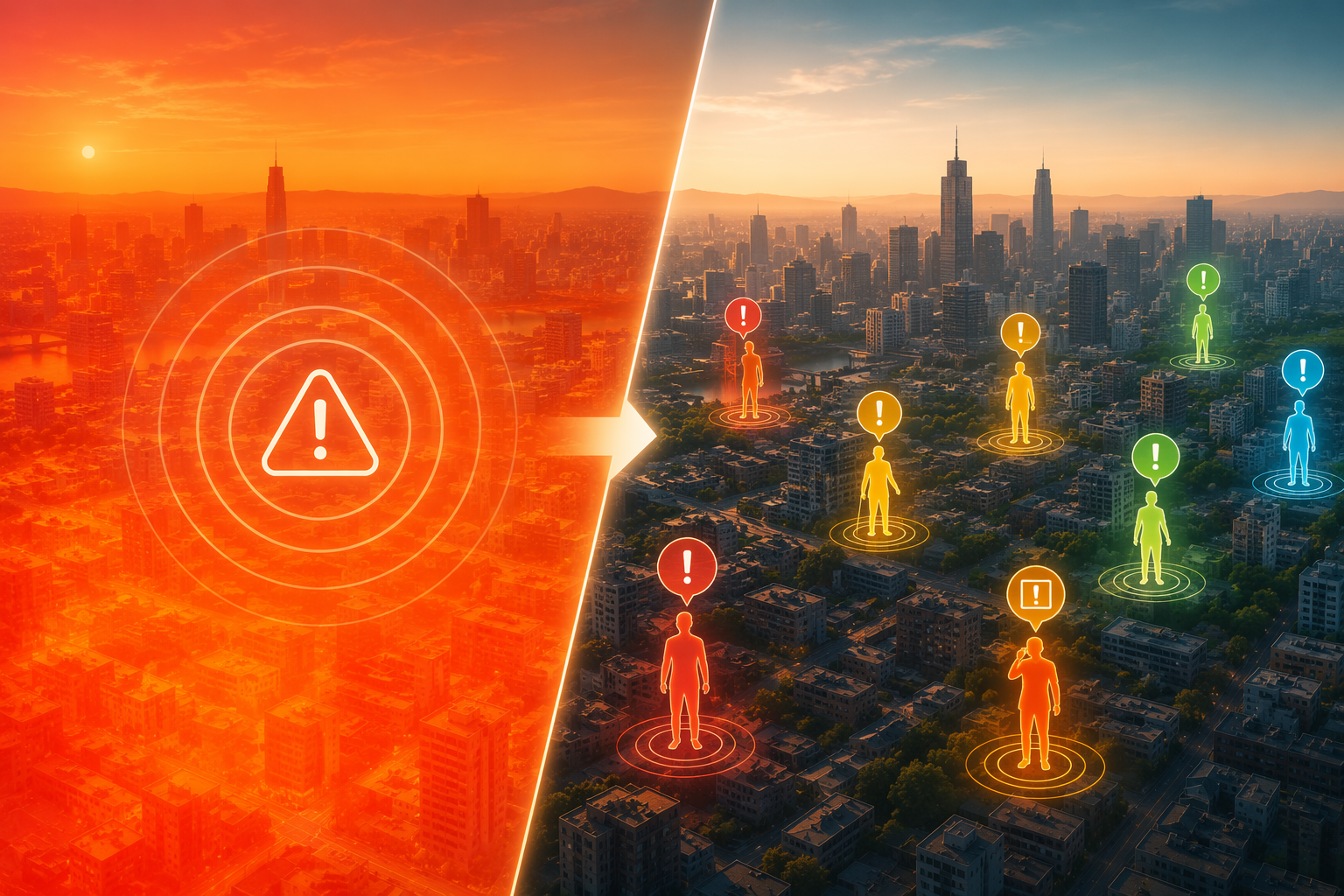
It is important to start with the older systems, because heat-health prevention did not begin with machine learning. Conventional heat health warning systems have already shown that alerts can save lives when they are connected to action. A systematic review reports that Philadelphia’s heat health warning system was estimated to have saved 117 lives between 1995 and 1998, and that France’s 2006 system was estimated to have saved about 4,400 lives.[1]
Those findings matter. They show that even a relatively coarse warning can reduce mortality if the public health apparatus knows what to do with it: issue the alert, open cooling options, intensify communications, check on vulnerable residents, and make heat visible as a clinical risk rather than an uncomfortable weather event.
What Personalization Adds To A Heat Warning
The limitation of a threshold-based warning is not that it is wrong. It is that it is blunt. Many conventional systems still depend heavily on meteorological cutoffs, such as temperature or heat-index thresholds, while doing less with the built environment, health outcomes, individual physiology, or social vulnerability data that determine whether the same heat event becomes tolerable for one person and dangerous for another.[1]
A citywide alert can tell an emergency department to expect more heat illness. It cannot, by itself, tell a primary care team which older adult living alone should be called today, which dialysis patient has lost air conditioning, which home-health client is in a top-floor apartment, or which road crew needs a revised work-rest schedule before the afternoon peak.
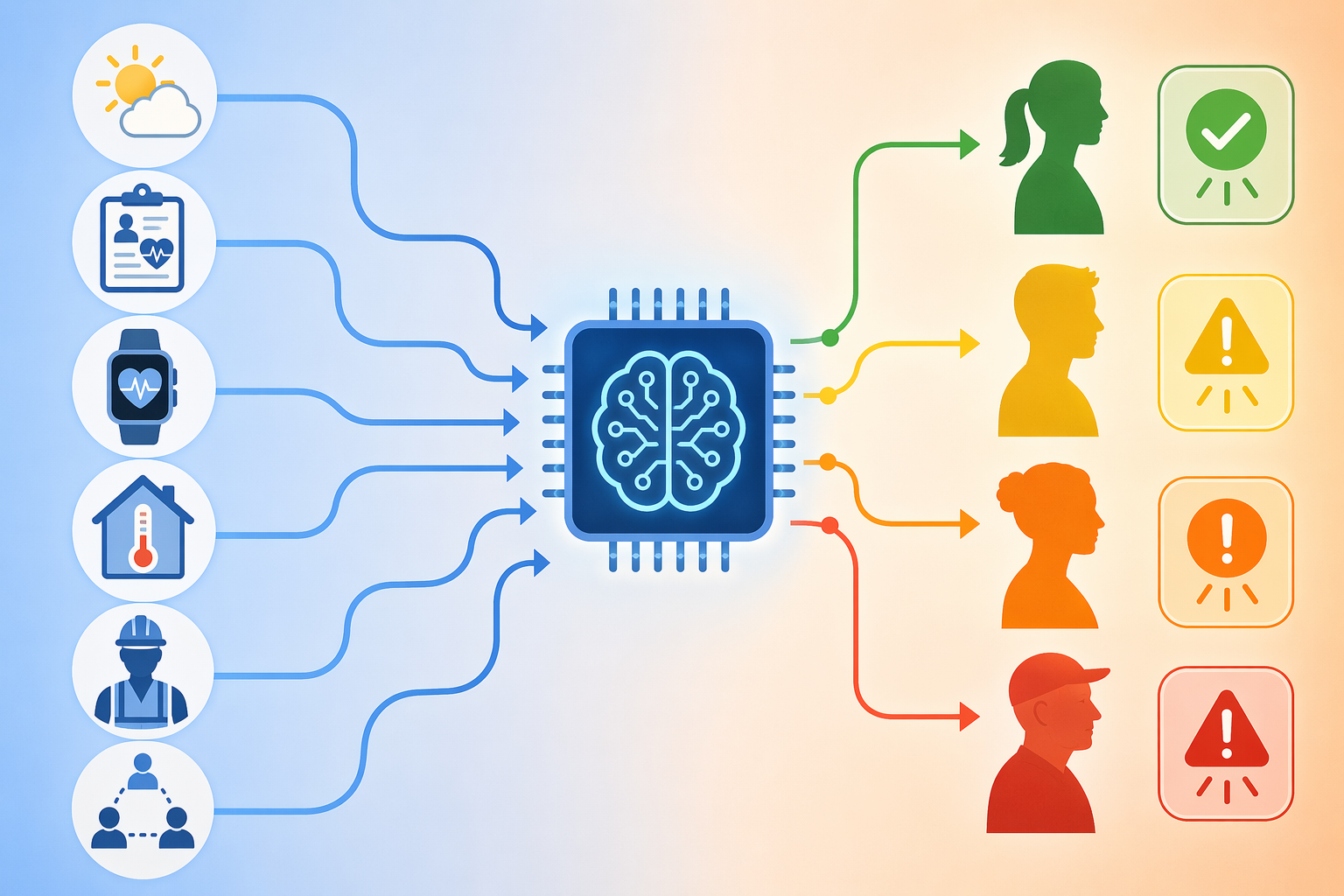
Personalized heat-risk systems try to narrow that distance. The inputs vary by project, but the general pattern is consistent: weather forecasts and heat exposure estimates are linked with one or more person-level or place-level risk indicators. In a clinical setting, that might mean age, cardiovascular or renal disease, medication burden, mobility limitations, or prior utilization. In an occupational setting, it may mean work intensity, clothing, sun exposure, rest breaks, and hydration opportunities. In housing-focused public health work, indoor temperature and cooling access may be more important than the official outdoor reading.
The result is a different kind of question. Instead of asking whether the city is hot enough to warn everyone, the system asks whether a given person, crew, building, or neighborhood is moving into a preventable danger zone.
The Pilot Tools Point Toward Risk-Stratified Prevention
Several current projects make this shift concrete, even though they should be read as emerging public health and research tools rather than finished clinical products.
ClimApp, developed in Europe, is described as providing personalized thermal-stress guidance using factors such as activity, clothing, age, and medical history.[2] That combination matters because the same outdoor temperature has different implications for an older adult walking slowly in light clothing, a worker wearing protective equipment, and a person with a medical history that reduces heat tolerance.
Worklimate focuses on occupational heat exposure, where the target is not a patient portal message but a safer workday.[2] For outdoor workers, the actionable unit may be a shift, a task, a rest cycle, or a supervisor’s decision to adjust work intensity. A useful warning in that setting has to arrive early enough to change staffing, timing, or protective measures, not merely document that conditions were dangerous after the fact.
The HE2AT Center in Africa is described as combining IBM Earth Observation foundation models with health outcomes and socioeconomic vulnerability to support mobile-app-based individual alerts.[2] A separate UN ESCAP discussion also frames AI-enabled early warning as a way to scale alerts for extreme heat, including through models that can connect environmental risk with local vulnerability.[3] The significance here is not that a foundation model is inherently clinically superior; it is that heat risk is being modeled as an exposure plus vulnerability problem, not as weather alone.
Indoor temperature modeling is another useful example because many heat injuries happen behind closed doors. The systematic review describes a German model that used AI to predict indoor temperature with 0.5°C accuracy, supporting more household-specific heat risk assessment.[1] That kind of tool could be especially relevant for older adults in poorly cooled housing, where the public forecast may underestimate actual exposure.
| Use Case | What AI Adds | Why It Matters Operationally |
|---|---|---|
| Personal thermal-stress guidance | Combines forecast conditions with activity, clothing, age, and medical history | Turns a general alert into advice that better matches individual vulnerability |
| Occupational heat protection | Links heat exposure to work conditions and worker risk | Supports changes to shifts, breaks, task intensity, and supervision |
| Mobile individual alerts | Connects environmental models with health outcomes and socioeconomic vulnerability | Helps public health programs prioritize outreach beyond temperature maps |
| Indoor heat-risk assessment | Estimates conditions inside homes rather than relying only on outdoor weather | Identifies households where exposure may be high even before a medical emergency occurs |
The common thread is not a single algorithm. It is the movement of heat-health warning upstream and sideways: upstream from emergency care to prevention, and sideways from meteorology into housing, work, chronic disease, and social risk.
Evidence Of Benefit Is Stronger For Warnings Than For AI
The evidence is not evenly distributed. Heat health warning systems as a category have mortality evidence behind them, including the Philadelphia and France estimates.[1] Smart or AI-enabled heat warning systems are more plausibly useful than proven at clinical scale.
The 2025 systematic review by Chandra and Lee found evidence that smart heat health warning systems can reduce mortality and morbidity, while also finding that they remain under-studied in low-resource settings.[1] That is a careful conclusion. It supports continued development and deployment research, not a claim that any given app or model is ready to determine individual clinical risk.
A 2026 comprehensive review in Discover Public Health adds another useful caution: much of the health-impact literature quantifies the burden of heat but does not link that burden to actionable clinical interventions.[4] For health systems, that distinction is decisive. A risk score is only clinically meaningful if someone can receive it, interpret it, act on it, and document what happened next.
A model that predicts heat vulnerability may be valuable for public health planning even if it never appears in an electronic health record. But if the intended use is individual clinical decision support, the bar rises. The model needs external validation, defined thresholds, known failure modes, workflow ownership, privacy governance, and a response plan for false positives and false negatives.
AI Does Not Automatically Beat Simple Rules
The most useful calibration point comes from a recent Cornell FAccT 2026 study of heat emergency planning in New York City. The study compared AI-based planning with simpler rule-based approaches and found that whether AI performed better depended on context.[5]
That should not be read as an argument against AI. It is an argument against assuming that a model is adding value simply because it is more complex. In some planning contexts, richer models may improve targeting. In others, a transparent rule may perform well enough, be easier to explain, and be faster to operationalize.
For clinical and public health buyers, the comparison should be explicit. The relevant question is not “Does this use AI?” It is “Does this outperform a simpler trigger for the intended population, outcome, and workflow?” A hospital trying to identify medically fragile patients for outreach has different needs from a city agency deciding where to open cooling centers or an employer adjusting outdoor work schedules.
The Readiness Problem Is Bigger Than The Model
The near-term barriers are familiar to anyone who has watched clinical AI move from demonstration to deployment. Heat illness is seasonal and comparatively rare at the individual level, which creates class-imbalance problems for prediction. The people most at risk may be the least likely to have continuous wearable data, stable primary care records, reliable broadband, or the health literacy needed to act on a personalized alert.
The data needed for personalization are also sensitive. Electronic health records, geolocation, housing conditions, employment status, and social vulnerability measures can all improve targeting. They can also expose people to surveillance, stigma, or administrative harm if governance is weak. A heat-alert program for homebound older adults, for example, has to decide who can see the risk list, whether community partners receive identifiable information, and how consent works when the intervention crosses clinical and public health boundaries.
Geography is another limitation. Reviews continue to describe a Northern or high-resource bias in the evidence base, with much of the research concentrated in settings such as the United States, Europe, and Australia, leaving applicability to many low- and middle-income settings uncertain.[1][6] That is not a minor footnote. Heat vulnerability is shaped by housing, labor protections, energy access, baseline disease burden, and public health capacity. A model trained or validated in one setting may fail quietly in another.
Regulatory status is equally important. In the reviewed material for this article, no FDA-cleared or CE-marked AI tools specifically for heat-wave clinical applications were identified. That does not make the tools unusable for public health pilots or preparedness planning. It does mean they should not be treated as regulated, medical-device-grade individual risk predictors.
What A Health System Can Reasonably Do Now
The most reasonable posture in 2026 is neither dismissal nor procurement enthusiasm. AI-enabled heat tools are credible enough to explore and immature enough to require guardrails.
For a health system, the first practical use may be population health planning: mapping patients with heat-sensitive conditions, identifying service areas with poor cooling access, coordinating with local public health agencies, and testing outreach protocols during heat advisories. In that role, an AI model can help prioritize attention without pretending to issue a clinical diagnosis.
For a public health department, the tool may be most useful as a way to move from citywide announcements to tiered response: routine messaging for the general population, proactive calls for known high-risk residents, field outreach for housing clusters with dangerous indoor exposure, and employer engagement for outdoor workforces.
For occupational health programs, the evaluation should focus less on prediction elegance and more on whether the system changes the workday. If alerts do not alter scheduling, rest breaks, hydration plans, supervision, or stop-work decisions, the model is not yet a safety intervention.
- Ask what outcome the tool predicts: heat illness, mortality, emergency visits, indoor exposure, occupational strain, or a composite risk category.
- Ask where it has been externally validated and whether that population resembles the intended deployment setting.
- Ask what simpler rule-based baseline it beats, if any, for the same decision.
- Ask who receives the alert, who acts on it, and what resources are available when risk is flagged.
- Ask how the program protects privacy when health, housing, work, and location data are combined.
- Ask whether the vendor or research team makes regulatory status, intended use, and limitations explicit.
Adjacent AI tools for urban planning, including heat-resilience and tree-canopy analytics, can also support preparedness by identifying hotter neighborhoods or infrastructure priorities. They should be kept in the right category. A company-published planning tool is not the same as independently validated clinical decision support, even if both are relevant to heat safety.
The Procurement Judgment
Heat-health warnings are genuinely moving toward personalization. The direction is clinically sensible: combine exposure with vulnerability, identify risk earlier, and route alerts to people who can act before the ambulance bay fills.
The current generation of AI-enabled tools is best understood as research, preparedness, and population-health infrastructure. They are appropriate for pilots, public health partnerships, workflow design, occupational safety planning, and evaluation studies. They are not yet ready to be purchased as stand-alone, regulated clinical products for individual heat-risk prediction without stronger validation, clearer governance, and regulatory clarity.
References
- A Systematic Review of Heat Health Warning Systems: Enhancing the Framework Towards Effective Health Outcomes, PMC
- AI is battling extreme heat, IBM Think
- In the era of extreme heat, AI can scale early warnings for all, UN ESCAP
- Discover Public Health comprehensive review, Discover Public Health, 2026
- Can AI plan heat emergencies better than simple rules? It depends, Cornell Chronicle, July 2026
- Rui et al. 2026 ScienceDirect review, ScienceDirect, 2026
Comments
Join the discussion with an anonymous comment.