
AI for heat stroke symptom recognition and alerts is no longer a single idea. In Q3 2026, it is a set of different systems trying to answer different questions: whether an individual is drifting toward exertional collapse, whether a hospitalized patient is likely to deteriorate, whether a city is seeing a heat illness signal in public posts, or whether a worksite should intervene before a crew member becomes an emergency. Those are not interchangeable tasks.
That distinction matters because no FDA-cleared or CE-marked AI medical device specifically for heat stroke recognition was identified in the available evidence. The strongest studies are still closer to research validation than routine clinical deployment, while several real-world examples are occupational safety or prototype systems rather than regulated diagnostic tools.
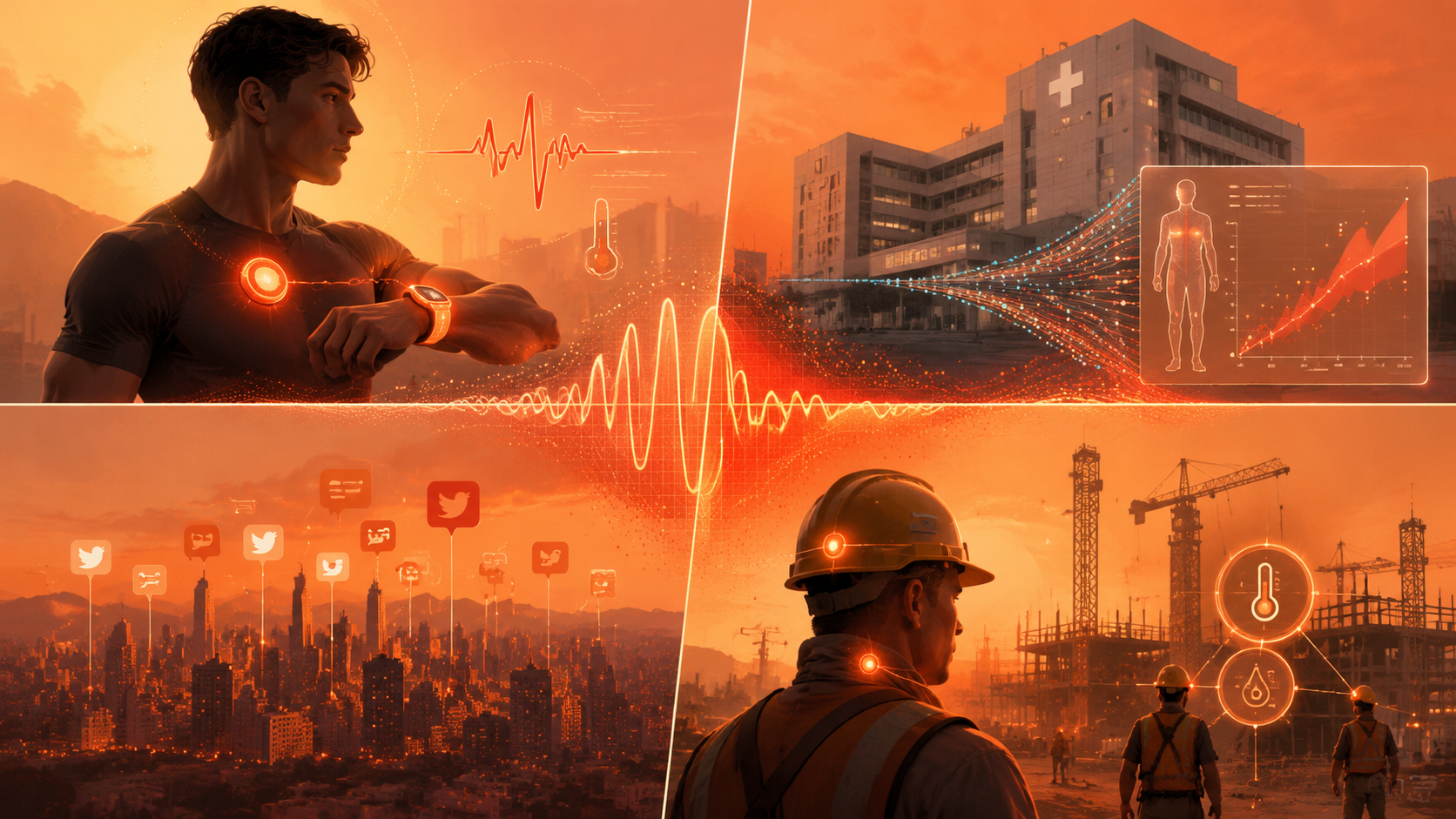
A practical review starts with the user who must act on the signal. A medic beside a training course needs minutes of warning and a low false-alarm burden. An emergency physician needs admission variables that can improve triage or escalation. A public-health team may only need an early community signal. A construction safety manager needs a workflow that gets a worker out of danger before a medical event. The same phrase, “AI alert,” can hide very different operational responsibilities.
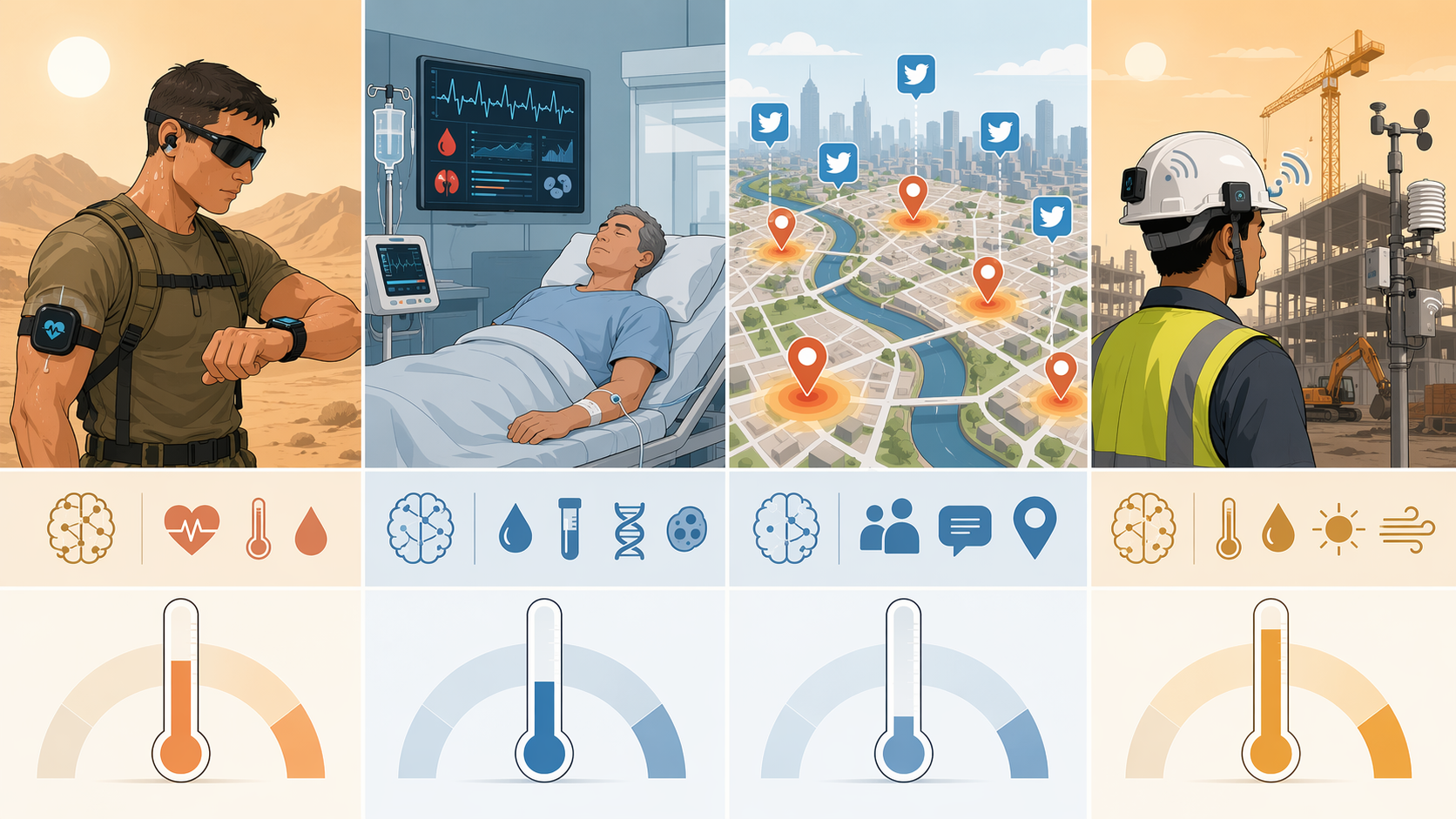
| Approach | Primary setting | What the model is trying to detect | Evidence maturity | Main caution |
|---|---|---|---|---|
| Wearable sensor ML | Military, athletic, occupational, or other high-exertion environments | Individual physiologic anomaly before exertional heat stroke or collapse | Most directly relevant to real-time alerts, with a reported 33- to 69-minute pre-collapse window in one large Ranger study | Population and sensor context may not transfer to older, medically complex, or low-exertion heat stroke |
| Clinical prediction models | Hospital admission and early inpatient assessment | Risk stratification using measured biomarkers | Peer-reviewed multi-center hospital data exist, including a 24-hospital Chinese study | The strongest available study population was predominantly young male military patients |
| Social media NLP | Public-health surveillance | Heat illness signals in geolocated or local-language posts | Peer-reviewed city-level tweet classification has been reported | It is surveillance, not bedside diagnosis |
| Environmental and occupational IoT | Worksites, farms, construction, industrial environments | Combined worker and environmental risk requiring safety intervention | Active prototypes and deployment reports exist | Vendor and field reports are not the same as independent clinical validation |
Wearable ML comes closest to a real-time individual alert
The wearable evidence is important because it addresses the part of heat stroke that feels least forgiving in practice: the interval before collapse. In a US Army Ranger study of 2,102 participants, anomaly detection using multimodal wearable data — heart rate and triaxial accelerometry — predicted exertional heat stroke 33 to 69 minutes before collapse.[1] For a training medic, athletic trainer, or occupational health nurse, that is the kind of time window that can change the response from rescue to prevention.
The study’s clinical appeal is not that it makes heat stroke abstractly “predictable.” It ties a sensor stream to a pre-collapse interval that someone could plausibly act on: stop activity, move the person to cooling, assess mental status, start aggressive cooling if indicated, and escalate transport. A 5-second warning would be interesting physiology but poor operations. A half-hour window begins to look like a usable alert, assuming the receiver is identified and empowered.
The boundary is equally important. Rangers are not a general heat stroke population. Exertional heat stroke in young, highly conditioned people under structured training is not the same clinical problem as classic heat stroke in an older adult with comorbid illness during a prolonged heat wave. Sensor adherence, baseline fitness, hydration practices, command structure, and the availability of immediate responders all shape whether the same alert would be safe outside that setting.
That does not make the Ranger findings weak. It makes them specific. The more a proposed deployment resembles high-exertion monitored activity with a trained responder nearby, the more relevant this evidence becomes. The farther it moves toward unsupervised consumer monitoring or medically fragile populations, the more validation is missing.
Admission biomarkers answer a different clinical question
Hospital prediction models do not usually solve the same problem as wearables. They are less about warning a field responder before collapse and more about stratifying risk after a patient has already entered care. A 2025 multi-center study across 24 Chinese hospitals analyzed 691 heat stroke patients and reported that a Gradient Boosting Machine using six admission biomarkers achieved an AUROC of 0.836 on testing data.[2]
That is a clinically legible kind of AI. The inputs are measured in the hospital, the output can be judged against patient outcomes, and the model can be inspected against familiar markers of organ injury and physiologic stress. The study also reported that CK-MB was the most impactful feature in SHAP analysis, which gives clinicians at least some sense of what drove the model’s predictions rather than leaving the score as a sealed box.[2]
The generalizability problem is not a footnote. The study population was 95.1% male with a median age of 22 years and was drawn from a Chinese military population.[2] That is a meaningful cohort for exertional and military heat illness. It is not automatically a model for older adults found confused at home during a heat wave, patients taking medications that impair thermoregulation, or mixed-gender civilian emergency department populations.
For a hospital or health system, the right adoption question is therefore narrow: does the admission-biomarker model improve risk stratification in a population that resembles ours, at a decision point where we are prepared to act? If the answer is “we want it to diagnose heat stroke from the waiting room,” the evidence does not support that broader claim. If the answer is “we are evaluating whether biomarkers at admission can support escalation decisions in exertional heat illness,” the study is much more relevant.
Social media NLP is surveillance, not a clinical alert
The Nagoya City NLP study belongs in the same survey, but not in the same procurement conversation as a wearable medical alert. A transformer-based LUKE Japanese base lite model classified heat stroke-related tweets from Nagoya City with 85.52% accuracy using 27,040 tweets, and the study compared the signal with emergency medical evacuation records.[3]
That is useful public-health machinery. It may help detect city-level changes in heat illness concern, symptoms, or help-seeking before formal reporting catches up. It also illustrates why “AI recognition” needs sharper language. A tweet classifier is not recognizing heat stroke in a patient. It is classifying public posts that may correlate with heat illness activity in a place and time.
The limitations are built into the design: Japanese-language tweets, a single city, and a single keyword strategy.[3] Such a model may be valuable for Nagoya-style municipal surveillance and still fail in another language, another social media culture, or a heat event where the people most at risk are not posting at all.
Occupational IoT systems are promising, but the evidence is thinner
Workplace systems are where the field often looks most deployable because the environment already has supervisors, shift rules, rest breaks, and safety programs. That can be an advantage. A heat alert sent to a named safety officer at a construction site has a clearer response path than a consumer app notification sent to a person already cognitively impaired by heat illness.
The IIT/SAS/BeeInventor smart helmet system is one example. It has been described as predicting heat risk 5 to 10 minutes ahead and was field tested in Hong Kong and Japan through the SAS Hackathon 2025 context and IIT reporting.[4] A helmet-based workflow makes intuitive sense in construction or industrial settings because the sensor is tied to required protective equipment rather than an optional consumer device.
A 5- to 10-minute horizon is operationally different from the Ranger study’s 33- to 69-minute pre-collapse window. It may still be enough to pull someone from a task, move them to shade, and check symptoms. It is not much time if the worksite has poor communication, delayed supervisor response, or no rapid cooling plan. Prediction windows should be judged against the response workflow, not admired as standalone model performance.
Other prototype work points in the same direction. MIT Lincoln Laboratory has described a torso-worn sensor prediction system for heat stress risk, and an Emory, Georgia Tech, and NIH-associated farmworker biopatch study reported 166 participants in coverage of heat monitoring for agricultural workers.[5][6] These examples matter because heat illness often occurs away from hospitals, in settings where workers may delay symptom reporting or lack immediate medical assessment.
They also show why occupational safety should not be quietly relabeled as clinical diagnosis. A worksite risk alert can be valuable without claiming to diagnose heat stroke. In many cases, its safest role is to trigger earlier rest, cooling, hydration assessment, buddy checks, or removal from exposure — interventions that do not require the system to be a definitive diagnostic instrument.
Deployment reports should not be read like clinical trials
The Saudi ABLEMKR construction case is the sort of example that will draw executive attention. The case study reported deployment among 15,000 workers, a 63% reduction in on-site medical emergencies, and 4,800 saved work hours.[7] Those are consequential numbers if they hold up.
But the source type changes the weight of the claim. A vendor case study without independent peer review cannot establish clinical effectiveness the way a well-designed external validation study can. It may describe a successful safety program, a favorable implementation context, a reporting change, or a true reduction in heat-related emergencies. Without independent methods and comparison details, those possibilities cannot be separated confidently.
That does not make the case irrelevant. Administrators need implementation evidence, not only journal articles. The problem begins when deployment metrics are treated as proof that a system can recognize heat stroke symptoms accurately across settings or satisfy medical-device expectations. The safer reading is narrower: a large occupational deployment reported promising safety and productivity outcomes, but those outcomes need independent evaluation before they carry clinical weight.
What makes an alert clinically usable
For heat stroke, an alert is only as good as the response it can trigger. A model can be technically impressive and still fail at the bedside, on the field, or at the worksite if no one knows who owns the next step.
- Receiver: the alert must go to someone able to interrupt activity or escalate care, not merely to a dashboard reviewed later.
- Timing: the prediction window must match the real time needed for cooling, transport, supervisor action, or clinical reassessment.
- Population: validation should resemble the people being monitored, including age, sex, baseline health, medications, job demands, and acclimatization.
- Error handling: false positives can disrupt work or training, while false negatives can leave a person in lethal heat; both consequences need explicit planning.
- Regulatory posture: occupational safety, wellness monitoring, clinical decision support, and diagnostic medical devices are different categories with different obligations.
The Ranger wearable study is valuable because its pre-collapse timing speaks directly to actionability.[1] The Chinese biomarker model is valuable because it uses measurable admission data and reports discrimination in a hospital cohort.[2] The Nagoya NLP model is valuable because it shows a plausible surveillance signal rather than pretending to be a patient-level diagnosis.[3] The occupational systems are valuable because they meet heat risk where it often occurs, outside the hospital. None of these strengths erases the others’ limitations.
Where each approach fits in 2026
Wearable ML is the most natural fit for real-time individual alerts in high-exertion environments, especially where responders are present and the monitored population resembles the validation cohort. Its appeal is early physiologic warning; its weakness is transferability.
Clinical biomarker models fit hospital risk stratification. They may help clinicians decide who needs closer monitoring, aggressive management, or escalation after presentation. Their weakness is that the best available evidence is not yet broad enough to assume performance in elderly, mixed-gender, or medically complex classic heat stroke populations.
Social media NLP belongs to public-health situational awareness. It can help a city understand signals emerging during heat events, but it should not be described as recognizing heat stroke symptoms in an individual patient.
Environmental and occupational IoT systems fit safety programs that can intervene quickly. Their promise is practical: they can combine worker-level and ambient risk in places where heat exposure is predictable. Their evidentiary problem is that prototypes, hackathon systems, institutional reports, and vendor case studies remain uneven substitutes for independent validation.
The adoption decision in Q3 2026 should therefore be context-specific. The question is not whether AI can detect heat stroke in general. It is which AI system, trained and tested on which population, issuing which alert, to which responsible person, with what regulatory status, and with what evidence that acting on the signal improves safety.
References
- PubMed PMID 37812534. PubMed.
- Multi-center clinical machine learning study of heat stroke admission biomarkers. PeerJ. 2025.
- Transformer-based classification of heat stroke tweets in Nagoya City. Scientific Reports. 2025.
- IIT/SAS/BeeInventor smart helmet system for heat risk prediction. SAS Hackathon 2025 and IIT news.
- Torso-worn sensor prediction system for heat stress risk. MIT Lincoln Laboratory.
- Farmworker biopatch heat monitoring study. NBC News.
- ABLEMKR Saudi construction deployment case study. ABLEMKR.
Comments
Join the discussion with an anonymous comment.