
The useful promise of AI in heat wave preparedness is not that a model can color a map red a few days earlier. It is that a warning could move through a chain quickly enough to change decisions: a forecasted heat event becomes an estimate of acute kidney injury, heat-related emergency visits, admission demand, ambulance pressure, staffing needs, cooling-center outreach, and targeted messages for people who will not be protected by a general alert.
That chain is now technically plausible. A 2026 review of 134 studies describes AI-based preparedness as a heat-health-system problem, not merely a weather-prediction problem. It also reports an 18.9% increase in hospital admissions during heat waves and a relative risk of 1.67 for acute kidney injury associated with heat exposure, figures that make the operational stakes concrete for hospitals rather than abstract for climate dashboards.[1]
The harder finding in the same review is the one that should keep planners cautious: by mid-2026, fewer than ten studies had demonstrated a fully linked system connecting heat prediction, health impact modeling, healthcare demand forecasting, and actionable hospital surge planning.[1] The components are advancing faster than the handoffs between them.
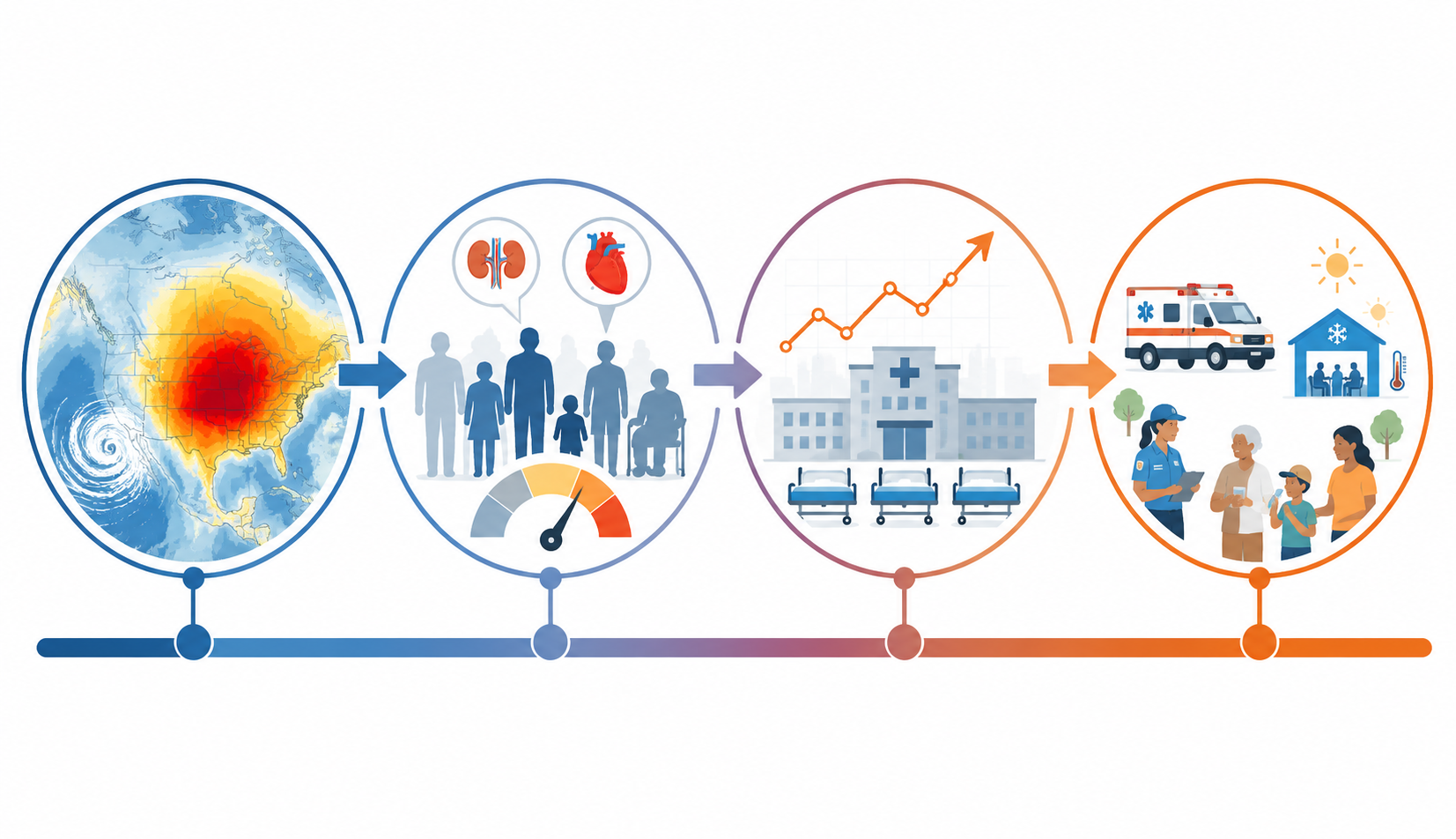
Where the forecast becomes a preparedness tool
A workable system for AI in heat wave preparedness and public health has to complete four tasks in order. It must detect the hazard early enough to matter, translate that hazard into disease-specific risk for a defined population, convert risk into expected healthcare demand, and deliver instructions to the people who can act before the emergency department is already crowded.
| Stage | Operational question | Decision that should change |
|---|---|---|
| Heat hazard prediction | How hot will it get, where, and with what lead time? | When to activate heat-health monitoring and preparedness protocols |
| Population health risk estimation | Which groups and conditions are likely to be affected? | Who receives targeted outreach and what clinical risks are emphasized |
| Healthcare demand forecasting | How many additional visits, admissions, or transfers should be expected? | How emergency departments, beds, transport, and staffing are adjusted |
| Clinical and public health action | Who receives the alert, who follows up, and what resources are opened? | Whether warnings reach older adults, outdoor workers, rural residents, and medically vulnerable groups |
The first stage is increasingly credible. Neural weather models and machine learning approaches can support heat prediction at the three- to ten-day lead times that emergency managers can plausibly use for staffing, outreach, and bed planning.[1] That time window matters. A same-day alert may help a person seek shade; a multi-day forecast can allow a health system to adjust rosters, review transfer capacity, prepare cooling-center coordination, and contact high-risk patients before the peak.
The second stage is where a heat forecast begins to become a health forecast. A temperature anomaly does not tell a renal service, an emergency department, or a rural clinic what to prepare for. Disease-specific modeling can estimate where heat exposure is likely to translate into acute kidney injury, cardiovascular strain, respiratory exacerbation, or heat-related illness. The AKI relative risk of 1.67 reported in the 2026 review is useful not because it is a universal bedside number, but because it shows why a hospital preparedness plan should not treat heat as a single generic syndrome.[1]
The third stage is often where strong research systems become weak operational systems. Knowing that risk will rise is not the same as knowing how many nurses, stretchers, observation beds, dialysis slots, ambulances, or transfer agreements may be needed. Hospital surge planning needs an estimate that maps onto operational units. A health department may be able to act on neighborhood-level risk; an emergency department needs timing, volume, and acuity estimates that are stable enough to justify staffing changes.
The fourth stage is the least glamorous and often the most decisive. Someone has to receive the signal, trust it, and have authority to act. If the warning is sent to a dashboard that nobody checks during weekend staffing decisions, the model has not improved preparedness. If the warning reaches a public health alert team but not home health workers, farm supervisors, shelters, or older adults living alone, the system has identified risk without reaching the risk.
The strongest operational attempt: China’s national warning system
China’s nationwide Heat-Health Risk Warning is the clearest example of a government-level attempt to link meteorological and health data into a formal warning function. Launched on July 2, 2025, the system is described as a joint national heat-health warning effort that integrates weather and health information rather than leaving health agencies to interpret meteorological alerts after the fact.[2]
That matters because the handoff is institutional, not just computational. A warning that is co-produced across meteorological and health authorities has a better chance of arriving in the language of health protection: population risk, expected harm, and response triggers. It can also create a national template for lower-level agencies that otherwise would have to improvise local thresholds and communication pathways.
But even this case should not be read as proof that the full heat-health-system chain has been solved. A national warning system can establish the hazard-to-risk bridge while still leaving open the next questions: whether hospitals adjust staffing, whether emergency departments see better load management, whether rural clinics receive usable instructions, and whether vulnerable groups are reached before illness occurs. The launch is a major operational step; the outcome evidence still has to follow.
Alert reach is not a communications detail
North Carolina’s heat alert experience shows why implementation data can be more revealing than model-performance data. A 2026 case study of heat alert communication and rural health data infrastructure reported 579 subscribers to the state’s Heat Health Alert System. Only 7.9% of subscribers were aged 65 or older, and only 6.6% were outdoor workers.[3]
Those percentages are not a minor footnote. Older adults and outdoor workers are among the groups for whom a heat warning is supposed to matter most. If they are weakly represented in the subscriber base, the system may be informative for agencies while under-serving the people whose daily choices, job conditions, housing, medications, mobility, or isolation raise their risk.
This is one reason an AI-enhanced heat alert should be judged by its delivery architecture as well as its predictive accuracy. A model can distinguish a dangerous heat event from an uncomfortable one, but the intervention depends on mundane arrangements: enrollment lists, trusted messengers, language access, employer channels, rural broadband limitations, clinic workflows, and whether public health staff have enough lead time to act. In heat preparedness, the last mile is not downstream from the system. It is part of the system.
Clinical prediction is possible, but calibration matters
Bedside and clinical-risk models add another layer to the chain, especially once patients begin arriving. Hirano and colleagues developed a machine learning mortality prediction model for heat-related illness using a multicenter Japanese registry of 2,393 patients. Their XGBoost model achieved an area under the precision-recall curve of 0.528, compared with 0.287 for APACHE-II, and Glasgow Coma Scale was the top predictor.[4]
That is an important result for classification: it suggests machine learning can help identify patients with heat-related illness who may need close attention. It is less reassuring as a direct probability engine. The model showed poor calibration, which limits its use for precise bedside probability estimation.[4] For surge planning, that distinction matters. A tool that ranks patients reasonably well may still be unsafe if clinicians or administrators interpret its output as an accurate individual risk percentage.
Clinical decision support also arrives late in the preparedness chain. It can improve triage once heat illness is present, but it does not replace earlier public health action. A hospital that waits for high-risk patients to appear in the emergency department has already missed the chance to reduce exposure, pre-position community resources, or smooth demand.
Africa-focused and disease-warning systems widen the ambition
The IBM-led HE2AT Center is one of the more ambitious attempts to connect extreme heat, geospatial modeling, and health action, with a focus on Africa. IBM describes work using geospatial foundation models and related AI approaches, along with examples such as the Extrema Global digital twin in Athens, to support heat-risk understanding and response.[5]
Its value is partly in where it points the field. Many AI-health studies are strongest in places with dense clinical data, stable digital infrastructure, and long-running registries. Heat vulnerability is not confined to those settings. Systems designed for African contexts have to confront data sparsity, informal labor, infrastructure gaps, and uneven access to care. A model that can operate only where hospitals already have rich electronic records will not cover many of the populations most exposed to extreme heat.
The weather-health linkage is also expanding beyond heat illness alone. Harvard Medicine has described work connecting climate variables to health outcomes through machine learning, helping explain how weather prediction can be paired with health data rather than treated as a separate scientific exercise.[6] The University of Maryland’s AWARE project similarly aims to build an AI-powered warning system for climate-sensitive diseases tied to extreme weather, supported by a $1.9 million effort involving an eight-country consortium focused on low- and middle-income countries.[7]
These efforts broaden the horizon from heat alerts to climate-sensitive disease warning. They should not, however, be collapsed into evidence that hospital surge integration is already routine. A disease-warning system can improve early warning without yet proving that emergency departments, ministries of health, transport systems, and community outreach networks have changed their operational behavior in response.
AI should beat the right benchmark, not the most convenient one
The obvious benchmark for an AI heat system is another model. The more useful benchmark may be a simple rule that emergency managers already understand: if the forecast exceeds a threshold for a defined period, open cooling centers, extend outreach, and alert hospitals. A July 2026 Cornell report cautioned that AI may not always outperform simpler rule-based approaches for heat emergency planning.[8]
That counterpoint is healthy. If a machine learning model produces marginally better discrimination but is harder to interpret, slower to update, more fragile under local data shifts, or less likely to be trusted by the officials who must trigger costly action, it may not be the better preparedness tool. The operational comparison should ask whether AI changes the timing, targeting, or scale of action enough to justify its complexity.
There are places where AI has a plausible advantage over simple thresholds. It can combine weather forecasts with prior admissions, land surface characteristics, population age structure, comorbidity patterns, occupational exposure, air pollution, and neighborhood vulnerability. It can estimate different risks for different outcomes rather than issuing a single severity label. It can also update as forecasts shift. But those strengths matter only if the resulting output is specific enough to change a preparedness decision.
What operational readiness would look like
A mature AI heat preparedness system would not stop at a public alert. Several days before the event, it would identify the expected geography, duration, and severity of heat exposure. It would estimate which health outcomes are likely to increase and where. It would translate those estimates into expected emergency visits, admissions, transport needs, and outpatient or community follow-up. It would then send different instructions to different actors: hospitals, EMS, local health departments, long-term care facilities, community organizations, employers, and clinical teams caring for high-risk patients.
The warning would also carry uncertainty in a form that planners can use. A hospital does not need a false sense of precision; it needs to know whether the forecast is stable enough to add staff, postpone elective bottlenecks, prepare observation capacity, or coordinate transfers. A public health department needs to know whether the risk is concentrated among older adults in poorly cooled housing, outdoor workers, rural residents with limited access to care, or patients with conditions that make heat exposure more dangerous.
The system would be measured after the heat event, not merely admired before it. Did alerts reach the intended groups? Did hospitals alter staffing or bed management? Did cooling centers open in time and in the right places? Did community outreach occur before peak temperatures? Did emergency departments experience lower avoidable load, faster triage, or better coordination? These are evaluation questions for operations, not just for machine learning.
As of Q3 2026, the field is best understood as a set of increasingly capable components moving toward dependable operations. AI-based heat prediction has useful lead times. Health-impact models can estimate disease-specific risks. Clinical models can stratify patients, though calibration remains a serious limitation in some cases. National and multinational initiatives are beginning to connect weather, health, and response infrastructure. Yet the evidence base still contains fewer than ten fully linked systems demonstrating the complete path from heat forecast to hospital surge planning.[1]
The next test is not whether AI can forecast heat. It can. The test is whether a forecast changes preparedness decisions for the people most likely to be harmed: the older adult who never subscribed to an alert, the outdoor worker whose employer controls exposure, the rural patient far from urgent care, the emergency department that needs staff before arrivals spike, and the public health team that has only a few days to turn risk into action.
References
- A comprehensive study of health impacts of heatwaves and AI-based preparedness for sustainable healthcare — Discover Public Health, 2026.
- China's pioneering heat-health warning system: A critical leap and future agenda — The Innovation Medicine, 2026.
- Navigating the heat: implementation challenges and opportunities for heat alert communication and rural health data infrastructure — Frontiers in Public Health, 2026.
- Machine learning-based mortality prediction model for heat-related illness — Scientific Reports, 2021.
- Using AI to battle extreme heat — IBM Think.
- Machine Learning Can Predict the Weather — and Human Health — Harvard Medicine Magazine, 2026.
- UMD developing AI-powered warning system to predict disease tied to extreme weather — University of Maryland School of Public Health, 2026.
- Can AI plan for heat emergencies better than simple rules? It depends — Cornell Chronicle, July 2026.
Comments
Join the discussion with an anonymous comment.