
For older adults, homelessness prevention often starts too late for healthcare to do its best work. By the time someone appears in an emergency department after sleeping outside, or enters a shelter after a hospitalization destabilized rent, the problem is already clinically advanced. The more useful question for AI in homelessness prevention and healthcare for older adults is narrower and more operational: can a health or county system identify people while they are still housed, reach them, and connect them to a prevention intervention that changes what happens next?
The stakes are not only social-service stakes. In the HOPE HOME study of homeless older adults in Oakland, California, the mortality rate was 3.5 times that of the general population, and the median age at death was 64.6 years.[1] That cohort was geographically and demographically specific, with limited generalizability beyond its setting. Still, it makes a point clinicians should not need to relearn at every discharge meeting: homelessness in later life behaves like a severe health risk state, not a housing inconvenience.
A systems approach to homelessness prevention for older adults places screening inside a broader chain of prevention, not at the end of it.[2] That distinction matters. A high-risk score does not negotiate with a landlord, restore benefits, arrange transportation, or persuade a frightened patient to accept help. Its value depends on whether it moves the right person into the right workflow early enough.

The Los Angeles County test: prediction connected to a prevention unit
Los Angeles County’s Homelessness Prevention Unit is the clearest evidence because it does not stop at risk stratification. The county uses a predictive model that evaluates 580 data factors across 90,000 county service users, ranks people by future homelessness risk, and then routes selected high-risk individuals toward a prevention program.[3]
The risk gradient is large enough to matter operationally. People in the top decile of the model’s risk ranking had a 24% homelessness rate within 18 months, compared with a 7% population baseline.[3] That does not mean three out of four flagged people would definitely become homeless. It does mean the prevention team is no longer searching a broad county population blindly. It can start with a smaller group where the outcome is concentrated.
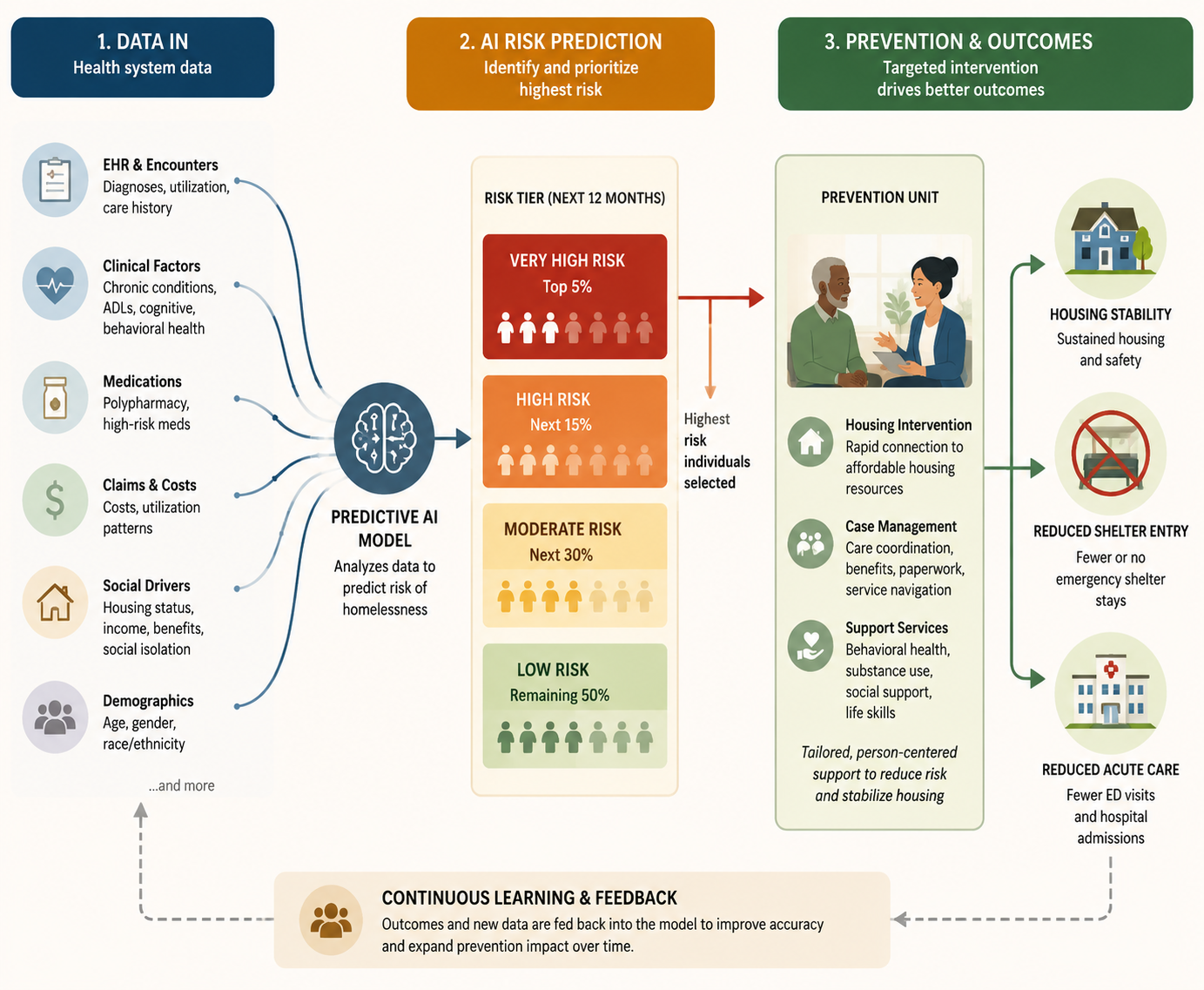
The stronger finding is attached to outcomes. In a matched comparison, participants in the Homelessness Prevention Unit were 71% less likely to enter a shelter or contact street outreach within 18 months than similar high-risk non-participants.[3] Among 1,498 enrollees, 86% retained housing upon program completion.[3]
For a clinician or health system administrator, the matched comparison is not the same as a randomized trial. Selection effects can remain even after matching, and randomized trial results were expected in 2027.[3] But the evaluation is still more clinically useful than a stand-alone model paper because it follows the chain from risk identification to outreach to housing status. The measured endpoint is not whether a dashboard looked plausible. It is whether fewer people appeared in shelter or street-outreach systems.
The housing-retention result also changes how the model should be judged. A prediction tool that identifies risk but feeds an underpowered prevention service can create a waiting list with better math. In the Los Angeles County example, the model is attached to a unit capable of delivering flexible prevention assistance. That pairing is why the evidence belongs in a healthcare discussion: many of the older adults who become homeless are visible somewhere in health, benefits, behavioral health, or county-service data before they are visible to the shelter system.
The older-adult question remains partly unresolved. The Homelessness Prevention Unit evidence is highly relevant to upstream prevention, but the program predominantly serves a younger demographic; its effectiveness for frail adults aged 65 and older may differ and needs separate analysis.[3] Frailty, cognitive impairment, caregiver loss, hospitalization, and fixed income can all change both the risk pathway and the kind of intervention required.
What the Veterans Health Administration model proves—and what it does not
The Veterans Health Administration evidence answers a different part of the question. It shows that machine-learning risk stratification for housing instability can be technically strong at very large scale. In a 2019 Health Services Research study, a random forests model for literal homelessness among 5.8 million Veterans achieved an AUROC of 0.92.[4]
AUROC is not an intervention, but here the authors translated model performance into screening operations. If screening were targeted to the top 50% of the risk distribution, the program would capture about 90% of positive screens while cutting screening volume in half.[4] At the most concentrated end, the top 0.5% risk tier had a 15% positive rate, compared with a 1.8% base rate.[4]
| Evidence point | What it means operationally | What it does not prove |
|---|---|---|
| AUROC of 0.92 in the VHA random forests model | The model separated higher-risk from lower-risk Veterans with strong discrimination. | It does not show that a prevention program changed housing outcomes. |
| Top 50% of risk distribution captures about 90% of positive screens | A health system could reduce universal screening workload while still finding most people who would screen positive. | It does not eliminate the need for outreach, consent, or service capacity. |
| Top 0.5% risk tier has a 15% positive rate versus 1.8% base rate | Risk is concentrated enough to justify more intensive follow-up for a small subgroup. | Most people in that highest tier still would not screen positive, so false positives remain substantial. |
That last point is important. A 15% positive rate is a dramatic enrichment over a 1.8% base rate, but it is still a low positive predictive value in everyday clinical terms.[4] If a care team treats every flag as a diagnosis rather than a reason to ask better questions, the model can produce stigma, unnecessary intervention, or wasted outreach time.
The VHA model is also not automatically portable to older non-Veteran adults in primary care. The underlying population consists of Veterans, with service-connected profiles and a demographic composition that may differ from Medicare, Medicaid, or safety-net geriatric panels.[4] Its main contribution is proof of feasibility: large administrative and health-system datasets can support clinically useful risk stratification for housing instability. Generalizing that result requires local validation.
Human triage is not the safe default
A common objection to algorithmic screening is that caseworkers already know who is in trouble. Sometimes they do. But human triage is also shaped by caseload pressure, incomplete information, and the understandable pull toward clients who are easier to help.
In reporting on the Los Angeles work, Janey Rountree told CalMatters that AI outperformed caseworkers by a factor of 3.5 in predicting homelessness, partly because it avoided a human tendency to prioritize lower-need clients who appeared more feasible to assist.[5] That finding should not be read as a reason to remove human judgment from prevention. It should be read as a warning that manual referral pathways can quietly ration help away from people with more complex risk.
For older adults, that bias can be subtle. A patient with missed appointments, untreated depression, hoarding behavior, cognitive decline, or a disconnected phone may look like a poor candidate for a prevention program. Those same features may be part of the risk pattern that makes prevention urgent. A model can keep such patients on the list long enough for a team to decide whether the right response is housing navigation, legal aid, benefits restoration, caregiver support, or a clinical reassessment.
Where the clinical workflow can fail
The deployment problem is less glamorous than the model problem. Hospitals are increasingly using predictive AI, and national reporting on hospital trends in predictive AI use, evaluation, and governance from 2023 to 2024 makes clear that adoption and governance are now health-system issues, not distant research topics.[6] Homelessness prevention models raise the usual monitoring questions—validity, drift, bias, and accountability—but add several social-care hazards.
- Low positive predictive value: Homelessness is a relatively rare outcome in many clinical populations. Even a strong model will flag many people who will not become homeless within the prediction window.
- Stigma from being flagged: A risk score can follow a patient in subtle ways if staff treat it as a label rather than a prompt for supportive assessment.
- Data-sharing constraints: The most useful signals may sit across health, behavioral health, benefits, justice, and housing-service systems. Linking those data requires privacy governance, consent policies where applicable, and clear limits on secondary use.
- Enrollment friction: A ranked list is only useful if outreach workers can find people, explain the offer, resolve documentation barriers, and keep the person engaged.
- Service scarcity: If legal aid, rental assistance, case management, and housing navigation are capped, the model may improve prioritization without expanding actual prevention.
Integrated care models for people experiencing homelessness emphasize analytics as one part of coordinated care rather than a substitute for it.[7] That framing is especially relevant for older adults, whose housing instability may be entangled with medication access, mobility limitations, serious illness, behavioral health needs, or benefit interruptions. A prevention pathway needs a clinical handoff, not merely a social-service referral faxed into the void.
A practical workflow would separate three decisions that are often blurred together. First, the model identifies people with elevated risk. Second, a trained team reviews whether outreach is appropriate and what kind of contact is least harmful. Third, the prevention program determines whether it has an intervention that matches the person’s risk pathway. The score should start the review; it should not be the review.
What would make AI useful for older-adult homelessness prevention in healthcare
The strongest case for predictive AI is in integrated systems that can combine health and social-service data, validate the model locally, and attach the result to a prevention unit with real capacity. Los Angeles County shows why: risk ranking became meaningful because someone could act on it, and the evaluation measured shelter or street-outreach contact after enrollment.[3]
For geriatric and primary care settings, the model’s target should be explicit. A tool built to predict shelter entry may miss older adults doubled up with family, living in unsafe housing, or facing eviction after a hospitalization. A tool built to predict any housing instability may generate more false positives but catch earlier distress. Neither target is inherently correct; the right target depends on the intervention that follows.
Evaluation should also follow outcomes patients and systems can recognize. Reasonable measures include shelter entry, street-outreach contact, housing retention, emergency department use, inpatient utilization, successful benefits restoration, and patient-reported housing stability. AUROC can remain in the methods section. It should not be the endpoint administrators celebrate.
Equity monitoring has to be built into the workflow from the beginning. It is not enough to compare average model performance. Health systems need to know who gets flagged, who is reached, who accepts services, who is denied because of documentation or eligibility barriers, and who remains housed. Outreach enrollment can become the new inequity even when prediction improves.
There is also a mid-2026 implementation reality that health systems cannot ignore: prevention programs depend on political and budgetary support for housing assistance, Housing First-aligned services, and community infrastructure. A model can make unmet need visible at a level of precision that is uncomfortable. If funding contracts or eligibility narrows, the same tool may simply document who was left without help.
So the answer is yes, but only in the clinically modest sense that matters. Predictive AI can be a useful targeting layer for preventive housing intervention, especially in integrated public-sector or healthcare systems with linked data and accountable outreach capacity. It is not a standalone clinical application. Before a health system treats a high-risk score as actionable prevention, it needs an evaluation design, privacy governance, service capacity, and equity monitoring strong enough to carry the consequences of being right—and of being wrong.
References
- Factors Associated With Mortality Among Homeless Older Adults in California: The HOPE HOME Study, JAMA Internal Medicine, 2022.
- A Systems Approach to Homelessness Prevention for Older Adults.
- Homelessness Prevention Unit participants 71% less likely to enter a shelter, UCLA California Policy Lab, July 2025.
- Predictive modeling of housing instability and homelessness in the Veterans Health Administration, Health Services Research, 2019.
- Using AI to prevent homelessness in California, CalMatters, 2024.
- Hospital Trends in the Use, Evaluation, and Governance of Predictive AI, 2023-2024, healthit.gov.
- An AI Analytics-Driven, Integrated Care Model for Individuals Experiencing Homelessness, NHCHC.
Comments
Join the discussion with an anonymous comment.