
Hospital water safety has a timing problem. A sink, shower, ice machine, decorative feature, or cooling-related exposure can sit quietly in the background until a culture result returns, a cluster appears, or an investigation forces attention onto the plumbing. For oncology, transplant, neonatal, and other highly vulnerable units, that delay is not an abstract inconvenience. It is the gap between managing a known risk and reconstructing one after patients have already been exposed.
That is why AI in water quality monitoring for bacterial contamination is attracting serious interest from infection prevention and facilities teams. The clinical need is real: in CDC healthcare-associated infection consultations from 2014 through 2017, 21.6% involved water-related pathogens, affecting 1,380 patients.[1] The question is not whether hospital water deserves closer surveillance. It is whether AI can move detection and risk assessment earlier without pretending to replace the hard, local work of a water management program.
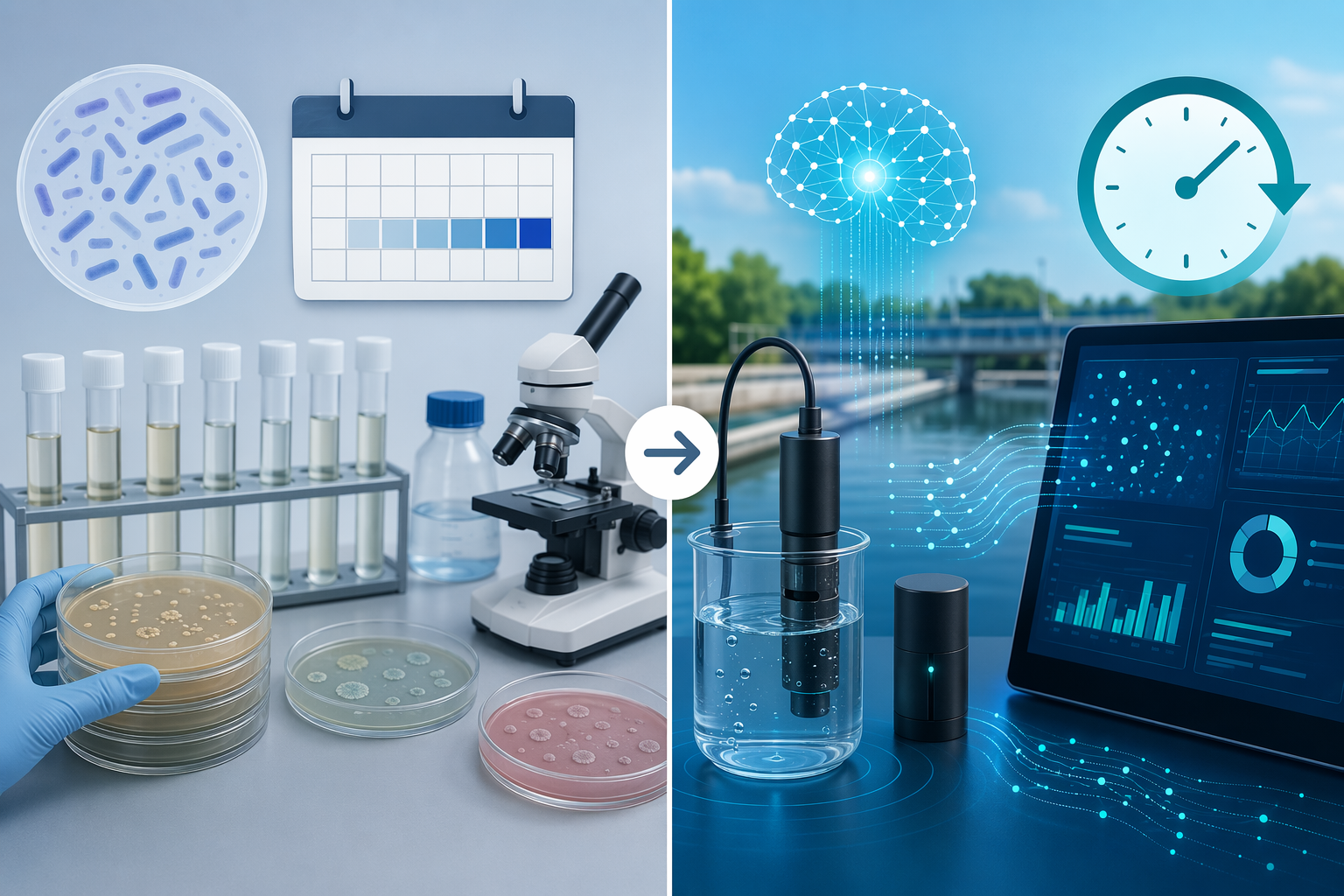
What AI Can Improve First: Time, Triage, and Pattern Recognition
Traditional bacterial water testing gives hospitals something AI cannot simply wish away: organism-level confirmation under defined laboratory methods. But culture-based workflows also impose delay. Samples have to be collected, transported, processed, incubated, interpreted, and then translated into action. During that interval, infection preventionists and facilities staff may already be making practical decisions: whether to restrict use, increase flushing, adjust temperature or disinfectant residuals, resample, notify a unit, or escalate to remediation.
AI is most useful when it shortens that ambiguous middle period. It can scan images faster than humans, learn from routine sensor patterns, and combine signals that would otherwise sit in separate logs: temperature, pH, chlorine residual, conductivity, location, season, recent maintenance, and prior positives. None of those signals, alone, proves that a patient-facing outlet contains a specific bacterial load. Together, they can help a team decide where risk is rising and where scarce sampling or engineering attention should go next.
That distinction matters. A useful AI alert in hospital water safety is not necessarily a diagnosis. It may be a signal to inspect a low-use line, review disinfectant residuals, prioritize sampling in a high-risk unit, or compare a current sensor pattern against past periods that preceded contamination. The value lies in changing the workflow before the next culture bottle is the only source of truth.
The CDC TowerScout Case Shows What Operational AI Can Do
The clearest operational example is not a hospital sink. It is CDC’s TowerScout, a computer vision tool used in Legionnaires’ disease investigations to identify cooling towers. CDC reports that TowerScout reduced cooling tower identification time by 98%, from 4 hours to 5 minutes, and saved more than 280 investigator hours annually.[2]

Those numbers are compelling because they map directly onto field work. In an investigation, investigators need to find possible aerosol-generating sources quickly. If a computer vision system can turn a multi-hour identification task into a minutes-long one, it removes a real operational bottleneck. It does not merely produce an elegant model score; it gives public health staff time back while an investigation is active.
For hospitals, the lesson is both encouraging and limited. TowerScout shows that AI can help with Legionella-related environmental surveillance when the task is well defined: identify candidate cooling towers from imagery, then support investigation. It does not show that an AI system can directly test water from a transplant-unit shower, distinguish colonization from exposure risk at the point of use, or replace a facility’s sampling plan. Cooling tower identification and hospital outlet monitoring sit in the same broad water-safety universe, but they do not carry the same validation burden.
That caveat is not a criticism of TowerScout. It is exactly why the case is useful. It demonstrates AI at its strongest: a constrained task, a measurable time reduction, and a clear operational handoff. Hospital adoption should ask for the same traceability. What does the model see? What source was sampled or imaged? Which organism is relevant? How fast is the signal available? Who receives it? What action is expected?
Prediction Models Are Attractive Because Hospitals Already Measure the Inputs
The next layer of evidence is less visually dramatic but closer to everyday facility management. Machine-learning models have been developed to predict Legionella risk using routine water quality parameters such as pH, temperature, chlorine residual, and conductivity. Reporting on Ohio State–style statistical learning theory models describes improved Legionella risk prediction compared with conventional statistical methods, with the practical appeal that these inputs can be collected through low-cost, continuous monitoring rather than expensive laboratory equipment.[3]
This is the part of AI water monitoring that fits naturally into hospital operations. Facilities teams already understand that water systems drift. Temperatures vary by loop and fixture. Disinfectant residuals fall in areas with low flow. Conductivity and pH can shift with source water, treatment, or plumbing conditions. Dead legs and aging infrastructure create local conditions that a building-wide average can hide. A model that watches those variables continuously could make the water safety plan less dependent on periodic snapshots.
| AI approach | What it can plausibly support now | What it should not be treated as |
|---|---|---|
| Computer vision for cooling tower identification | Faster environmental source identification during Legionnaires’ disease investigations | Direct point-of-use bacterial testing inside hospital plumbing |
| Machine-learning models using routine water quality parameters | Continuous risk stratification and prioritization of sampling or engineering review | Confirmed diagnosis of Legionella or other pathogens at a specific outlet |
| AI-assisted biosensing | Research-stage faster bacterial detection with promising analytical performance | A broadly validated clinical water-monitoring replacement for culture-based protocols |
| Commercial IoT and AI monitoring platforms | Sensor-based visibility, alerts, and operational dashboards | Independent proof of clinical effectiveness unless validated in the facility’s intended use case |
The risk is overinterpretation. A model trained on water quality parameters is not the same as a positive culture or molecular confirmation from a hospital outlet. It may identify conditions associated with higher risk, but the action that follows still belongs to a governed water management process. A high-risk score might justify resampling, flushing review, engineering inspection, or temporary precautions in a vulnerable unit. It should not be silently converted into either reassurance or panic.
For infection prevention teams, the useful question is not simply whether the model is accurate in a paper. It is whether the model has been validated against the facility’s relevant water sources, plumbing age, disinfectant strategy, seasonal variation, sampling points, and organisms of concern. A hospital with a complex hot-water loop and immunocompromised units needs more than a general environmental risk model. It needs a documented link between the alert and a decision.
AI-Biosensing Is the Most Ambitious Detection Evidence, but Not Yet a Hospital Answer
The most technically ambitious evidence comes from AI-assisted biosensing. Yi et al., published in Water Research in 2023, reported a phage-induced lysis biosensing framework combined with AI analysis that achieved 80–100% bacterial detection accuracy on real-world water samples in less than 5.5 hours, with a reported limit of detection of about 1 CFU/L.[4]
That is a serious signal. A result in under 5.5 hours sits in a different operational category from waiting days for culture growth. A low reported detection limit matters because hospital water decisions often turn on whether contamination can be detected early enough to intervene, especially where the exposed population has little margin for error. The combination of biological specificity and AI analysis is also more directly tied to bacterial detection than a model that only infers risk from water chemistry.
The constraint is the validation setting. The system was trained on lab-cultured bacteria and generalized to environmental samples, but the briefed evidence places its primary testing context in food, agricultural water, and environmental-water validation rather than direct clinical hospital water systems.[4] Hospital plumbing is not just another water matrix. Biofilm, temperature gradients, disinfectant residuals, fixture materials, intermittent use, and sampling technique can all affect what is recovered and how results should be interpreted.
For a hospital team, the difference is practical. A promising biosensor may detect bacteria rapidly in real-world water, but before it can guide patient-protective decisions, the facility needs to know which organisms it detects, how it performs in hot and cold potable water, whether disinfectants interfere, whether biofilm-associated organisms are represented, how false positives and false negatives are handled, and whether results align with the hospital’s existing culture or investigation protocols.
Continuous Monitoring Fits the Direction of Travel
Commercial water platforms are already moving in the direction hospitals want: continuous sensor streams, dashboards, automated alerts, and analytics that promise to shift water quality management from reactive sampling toward proactive risk management. Aquanomix, for example, describes healthcare water monitoring platforms using IoT sensors and AI analytics for rapid contaminant detection and continuous oversight.[5]
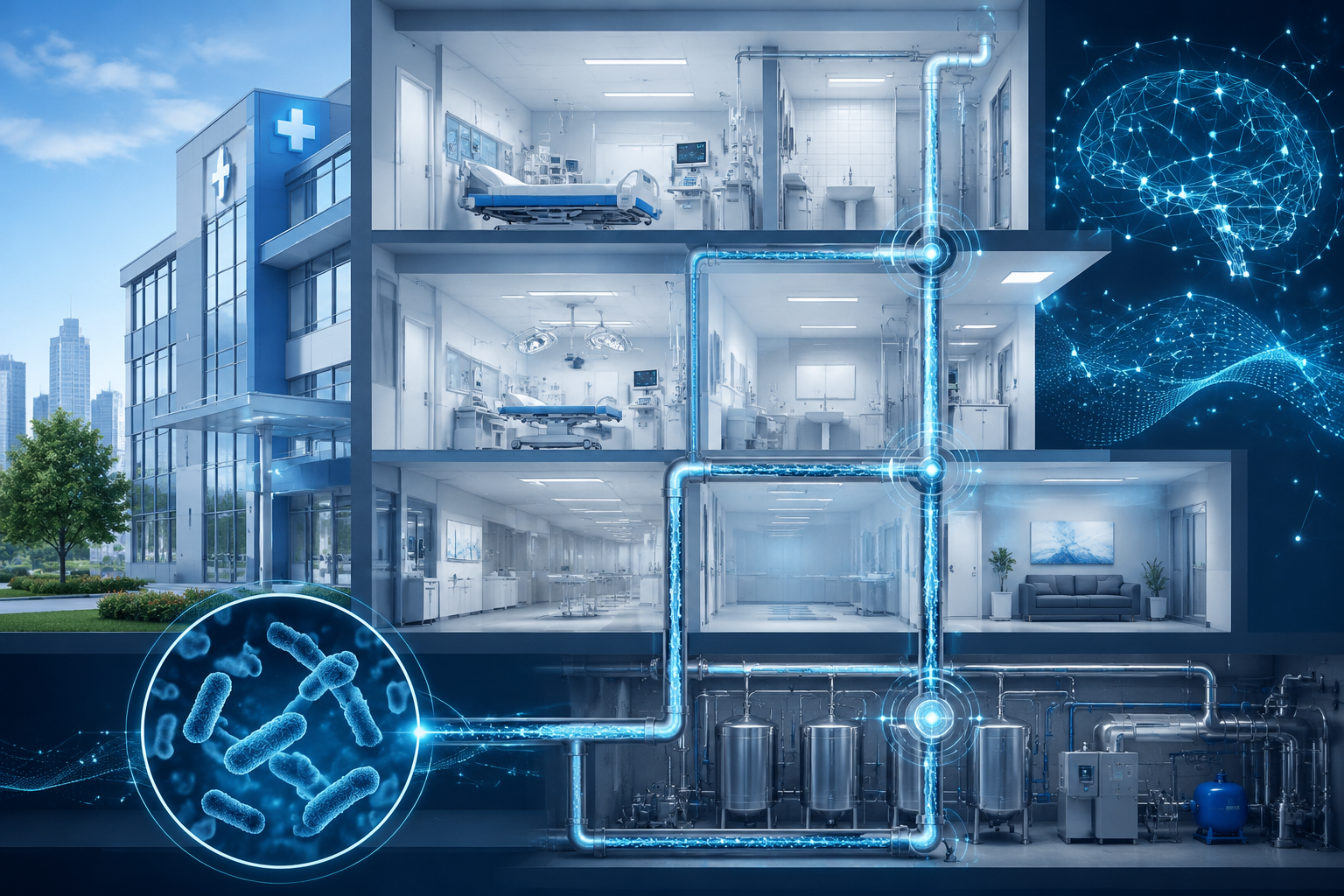
The direction makes sense. Hospitals cannot manage complex water systems well if the only information comes from occasional sampling, complaint-driven checks, or outbreak investigations. A continuous platform can make hidden system behavior visible: temperature drift after construction work, low residuals in a distant wing, recurring abnormalities after weekend low use, or sensor changes after valve adjustments. That kind of visibility can support a stronger water management program even when it is not a standalone bacterial diagnostic.
Vendor claims, however, should not carry the evidentiary burden for clinical adoption. A dashboard that looks convincing in facilities operations still needs local validation before it informs infection prevention decisions. Hospitals should separate three questions that are often blurred together: whether the sensors measure accurately, whether the AI model predicts bacterial risk in the intended setting, and whether acting on the alert reduces exposure or improves response time without creating unmanageable false alarms.
What a Hospital Should Ask Before Trusting an AI Alert
The central adoption issue is traceability. AI systems tend to be described in broad terms: faster detection, smarter monitoring, predictive analytics. Hospital water safety requires narrower claims. The alert has to connect to a pathogen, a sample type, a sampling location, a validation environment, and an operational decision.
- Pathogen: Does the system address Legionella specifically, a broader bacterial group, or only indirect risk conditions?
- Water source: Was it validated on cooling towers, environmental water, agricultural water, potable building water, or hospital point-of-use outlets?
- Sampling point: Does performance hold at taps, showers, ice machines, storage tanks, recirculation loops, and distal outlets?
- Detection time: Does the faster result arrive early enough to change flushing, restriction, remediation, or clinical communication?
- Action threshold: Who reviews the alert, what confirms it, and what happens if the signal conflicts with culture results or clinical observations?
These questions are not procurement formalities. They protect staff from being handed an ambiguous signal without authority, staffing, or a response pathway. An infection preventionist cannot simply receive an AI-generated risk score and decide alone whether a unit should stop using sinks. A facilities engineer cannot remediate every alert if the system has not been tuned to distinguish sensor noise from meaningful risk. A microbiology team cannot be expected to reconcile new AI outputs with standard methods if the comparison plan was never built.
The best near-term use is therefore layered. AI can flag abnormal conditions, rank locations for sampling, accelerate environmental source identification, and help teams see patterns across time. Standard water management protocols still define responsibilities, routine control measures, confirmatory testing, documentation, escalation, and communication with affected clinical areas.
The Evidence Supports Early Warning, Not Replacement
The current evidence points in a consistent but limited direction. CDC’s TowerScout shows that AI can remove major time friction from Legionnaires’ disease investigations, but it operates in environmental source identification rather than direct hospital water testing.[2] Machine-learning models using routine water quality parameters are appealing because they could make risk monitoring continuous and affordable, but they remain risk prediction tools rather than organism confirmation.[3] AI-biosensing research shows faster bacterial detection with impressive reported performance, but the cited validation context does not yet establish routine use in clinical hospital water systems.[4]
The evidence set reviewed here also does not identify an FDA-cleared AI device for clinical bacterial detection in hospital water systems. That absence should keep expectations grounded. Hospitals can still pilot AI-supported monitoring, especially where it strengthens an existing water management program, but they should not treat AI output as a substitute for cultures, outbreak investigation, clinical protocols, or infection prevention governance.
A cautious adoption posture is not anti-innovation. It is how hospitals prevent a useful early-warning layer from being mistaken for a finished clinical safeguard. The right question is whether a specific system has been validated on the water sources, pathogens, sampling points, and operational decisions that matter inside that facility. If it has, AI may help teams act earlier. If it has not, the model is still evidence to evaluate, not protection to assume.
References
- Water Management Program Toolkit, CDC, https://www.cdc.gov/healthcare-associated-infections/php/toolkit/water-management.html
- AI’s Role in Stopping Legionnaires’ Disease, CDC, https://www.cdc.gov/ai/ai-success-stories/ais-role-in-stopping-legionnaires-disease.html
- AI Water Monitoring Legionnaires’ Disease Prevention, MedBound Times, https://www.medboundtimes.com/medbound-blog/ai-water-monitoring-legionnaires-disease-prevention
- Phage-induced lysis biosensing coupled with artificial intelligence for bacteria detection in water, Water Research, 2023, https://www.sciencedirect.com/science/article/abs/pii/S0043135423006942
- Enhancing Patient Safety: Water Quality Management for Healthcare Operations, Aquanomix, https://www.aquanomix.com/blog/enhancing-patient-safety-water-quality-management-for-healthcare-operations
Comments
Join the discussion with an anonymous comment.