
Hospitals do not make hurricane decisions from a forecast cone alone. A cone can tell a region to prepare; it does not tell an emergency manager whether the ambulance bay will flood before the ED entrance, whether a feeder line serving the generator plant is exposed, whether dialysis patients and ICU transfers will arrive on the same afternoon, or whether a loading dock will still take oxygen deliveries when the wind shifts.
That gap is where using AI in hurricane forecasting for healthcare emergency planning becomes more interesting than the usual claim that models are getting better at predicting storms. The useful question is narrower: which AI-enabled tools can turn weather information into facility-level choices early enough for hospitals to staff, protect, transfer, stage supplies, and harden weak points?
The pressure to answer that question is increasing. Swiss Re reported in 2025 that global insured losses from natural catastrophes have been growing by 5% to 7% per year, and Georgia Tech has noted that damage from tropical cyclones has increased by about 380% since 1970.[1][2] Those figures do not, by themselves, prove that a given hospital should evacuate sooner or buy a digital twin. They do explain why scenario-based contingency plans feel less forgiving when the storm exceeds the assumptions used in last year’s tabletop exercise.
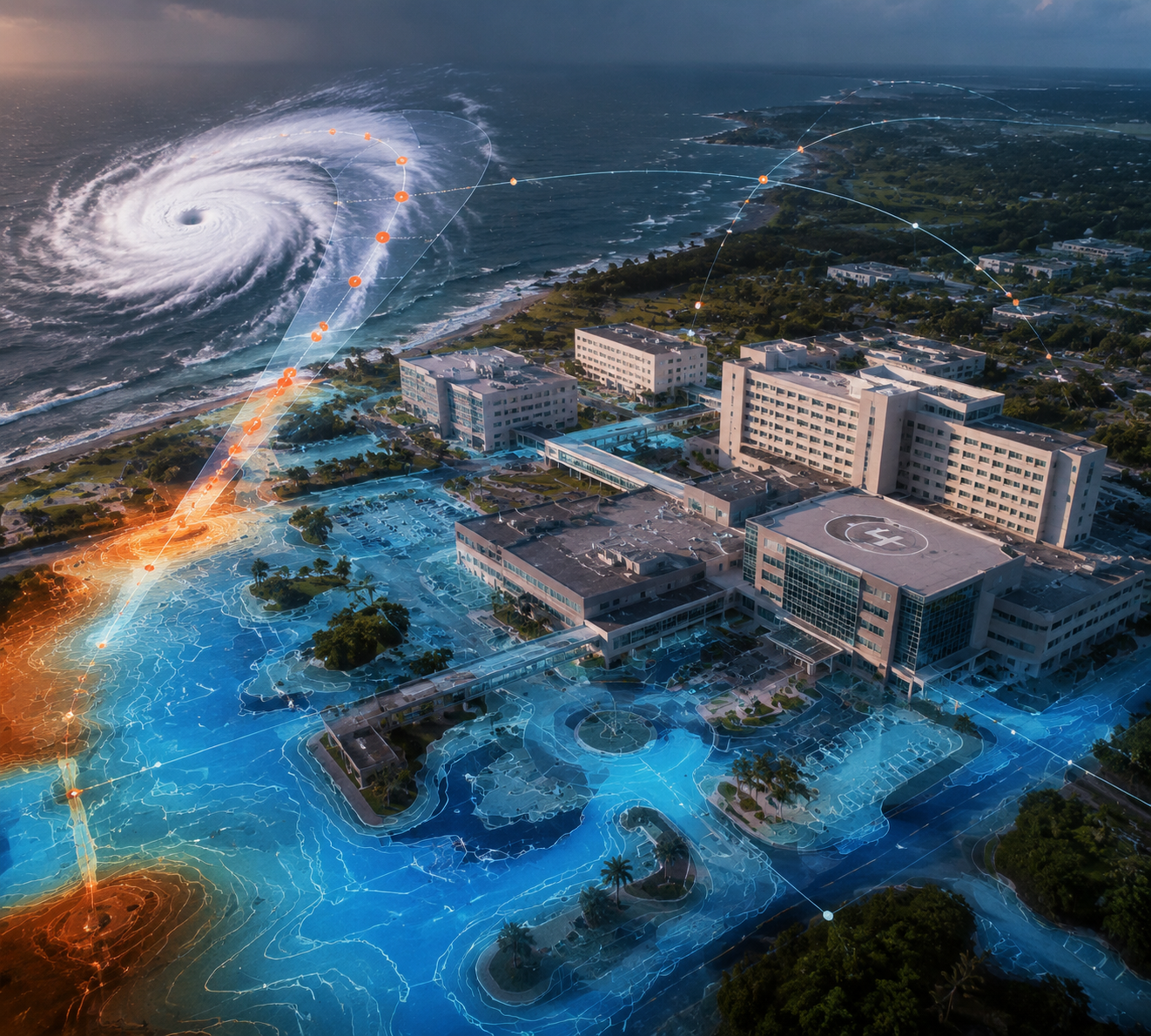
The Planning Problem Is Too Local for County-Level Forecasts
Traditional hurricane preparedness plans usually rely on scenarios: a Category storm, a projected surge range, a staffing plan, a fuel plan, an evacuation trigger, a shelter-in-place checklist. Those documents are necessary. They also tend to assume that the facility’s weak points will behave as expected.
In practice, the first operational failure may be embarrassingly specific. A service road ponds earlier than expected. A switchgear room sits lower than the rest of the campus. A transfer partner is also in the flood zone. A backup generator is ready, but the fuel vendor cannot reach the dock. A nursing unit is technically safe while the path between that unit and imaging is not.
This is why the most valuable AI work for hospitals is not just storm-track prediction. It is translation: turning meteorological, hydrologic, infrastructure, and utilization data into warnings that match the unit of hospital action. The building matters. The access road matters. The power feed matters. The timing of discharge, transfer, dialysis, ED surge, and staff arrival matters.
Building-Level Flood Prediction Changes the Unit of Decision
The Georgia Tech building-level flood prediction work is the clearest bridge between AI hurricane forecasting and hospital emergency planning. The research describes physics-informed AI models that integrate storm surge, rainfall, and river flooding to estimate flood depth at the level of individual buildings, with a planning window of three to five days before landfall.[2]
For a hospital, that is a different kind of forecast. It is not simply, “the county may flood.” It is closer to, “this building, this entrance, this utility area, or this access route may face a depth that changes the preparedness choice.” That distinction can affect whether a facility moves portable imaging, stages pumps, relocates pharmacy inventory, accelerates discharge planning, transfers a fragile census earlier, or protects a lower-level mechanical room before staff are locked into response mode.
The three-to-five-day window is important because many hospital actions are not last-minute actions. Ambulance contracts, receiving-facility coordination, oxygen and fuel deliveries, staff lodging, dialysis scheduling, and ICU transfer decisions all consume time. A forecast that becomes operationally specific only after roads begin to fail is too late for the people who have to move patients safely.
Georgia Tech reported that the model achieved above 90% accuracy in a Hurricane Sandy demonstration.[2] That result deserves attention, but it should be held at the right size. Sandy is a test case, not proof that every coastal hospital can treat the method as a broadly validated operational standard. Generalizability across storm types, coastal geographies, drainage systems, and hospital campuses is still the question that matters.
Even with that caution, the direction is practical. A county evacuation zone can leave a hospital deciding whether it is overreacting or waiting too long. A building-level flood-depth estimate can support a more defensible preparedness posture: protect this entrance first, stage supplies on this side of campus, move these services off the ground floor, verify this route for EMS, and revisit the transfer trigger if the depth estimate crosses a known threshold.
| Forecast Output | Hospital Planning Use | Operational Caution |
|---|---|---|
| County or regional flood risk | Broad situational awareness and coordination with public authorities | Often too coarse for campus-level decisions |
| Building-level flood-depth estimate | Entrance protection, utility-room protection, transfer timing, loading dock planning, access-route review | Needs local validation and interpretation by emergency management and facilities teams |
| Three-to-five-day warning window | Staffing, supply staging, patient movement, discharge acceleration, receiving-facility coordination | Still depends on forecast uncertainty and downstream infrastructure conditions |
Digital Twins Belong Before the Storm, Not During the Panic
Digital twins are useful to hospital preparedness only if they expose vulnerabilities early enough to fix or work around them. The Georgia Tech team has described digital twin modeling that can run virtual hurricanes through hospital infrastructure to identify vulnerable substations, power lines, and related dependencies before a storm hits.[2]
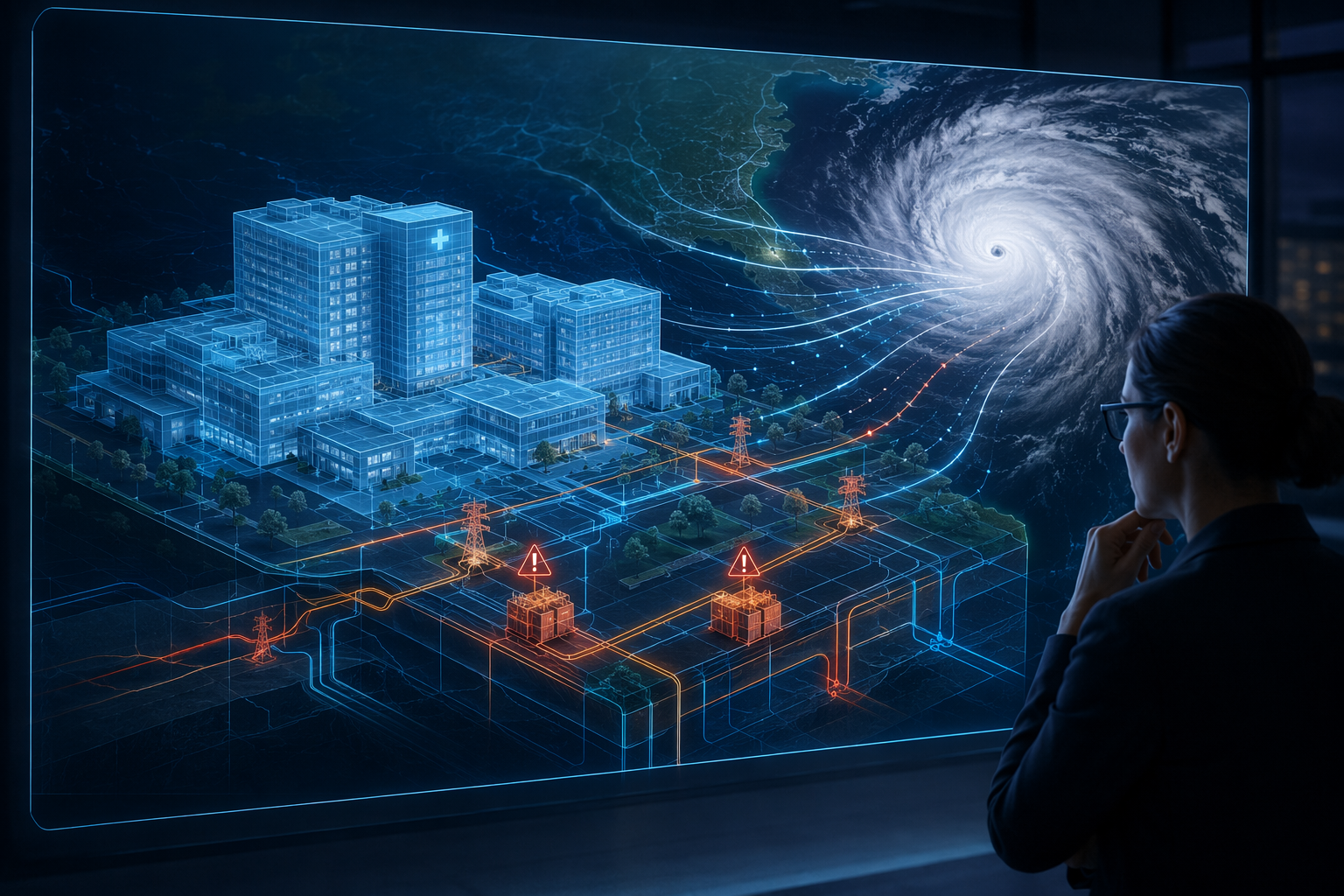
That is a pre-season use case. If the model shows that an electrical dependency, substation exposure, or utility pathway is likely to fail under plausible storm conditions, the hospital has time to harden, reroute, stage backup assets, revise downtime procedures, or change the assumptions in its shelter-in-place plan. The value is not the elegance of the simulation; it is the maintenance ticket, capital request, mutual-aid agreement, or operating procedure that changes because the weakness is visible before June.
The line to keep bright is this: a simulated hospital has not survived a hurricane. Digital twins can reveal where the plan may be brittle. They should not be sold internally as proof that the facility will perform under real wind, water, heat, staffing shortages, vendor delays, and competing regional demand.
Surge Forecasting Has to Match the Calendar of Care
Flood depth is only one side of the hospital problem. The other is patient load. AI-driven surge capacity forecasting aims to combine forecast storm severity, historical utilization, and population vulnerability to estimate ED census, ICU demand, staffing pressure, and supply needs three to five days before landfall. Deloitte’s 2023 emergency preparedness and response analysis described resource allocation optimization as a plausible use of predictive analytics, while also noting barriers that have kept such approaches from scaling easily across organizations.[3]
That caveat is familiar. Surge forecasting depends on data that are often messy, unevenly shared, or trapped in systems that were never designed for regional disaster operations. A model may estimate that ED demand will rise, but the useful operational question is more specific: which beds can be staffed, which discharges can safely happen earlier, which transfer partners have capacity, which supplies cannot be replenished if roads close, and which patient groups will lose access to routine care during the storm window?
Some secondary industry discussion has pointed to Texas hospitals during Hurricane Harvey as an example of predictive analytics being used for resource allocation, but the available material in this brief does not provide named institutions, study design, or detailed outcomes. That makes it a cautionary example rather than evidence of general effectiveness.[4]
For hospital leaders, the near-term use is still worth pursuing. A modest surge forecast that helps bed management, transport coordination, dialysis scheduling, and supply chain teams look at the same three-to-five-day risk picture may be more valuable than a sophisticated dashboard that no one trusts enough to act on.
Threshold Monitoring Is Promising Because It Watches the Boring Failure Points
The January 2026 npj Digital Medicine article on agentic AI and scenario-based contingency planning is directionally important because it reframes preparedness around latent hospital vulnerabilities. It proposes multi-agent AI systems that continuously compare operational thresholds for equipment and facilities—temperature, humidity, power requirements, and related conditions—against real-time weather forecast data, then trigger early warnings when those thresholds may be breached.[5]
That sounds less dramatic than a storm forecast, which is partly why it matters. Hospitals fail under pressure when small dependencies stack up: a room gets too humid for a device, a refrigeration requirement is missed, a backup power assumption no longer holds, an equipment cache is staged in the wrong place, or a clinical service remains nominally open while its environmental requirements are no longer reliable.
A threshold-based system would not need to “decide” whether a hospital evacuates. Its more credible role is continuous monitoring: watch the requirements, watch the forecast, watch infrastructure status, warn the right team early, and preserve a traceable record of why the alert fired. That is the kind of AI support emergency managers can use, provided the system is validated, governed, and connected to people who have authority to act.
At this point, however, the framework should be treated as research-stage. The article argues that scenario-based contingency planning can fail for “climatic black swan” events where conditions exceed the training data or planning assumptions, but it does not establish that agentic threshold systems have already been validated in real hurricane operations.[5]
Forecasting AI Still Needs Human Guardrails
Hospitals should also keep a boundary between AI guidance and operational authority. The National Hurricane Center has stated that AI models are used as complementary guidance, not standalone decision tools.[6] That stance fits healthcare emergency planning. A model can sharpen the picture, but it cannot own the consequences of a delayed evacuation, a failed transfer, or a power dependency that was never checked.
Reliability concerns are not theoretical. A March 2026 Rice University study evaluating Pangu-Weather and Aurora found physical realism limitations, including deviations from gradient wind balance and overestimation of inner core size.[7] For a hospital, the lesson is not to reject AI weather models. It is to avoid treating a fluent forecast product as an operational fact unless its limits are understood by the people using it.
This matters because healthcare decisions compound uncertainty. A coastal facility may be weighing flood exposure, generator risk, staffing availability, ambulance access, receiving-hospital capacity, and medically fragile patients who cannot be moved casually. AI can reduce some uncertainty and organize signals faster. It does not remove the need for emergency management judgment, clinical risk review, facilities expertise, and coordination with public authorities.
A Practical Readiness Map for Hospitals
For hospitals updating hurricane plans in 2026, the most practical approach is to separate AI capabilities by planning use and maturity rather than treating them as one category.
| Capability | Best Current Use | Maturity to Assume |
|---|---|---|
| Building-level flood prediction | Facility-specific flood-depth planning for buildings, entrances, access routes, and vulnerable infrastructure | Promising demonstrated research capability; Sandy result should not be generalized without local validation |
| Hospital digital twins | Pre-season stress-testing of power, utilities, substations, and campus dependencies | Planning and simulation tool; not proof of real-event performance |
| AI-driven surge capacity forecasting | Three-to-five-day planning for ED census, ICU demand, staffing, transfers, supplies, and medically vulnerable populations | Plausible and partially actionable, but difficult to scale across fragmented systems |
| Agentic threshold monitoring | Continuous comparison of equipment and facility requirements against weather and infrastructure conditions | Research-stage framework needing real-event validation |
| General AI hurricane models | Additional forecast guidance for expert interpretation | Complementary input, not a standalone decision authority |
The first near-term move is facility-level flood risk work. If a hospital can obtain credible building-level flood-depth estimates, emergency managers and facilities teams can compare those estimates against known campus weak points: doors, ramps, generators, switchgear, loading docks, tunnels, oxygen storage, pharmacy areas, and ambulance routes. That exercise can produce concrete pre-storm actions even before more ambitious AI systems are in place.
The second move is data-driven surge planning. Hospitals do not need to wait for a fully automated command center to improve how they forecast bed pressure, transfers, staffing, and supply consumption. They do need agreement on which data are trusted, who reviews the forecast, when it is updated, and what threshold changes the plan.
Digital twins and agentic threshold systems deserve exploration, especially for health systems with complex campuses, older infrastructure, or repeated storm exposure. They should enter preparedness programs as stress-testing and monitoring tools that still need validation in real events, not as replacements for drills, facilities inspections, mutual-aid planning, and experienced incident command.
The useful distinction is simple enough to put on the planning table: hospitals can begin exploring facility-level flood prediction and data-driven surge forecasting now, while treating digital twins and agentic threshold monitoring as promising infrastructure that must prove itself against real hurricane conditions before it becomes trusted emergency-planning machinery.
References
- Swiss Re natural catastrophe insured loss analysis, Swiss Re, 2025.
- How AI-powered flood forecasts could transform hurricane resilience, Georgia Tech.
- Emergency preparedness and response analysis, Deloitte, 2023.
- Predictive analytics for disaster management in hospitals, KareXpert.
- Agentic AI and scenario-based contingency planning in healthcare disaster preparedness, npj Digital Medicine, January 2026.
- National Hurricane Center guidance on AI models as complementary forecast tools, National Hurricane Center.
- Rice University evaluation of Pangu-Weather and Aurora hurricane model realism, Rice University, March 2026.
Comments
Join the discussion with an anonymous comment.