
The uncomfortable version of the 2026 board question is not whether a hospital or physician group should “use AI.” It is whether remaining independent still leaves enough scale to build, govern, integrate, and benefit from AI at the level competitors will soon treat as table stakes. PwC’s midyear 2026 health services deals outlook puts a useful marker on that question: physician medical group consolidation reached a record 46% of Q1 2026 deal volume, with PwC tying the activity to demand for AI-enabled efficiency and value-based care capabilities.[1]
That does not mean every hospital merger is suddenly an AI transaction. Margin pressure, workforce shortages, regulatory burden, demographics, and the move toward value-based care were already compressing the room available to smaller providers. AI matters because it changes the minimum operating platform required to respond to those pressures. A merger thesis that once rested on purchasing power, referral capture, and back-office consolidation is now increasingly tested against another question: can the combined organization assemble enough data, technical infrastructure, compliance capacity, and specialized talent to compete?

AI Turns Scale Into an Operating Requirement
For many smaller organizations, the first wave of AI can still be bought. Ambient documentation, coding assistance, scheduling optimization, call-center support, and some revenue-cycle tools are often delivered as software-as-a-service products. They may require integration work and vendor oversight, but they do not always require a hospital to own the underlying model development, large-scale data engineering, or advanced analytics stack.
The consolidation pressure is stronger in the uses that depend on dense clinical data and operational integration: predictive analytics, population health, imaging workflows, risk stratification, care-management automation, utilization management, and enterprise-wide command-center functions. These are not plug-ins in the ordinary sense. They need data that is broad enough to be useful, clean enough to be trusted, and governed tightly enough to survive clinical, compliance, and board scrutiny.
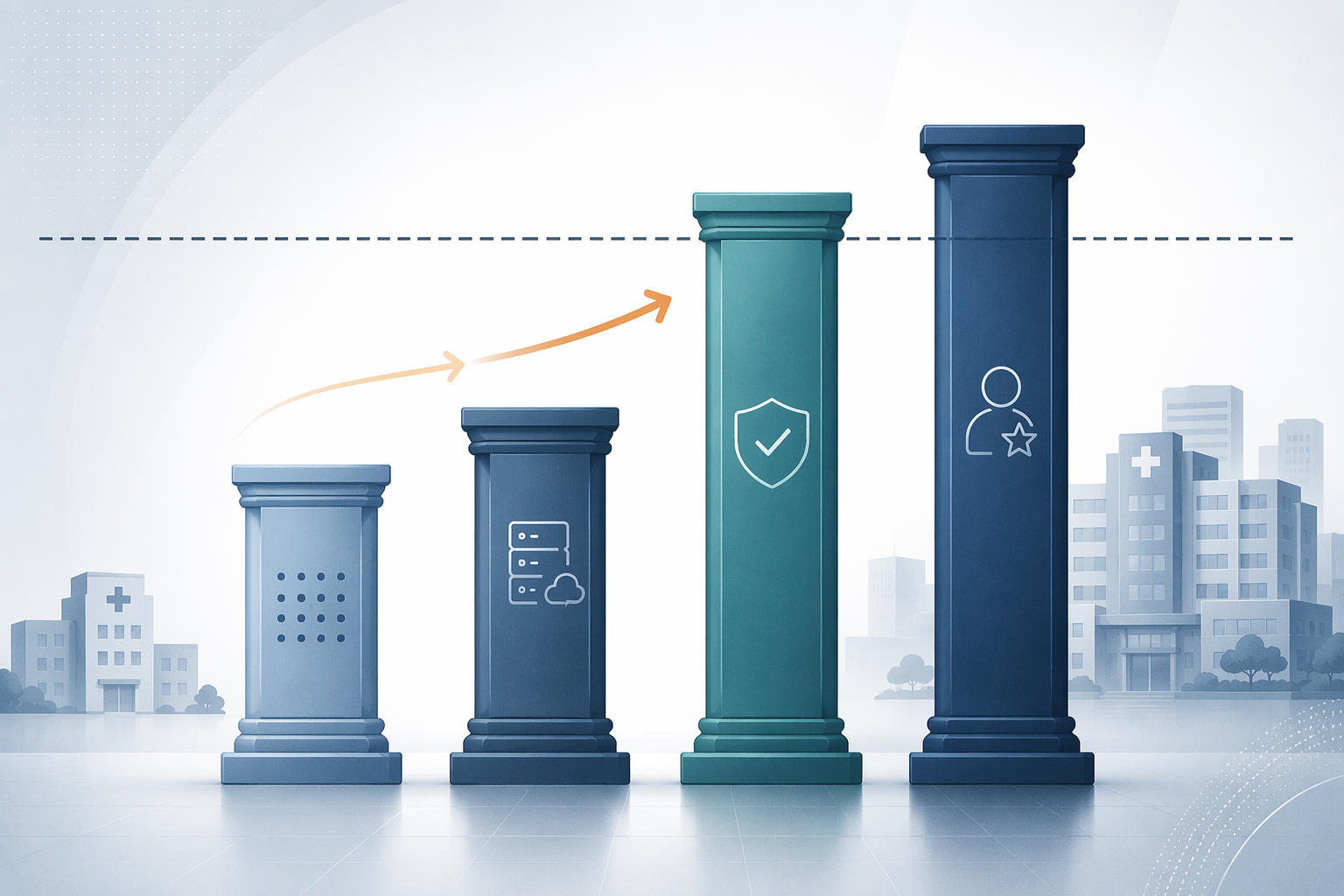
| Capability | Why It Favors Scale |
|---|---|
| Data density | Larger systems have more encounters, claims, images, longitudinal histories, and variation across sites, which can make analytics more useful and easier to validate. |
| Compute and IT infrastructure | Enterprise AI depends on interoperable systems, secure data movement, model monitoring, and integration into clinical and administrative workflows. |
| Governance and compliance capacity | AI programs need review structures for privacy, bias, safety, vendor accountability, documentation, and change management. |
| Specialized talent | Health systems need clinicians, data scientists, informaticists, security leaders, compliance staff, and operational owners who can work together over time. |
That bundle is where independence becomes less romantic. A 200-bed hospital can have excellent clinicians, a loyal community, and a board willing to invest. It may still struggle to justify a standing AI governance office, enterprise data engineering capacity, model monitoring, integration teams, clinical informatics leadership, privacy review, cybersecurity depth, and enough deployment volume to learn from failures without turning every project into a one-off experiment.
The practical consequence is not that smaller hospitals cannot use AI. It is that they may use it on terms set by vendors, payers, or larger platforms. They can procure point solutions, but they may not control the data architecture, learning loop, or strategic roadmap. Over time, that distinction becomes material. The organization that owns the operating platform can decide where AI is applied, how performance is measured, which workflows are redesigned, and how gains are reinvested. The organization that only rents the tool has less leverage.
The Funding Signal Is Concentrating Around Platforms
The capital markets are already behaving as if this threshold matters. Galen Growth reported that 83% of U.S. Health Management Solutions funding went to AI-powered ventures in Q1 2026, and that average deal size in the category rose from $13.6 million in Q1 2022 to $46.6 million in Q1 2026.[2] Those figures do not describe hospital M&A directly; they describe a health management solutions slice of the market. But they are still relevant to hospital strategy because they show where capital expects operating leverage to accumulate.
The message is not that every AI company is winning. It is that investors are rewarding platforms with enough distribution, data access, workflow reach, and implementation capacity to turn AI into recurring operational value. That is a different market from one built around isolated tools. It favors companies and health systems that can absorb smaller capabilities, standardize deployment, and spread fixed costs across a larger base.
HGP’s February 2026 view of the health IT transaction landscape makes the defensive nature of the shift clearer. It reported that AI is no longer merely an offensive differentiator; companies without a credible AI plan risk valuation erosion. HGP also found a bifurcation: only about 13% of Health IT M&A deals involved AI-native companies, while roughly half of capital was going to AI-enabled firms.[3]
That distinction matters. If only deal counts are watched, AI can look like a niche feature in the transaction market. If capital allocation and valuation logic are watched, AI looks more like a filter. Buyers do not have to acquire an AI-native company for AI to affect diligence. They can ask whether the target has clean data, defensible workflows, automation capacity, credible governance, and a roadmap that will not require a rebuild after closing.
Where the Capability Gap Enters Merger Math
The impact of AI on hospital mergers and consolidation is easiest to overstate when AI is treated as a shiny asset. The more important effect is quieter: it changes what the buyer believes the combined organization must be capable of doing after the transaction.
A health system evaluating a hospital or physician group is no longer just reviewing service lines, physician alignment, payer mix, debt, capital needs, and market share. It also has to ask whether the target’s data can be integrated, whether its EHR configuration will support analytics, whether its documentation quality is reliable, whether its local workflows can absorb automation, and whether the organization has leaders capable of governing AI use after the deal closes.
For a seller, the same facts can cut the other way. A group with valuable clinical volume but weak infrastructure may conclude that independence leaves too much value stranded. It may have the patients, physicians, and local relationships, but not the platform needed to convert those assets into better care management, lower administrative cost, or stronger performance under value-based arrangements.
This is where AI becomes an accelerant rather than a standalone cause. It intensifies existing pressure by raising the cost of standing still. If the organization delays investment, its data becomes harder to use. If it signs narrow vendor contracts, it may create a patchwork that is difficult to govern. If it lacks analytics staff, it may not know whether tools are improving performance or simply moving work from one department to another. If it cannot recruit technical talent, it may become dependent on outside parties for decisions that increasingly affect operations.
The self-reinforcing loop
The scale advantage compounds. Larger systems generate more clinical and operational data. More data can support better analytics, more reliable validation, and more useful workflow redesign. Better deployment can improve margins or performance under risk-based contracts. Stronger performance can support more capital access. More capital can fund acquisitions, partnerships, and platform investments that add still more data and deployment surface.
That loop does not guarantee better care. It does not make every large system well managed, and it does not make every acquisition wise. Scale can also preserve bureaucracy, dilute local accountability, and create integration debt. But from a transaction standpoint, AI gives scale a new rationale: the larger platform may be the only realistic way to spread the fixed costs of data governance, cybersecurity, informatics, model oversight, and technical integration.
Machinify Shows the Platform Logic, Not the Whole Hospital Story
The clearest 2025 example of AI acting as an organizing center for consolidation came outside hospital ownership itself. New Mountain Capital formed Machinify by combining SmarterDx, Thoughtful.ai, Apixio, Varis, and Rawlings Group into an AI-powered healthcare payments platform valued at about $5 billion.[4][5]
Payments are not hospitals. A platform built around coding, payment integrity, claims, and automation cannot by itself prove that hospitals must merge. Still, the case is instructive because healthcare payments are fragmented, workflow-heavy, data-dependent, and financially consequential. The consolidation logic was not simply to own more companies. It was to assemble complementary data assets, automation capabilities, and operating reach under one platform.
Hospital and physician group transactions are moving through a similar strategic filter, even when the assets look different. Buyers are looking for density, integration potential, and the ability to deploy capabilities across a larger base. Sellers are looking for access to tools, talent, and contracting strength they cannot build alone. AI does not replace the traditional reasons for consolidation; it makes the infrastructure side of those reasons harder to ignore.
Independence Now Has to Be Underwritten
For boards, the serious question is not whether independence is emotionally or historically valuable. Often it is. Local governance can preserve community priorities, sustain trust, and prevent strategic decisions from being made entirely from a distant corporate center. The question is whether independence is financially and operationally underwritten for the AI era.
That underwriting requires more than approving a pilot. A credible independent strategy has to identify which AI capabilities the organization will own, which it will rent, which it will access through partnership, and which it will deliberately avoid. It has to fund the governance layer, not just the software license. It has to know who reviews model performance, who signs off on workflow changes, who monitors vendor claims, who handles patient and clinician concerns, and who is accountable when automation changes staffing assumptions or denial patterns.
Some independent hospitals and groups will answer that challenge through selective partnerships rather than full mergers. Others will affiliate clinically, join purchasing or data collaboratives, outsource defined functions, or accept platform dependence in areas where ownership is unrealistic. Those are not failures if the trade-offs are explicit. The risky posture is pretending that a thinly staffed organization can carry enterprise-grade AI obligations because the board has seen an impressive demonstration.
- If AI is part of the merger rationale, diligence should test data quality, interoperability, workflow readiness, governance maturity, and post-close integration cost.
- If AI is part of the independence rationale, the board should see a funded plan for talent, compliance, cybersecurity, clinical oversight, and vendor management.
- If AI is outsourced, leadership should know which strategic capabilities are being ceded to vendors, payers, or platform partners.
- If projected AI savings support valuation, the assumptions should separate purchased administrative tools from harder enterprise deployments that require data and workflow redesign.
What This Means for 2025–2026 Deal Strategy
The strongest reading of the current evidence is narrow but consequential. AI is not the sole cause of hospital mergers, and the data sources now available describe different slices of the market: PwC is looking at health services deals, Galen Growth at Health Management Solutions funding, HGP at health IT transactions, and Rock Health at digital health funding through the lens reported in 2025.[1][2][3][5] They should not be collapsed into one universal M&A statistic.
Taken together, though, they point in the same strategic direction. Capital is concentrating around AI-capable platforms. Buyers are scrutinizing AI readiness as part of valuation and diligence. Physician group consolidation is rising in a market where efficiency, data leverage, and value-based care infrastructure matter. Health IT companies without credible AI plans face valuation pressure. These are not cosmetic shifts.
For hospital and physician group boards, AI capability should now sit inside the core merger analysis, alongside market position, capital needs, clinical strategy, payer dynamics, and workforce risk. The question is not whether consolidation is automatically better for patients or operations. It often is not. The question is whether the organization can realistically assemble the data, infrastructure, talent, and governance required to remain a capable operator on its own.
That is the defensive turn. AI capability gaps are making scale more valuable. For organizations that cannot close those gaps independently, consolidation is becoming less a growth play than a way to avoid being structurally underpowered.
References
- Health services: US Deals 2026 midyear outlook, PwC.
- AI in U.S. Healthcare Operations: Why Health Management Solutions Attracted $4.5B in 2025, Galen Growth.
- AI trends shaping the Health IT Transaction Landscape, HGP, February 2026.
- How Artificial Intelligence is Rewriting the Playbook for Healthcare M&A, PMCF Investment Banking.
- Big bets on healthcare AI push digital health funding to $6.4B, Fierce Healthcare, H1 2025.
Comments
Join the discussion with an anonymous comment.