
The scale of the problem
The largest cohort study to date makes the scale hard to ignore: 77,790 in-flight medical events across 84 airlines, about 1 event for every 212 flights and 39 events per million enplanements [1]. Neurologic problems accounted for 37% of events and gastrointestinal problems for 23%, so the cabin crew's first task is usually to recognize symptoms and stabilize them, not to solve a clean diagnostic puzzle.
The more operationally important finding is the diversion paradox. A volunteer physician was present only 20.1% of the time, yet physician involvement was associated with 7.86 times higher odds of diversion [1]. That is the kind of asymmetry that makes airline medicine look like a standardization problem: the person with the most medical training is often missing, but when that person appears, the system becomes more likely to change course. The same paper is strong epidemiology, but it is not a pure outsider view; the author list includes MedAire employees [1].
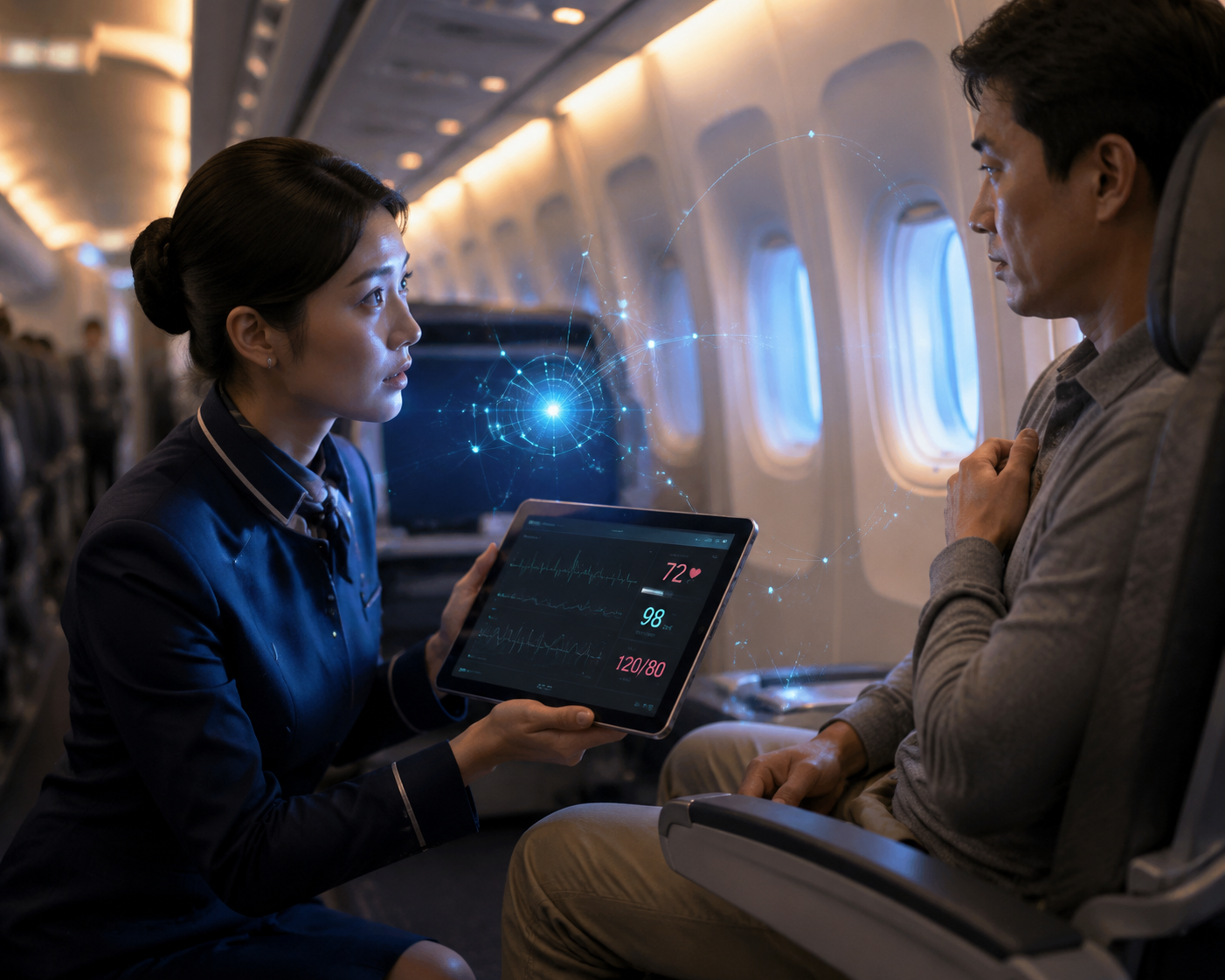
What the workflow looks like
The useful way to think about AI for passenger medical emergencies on flights is as a sequence of handoffs, not a single magic model. Pre-flight tools try to surface elevated risk before boarding, crew-facing protocols structure the first minutes in the cabin, connected diagnostics package the available vitals for a ground physician, and documentation closes the loop for the next event.
| Stage | What AI or telemedicine does | What still matters |
|---|---|---|
| Before boarding | A Fit-to-Fly screen can flag passengers who may need extra review before takeoff [3]. | It only helps if the airline can act on the flag. |
| In the cabin | Crew uses AI-guided assessment prompts and records basic findings without improvising the process [2][3]. | The first minutes still depend on crew skill and calm. |
| With ground support | Bluetooth-connected vitals can be sent to a remote physician for interpretation [3]. | This depends on a reachable clinician and a usable link. |
| After the event | The episode is documented so the case can be reviewed and the protocol can be refined. | Documentation quality determines whether the next call is easier. |
That order matters because the hard part is not singular AI. It is the handoff. The pre-flight screen can only reduce surprises if someone can act on it before pushback. The cabin tool can only help if the crew can gather enough vitals without slowing the response. The ground physician can only add value if the device actually sends usable data.
The deployed stack
MedAire's In-Flight App is the clearest public example of the current model. MedAire says its AI-guided assessment protocols are trained on patterns from more than 1 million real aviation medical cases, and that the platform is used across more than 25 airlines by more than 300,000 crew members [2][3]. The company also describes more than 10,000 call minutes a month through the app, which is a better sign of operational adoption than any marketing slide [2].
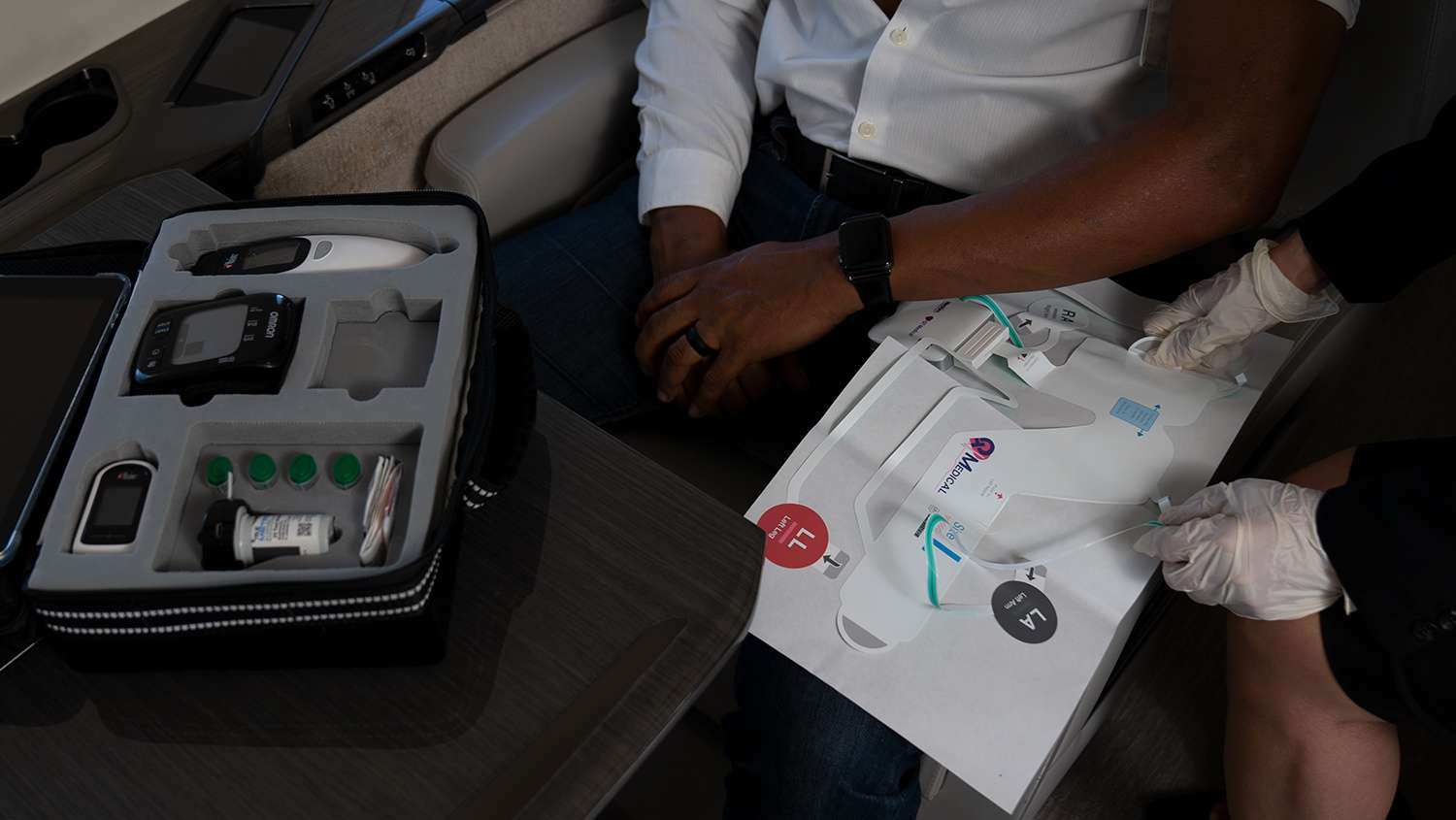
The Digital Assessment Kit is the piece that turns a subjective call into data a remote clinician can actually read. In the deployed setup, it bundles a 12-lead ECG, blood pressure cuff, pulse oximeter, glucometer, thermometer, and MedLink communication device, with Bluetooth transmission of vitals to ground physicians [3]. Air Europa's April 2026 rollout matters because it shows the stack in use, not just in a brochure: the carrier became the first Spanish airline to deploy the full ecosystem, including a pre-flight Fit-to-Fly digital decision-support tool for identifying higher-risk passengers before boarding [3].
All of that still depends on a link. NBAA notes that LEO satellite systems such as Starlink are producing about 30 ms of round-trip latency, comfortably below the sub-300 ms range cited for real-time telemedicine and remote ECG interpretation [4][5]. That makes connected triage plausible on many routes, but not universal; the route, the aircraft, and the coverage map still decide whether the system works the way the brochure says it will.
Where the evidence stops
What the public record supports here is AI-assisted decision support, not autonomous triage. The public descriptions of MedAire's app explain the workflow and the protocol layer, but they do not disclose the model architecture, training recipe, or a peer-reviewed technical validation of the AI component [2][3]. None of the materials here describe an FDA-cleared system that lets non-medical crew hand the decision over to autonomous in-flight AI, so the defensible claim is narrower and more useful: current tools can standardize the first minutes, package data for the ground physician, and make the diversion discussion less improvised. That is a meaningful workflow gain, but it is not yet proof of improved outcomes.
References
- In-Flight Medical Events on Commercial Airline Flights - JAMA Network Open, 2025
- What the Largest Aviation Medical Database Reveals About Sick Passengers - MedAire
- Air Europa/MedAire press release - April 2026
- In-flight connectivity for remote medical treatment is evolving - NBAA
- Telehealth in-flight - PMC
Comments
Join the discussion with an anonymous comment.