
By mid-2026, the question is no longer whether AI is used in healthcare. It plainly is. One survey cited in a 2026 adoption review found that 75% of health systems had deployed at least one AI solution as of February 2026, up from 59% a year earlier; the same review cites physician use rising to 66% in 2024 from 38% in 2023.[1] Yet the same field still has a much thinner record when the task moves from helping the work happen to making or steering core clinical diagnoses. A 2025 review summarized in NEJM Catalyst found that under 20% of institutions reported sustained high-success use of AI in core clinical diagnosis, despite broad AI activity somewhere in hospital operations.[2]
That gap is the state of AI in healthcare in 2026: wide deployment, uneven depth. The distinction matters because a tool that drafts a note, flags a denial risk, or finds a missed follow-up order creates a different kind of obligation than a tool that tells a clinician what a patient has. Both can help. Both can fail. But only one gets treated, too often, as if being installed means being clinically integrated.

Deployment Is Broad, but the Word “Deployed” Is Doing Too Much Work
A health system can count as having deployed AI because it uses an ambient documentation tool in ambulatory care, a claims model in revenue cycle, a sepsis alert in one hospital, a radiology triage product, or a chatbot that answers scheduling questions. Those are not interchangeable forms of maturity. They touch different users, carry different risks, and leave different cleanup work behind when the model is wrong.
The adoption figures are still meaningful. A 75% health-system deployment rate means AI has moved out of innovation-center slide decks and into procurement, implementation, governance, and support queues.[1] A 66% physician-use figure means clinicians are not simply watching this from a distance.[1] But adoption data answers the first question only: has AI entered the environment? It does not answer whether clinicians trust it, whether it changes care, whether it reduces harm, or whether it survives the EHR handoffs where good demos often go to die.
| What the number describes | What it can show | What it cannot show by itself |
|---|---|---|
| Health-system AI deployment | AI has entered operational systems and budgets | Whether the tool is deeply embedded in clinical decisions |
| Physician AI use | Clinicians are encountering or using AI in practice | Whether the use is sanctioned, safe, or clinically effective |
| Core diagnostic success | AI is producing sustained value in high-stakes clinical work | Whether AI is broadly useful across unrelated specialties |
The most useful reading of the 2026 landscape separates presence from integration. Presence means the model exists inside the institution. Integration means the right user sees the output at the right moment, understands what action is expected, can override it, and is not left manually reconciling the consequences three clicks later.
The Strongest Returns Are Showing Up in the Work Around Care
The least glamorous AI use cases are also some of the most persuasive. Clinical documentation improvement led the adoption review’s ROI category, with 71% of implementers reporting at least 2x return; denial prediction followed at 70%.[1] Ambient documentation was associated with a 40% to 45% reduction in physician charting time and a 25% to 30% reduction in note error rates in the same adoption review.[1]
Those are not small effects if they hold in a given local workflow. Charting time is not an abstract administrative nuisance. It determines whether physicians finish notes after clinic, whether the next clinician can understand the plan, whether billing and quality abstraction proceed cleanly, and whether the patient portal receives a readable account of what just happened. A model that reduces after-hours note work may not feel as dramatic as an autonomous diagnostic system, but it acts on a pain point clinicians have been naming for years.
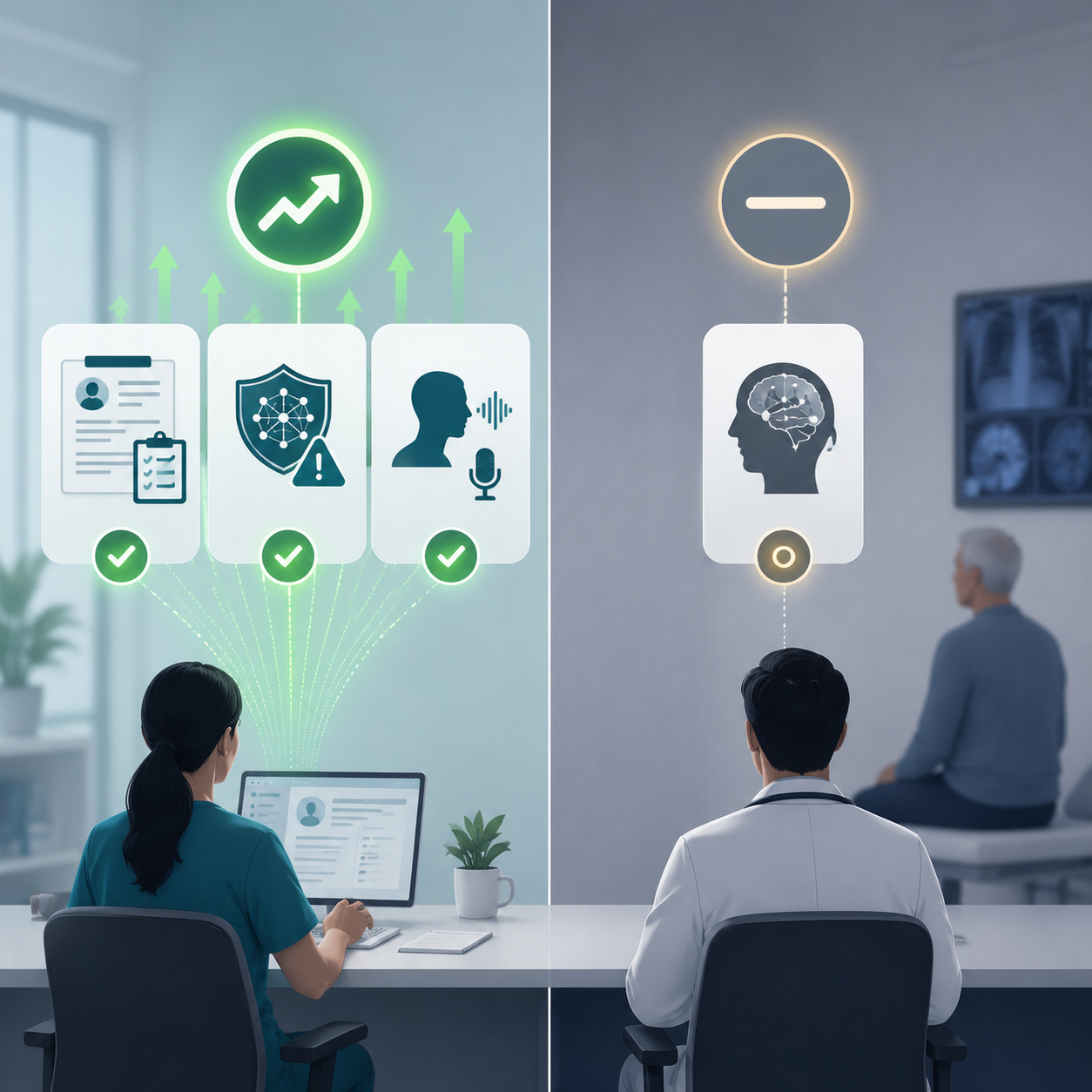
Denial prediction belongs in the same practical category. It does not diagnose the patient, but it can change whether a prior authorization, documentation query, or appeal is handled before a claim fails. The people who feel that outcome are not only revenue-cycle teams. Clinicians feel it when care is delayed, patients feel it when coverage is uncertain, and operational leaders feel it when avoidable rework piles up.
The caveat is important: the adoption and ROI figures come from a survey of 120 health systems cited through a secondary review, so they are directional rather than nationally representative proof.[1] They are still useful because they point toward the same pattern visible in many implementations: AI performs best when the task is bounded, the output has a clear recipient, and the next action is operationally obvious.
Workflow AI Becomes More Convincing When It Triggers a Real Action
The more interesting evidence is not that a model predicted something. It is that someone changed what they did because of the prediction. NEJM Catalyst described a machine-learning model that predicted 7-day hospitalization risk among hemodialysis patients; when the prediction triggered targeted interventions, the program was associated with an 8% reduction in hospitalization odds.[2]
That is the level at which healthcare AI starts to matter operationally. A hospitalization-risk score sitting in a dashboard is another signal in a system already drowning in signals. A risk score tied to a defined intervention asks a sharper question: who receives the alert, what can they do today, and how will the team know whether the intervention worked?
A second NEJM Catalyst example is even more mundane, and for that reason more useful. An AI agent used for radiology follow-up identified six times more follow-up cases than an existing structured-macro process.[2] The clinical importance is not that the system sounded intelligent. It found patients who otherwise risked falling through a known crack: recommended follow-up after imaging.
These examples sit between administration and diagnosis. They do not ask AI to replace clinical judgment. They ask it to surface a patient, a gap, or a near-term risk so a human team can act. That is a lower-drama use of AI, but it is often closer to how care actually improves: not through a single brilliant answer, but through fewer missed handoffs.
Diagnostic AI Looks Best When the Task Is Narrow
The evidence for clinical AI is strongest when the model’s job is specific and the input is constrained. Published summaries report narrow AI models reaching about 96% accuracy in diabetic retinopathy detection, AI-assisted mammography achieving 90% to 92% sensitivity with a 20% to 25% false-positive reduction, and DeepRhythmAI ECG monitoring producing a 0.3% false-negative rate compared with 4.4% for human technicians in a Nature study of 14,606 patients.[3]
These are the kinds of use cases that deserve respect. Retinal images, mammograms, and ECG monitoring streams are not simple, but they are bounded. The model is not being asked to absorb the whole patient narrative, reconcile half-complete medication lists, interpret family dynamics, and decide whether the patient can safely wait until morning. It is being asked to perform a defined perceptual or signal-detection task against a measurable comparator.
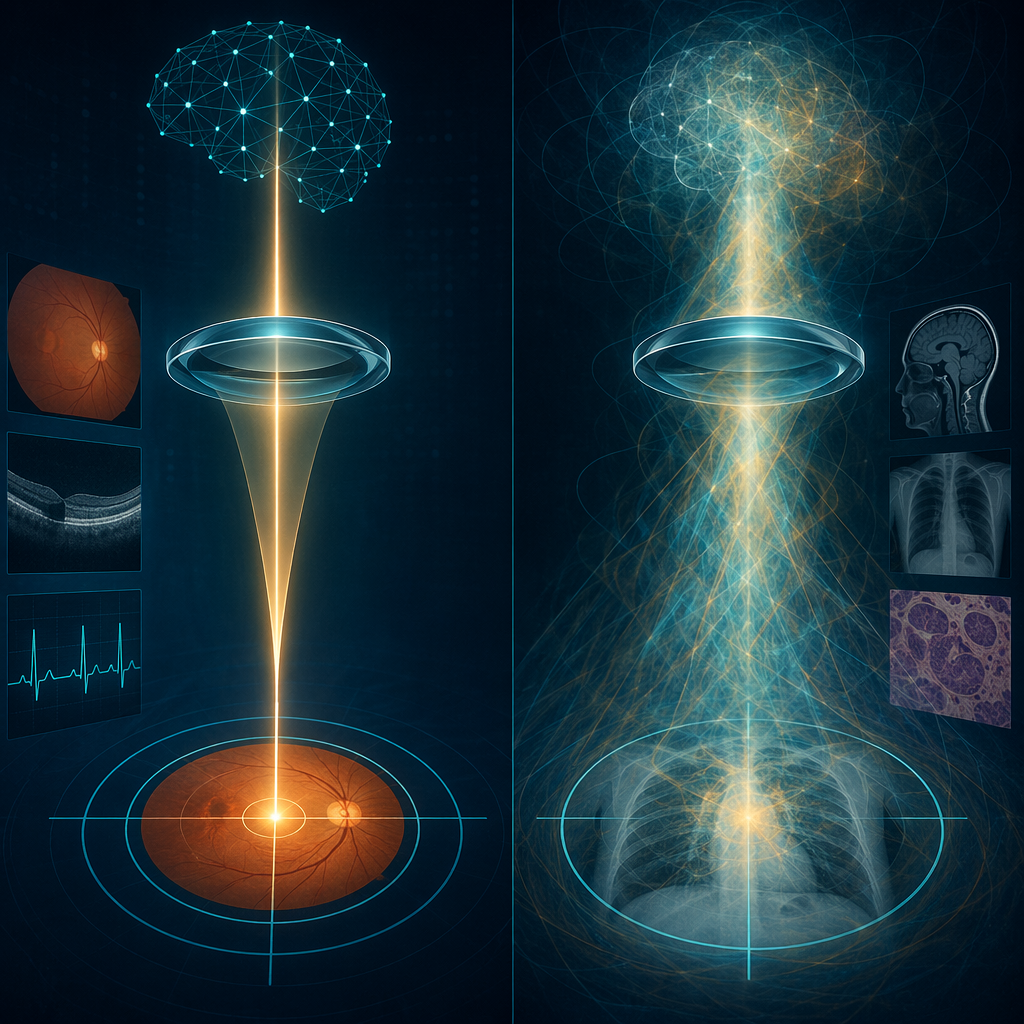
That boundary should not be treated as a weakness. In medicine, bounded competence is valuable. A tool that reliably detects diabetic retinopathy in a screening workflow can expand access and reduce missed disease. A mammography model that preserves sensitivity while reducing false positives can change downstream recalls, biopsies, and patient anxiety. An ECG monitoring system with a very low false-negative rate can alter how teams manage large volumes of rhythm data.
The mistake is to generalize from those successes to “AI diagnosis” as a single category. The evidence does not support that leap. The better conclusion is narrower and more useful: AI can perform extremely well on selected diagnostic tasks when the input, output, comparator, and workflow are well defined.
General-Purpose Clinical AI Still Has a Safety Boundary
General-purpose generative AI is harder to place safely inside care decisions because it behaves less like a calibrated medical device and more like a fluent reasoning interface. That can be useful for drafting, summarizing, translating, or preparing patient-friendly explanations. It becomes more dangerous when the output is treated as triage or diagnosis without a validated workflow around it.
The clearest warning in the 2026 evidence comes from Ramaswamy and colleagues in Nature Medicine. In structured testing of ChatGPT Health, the model undertriaged 51.6% of true emergency cases, including scenarios involving diabetic ketoacidosis and impending respiratory failure that were directed to evaluation within 24 to 48 hours rather than emergency care.[4]
That finding should be read precisely. The study tested a single model, gpt-5-mini thinking, at a single point in time, using clinical vignettes rather than live patient interactions.[4] It does not prove that every future or differently designed system will undertriage at the same rate. It does show why general-purpose medical chat interfaces cannot be waved into high-stakes triage on the basis of fluency, benchmark scores, or user enthusiasm.
The operational concern is not only that the model can be wrong. Clinicians are wrong too. The concern is that the error may arrive wrapped in confident language, outside the EHR, without local governance, without monitoring for drift, and without an obvious accountable owner. That is where shadow AI becomes a patient-safety issue rather than an IT policy annoyance.
Regulatory Records Confirm the Shape of the Field
FDA clearance is not proof that a product will improve outcomes in a specific hospital. It is, however, a useful signal about where medical AI has matured enough to enter regulated device pathways. Innolitics reported 295 FDA-cleared AI/ML-enabled medical devices in 2025, with 71.5% in radiology, 8.8% in cardiovascular medicine, and 4.7% in neurology.[5]
That concentration is not surprising. Radiology has digital inputs, defined interpretation tasks, established worklists, and measurable outputs. Cardiovascular monitoring has similar advantages for certain signal-detection problems. These are places where AI can be shaped into a product with a clear intended use, even if local deployment still requires validation, training, monitoring, and support.
The same Innolitics review reported that 62% of 2025 cleared AI/ML devices were classified as software as a medical device, 10% had predetermined change control plan approval for continuous learning, and the median clearance time was 142 days.[5] Those details matter because they show AI regulation moving from static software review toward the harder problem of how models change after deployment.
Continuous-learning pathways raise the right questions for health systems. Who monitors post-deployment performance? How quickly can bias or drift be detected? What happens when an update changes sensitivity, specificity, or alert volume? A clearance record may get the tool through a regulatory gate, but it does not staff the governance meeting, tune the EHR integration, or answer the malpractice question when a clinician follows a model’s recommendation.
The Hard Part Is Matching the Tool to the Work
The current evidence does not support a simple pro-AI or anti-AI position. It supports a sorting problem. Documentation tools, denial prediction, follow-up agents, risk-triggered interventions, retinal screening, mammography support, and ECG monitoring do not belong in one undifferentiated bucket. They differ in evidence quality, regulatory status, failure mode, user burden, and consequence of error.
A practical evaluation starts with the task. If the task is clerical, the main questions are whether the output saves time, reduces rework, preserves accuracy, and avoids creating new review burden. If the task is clinical prioritization, the questions shift to calibration, alert fatigue, equity across patient groups, and whether a specific team can act on the signal. If the task is diagnosis or triage, the evidence bar rises again: comparator, sensitivity, false negatives, local validation, liability, and override design all matter.
The EHR remains the test that many AI tools underappreciate. A model can be accurate in isolation and still fail because the alert fires after the clinician has moved on, the recommendation lands in the wrong inbox, the note draft invents cleanup work, or the output cannot be audited when a quality team asks what happened. Integration is not a synonym for single sign-on. It means the model fits the sequence of care closely enough that people can use it without building an unofficial workaround.
Market-size estimates add little clarity here because they vary widely depending on what gets counted as healthcare AI. A scheduling chatbot, an FDA-cleared radiology device, a claims model, and a consumer symptom checker may all contribute to the same market story while posing completely different clinical questions. The more useful unit of analysis is the use case.
Mainstream, but Not Yet Deep
AI used in healthcare is now ordinary enough that health systems need governance as much as experimentation. The adoption numbers show that the field has crossed into mainstream use. The ROI data show why documentation and workflow automation have moved quickly. The clinical performance data show that narrow models can be excellent when the task is bounded. The triage evidence shows why general-purpose fluency is not the same thing as clinical safety.
The next phase is less about proving that AI can appear somewhere in care and more about deciding where it deserves to stay. That decision depends on matching task, evidence, regulatory status, workflow constraints, and human accountability. Deployment breadth is real. Reliable value is more concentrated. Deep clinical integration remains the scarce part.
References
- Healthcare AI Adoption 2026: Survey Data, Agentman.ai, 2026.
- NEJM Catalyst article on AI implementation in health care, NEJM Catalyst, 2026.
- AI in Healthcare Statistics, DemandSage.
- Evaluation of ChatGPT Health for clinical triage, Nature Medicine, 2026.
- Year in Review: AI/ML Medical Device 510(k) Clearances, Innolitics, 2026.
Comments
Join the discussion with an anonymous comment.