
The central question for AI in the healthcare industry in 2026 is no longer whether hospitals are using it. They are. Wolters Kluwer reports that about 80% of hospitals are using AI somewhere, while fewer than 20% report sustained high-success use in core clinical diagnosis.[1] That gap is the story: adoption has spread faster than dependable clinical integration.
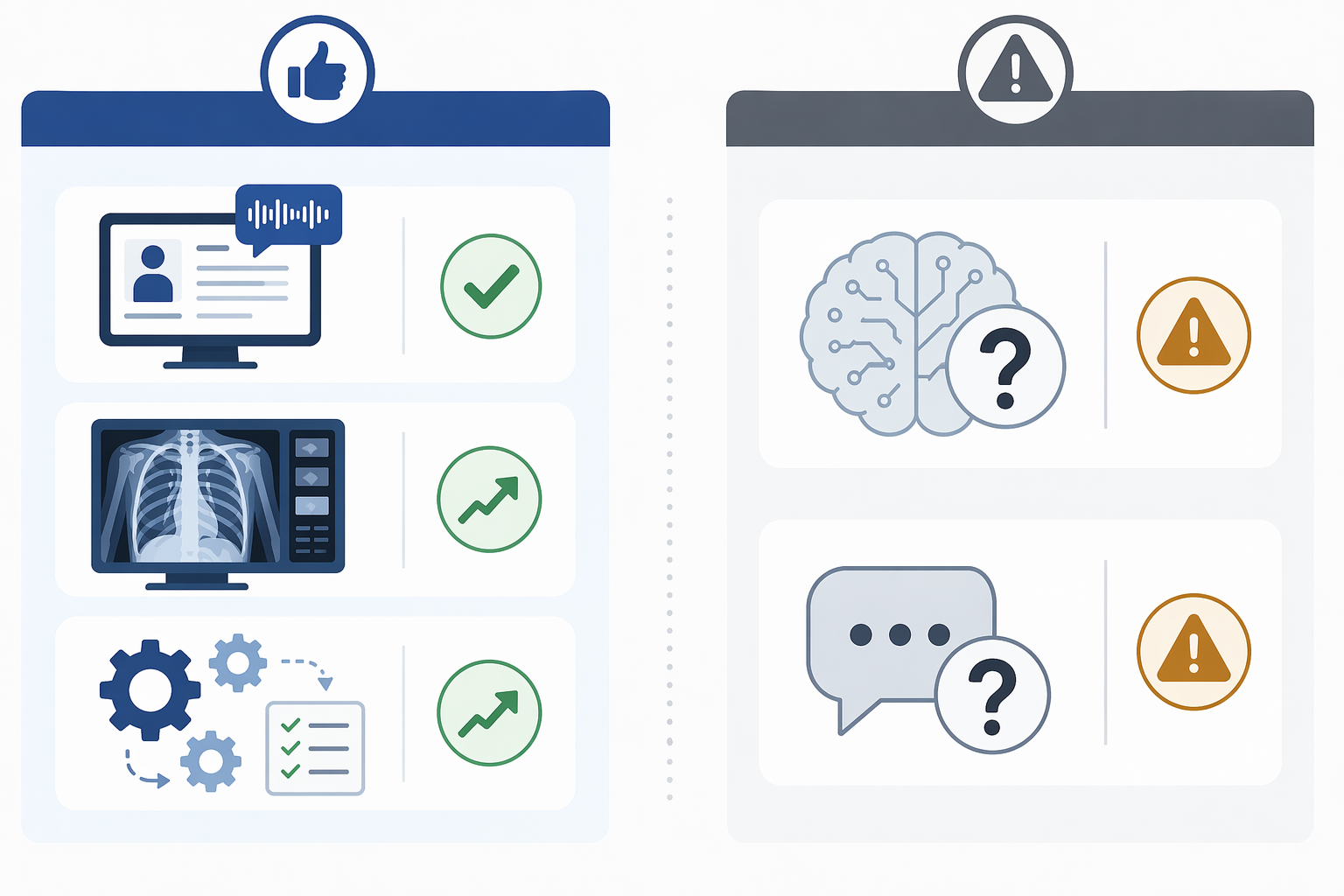
The evidence now separates into two very different classes of tools. On one side are bounded systems that shorten documentation, triage images, flag screening findings, or move revenue cycle work through queues. On the other are broad clinical reasoning tools, especially generative AI used diagnostically, where performance remains far below what health systems should accept for core decision-making.

| AI use case | 2026 evidence signal | What the number actually supports |
|---|---|---|
| AI scribes and documentation | 40-45% reduction in physician documentation time; 25-30% lower error rates[1][2] | Strong case for clinician time recovery and documentation workflow investment |
| Radiology and imaging workflow | Radiology represents 76% of FDA-cleared AI/ML medical devices; reported 25-30% throughput gains[3][4] | Regulatory activity and workflow maturity are strongest in imaging, though throughput figures still need local validation |
| Screening applications | About 96% accuracy for diabetic retinopathy detection; 90-92% sensitivity for breast cancer screening; 20-25% false-positive reduction[4] | Promising evidence for narrow detection tasks, especially where outputs enter a reviewed clinical pathway |
| Revenue cycle automation | 70% reduction in handling time for AI-enabled appeals processes; industry average ROI of 3.2:1 with 12-18 month payback concentrated in workflow and revenue cycle use cases[2][4] | Useful operational case, but industry averages may overrepresent successful adopters |
| Broad generative diagnostic reasoning | Meta-analytic diagnostic accuracy around 50%, comparable to non-expert clinicians and below specialists[5] | Not enough for autonomous or high-stakes diagnostic use without controlled validation |
The Adoption Number Is Too Blunt
A hospital that uses AI for coding assistance, prior authorization, sepsis alerts, radiology triage, chatbot routing, and ambient documentation can truthfully say it has adopted AI. That statement says almost nothing about whether AI is making reliable diagnostic judgments.
This matters because procurement conversations often compress unlike things into one category. A scribe that drafts a note for physician review, a model that prioritizes a chest image in a worklist, and a generative system that proposes a diagnosis are not sitting on the same risk shelf. The closer the system moves toward diagnosis, treatment selection, or clinical reasoning, the more evidence it should carry.
Even adoption surveys need careful handling. NVIDIA’s 2026 survey reports that 70% of organizations are actively using AI, while Wolters Kluwer reports about 80% of hospitals using AI somewhere.[1][2] Those figures are directionally consistent, but they come from different sampling frames and definitions. They should not be treated as interchangeable proof that clinical AI is broadly mature.
Where AI Is Earning Its Budget
The clearest successes share a pattern: the task is narrow, the output is reviewable, and the workflow already has a place for the result. These systems do not need to behave like a senior clinician. They need to remove a step, shorten a queue, surface a likely finding, or reduce avoidable rework.
Documentation: the value is obvious because the burden is obvious
AI scribes are one of the easier 2026 use cases to defend. The work they target is painfully familiar: clinicians finishing notes after visits, reconstructing conversations, correcting templates, and spending high-value time on low-value clerical residue. Reported deployments show 40-45% reductions in physician documentation time and 25-30% lower error rates.[1][2]
That does not mean every scribe implementation will work. Accent recognition, specialty vocabulary, EHR integration, note style, privacy review, and clinician editing habits all affect whether the product survives contact with a real clinic. But the proof burden is different from a diagnostic system. A physician still reviews the note. The tool’s job is to produce a better draft faster, not to decide what disease the patient has.
For health systems trying to reduce burnout pressure, documentation AI has a credible investment case because the measured benefit lands where the pain already is. It gives time back in a place where clinicians can feel the difference by the end of the day.
Radiology: mature does not mean automatic, but it does mean more tested
Radiology remains the most developed clinical AI lane. The Imaging Wire’s March 2026 summary of the FDA AI device list reported 1,451 AI/ML-enabled medical devices, with radiology accounting for 76%, or 1,104 devices; it also noted 295 new clearances in 2025.[3] That concentration is not the same as proof that every cleared tool improves outcomes, but it does show where regulatory activity, vendor specialization, and clinical workflow fit have accumulated.
Radiology AI works best when it behaves like a queue and detection assistant: flagging a suspected finding, prioritizing a study, measuring a structure, or helping a radiologist process volume. Uvik’s 2026 compilation reports 25-30% throughput gains for AI tools in radiology.[4] That figure should be read as a workflow signal, not a universal guarantee. Throughput depends on local staffing, case mix, integration quality, and whether the model adds false alarms that radiologists must chase.
The procurement test is therefore practical. Does the system put the right exams in front of the right reader sooner? Does it reduce a measurable bottleneck? Does it preserve radiologist authority while making the queue less chaotic? If yes, the tool is operating in the part of healthcare AI where evidence and workflow are beginning to align.
Screening: narrow detection can be strong when review is built in
Screening applications sit close to radiology in the evidence map because they ask AI to solve constrained recognition problems. Uvik’s curated 2026 compilation reports about 96% accuracy for diabetic retinopathy detection, 90-92% sensitivity for breast cancer screening, and 20-25% reductions in false positives.[4]
Those numbers are promising, especially in settings where screening backlogs or specialist scarcity create delays. But they still describe specific tasks, not general diagnostic competence. A model that performs well on retinal images or mammography screening is not demonstrating that it can reason through a medically complex patient with overlapping symptoms, missing history, and uncertain lab findings.
The better framing is assisted detection inside a governed pathway. The model flags. The clinician reviews. The program monitors false positives, false negatives, equity effects, and downstream workload. That is less glamorous than autonomous diagnosis, but it is closer to how dependable healthcare AI actually reaches patients.
Revenue cycle automation: operational evidence is useful, not sacred
Revenue cycle AI is not as clinically dramatic as image interpretation, but it is often easier to measure. Appeals handling time, denial rework, coding queues, authorization status, and payment delays are operationally visible. Uvik’s compilation reports a 70% reduction in handling time for AI-enabled appeals processes.[4]
Industry ROI figures also look strongest in these workflow-heavy areas. NVIDIA’s 2026 survey and cross-referenced industry compilations report an average 3.2:1 return on healthcare AI investments, with typical payback periods of 12-18 months, concentrated in workflow and revenue cycle rather than direct diagnosis.[2][4]
Those figures should help build a business case, not end the discussion. Industry surveys can overrepresent organizations with successful deployments, mature data infrastructure, or stronger vendor relationships. A hospital with messy payer rules, fragmented EHR workflows, or weak change management should not assume it will inherit the average. Still, when the target is a defined administrative bottleneck and the outcome is measurable in days, minutes, dollars, or rework rates, AI has a much cleaner path to accountability.
Where the Evidence Still Does Not Carry the Claim
Broad generative clinical reasoning is where the language around AI becomes most expensive. The models can produce fluent explanations, differential diagnoses, patient-facing summaries, and care suggestions. Fluency is useful for drafting and communication. It is not the same as dependable clinical judgment.
The current evidence does not support treating general-purpose generative AI as a substitute for specialist diagnostic reasoning. Nature Medicine’s April 2026 editorial context cites meta-analytic diagnostic accuracy around 50%, comparable to non-expert clinicians and well below specialists.[5] That is not a rounding error. It is the difference between an assistive experiment and a tool that can be trusted near the center of diagnosis.
This does not make generative AI useless in clinical environments. It may still support soft-ROI use cases: summarizing records, preparing visit notes, explaining discharge instructions, drafting patient messages, or helping staff navigate information. But those uses need to be described honestly. They are workflow and communication aids, not proof that the system can reason safely across open-ended medical uncertainty.
The mistake is to let a successful bounded deployment lend credibility to an unbounded one. A hospital may have excellent results with ambient documentation and still have no evidence that a general model should guide diagnostic decisions in complex cases. The shared label “AI” hides that distinction.
The Trust Gap Is Not Just Patient Skepticism
Public behavior is moving quickly. Wolters Kluwer reports that 52% of patients use AI for health research and 74% trust AI answers.[1] That trust creates real pressure on clinicians, because patients may arrive with confident AI-generated interpretations before a clinician has reviewed the chart.
Clinicians are not simply resisting change. The same survey reports that 77% of clinicians validate AI outputs because of bias and hallucination concerns.[1] That validation work is a safety behavior, but it can also become a hidden labor cost. A tool that saves five minutes in one step and creates eight minutes of checking, explaining, or correcting in another has not improved the workday.
Trust, then, is not a public relations problem to be solved with adoption messaging. It is an operational property. The system earns trust when its errors are visible, its output is reviewable, its intended use is narrow, and its performance is monitored after deployment.
How Health Systems Should Read the 2026 Evidence
The practical split is not “clinical AI” versus “administrative AI.” Some clinical tools are well bounded and measurable; some administrative tools are poorly implemented and expensive. The stronger dividing line is whether the task, evidence, and workflow match.
- Fund first where the task is narrow: documentation drafting, imaging triage, screening detection, appeals handling, coding support, and queue management.
- Demand local validation where the outcome affects clinical prioritization, specialist workload, or patient follow-up.
- Treat ROI averages as planning inputs, not promises, especially when they come from industry surveys or curated compilations.
- Keep generative clinical reasoning in controlled evaluation unless the use case is assistive, reviewed, and clearly separated from autonomous diagnosis.
- Do not use hospital-wide AI adoption as a proxy for readiness in diagnosis, treatment planning, or complex clinical decision support.
Market-size estimates are not much help for these decisions. Healthcare AI estimates vary widely because analysts define “AI” differently, fold in different software categories, and mix mature workflow tools with speculative clinical applications. A market forecast cannot tell a radiology chair whether a triage model will reduce turnaround time in her department, or tell a chief medical officer whether a generative diagnostic assistant is safe enough for scale.
The discipline in 2026 is proportional evidence. A tool that drafts a note can be judged by time saved, edit burden, clinician acceptance, and documentation quality. A tool that affects diagnostic reasoning needs a higher standard: controlled evaluation, subgroup performance, failure-mode analysis, clinician oversight, and post-deployment monitoring.
AI in healthcare delivers when the task is narrow, measurable, and embedded in a workflow that knows what to do with the output. It underdelivers when institutions ask it to perform broad clinical judgment before the evidence has caught up.
References
- How AI Is Transforming Healthcare in 2026, Wolters Kluwer
- Survey Reveals AI Is Delivering Clear Return on Investment in Healthcare, NVIDIA Blog
- FDA Updates AI List with New Clearances, The Imaging Wire, March 2026
- AI in Healthcare Statistics 2026: 80+ Key Data Points, Uvik Software
- Show us the evidence for the value of medical AI, Nature Medicine, April 2026
Comments
Join the discussion with an anonymous comment.