
AI in sports injury diagnosis and recovery is already present at several points where clinical teams make consequential decisions: reading MRI studies, estimating injury risk from movement and sensor data, and monitoring rehabilitation before a return-to-play discussion. The harder question is not whether a model can classify an image or detect a risky movement pattern. It is whether that output changes the care pathway in a way that reduces missed injuries, prevents reinjury, or supports a safer return to sport compared with standard care.
That distinction matters because the pathway is not a single handoff. An athlete may move from imaging to clinical examination, from a sideline or training-room judgment to a rehab plan, and then into a clearance conversation where uncertainty is shared unevenly. A high AUC in one phase can be useful, but it does not automatically settle the next phase.
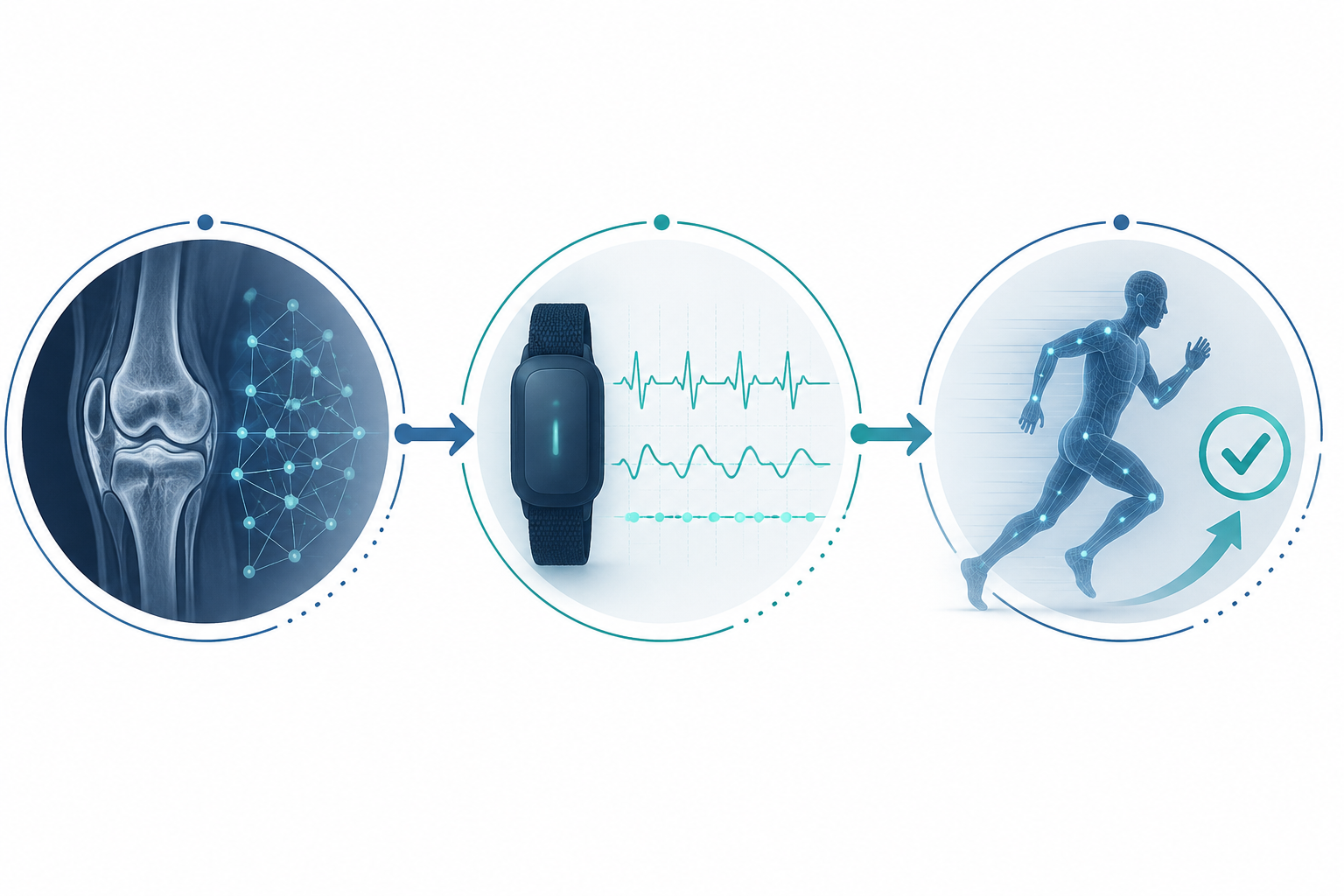
Where AI Enters the Injury Care Pathway
The most clinically recognizable entry point is diagnostic imaging. Convolutional neural networks have been studied for detecting injuries such as ACL tears, rotator cuff pathology, and meniscal tears on MRI, with some reports describing performance comparable to musculoskeletal radiologists for ACL tear detection on knee MRI.[1] That is a familiar use case: a model reviews an image, flags a likely abnormality, and may function as a second reader or triage tool.
The second entry point is risk prediction. Here, the input is less stable than an MRI series. Wearable sensors, inertial measurement units, surface electromyography, force or motion data, training load, and athlete history can all become model inputs. The intended clinical action also differs: the model is not confirming an existing tear; it is estimating whether a movement state, fatigue pattern, or exposure profile suggests elevated risk before an injury occurs.
The third entry point is rehabilitation and return-to-play support. AI systems may generate or adapt exercise programs, quantify asymmetry, track joint-angle recovery, or simulate biomechanically plausible motion. This is the phase where patient adherence, coaching context, tissue healing, sport demand, and clinician judgment collide most directly. It is also where a technically impressive model can look least decisive if it has not been tested against outcomes that matter to clearance decisions.
Diagnostic Imaging Has the Clearest Clinical Fit
Imaging AI benefits from a relatively well-defined task. The scan exists, the target abnormality is visible or not visible, and the model can be compared with radiologist interpretation. That does not make implementation simple, but it gives the evidence a cleaner shape than many prevention or return-to-play studies.
One recent framework, BINN with adaptive spatial memory search, reported an AUC of 0.912 on the MURA musculoskeletal radiograph dataset.[2] The result is a useful anchor because it shows that modern architectures can extract clinically meaningful musculoskeletal imaging patterns rather than merely performing well on generic computer-vision benchmarks. Still, the sports injury relevance should be read carefully: the study’s direct sports-injury-specific validation was limited, and its broader benchmarking included general-purpose computer-vision datasets.[2]
The practical promise is not that AI replaces a radiologist in a sports medicine workflow. The more plausible near-term role is prioritization, second-read support, consistency checking, or assistance in settings where subspecialty expertise is limited. A missed meniscal tear, an equivocal partial-thickness rotator cuff injury, or an ACL graft concern does not become less consequential because a model was involved; if anything, the model adds another object that must be interpreted, documented, and defended.
The central limitation is external validity. A 2026 scoping review of 59 studies found that many sports injury imaging models were trained on single-institution or single-sequence datasets, with multicenter validation still limited.[3] That is not a small technical footnote. MRI protocols vary, scanners vary, field strength varies, and image quality varies with the athlete and the clinical setting. A model that performs well on one institution’s knee MRI sequence may not behave the same way on another scanner, in another population, or after a protocol change.
For clinicians, that makes diagnostic imaging AI most credible when it is deployed within a narrow, validated indication. The question should be specific: this anatomy, this modality, this sequence range, this patient population, this reporting workflow. Broad claims about musculoskeletal AI are less useful than knowing whether the tool was tested on images resembling the ones actually arriving in the reading queue.
Risk Prediction Is Powerful, but Fragile Outside the Test Setting
Injury risk prediction is where AI can feel most compelling. It aims to move the care pathway upstream, before the ligament ruptures or the overuse injury declares itself. It also asks models to do something much harder than classify a completed image: identify a changing risk state in a moving athlete, often using signals collected in noisy training environments.
A 2026 Scientific Reports study using a hybrid IMU-sEMG long short-term memory model reported 92.3% accuracy and an AUC of 0.93 for real-time injury-risk classification. The same study reported that the system detected risk precursors 1.4 to 2.6 seconds before expert visual detection in 78% of cases.[4] Those numbers are clinically interesting because they point to a possible role at the edge of practice: alerting a clinician, coach, or athlete before a risky pattern becomes obvious to the eye.
But the study population matters. The wearable study enrolled 50 athletes from a single stadium in Pakistan, with gender imbalance and limited ethnic diversity noted as constraints on generalizability.[4] That does not invalidate the result. It does mean the result should not be casually stretched to professional teams, adolescent athletes, female ACL-risk populations, or post-operative return-to-sport cohorts without further validation.
Other risk-prediction work is more modest. A Random Forest model for lower-extremity musculoskeletal injury risk in student athletes achieved 79% accuracy.[5] That kind of performance may still be useful depending on the intervention threshold and clinical context, but it is not the same as a reliable prevention system. Even within ACL-related prediction research, some models have reported AUC values below 0.70, which is a reminder that the field contains both impressive demonstrations and models with limited discriminative utility.[3]
Device dependence is one of the most important deployment problems. A 2026 report found that integrating data across five different devices caused a performance drop greater than 25%.[6] In a research lab, the sensor, placement protocol, sampling rate, and preprocessing pipeline can be controlled. In routine sport, devices change, firmware changes, athletes wear sensors imperfectly, and clubs may already have existing vendor contracts. A model that degrades when the data source changes is not ready to carry prevention decisions across settings.
| Pathway phase | What AI is trying to do | Evidence signal | Main clinical caution |
|---|---|---|---|
| Diagnostic imaging | Detect or flag musculoskeletal injury patterns on MRI or radiographs | CNNs reported comparable performance to MSK radiologists for some MRI tasks; BINN reported AUC 0.912 on MURA | Single-institution and single-sequence training limits generalization |
| Risk prediction | Classify risky movement states or injury precursors from wearable and movement data | Hybrid IMU-sEMG LSTM reported 92.3% accuracy and AUC 0.93 | Performance may drop across devices, populations, and uncontrolled sport settings |
| Rehabilitation and return-to-play | Personalize exercises, generate motion, and track recovery metrics | Wearable pilots and generative biomechanics models show feasibility | No head-to-head RCT evidence yet proves reduced reinjury or safer return-to-play |
Rehabilitation AI Is Promising, but the Endpoint Is Still the Problem
Rehabilitation is attractive territory for AI because it produces repeated measurements. A clinician may see an athlete during scheduled visits, but wearables can observe movement more often. A model can track joint angles, asymmetry, loading patterns, or exercise completion over time. In principle, that creates a more responsive rehab plan than a static protocol.
Generative biomechanics adds another layer. UC San Diego’s BIGE model was described in 2025 as generating physically realistic exercise motions for training and rehabilitation.[7] That is a meaningful technical capability because rehabilitation is not just a list of exercises; it depends on movement quality, constraints, and progression. A generative model that can produce plausible motion may help test, simulate, or personalize exercise options before they are prescribed.
The clinical leap is larger than the technical one. A motion can be biomechanically plausible and still not be the right prescription for a particular athlete after meniscal repair, hamstring strain, shoulder instability, or ACL reconstruction. Tissue status, pain response, sport demands, surgical restrictions, fear of movement, and adherence all sit between model output and safe progression.
Wearable rehabilitation pilots show why the area deserves attention without proving the full return-to-play case. In the same Alzahrani et al. study, a pilot rehabilitation component reported muscle force balance improvement from 21.3% baseline asymmetry to 4.2% after 2 weeks, and joint angle recovery from 83.5 degrees to 102.7 degrees over 3 weeks.[4] Those are useful recovery measures, but they are not equivalent to proving faster safe return to play, lower reinjury rates, or better long-term function.
A 2024 Diagnostics review described machine learning and deep learning approaches as both predictive and prescriptive tools for personalized rehabilitation planning.[8] That framing is reasonable as a description of capability. It should not be mistaken for proof that AI-directed plans outperform skilled physiotherapy, criteria-based progression, or multidisciplinary return-to-sport assessment in controlled trials.
Return-to-Play Decisions Need More Than Better Monitoring
Return-to-play is where the pathway becomes most exposed. The athlete may feel ready, the coach may be waiting, the imaging may look reassuring or ambiguous, strength numbers may be improving, and the clinician still has to decide whether the residual risk is acceptable. AI can add measurements to that discussion, but measurement is not the same as clearance.
As of Q3 2026, the evidence boundary is clear: no head-to-head randomized controlled trial has shown that AI-driven rehabilitation or return-to-play interventions reduce reinjury rates or accelerate safe return to sport compared with standard care.[3][8] That absence matters more than any single wearable accuracy figure, because return-to-play decisions are judged by downstream consequences. A model that identifies asymmetry may help a physiotherapist adjust exercises; it does not, by itself, establish that the athlete should resume competition.
The clinically sensible role today is adjunctive. AI-derived metrics can support conversations about movement quality, workload progression, or persistent deficits. They can help document why a rehab plan changed. They may help identify athletes who need closer follow-up. But when the final decision concerns exposure to contact, cutting, sprinting, throwing volume, or competitive load, responsibility remains with the clinical team using the model as one input among many.
Regulation, Liability, and Data Do Not Yet Fit the Whole Pathway
The care pathway cuts across product categories that are regulated and governed differently. An imaging decision-support tool, a consumer-grade wearable, a team performance dashboard, and a rehab exercise generator may all affect the same athlete’s care, but they do not necessarily pass through the same regulatory channel or produce data in compatible formats.
That fragmentation creates a familiar clinical problem: the output may look integrated to the athlete and the team, while accountability remains fragmented for everyone else. If a model-generated risk alert is ignored, who is responsible? If a false reassurance contributes to premature clearance, does liability rest with the clinician, the institution, the software developer, the wearable vendor, or the team that configured the system?
Legal commentary summarized in sports medicine literature has argued that clinicians currently bear liability for AI-assisted decisions even when they rely on AI tools, while some scholars have proposed recognizing a duty of care for software developers.[1] That proposal may fit the reality of AI-supported care better than placing the entire burden on the clinician at the end of the pathway, but it is not yet a settled operating rule for sports medicine teams.
Privacy is equally unsettled. U.S. college athlete biometric data have been reported as shared with commercial partners without explicit consent and without clear HIPAA protection.[1] The clinical relevance is direct: injury-risk models and rehabilitation dashboards often depend on the same biometric and workload data that teams, vendors, and institutions may want to use for performance, recruitment, or commercial analytics. Medical use and nonmedical use can become difficult to separate once the data stream exists.
Interoperability is not a purely administrative inconvenience. If model performance drops when device inputs change, if imaging outputs do not connect to rehab platforms, or if return-to-play dashboards cannot show how risk scores were generated, clinicians are left reconciling disconnected signals. The weakest link may not be the algorithm; it may be the handoff between systems.
What Clinicians Should Ask Before Adoption
The useful adoption question is narrow. It is not whether AI belongs in sports medicine. It is whether a specific tool has been validated for the specific decision it is being asked to support, in a setting close enough to the one where it will be used.
- For imaging tools, ask whether validation included external sites, scanner variation, relevant anatomy, and the same clinical workflow in which the model will operate.
- For injury-risk tools, ask whether the model was tested across devices, athlete populations, sport settings, and data-quality conditions likely to occur outside the development study.
- For rehabilitation tools, ask whether the endpoint is a surrogate measure such as joint angle or asymmetry, or a clinical outcome such as reinjury, function, adherence, or safe return to sport.
- For return-to-play support, ask who reviews the AI output, how disagreement with clinical judgment is documented, and who carries responsibility if the decision contributes to harm.
- For any athlete data system, ask who owns the biometric data, who can share it, whether explicit consent is required, and whether the data may be used beyond care.
Industry estimates may describe rapid commercial interest in AI sports technology, including a reported market estimate of $2.25 billion in 2026.[9] That figure is useful only as a signal of investment activity. It is not evidence that clinical outcomes have improved, that return-to-play decisions are safer, or that models have been validated across the messy settings in which athletes are actually treated.
AI is already clinically relevant in parts of sports injury diagnosis and recovery. Imaging tools can support detection tasks, wearable models can identify risk patterns earlier than visual assessment in selected settings, and rehabilitation systems can quantify or generate movement in ways that may help clinicians personalize care. The pathway as a whole, however, is not yet an integrated, outcomes-proven AI system. Until reinjury reduction, safe return-to-play, external validation, liability, and data governance are handled with the same seriousness as model performance, AI should be adopted as decision support rather than as a pathway-level solution.
References
- Artificial intelligence and sports injuries. Sports Injury Bulletin. https://www.sportsinjurybulletin.com
- BINN: Brain-Inspired Neural Network with adaptive spatial memory search for medical image classification. Scientific Reports. 2025. doi:10.1038/s41598-025-20580-y
- Artificial intelligence in sports injury diagnosis: a scoping review. International Journal of Medical Informatics. 2026. International Journal of Medical Informatics
- Hybrid IMU-sEMG LSTM model for real-time sports injury risk detection and rehabilitation monitoring. Scientific Reports. 2026. doi:10.1038/s41598-025-34551-w
- Machine learning to predict lower-extremity musculoskeletal injury risk in student athletes. Frontiers in Sports and Active Living. 2020. Frontiers in Sports and Active Living
- Data integration across wearable devices in AI-based sports injury prediction. 2026. doi:10.1080/07853890.2026.2658879
- BIGE generates physically realistic exercise motions for training and rehabilitation. UC San Diego Today. Oct 2025. today.ucsd.edu
- Artificial intelligence in rehabilitation medicine: machine learning and deep learning as predictive and prescriptive tools. Diagnostics. 2024. Diagnostics 14(22):2516
- Sports Technology Market Report. Research and Markets. 2026. Research and Markets
Comments
Join the discussion with an anonymous comment.