
By July 21, 2026, the U.S. cyclosporiasis investigation had reached more than 1,645 confirmed cases across 34 states, with 94 hospitalizations and no single contamination source identified. The CDC’s outbreak update and Health Alert Network notice gave clinicians and public health agencies the familiar instructions: test when symptoms fit, report cases, preserve traceback information, and keep looking upstream. The last identified distribution link included Taco Bell/Taylor Farms, but that is not the same thing as knowing where Cyclospora entered the food chain.[1][2]
That unresolved gap is the right place to ask whether AI in indoor farming to prevent Cyclospora contamination is a serious food-safety intervention or just another controlled-environment sales pitch. The useful question is not whether indoor farms look cleaner than fields. It is whether an AI-monitored controlled environment can interrupt the organism’s preferred route into produce before a recall, a restaurant cluster, or a multi-state case count has to reveal the failure.
Cyclospora Is a Water and Time Problem Before It Is a Traceback Problem
Cyclospora cayetanensis is awkward for produce systems because the human-to-food pathway does not behave like a simple person-to-person outbreak. Oocysts shed in feces are not immediately infectious; they need an environmental sporulation period, commonly described as about 1 to 2 weeks, before they can infect another person. The organism is transmitted through the fecal-oral route, and contaminated water is a central vehicle for moving oocysts onto crops.[3]
That delay matters. It means the highest-risk events can occur away from the consumer and long before the salad reaches a refrigerator. A field can be exposed through irrigation water, runoff, worker sanitation failures, or contaminated environmental water, and the crop may not look different. Once oocysts are on delicate fresh produce, post-harvest washing is a weak place to be placing all the confidence.
The infective dose is another uncomfortable detail. Reviews of major outbreaks describe a low infective dose, with fewer than 10 oocysts potentially sufficient to cause infection. That does not leave much room for a system that only notices trouble after a batch has moved through harvesting, commingling, cutting, packing, distribution, and food service.[3]
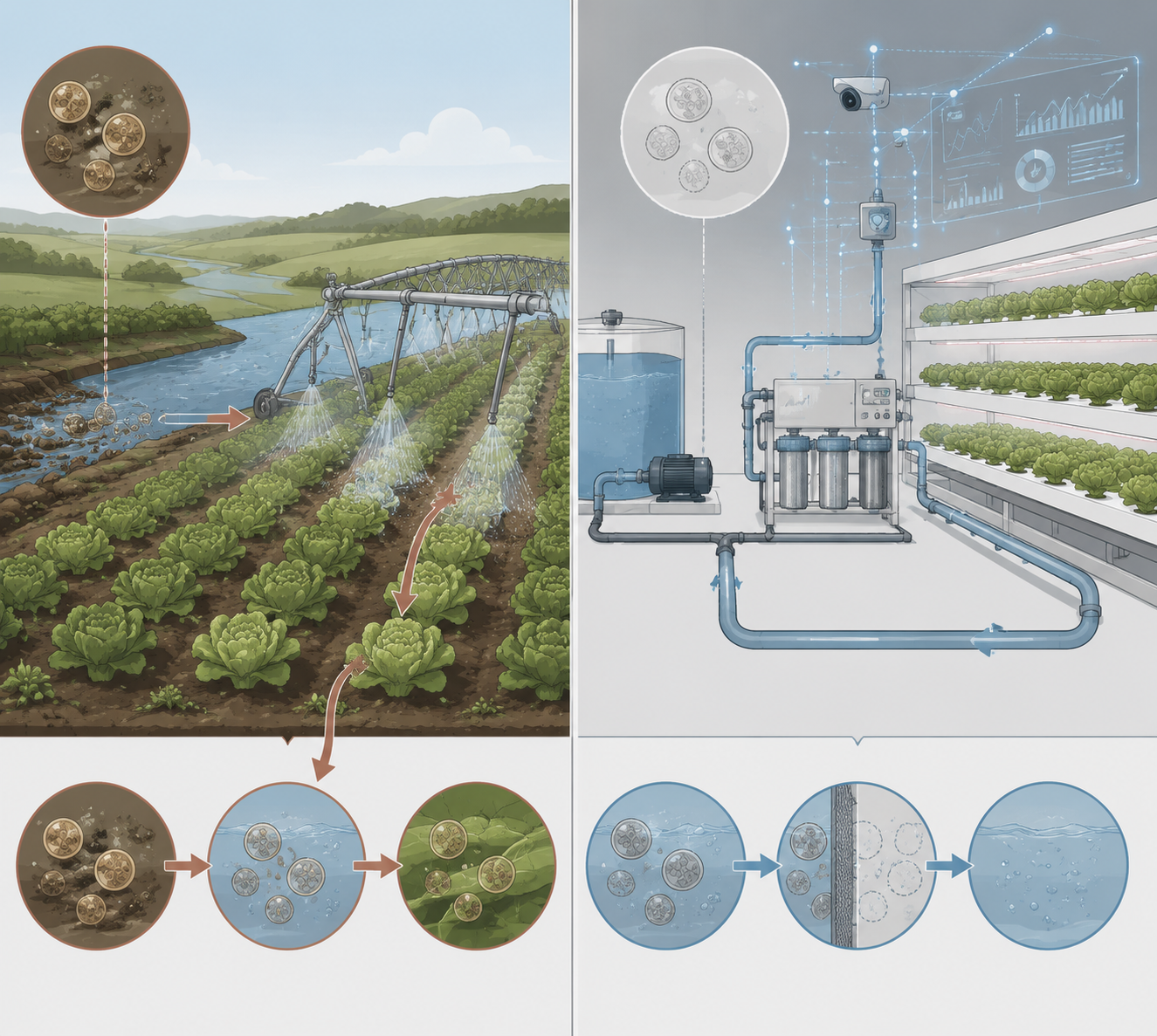
Open-field farming has many controls, and good growers do not simply hope for the best. The structural problem is that the field is open by design. Water sources, weather, soil contact, adjacent land use, human activity, and animal intrusion can all become part of the risk environment. When an outbreak is already underway, investigators often have to reconstruct a long, distributed chain from patient interviews, restaurant records, supplier records, and product movement. The 2026 investigation shows how much time can pass while the critical entry point remains uncertain.[1][2]
Controlled environment agriculture changes the geometry of that problem. A vertical farm or greenhouse using treated, recirculated water is not immune to contamination, but it can remove some of Cyclospora’s best opportunities: untreated surface water, field runoff, soil splash, and uncontrolled environmental fecal exposure. That is the prevention claim worth examining. If it is true, the value of AI is not that it makes lettuce futuristic. It is that it can watch the failure points continuously enough to catch drift before the crop becomes the evidence.
Where AI Actually Adds Something
A closed facility without disciplined monitoring can become a beautifully lit blind spot. The AI layer matters only where it makes the system less dependent on occasional sampling, delayed lab results, or logs filled out after a shift has gone badly. For Cyclospora prevention, the strongest use case begins with water.
| Control layer | What it can reduce | What it does not prove |
|---|---|---|
| Closed-loop treated water | Exposure to untreated irrigation water, runoff, and uncontrolled field water sources | That contamination cannot enter through equipment, workers, seed, inputs, or protocol failures |
| AI water-quality monitoring | Delayed recognition of physicochemical or microbial changes that suggest contamination risk | Cyclospora-specific detection unless the system has validated organism-specific assays |
| Biosensor integration | Dependence on slow, centralized testing for every warning signal | Commercial-scale performance for Cyclospora in produce facilities |
| Automated controls and alerts | Human delay after an abnormal reading | Operator compliance with shutdowns, sanitation, and product-hold decisions |
Recent food-safety AI work describes machine-learning models, including Random Forest and XGBoost approaches, trained on physicochemical and microbial water parameters to predict protozoan contamination with more than 85% accuracy. That evidence is not a Cyclospora field trial. It is proxy evidence using water-quality signals and related protozoan contamination problems. Still, it points to the kind of surveillance that indoor farming can operationalize: continuous data streams from water systems rather than sporadic checks after exposure may already have occurred.[4]
In practice, the useful model is not a dashboard that tells managers the farm is generally healthy. It is a system that watches pH, turbidity, conductivity, temperature, disinfectant residuals, microbial indicators, flow anomalies, filter performance, and other water signals together; learns what normal looks like for that facility; and flags combinations that deserve immediate action. A single reading may be explainable. A pattern of drift is harder to dismiss.
That distinction is important for public health. Outbreak investigations are often forced to work backward from illness. AI water monitoring is valuable only if it lets an operator work forward from a warning: hold a crop lot, divert water through treatment, replace a filter, inspect a reservoir, check worker sanitation, or stop harvest until the abnormal condition is resolved. Detection that does not change behavior is documentation, not prevention.
From Proxy Signals to Direct Detection
The next layer is more direct organism detection. A 2023 review of waterborne protozoa sensing technologies describes electrochemical aptasensors, microfluidic impedance cytometry capable of single-cell oocyst discrimination, and smartphone-integrated colorimetric sensors with reported detection limits reaching 5 μM in the reviewed sensor context. These are not plug-and-play proof that a commercial farm can catch Cyclospora every time. They do show that detection is moving toward faster, smaller, more integrable tools than the old model of sampling, shipping, waiting, and hoping the sample represented the risk.[5]
Cyclospora itself remains hard to detect in irrigation water. Research on detection methods has emphasized the difficulty of recovering and identifying the organism from water samples, including the need for concentration and molecular methods. That should keep the discussion honest. A water-monitoring AI model may warn that conditions resemble known contamination risk; it does not automatically prove that Cyclospora is present unless a validated assay says so.[6]
The practical path is layered: AI screens continuously for abnormal water conditions; targeted biosensors or molecular assays investigate the warning; automated controls prevent suspect water from reaching crops; and the quality team documents the decision. Each layer is weaker alone. Together, they start to address the part of Cyclospora control that open-field systems struggle with most: knowing about a water problem early enough to keep it from becoming a produce problem.
Closed-Loop Controls Have to Be More Than Alerts
Indoor farming already uses sensors, automation, and AI to manage light, climate, irrigation, nutrient dosing, and crop conditions. Reviews of IoT and AI-driven vertical farming describe sensor networks and control systems as core parts of modern production, not decorative add-ons.[7] For food safety, the same architecture is useful only when an abnormal signal has a defined consequence.
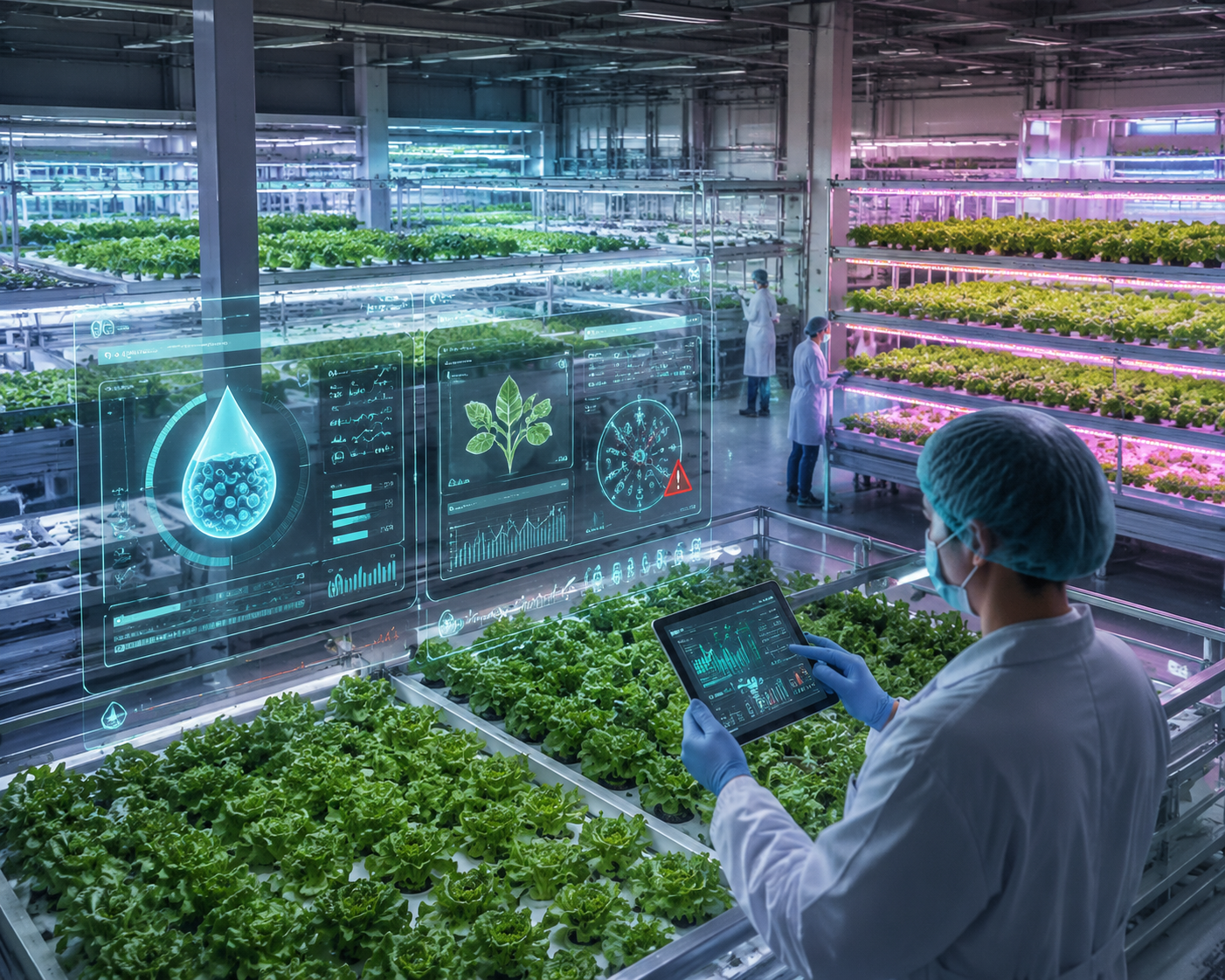
A credible Cyclospora prevention system would not simply display a yellow warning next to a reservoir icon. It would have thresholds and escalation rules: increase treatment, isolate a loop, stop irrigation to a zone, hold affected lots, require supervisor sign-off, and preserve the data trail. The alarm should make it harder to keep producing as if nothing happened.
This is where “controlled environment” earns or loses its meaning. A controlled environment is not controlled because it has walls and LEDs. It is controlled when the system knows what should be happening, notices when it is not happening, and prevents people from quietly routing around the inconvenient parts. In a public health investigation, a beautiful facility with incomplete logs is just another facility with incomplete logs.
Industry food-safety statements from the CEA sector emphasize features that are genuinely relevant to Cyclospora risk: enclosed production, filtered and treated water, limited animal intrusion, worker hygiene controls, and traceable production lots. Those are meaningful advantages over an exposed field environment, but they are design claims until they are matched by monitoring records, sanitation verification, and corrective actions that can survive scrutiny after an outbreak.[8]
What the Evidence Can and Cannot Say About Cyclospora
The strongest case for AI-integrated indoor farming is structural. Cyclospora needs fecal contamination, environmental time, and a route onto food. Open-field fresh produce can provide that route through contaminated irrigation water or environmental exposure. CEA can narrow those routes by using treated recirculating water, enclosed production, sanitation barriers, and shorter, more traceable supply chains. AI can make those barriers less passive by detecting drift and forcing earlier intervention.
The weaker case would be claiming that AI has already been proven to prevent Cyclospora outbreaks in commercial indoor farms. The research brief does not support that. The available machine-learning evidence is largely based on proxy protozoa such as Cryptosporidium and Giardia or on broader food-safety water monitoring, not Cyclospora-specific controlled trials in CEA facilities.[4] The sensing literature shows promising detection technologies for waterborne protozoa, but it does not remove the need for organism-specific validation under commercial conditions.[5][6]
That limitation does not make the prevention argument empty. Public health decisions often have to distinguish between direct proof and a strong mechanism. Here, the mechanism is unusually relevant: if the main recurring hazard is contaminated water reaching produce before anyone knows it, then a closed, monitored, treated water system addresses the route more directly than trying to wash the problem off later.
But mechanism is not a warranty. A farm can have sensors and still ignore alarms. A water loop can be closed and still contaminated. A treatment system can be installed and poorly maintained. A model can be accurate in a study and badly tuned to a particular facility. A low false-alarm threshold can exhaust operators until they stop trusting it; a high threshold can miss the slow drift that mattered. The people who live with the system decide whether the data becomes prevention or noise.
The BrightFarms Lesson
The necessary counterexample is BrightFarms. In 2021, a Salmonella outbreak was linked to packaged salad greens from an indoor CEA facility, with irrigation water identified as part of the problem in the outbreak analysis summarized by vertical farming industry coverage.[9] Salmonella is not Cyclospora, and a single outbreak does not define the safety profile of an entire production model. It does, however, puncture the lazy version of the argument.
An indoor farm can still create a waterborne contamination event if water management, sanitation, environmental monitoring, or corrective action fails. The walls do not disinfect the reservoir. Automation does not guarantee that a filter was changed, a line was cleaned, a contaminated input was excluded, or a positive result triggered a product hold. If anything, the closed system can spread a problem efficiently when the contaminated loop keeps feeding crops.
That is why AI belongs in the operational protocol, not in the marketing copy. The system has to define who receives the alert, who has authority to stop production, how long a lot remains on hold, what confirmatory testing is required, which sanitation steps are mandatory, and when the line can restart. Without those decisions, “real-time monitoring” can become a phrase that sounds reassuring while everyone waits for someone else to act.
The Narrow Claim That Holds
The 2026 outbreak makes the central problem visible: by the time cyclosporiasis cases accumulate across states, investigators may still be trying to locate the point where contaminated water, produce, handling, distribution, and food service intersected.[1][2] AI-integrated CEA offers a different prevention posture. It can reduce reliance on exposed irrigation sources, shrink the environmental entry points, monitor water continuously, and connect abnormal conditions to automated controls and documented corrective action.
That is enough to take seriously. It is not enough to declare the problem solved. The evidence supports a narrower judgment: AI-monitored indoor farming can structurally reduce Cyclospora risk by blocking the organism’s main transmission pathways and detecting water-system drift earlier than conventional field-to-wash controls. The claim is strongest when the facility uses treated closed-loop water, validated monitoring, enforceable alarms, hygiene controls, and lot-level traceability. It weakens quickly when any of those pieces becomes optional.
References
- CDC Investigation Update, CDC, July 2026, https://www.cdc.gov/cyclosporiasis/outbreaks/07-26/investigation.html
- CDC Health Advisory HAN00531, CDC, https://www.cdc.gov/han/php/notices/han00531.html
- Cyclospora Cayetanensis Major Outbreaks Review, PMC, 2020, https://pmc.ncbi.nlm.nih.gov/articles/PMC7699734/
- AI-Powered Innovations in Food Safety, PMC, 2025, https://pmc.ncbi.nlm.nih.gov/articles/PMC12154576/
- Protozoan Detection Sensing Technologies, Frontiers in Microbiology, 2023, https://pmc.ncbi.nlm.nih.gov/articles/PMC9999019/
- Detection of Cyclospora in Irrigation Water, PMC, 2021, https://pmc.ncbi.nlm.nih.gov/articles/PMC7930117/
- IoT and AI-Driven Technologies in Vertical Farming, Heliyon, 2024, https://www.sciencedirect.com/science/article/pii/S2405844024110298
- CEA Alliance Indoor Farming Food Safety, GPN, https://gpnmag.com/news/cea-alliance-indoor-farming-food-safety-cyclospora/
- Cyclospora outbreak analysis, Vertical Farming Blog, https://verticalfarming.blog/cyclospora-outbreak-vertical-farming-2026/
Comments
Join the discussion with an anonymous comment.