The most useful recent development in AI for Legionella prevention in home water systems is not a chatbot, a dashboard, or a promise that software can “find” bacteria in a pipe. It is a water heater.
In July 2026, the National Institute of Standards and Technology announced a patented heat-exchanger water heater design that sends incoming water through a high-temperature zone near the heating element, where it is pasteurized at 70 C (160 F), then cools it before it leaves the unit for use at the tap. NIST says the design can be built from an off-the-shelf water heater with about $100 in added components and that the 70 C zone kills nearly all Legionella almost instantly.[1]
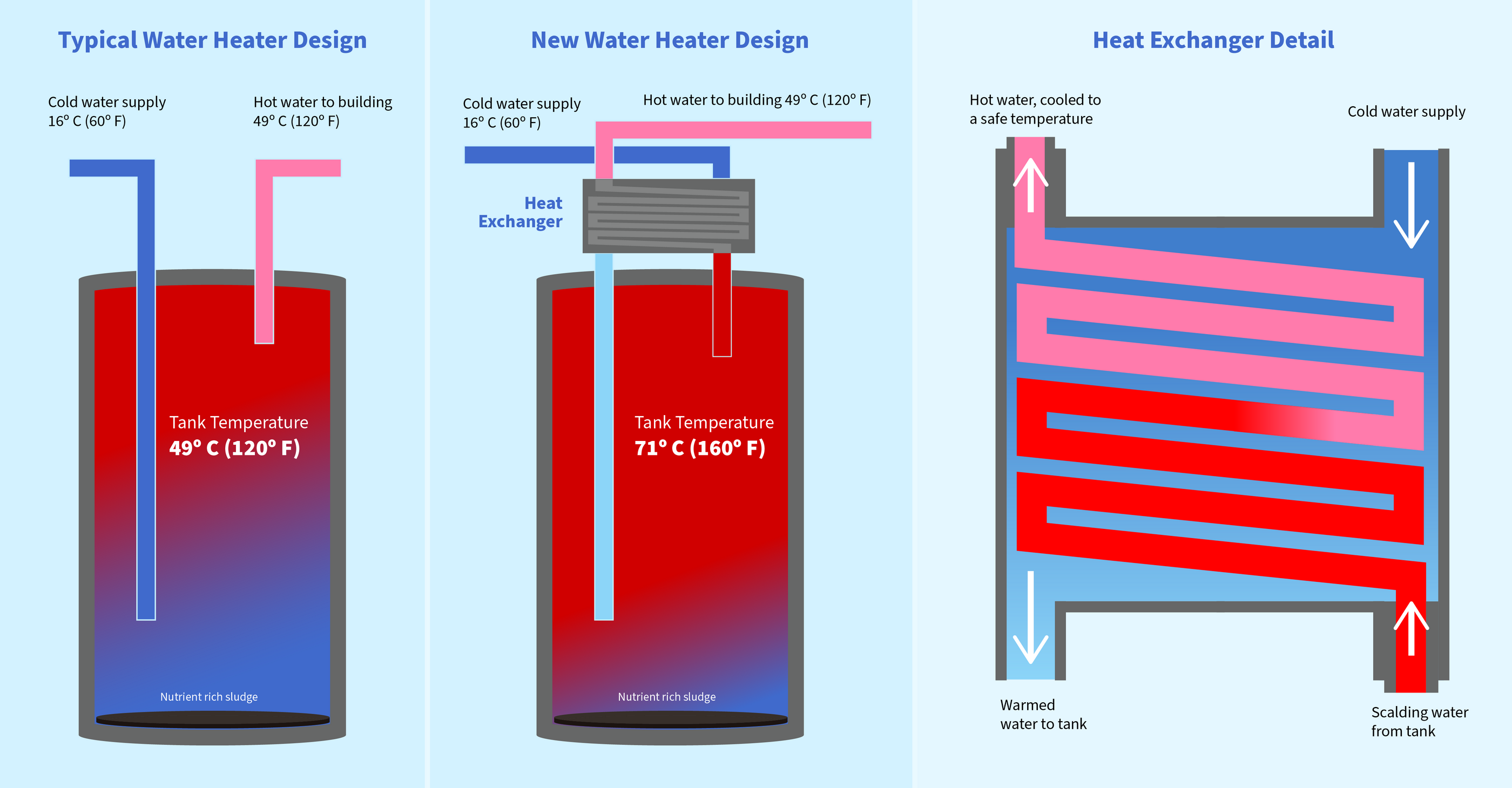
That is an engineering answer to a microbiological problem: change the thermal conditions in the appliance before trying to interpret risk downstream. It also explains where AI fits best. Smart monitoring is most valuable when it watches whether the system is continuing to behave as intended after installation, after seasonal changes, after plumbing modifications, after long periods of low use, and after the first few years when the owner has stopped thinking about the equipment.
The serious question is therefore narrower than the phrase “AI for Legionella prevention in home water systems” sometimes suggests. The question is not whether an algorithm can certify that a home water system is free of Legionella. The current evidence does not support that. The practical question is whether smart heaters, IoT sensors, and predictive models can make risky water conditions visible early enough for someone to intervene before the only remaining options are delayed lab results, broad flushing, emergency disinfection, or post-incident review.
What continuous monitoring changes
Traditional Legionella control depends heavily on a water management plan, periodic measurements, maintenance records, sampling decisions, and the judgment of the people responsible for the system. In a hospital, senior living facility, hotel, or large apartment building, that can mean a real program with assigned duties. In a single-family home, it is more often scattered across appliance settings, plumbing design, occasional maintenance, and whether anyone notices that a guest bathroom has not been used for weeks.
Continuous monitoring changes the shape of that work. Instead of a technician taking a temperature at one fixture on one morning, temperature sensors can collect readings as frequently as every 30 seconds. Flow data can show whether a branch is being used or sitting idle. Biocide and pH measurements, where applicable, add more context. Historical patterns show whether a system usually recovers quickly after a draw or whether it spends long periods in the 20-45 C range where Legionella growth is favored.
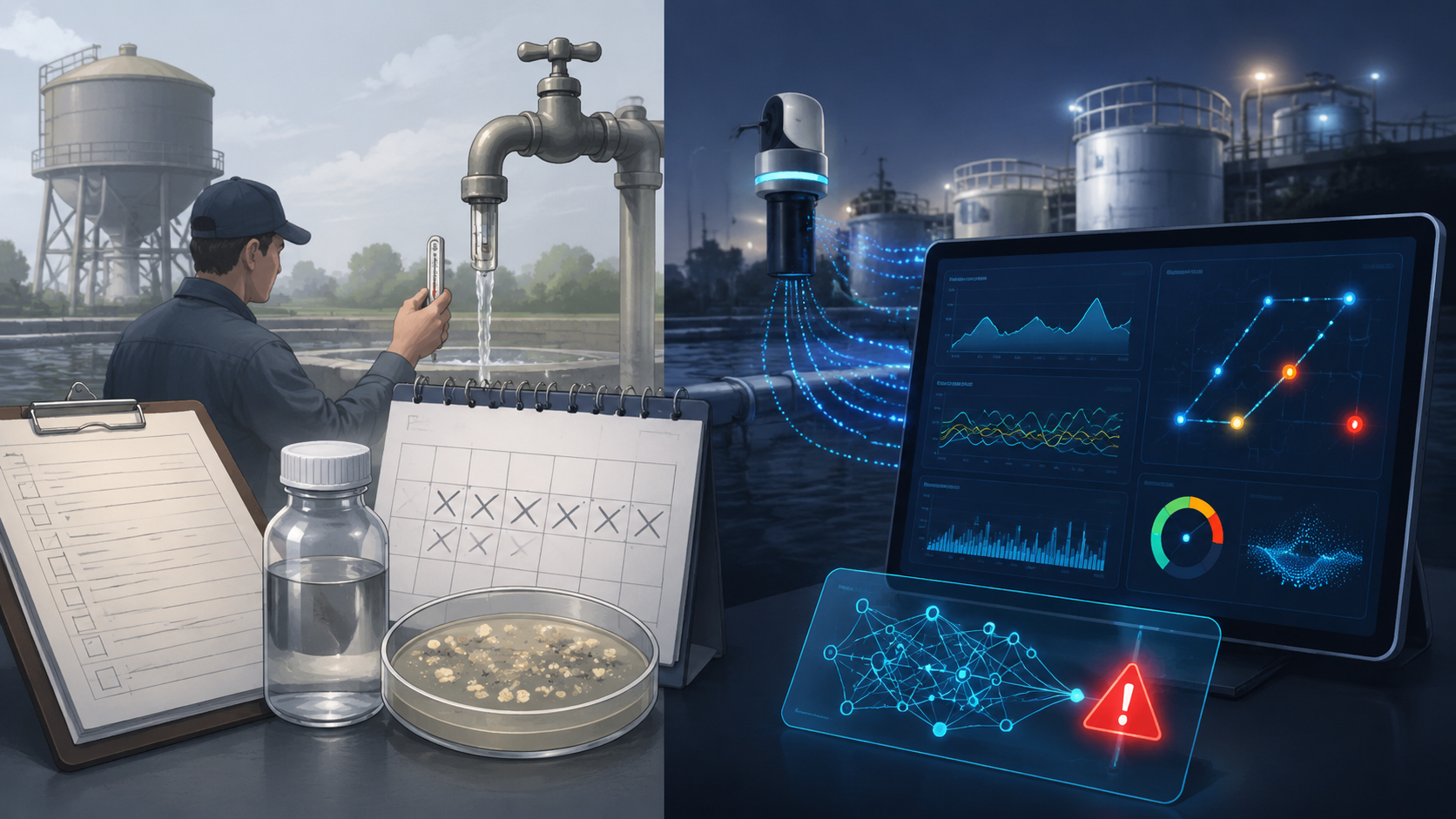
| Snapshot-based management | Continuous risk surveillance |
|---|---|
| A measurement captures one point in time. | A sensor stream shows how the system behaves across use cycles, low-use periods, and recovery. |
| Culture results can arrive after a delay. | Risk flags can appear when proxy conditions drift in the wrong direction. |
| A normal reading may miss intermittent stagnation or temperature decay. | Trends can reveal repeated time in the 20-45 C growth range. |
| The operator reacts to scheduled checks, complaints, or results. | The operator receives prompts to inspect, flush, adjust, sample, or escalate. |
The word “prompt” matters. A risk signal is not a diagnosis. It is a reason to ask what changed: a failed mixing valve, a poorly insulated recirculation loop, a rarely used outlet, a water heater setpoint that drifted, a control valve stuck in the wrong position, a sensor out of calibration, or an occupancy pattern the original plumbing assumptions did not anticipate.
What the model can infer, and what it cannot
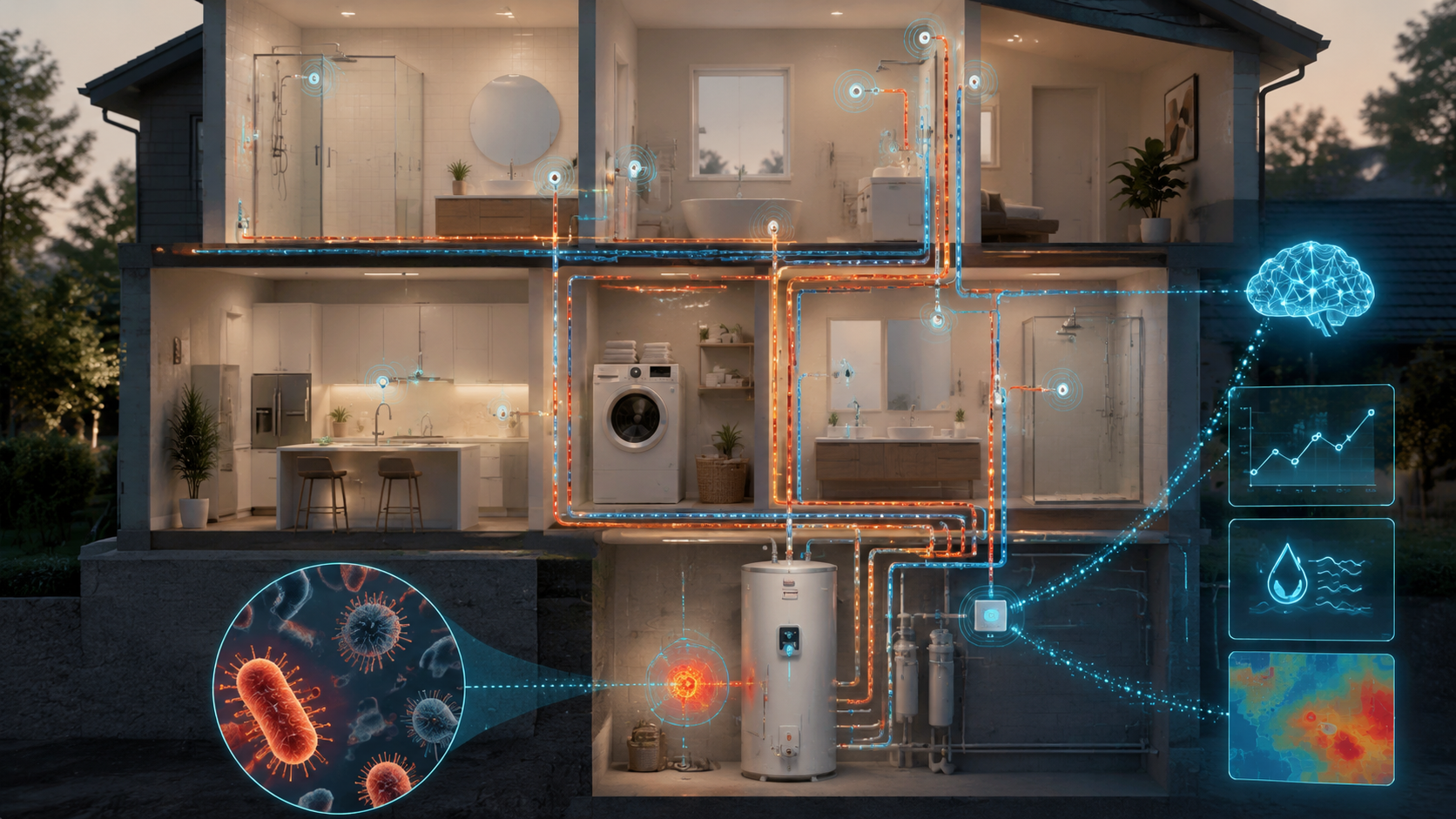
A predictive model for Legionella risk usually works from proxies. Temperature is the obvious one. Stagnation is another, inferred from flow or lack of flow. Depending on the system, the model may also incorporate disinfectant residual, pH, fixture location, tank behavior, recirculation performance, maintenance history, and previous sampling results.
That kind of model can notice patterns a person would struggle to see in a spreadsheet. It can flag a distal outlet that repeatedly cools into the risk range overnight. It can show that a tank reaches a safe setpoint but leaves a zone of cooler water after recovery. It can detect that a loop behaves normally on weekdays but sits differently over long weekends. In a large residential building or care environment, those signals can move a team from calendar-based attention to condition-based attention.
It still does not mean the model has detected Legionella. Unless a system is using a validated microbiological test, it is predicting conditions associated with risk. That distinction is not academic. If a dashboard says “high risk,” the next step is not to assume contamination; it is to verify the engineering condition, check the sensor, review recent use, compare against the water management plan, and decide whether the response should be flushing, temperature correction, maintenance, sampling, disinfection, or a temporary control measure.
The same caution applies in the other direction. A “low risk” display should not become permission to ignore a control plan. Models are only as good as their sensor placement, calibration, assumptions, and training data. A system that does not measure a dead leg, a poorly used shower, or a failed local control cannot reason its way into seeing it.
The strongest evidence is still mostly from larger systems
The home-water promise is real enough to examine, but the validation base is uneven. The NIST heater is directly relevant to residential equipment because it starts with a familiar appliance and modifies water movement through the tank. The AI and IoT evidence, by contrast, is stronger in settings that have more instrumentation, more complex plumbing, clearer maintenance roles, and higher consequences when control fails: hospitals, commercial buildings, nursing homes, and other large facilities.
One useful proof of concept predates today’s cloud dashboards. In 2014, researchers described NARA, a neuro-fuzzy system tested in a real hot water distribution system. The system predicted water temperature profiles with more than 97% accuracy within +/-0.5 C, allowing operators to identify areas of a hot water tank that could be at risk.[2]
That study does not prove that a 2026 home AI product prevents Legionella. It proves something narrower and still important: temperature behavior inside a hot water system can be modeled with enough precision to help operators see risk-relevant zones they might otherwise miss. The hardware, data infrastructure, and user interface have changed since then. The operational logic has not changed nearly as much.
More recent machine-learning work continues in the same direction: using environmental and operational variables to predict conditions favorable to growth rather than claiming direct organism detection. The limitation is not a small print issue; it is the central purchasing and governance issue. Before a facilities team treats an alert as actionable, it needs to know what the model was trained on, what system types were represented, how sensor error is handled, what threshold triggers a warning, and whether the workflow produces auditable actions rather than just a colored tile on a screen.
Where this fits in an actual water safety workflow
In a well-run facility, AI monitoring should sit inside the water management program, not beside it. The program defines control locations, acceptable ranges, response thresholds, roles, documentation, and escalation. The monitoring layer makes departures from expected behavior easier to see.
A practical workflow looks less like autonomous control and more like disciplined triage:
- Sensor reports repeated time in the 20-45 C range at a monitored outlet or loop segment.
- The platform compares the pattern with historical behavior and current flow.
- A risk flag is generated because the condition persists, recurs, or coincides with low use.
- A responsible person verifies the reading, checks the local equipment, and reviews recent occupancy or maintenance changes.
- The response is documented: flushing, temperature adjustment, valve repair, heater service, targeted sampling, or escalation under the water management plan.
That sequence is where the technology earns its keep. It can reduce the time between a system drifting and a person noticing. It can also reduce wasted effort by showing whether a problem is isolated, recurring, or system-wide. But it does not remove the need for the person who knows which valve is upstream, which wing has been vacant, which renovation changed the pipe path, and which patient or resident population changes the acceptable level of conservatism.
Single-family homes are the hard case
The phrase “home water systems” covers very different realities. A single-family house with one water heater, short pipe runs, and a few fixtures is not the same as a high-rise apartment building, assisted living residence, or condominium complex with storage tanks, recirculation loops, mixed-use occupancy, maintenance contractors, and vulnerable residents.
The case for AI monitoring is strongest as the system becomes larger, more complex, or harder to observe manually. In multi-unit housing, senior residential settings, and mixed residential-care environments, continuous monitoring can expose patterns that scheduled checks miss. In a typical single-family home, the value proposition is less settled. The system may not have enough sensors, enough risk events, or enough professional oversight to turn a risk score into a reliable prevention program.
That does not make smart residential equipment irrelevant. The NIST design is important because it addresses the appliance directly rather than assuming every homeowner will behave like a trained facility operator. A heater that pasteurizes water before delivery, if commercialized and properly installed, could build a control step into ordinary residential infrastructure. Add simple monitoring that warns when temperatures, usage, or equipment behavior fall outside expected limits, and the home system becomes more observable without pretending the homeowner is running a hospital-grade water program.
What buyers should ask before trusting the dashboard
The purchasing conversation should start with the control plan, not the animation on the screen. A vendor should be able to explain exactly what is measured, where sensors are installed, how often data is captured, how calibration is maintained, and what the alert thresholds mean. If the platform uses a model, the buyer should ask what outcome it predicts: temperature decay, stagnation, disinfectant loss, biofilm-favorable conditions, or confirmed Legionella occurrence. Those are not interchangeable.
- Does the system identify risk conditions or claim direct Legionella detection?
- Which sensors are required, and how are they calibrated and replaced?
- What happens when a sensor fails, drifts, or reports an implausible value?
- Are alert thresholds configurable to the building’s water management plan?
- Can the platform preserve an audit trail of alerts, investigations, corrective actions, and closeout?
- Has the model been validated in systems resembling this building, or only in larger commercial or institutional settings?
The best systems make uncertainty visible. They show raw trends as well as scores. They allow the operator to see why an alert fired. They support documentation. They make it easier to follow a standard, not easier to avoid one.
The reasonable conclusion
AI, IoT sensors, and smarter water-heating hardware can make home and residential water systems safer by making hidden behavior visible sooner. A heater design that pasteurizes water at 70 C before cooling it for use attacks the thermal condition directly.[1] Continuous monitoring can then watch whether temperatures, flow, and related variables are drifting toward risk. Predictive models can turn those streams into earlier warnings than a program built only on periodic checks and delayed microbiological results.
The boundary is just as clear. Current AI systems are best understood as surveillance and decision-support tools. They predict proxy conditions, not microbiological certainty. The strongest validation remains closer to complex building systems than ordinary single-family homes. For hospitals, senior living environments, multifamily buildings, and other residential systems with real operational oversight, that can still be a meaningful advance. For everyone else, the technology is useful only if it leads to better control actions: verified temperatures, corrected stagnation, maintained equipment, targeted sampling when needed, and a water safety program that someone competent still owns.
References
- NIST Receives New Patent for Microbe-Killing Water Heater, National Institute of Standards and Technology, July 2026.
- Artificial Intelligence in Legionella Risk Management, International Journal of Environmental Research and Public Health, 2014.
Comments
Join the discussion with an anonymous comment.