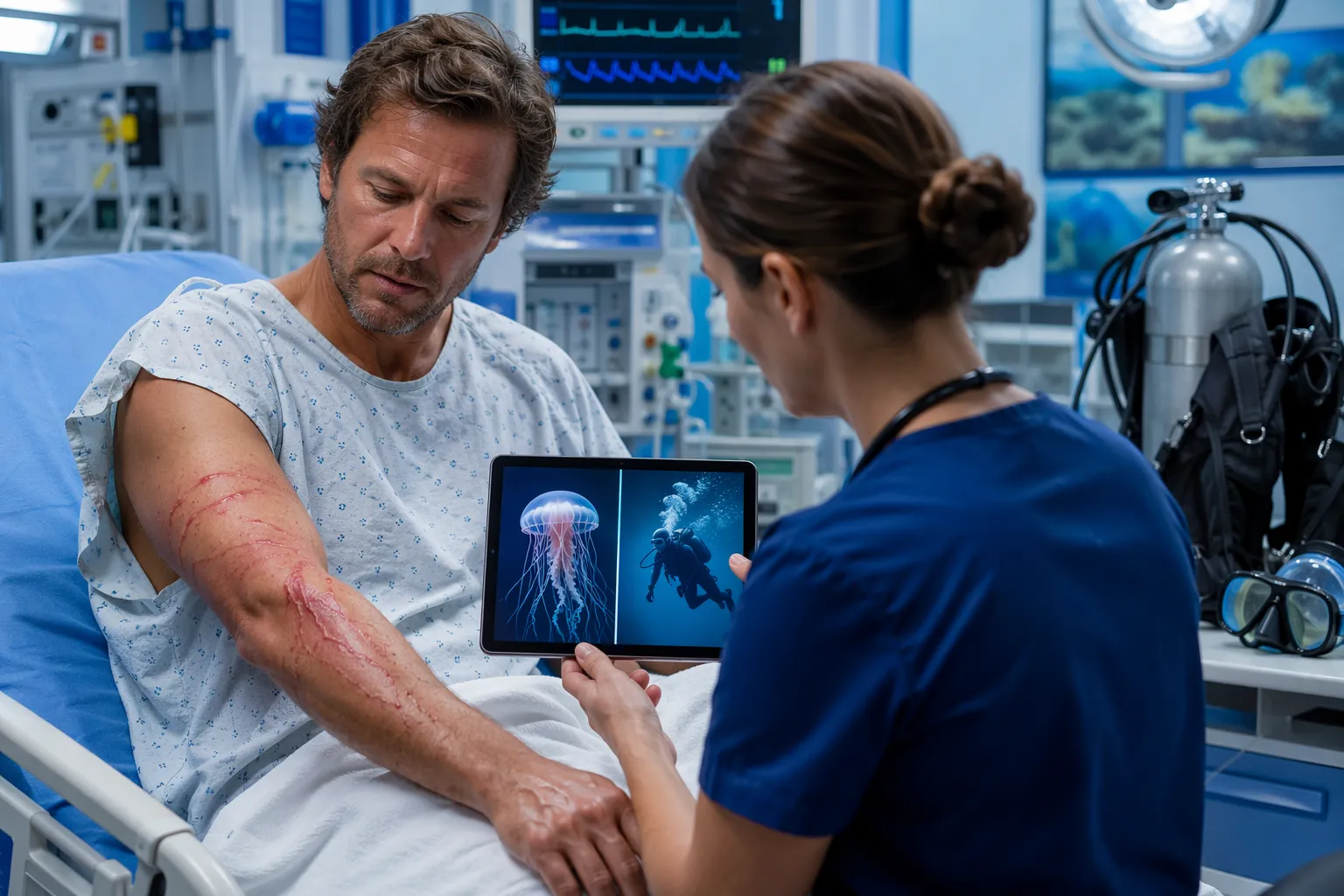
The hard part of lion's mane jellyfish sting first aid is not always the rinse or the heat source. It is the earlier moment when the presentation has not yet declared itself. In Orkney waters, five divers with lion's mane jellyfish envenomation were initially suspected of having decompression sickness; two were recompressed before the diagnosis was recognized as jellyfish sting injury.[1] That is the kind of error pathway where a clinical decision support system would have to prove its worth: not after the organism is known and the protocol is obvious, but while a diver, rescuer, or emergency clinician is still deciding which branch of care is safest.
Species identity matters because jellyfish first aid is not a single universal maneuver. A protocol that is sensible for one cnidarian can be unhelpful, or potentially harmful, for another. The evidence is also uneven: some recommendations rest on consensus-level synthesis of small and heterogeneous studies, while species-specific laboratory findings can point in a different direction. AI can look attractive in that gap, especially if it helps shorten the path from messy exposure history to a safer first action. But the question is narrower than whether AI can be used in toxicology. It is whether AI can be trusted at the point where a lion's mane sting is still only one competing diagnosis.
The useful AI question starts before the protocol
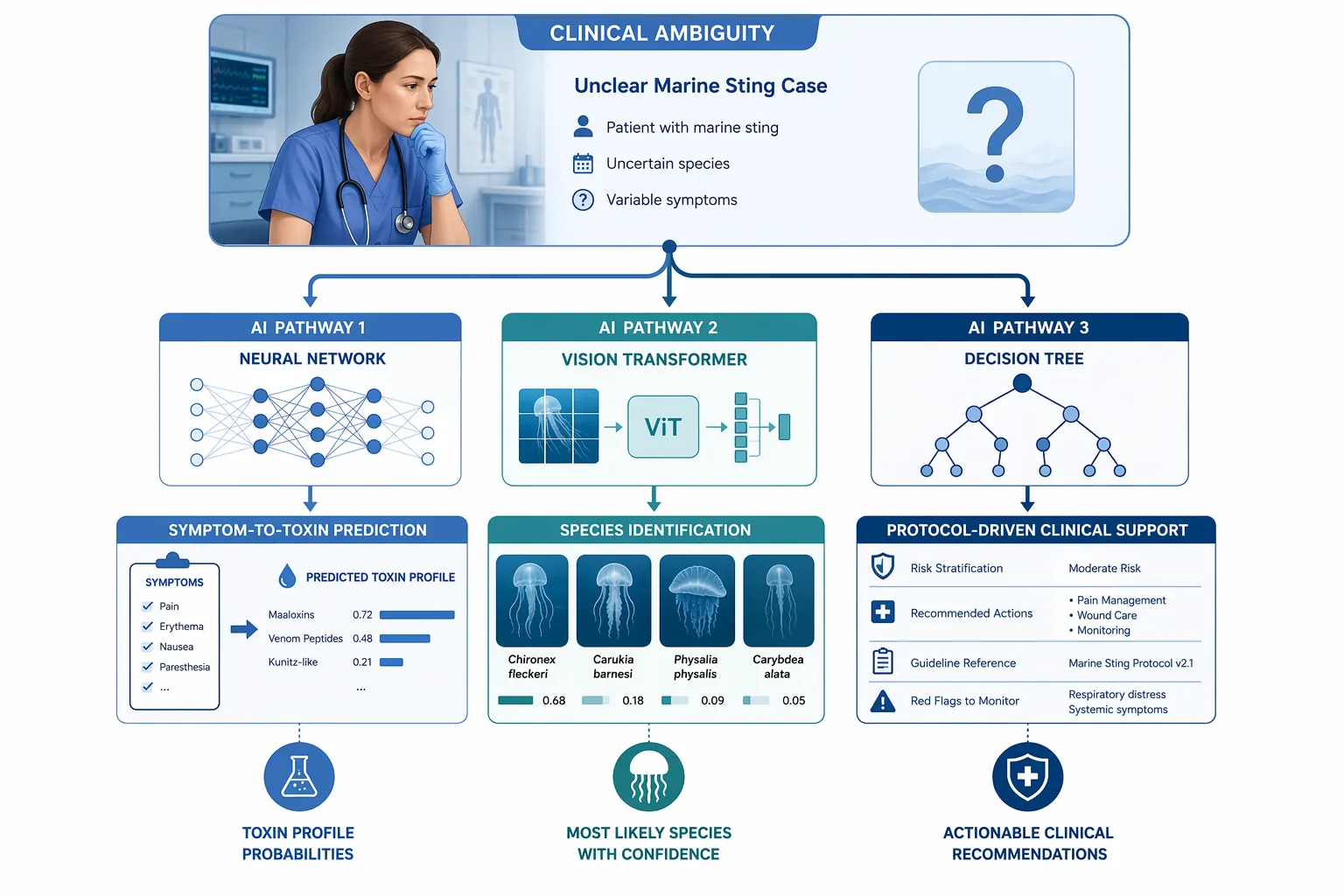
A clinician facing a possible marine envenomation usually needs help with three related but different tasks. The first is syndrome recognition: do the symptoms fit a toxic exposure pattern, a diving injury, an allergic reaction, trauma, or something else? The second is vector or species identification: was the patient exposed to lion's mane jellyfish, another jellyfish, Portuguese man o' war, a box jellyfish, or an organism that was never seen clearly? The third is protocol selection: once the organism and setting are sufficiently likely, which first-aid steps should be prompted, discouraged, or escalated?
Those tasks map onto three AI pathways already visible in emergency toxicology: symptom-to-toxin prediction, image-based organism recognition, and protocol-driven clinical decision support. None of those pathways currently amounts to a validated lion's mane jellyfish sting first aid tool. The evidence is still indirect. But the indirect evidence is strong enough to define what should be studied, and where a deployment claim would be premature.
Symptom-to-toxin prediction is the strongest analogy
ToxNet is clinically interesting because it starts from the same kind of uncomfortable premise that emergency toxicology often starts from: the exposure may be unknown. Zellner and colleagues trained a graph attention network on 781,278 real poison center calls from the Munich Poison Information Center, using symptoms to predict the intoxicant. For a 10-substance classification task, the model reported an F1 score of 0.66 and outperformed experienced clinical toxicologists in identifying the correct intoxicant from symptoms alone.[2]
That does not mean a model trained on poison center calls can diagnose a lion's mane sting. It does show why symptom-first prediction is more than a technical novelty. In the Orkney series, the consequential problem was not ignorance of first aid after a confirmed jellyfish sting; it was that the clinical picture was routed toward decompression sickness. A marine envenomation model would need to learn from cases where exposure history, timing, pain pattern, skin findings, neurologic symptoms, and local marine ecology point in competing directions. The output would be most useful if it changed the differential diagnosis early enough to affect triage, consultation, or avoidance of an unnecessary intervention.
The design standard should stay modest. A symptom-to-toxin model might rank likely exposure categories, flag contradictions, or prompt targeted questions. It should not silently collapse uncertainty into a single organism label. If the patient was diving, if the skin findings are incomplete, or if the species was not observed, the model's value would lie in surfacing the competing branches rather than pretending the branch has already been chosen.
Vision models suggest a route to species recognition, not proof of jellyfish readiness
Image recognition is the tempting next step because marine first aid depends so heavily on what touched the patient. In the broader toxicology literature, vision-based species recognition has already shown clinically relevant performance in another envenomation domain. A 2022 study cited in Yong and colleagues' review reported 96.0% snake species-level identification accuracy using vision transformers.[3] The same review describes emergency toxicology AI applications spanning poison prediction, vector recognition, ECG analysis, and toxicovigilance, including a digoxin toxicity detection model with an AUC of 0.929 and an NLP toxicovigilance analysis of 30,203 social media posts.[3]
The parallel to jellyfish is obvious but incomplete. A snake photograph is often a photograph of the vector. A jellyfish exposure may involve a partial tentacle, a blurred beach image, a verbal report, a regional bloom alert, or no image at all. Lion's mane jellyfish also has to be distinguished from organisms with different first-aid implications. The informatics task is therefore not simply image classification; it is evidence fusion across image, geography, season, exposure setting, and clinical syndrome.
Clinical adoption signals are beginning to appear in toxicology recognition and reasoning tools. Yong and colleagues note a Google Gemini example involving Datura stramonium ingestion identification.[3] That is worth noticing because clinicians are already testing general-purpose recognition tools against toxicology problems. It is not evidence that a marine envenomation system can identify lion's mane jellyfish safely, and it should not be used that way.
Protocol support inherits the weakness of the jellyfish evidence
Protocol-driven clinical decision support feels more deployable than diagnostic AI because it can be constrained: if suspected jellyfish sting, then rinse; if pain persists, then consider heat; avoid substances associated with worse pain. In toxicology, rules-based and hybrid systems already exist. MediTox, cited in Yong and colleagues' review, is described as using 38 rules-based antidote protocols with hybrid AI reasoning.[3] That kind of architecture is attractive for marine envenomation because it can make the logic visible.
The trouble is that a visible rule is only as strong as the evidence behind it. The 2025 ILCOR systematic review and CoSTR on jellyfish sting first aid made a strong recommendation for seawater rinse as first-line first aid and a weak recommendation for heated water immersion at 40-45°C. The same review found no studies evaluating survival or need for hospitalization, and it rated the overall certainty of evidence as very low because of high risk of bias, heterogeneity, and imprecision.[4] It also found ethanol, isopropanol, and ammonia associated with increased pain.[4]
For a bedside tool, those details matter. A CDS rule that says "use seawater" would be easy to encode but too blunt if it hides the certainty rating, the outcome gap, and the possibility of species-specific exceptions. A safer CDS design would separate the level of evidence from the action prompt: what is broadly recommended, what is weakly recommended, what is discouraged, what has not been studied for severe outcomes, and what depends on identifying the species.
Lion's mane evidence creates exactly the contradiction CDS would need to handle
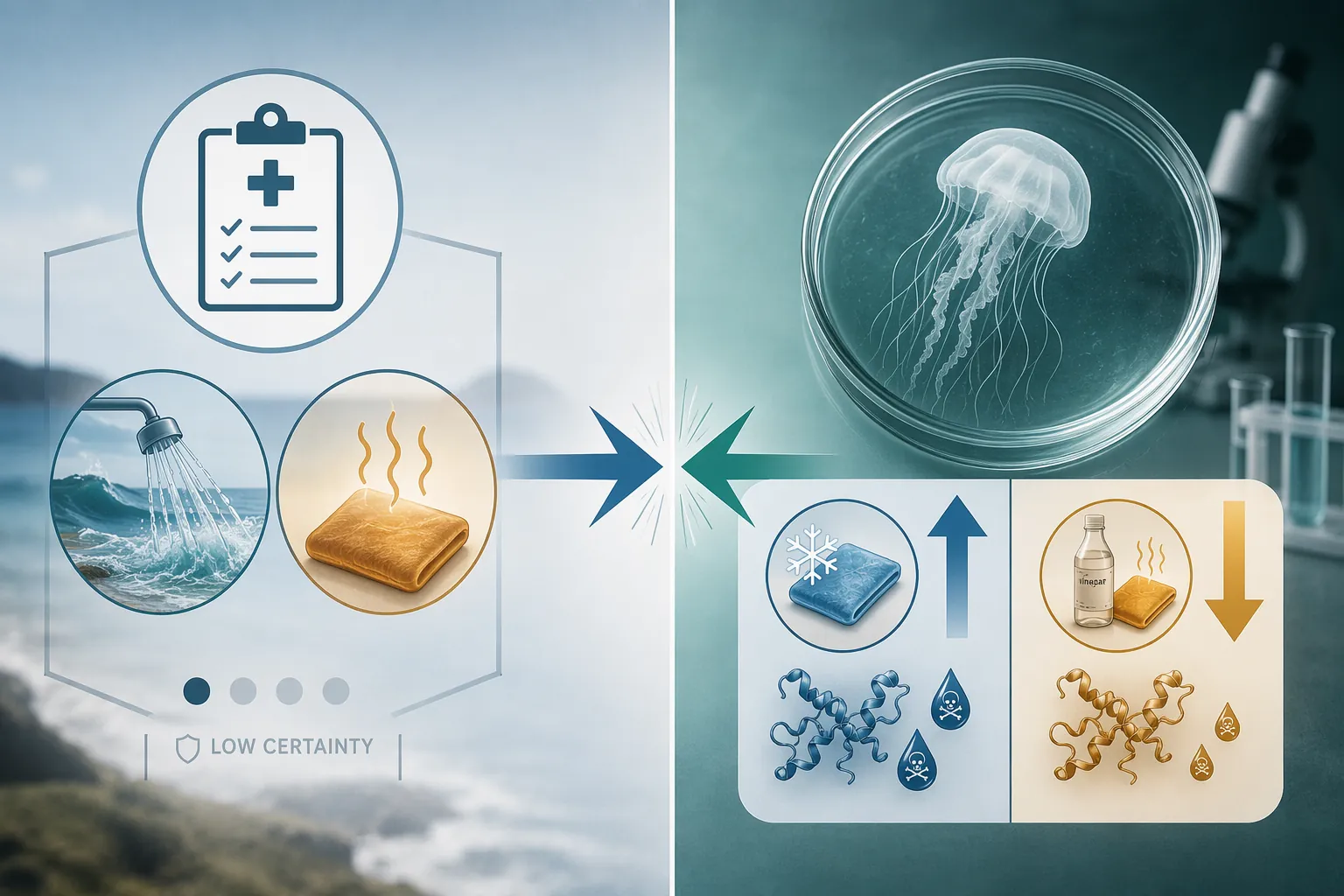
Doyle and colleagues studied Cyanea capillata, the lion's mane jellyfish, using ex vivo and in vitro methods. Their findings complicate the usual UK and Ireland practice pattern they describe: seawater rinse followed by cold packs increased venom delivery, while vinegar rinse followed by hot water immersion at 45°C for 40 minutes significantly reduced venom activity.[5] This is not a clinical outcomes trial, and it should not be treated as one. But it is precisely the kind of species-specific evidence that makes a generic jellyfish-sting pathway feel unsafe.
A protocol engine could help here only if it preserves the contradiction rather than smoothing it away. For a suspected lion's mane sting in a UK or Irish context, the tool might show that consensus-level guidance favors seawater rinse and heat, while a species-specific laboratory study found worse venom delivery with seawater followed by cold packs and lower venom activity with vinegar followed by hot water. The clinician would still need to decide how much weight to give ex vivo and in vitro findings against low-certainty first-aid consensus. The CDS contribution would be retrieval, context, and warning against an unexamined default.
The heat recommendation has its own evidence boundary. ILCOR's review discusses heated water immersion, but its certainty rating remains very low.[4] Knudsen's 2016 randomized trial comparing hot water immersion with lidocaine for lion's mane stings is available only as a conference abstract, so the full methods cannot be evaluated from the available material.[4] A CDS system that turns this evidence into a confident, uniform treatment directive would be doing more than the evidence permits.
What an AI-supported workflow could plausibly add
The most defensible near-term role is not autonomous treatment selection. It is structured uncertainty management. A marine envenomation CDS tool could ask for the details that often get lost under pressure: location, water activity, timing after exposure, visible tentacle contact, skin pattern, systemic symptoms, diving profile, available image, and whether a local species is known. It could then keep several hypotheses alive while showing which first-aid options are supported, weakly supported, contradicted, or unstudied for the suspected organism.
| Workflow problem | AI pathway | What it could safely contribute |
|---|---|---|
| Symptoms suggest more than one urgent diagnosis | Symptom-to-toxin prediction | Rank exposure categories, prompt missing history, and flag competing diagnoses rather than returning a single answer |
| The organism is uncertain or only partly observed | Vision-based species identification | Use images as one input alongside geography and clinical findings, with explicit confidence and fallback pathways |
| First-aid options conflict by species or evidence type | Protocol-driven CDS | Display consensus guidance, species-specific findings, contraindicated substances, and evidence certainty separately |
That workflow would be most useful in exactly the cases that are least tidy: divers with pain and neurologic complaints, beach presentations where the animal was not captured, patients transferred after informal first aid, or regional settings where several cnidarians are plausible. It would also have to know when not to narrow. If a model cannot distinguish lion's mane from another clinically relevant cnidarian, the safest output may be a constrained differential and an escalation prompt, not a protocol recommendation.
Complex AI is not automatically the right model
The most important critique in Yong and colleagues' review is not that AI is unavailable. It is the necessity question. The review notes that simpler logistic regression models often match or outperform complex machine learning models for poisoning outcome prediction.[3] That matters for marine envenomation because the first deployable system may not need a deep network at every layer. If the task is identifying patients at risk of admission, severe pain, systemic toxicity, or need for consultation, a transparent statistical model may be easier to validate, calibrate, and explain.
Model choice should follow the clinical task. Vision transformers may be appropriate for image-heavy species recognition if there is a validated jellyfish image set, which currently is not established in the evidence provided here. Graph attention methods may be appropriate when symptom relationships and exposure categories are complex, as ToxNet suggests in general poison-center data.[2] Rules-based CDS may be appropriate when the goal is to present first-aid protocols and certainty grades. Logistic regression may be the better first choice when the outcome is structured, the sample is limited, and interpretability is central.
A hybrid system is plausible, but only if each component earns its place. A deep model that guesses the organism, a rules engine that recommends treatment, and a risk model that predicts escalation are three separate claims. Each would need its own validation against the clinical decision it is meant to support.
The validation gap is still the deployment boundary
No AI tool in the provided evidence has been specifically developed and validated for jellyfish species identification, lion's mane sting diagnosis, or lion's mane jellyfish sting first aid decision support. The strongest AI evidence comes from adjacent emergency toxicology tasks: poison prediction, snake species recognition, ECG-based toxicity detection, NLP surveillance, and protocol support.[2][3] Those are useful analogies, not substitutes for marine validation.
Prospective validation would need to test the exact decision points that matter. Does the tool reduce misclassification between marine envenomation and diving illness? Does it improve correct species identification when image quality is poor or absent? Does it change first-aid selection in a way that improves pain, venom activity, escalation, hospitalization, or adverse events? The current jellyfish first-aid literature does not even provide survival or hospitalization outcomes for ILCOR's review, which leaves any severe-case CDS claim on weak ground.[4]
A deployment-ready system would also need local governance. Species prevalence, beach reporting, poison center access, dive medicine expertise, and emergency department workflows vary. A protocol that is tolerable as an educational reference may be unsafe as an interruptive order-set prompt. The higher the automation pressure, the stronger the evidence and monitoring burden should be.
AI-supported marine envenomation CDS is plausible and worth studying because the clinical pain points are real: uncertain species, overlapping syndromes, and first-aid protocols that can diverge by organism and evidence type. For lion's mane jellyfish, the current record supports prospective validation and careful model selection before clinical use. It does not yet support operational deployment of an AI tool that tells clinicians how to treat an individual sting.
References
- Jellyfish envenomation in temperate waters: the management of stings from the lion's mane jellyfish, PMC, 2019, link
- ToxNet: a graph attention network for predicting the intoxicant from clinical features in poison center calls, Clinical Toxicology, 2023, link
- Artificial Intelligence in Emergency Toxicology: Scoping Review, JMIR, 2025, link
- Treatment of Jellyfish Stings: FA 7211 TF SR, ILCOR CoSTR, 2025, link
- Evaluation of Cyanea capillata sting management protocols using ex vivo and in vitro models, PMC, 2017, link
Comments
Join the discussion with an anonymous comment.