
The nutrition problem in long-term care is often recorded in a form that looks cleaner than the meal itself. A resident is served breakfast, lunch, and dinner; someone later documents how much was eaten; the chart turns that moment into a percentage. In a busy ward or care home, that percentage may be based on a glance at a tray, a memory of several trays, or a staff member’s best effort after several other tasks have already intervened.
That weakness matters because the stakes are not marginal. More than half of long-term care residents are described as malnourished or at risk of malnutrition, and malnutrition in England has been associated with an estimated £19 billion annual cost to the NHS.[1] Those figures do not prove that a camera or sensor can solve the problem. They do explain why an unreliable intake record is not a harmless clerical inconvenience.
The strongest case for AI in elderly nutrition and dietary habits starts here: not with a promise to replace clinical judgment, but with the possibility of measuring what was actually left on the plate more consistently than a hurried human estimate.
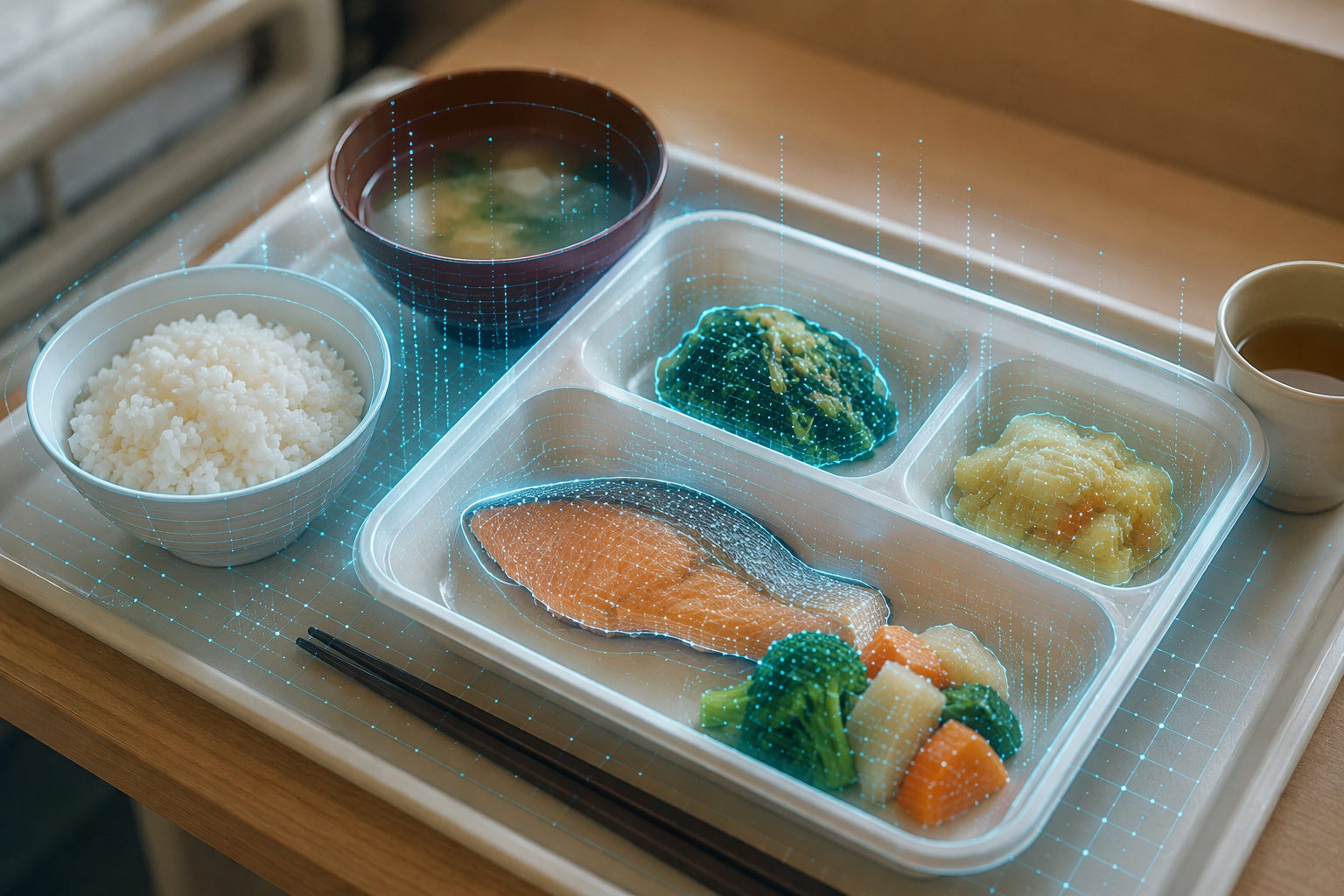
What the Waterloo plate-analysis system actually measures
The University of Waterloo plate-analysis work is useful because it is concrete. It does not ask the reader to imagine a vague smart dining room. The system analyzes food remaining on a tray using depth-refined semantic segmentation, color and depth features, and institutional recipe information. In the reported work, this approach reduced food intake estimation error to about 5%, compared with roughly 50% error for manual estimation.[2]
That difference is operationally large. A 50% error can turn half a meal into something that looks like almost all of a meal, or make a meaningful decline look like ordinary variation. A 5% error, if reproduced in real dining conditions, would give dietitians and nursing teams a much firmer basis for escalating supplements, adjusting meal texture, reviewing medication effects, or looking for swallowing problems.
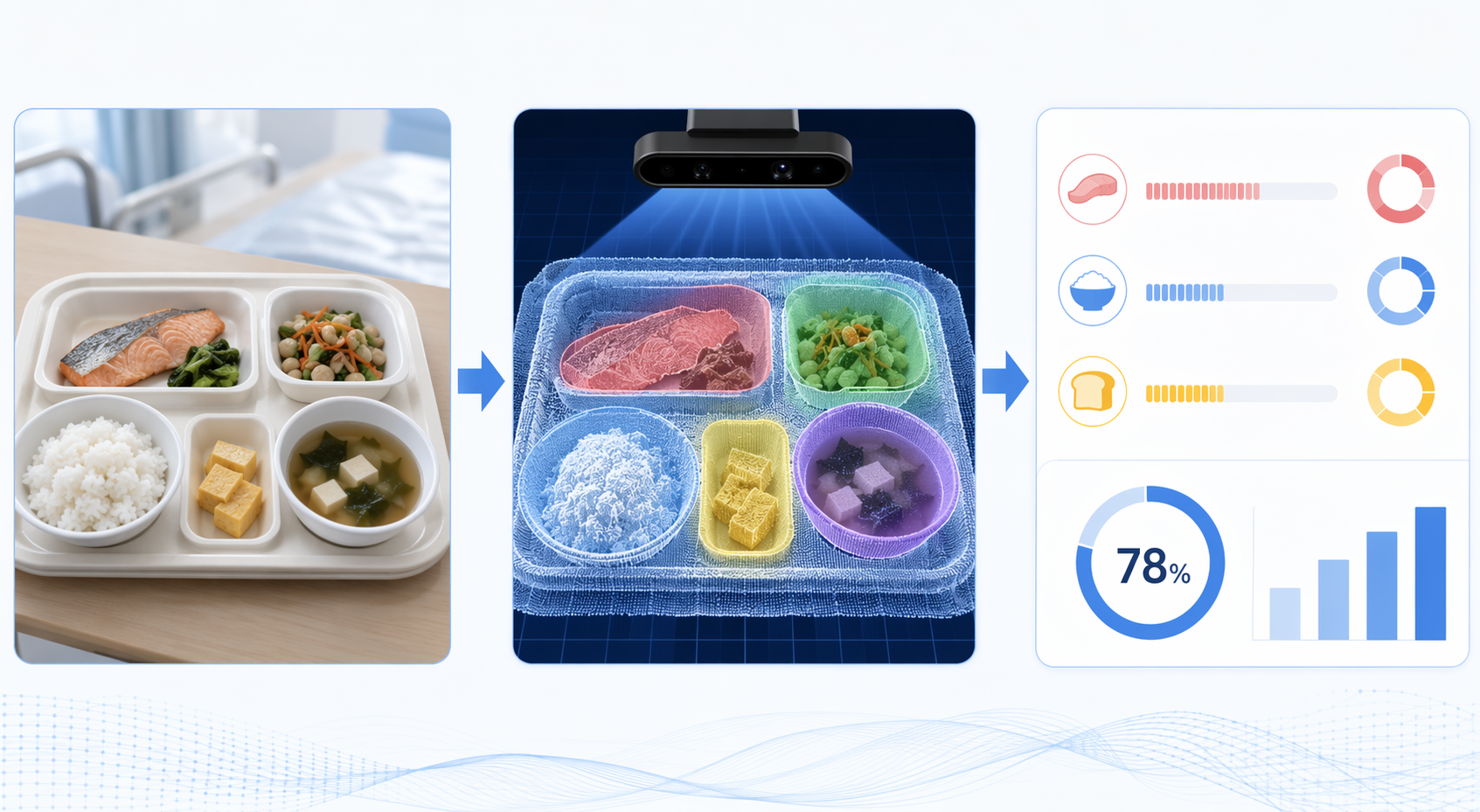
The recipe linkage is not a minor technical detail. A system that only says “food remains” is measuring volume or visible leftovers. A system that links plate analysis to institutional recipes can move closer to dietetic questions: how much protein was likely consumed, how much carbohydrate remained, and whether the resident is missing the nutrients that were actually prescribed. The Waterloo report specifically notes the ability to distinguish nutrient categories such as protein and carbohydrate consumption.[2]
That still leaves a careful boundary around the claim. A tray image can help estimate intake from the food served and the food left behind. It does not by itself diagnose malnutrition, explain why the resident did not eat, or capture food consumed outside the monitored tray. It also depends on the institution’s own menu, plating practices, recipes, lighting, tray presentation, and workflow. The promising part is not that the machine “understands nutrition.” The promising part is that it may create a more reliable intake measurement than the documentation many teams currently have to work with.
The broader evidence is promising, but the measurements are not interchangeable
The 2025 systematic review by Kalu and colleagues is the most useful evidence map for this question because it separates several kinds of AI nutrition technologies rather than treating them as one category. The review covered 30 studies published from 2015 to 2025 and reported high-performing examples across malnutrition risk detection, dysphagia screening, food recognition, and sensor-based eating activity detection.[3]
| System type | What it measures | Reported signal in the review | Why the distinction matters clinically |
|---|---|---|---|
| Malnutrition risk detection | Risk classification using clinical or dietary inputs | Up to 94% accuracy in a study cited by Kalu et al. | A risk score can support screening, but it is not the same as observed meal intake. |
| Dysphagia screening | Likelihood of swallowing difficulty or related risk | Up to 95% screening accuracy in a study cited by Kalu et al. | Swallowing risk may explain reduced intake, but it measures a different clinical problem. |
| Food recognition | Identification of food items or categories | A 91% food recognition rate in a study cited by Kalu et al. | Recognizing food does not automatically estimate how much was eaten. |
| Plate-waste analysis | Food served versus food remaining | Waterloo reported about 5% estimation error in its study context | This is closest to the meal-tray documentation problem. |
| Wearable or ambient sensors | Eating gestures, motion, or activity patterns | Wrist-mounted IMU eating-gesture detection reported F1=0.944 in a study cited by Kalu et al. | Gestures can indicate eating activity, but not necessarily nutrient intake. |
Those numbers are worth attention, but they should not be read as a single leaderboard. A model that detects malnutrition risk with 94% accuracy is not doing the same job as a system that identifies a sandwich, counts eating gestures, or estimates leftover mashed potatoes. In practice, these tools would enter different parts of care: admission screening, meal monitoring, dysphagia triage, nutrition care planning, or quality documentation.
The difference between adoption and effectiveness also matters. A sensor can be feasible to wear without improving nutrition outcomes. A camera can classify food accurately without fitting nursing workflow. A risk model can perform well in a study dataset without proving that residents receive earlier intervention, fewer complications, or better weight stability. The current evidence is strongest for measurement performance in research settings, not for routine clinical outcome improvement.
Plate waste, food recognition, and intake are related but not identical
Food recognition is often the most visually impressive part of AI nutrition work. It is also the easiest to overinterpret. If a system correctly recognizes chicken, rice, and carrots, the care team still needs to know portion size, what was served, what was eaten, what was spilled, whether the resident traded food, whether a supplement was consumed, and whether the meal matched the diet order.
Plate-waste systems are closer to the institutional question because they compare the served meal with what remains. Even there, the measurement is not complete unless the system can connect the image to the recipe, meal order, and resident-specific nutrition plan. The Waterloo work is therefore more clinically relevant than a generic food-recognition demo, because it attempts to tie the image to institutional recipes and nutrient categories.[2]
Sensors can detect eating behavior without knowing what was eaten
The sensor-based studies in the Kalu review show another route: wrist-mounted inertial measurement units, passive infrared motion sensors, and bite-detection algorithms. One wrist-mounted IMU eating-gesture detection study reported an F1 score of 0.944.[3] That is a strong technical signal for recognizing a pattern of movement associated with eating.
For a frail resident, however, the clinical question is rarely just whether the arm moved. Tremor, assisted feeding, fatigue, slow eating, adaptive utensils, and dysphagia precautions can all complicate what a gesture means. A sensor may help identify meal engagement or missed meals, but it cannot automatically convert gestures into protein consumed or fluid intake achieved.
The readiness gap is still the main finding
The uncomfortable part of the evidence is not that the systems are weak. Many are technically impressive. The problem is that most remain prototypes or pilots, and many validation studies have small samples, often with fewer than 30 participants.[3] That is not enough to assume dependable performance across a full long-term care population.
The regulatory picture is also thin. The evidence summarized in the research literature does not identify FDA-cleared or CE-marked AI nutrition monitoring products specifically validated for elderly monitoring.[3] For administrators, that distinction matters. A tool can be useful in a research collaboration and still not be ready to function as clinical infrastructure in a regulated care environment.
The most important validation gap concerns the residents who are often hardest to document accurately: people with cognitive impairment, frailty, fluctuating appetite, dysphagia, tremor, delirium risk, or need for feeding assistance. The Kalu review identifies limited testing in cognitively impaired or frail older adults.[3] Excluding or underrepresenting those residents may make a model look cleaner while weakening its relevance to the population most likely to be harmed by missed malnutrition.
Consent also cannot be treated as a footnote. Camera-based monitoring in a dining room or bedside setting changes the character of the meal. Even when the purpose is nutrition care, institutions still have to decide who can consent, how images are stored, who can review them, whether staff activity is incidentally captured, and how residents can decline without losing attention to their nutrition needs. Better documentation should not require turning every meal into a surveillance event.
Why results may not travel cleanly from one institution to another
AI nutrition tools are unusually sensitive to local context. A plate-analysis system trained around one institution’s recipes, trays, lighting, and menu cycle may not perform the same way after a vendor change, a texture-modified diet update, or a move from one country’s care model to another. Examples from Canada, Singapore, and South Korea are useful precisely because they warn against assuming transferability across menus, care routines, languages, and regulatory environments.
Broader reviews of AI in nutrition and dietary assessment show that this is not only an elder-care problem. AI-assisted dietary assessment is an active research area across populations, and a 2025 Frontiers scoping review identified 66 studies on AI-assisted dietary assessment tools.[4] A 2024 systematic review of AI in malnutrition also places elderly monitoring inside a wider field of automated nutrition assessment.[5] Those reviews widen the context, but they do not remove the need for local validation in long-term care and hospital geriatric settings.
For a hospital or nursing home, the transferability question is practical. Does the system recognize pureed meals, mixed dishes, supplements, culturally specific foods, fortified recipes, and partially eaten snacks? Does it handle trays photographed at different times by different staff? Does it still work when a resident eats slowly and the tray is cleared late? Does the output enter the dietitian’s workflow in a form that prompts action rather than adding another dashboard?
A reasonable adoption threshold
The evidence supports a cautious yes to the narrow question: AI systems can measure parts of elderly nutrition and dietary habits more accurately than manual estimation in controlled studies. The Waterloo plate-analysis result is especially relevant because it addresses the tray-level documentation failure directly. The Kalu review shows that related AI systems can achieve high reported accuracy in malnutrition risk detection, dysphagia screening, food recognition, and eating-gesture detection.[2][3]
The evidence does not support treating these tools as ready-made replacements for nutrition assessment, nursing observation, speech-language pathology input, or dietitian review. Most systems still need testing outside controlled or prototype settings. The unanswered questions are not peripheral; they concern sample size, regulatory status, workflow fit, privacy governance, and performance in cognitively impaired or frail residents.
A responsible institution would treat AI food intake monitoring as a research or pilot candidate, not as routine clinical infrastructure. Before relying on it, the site would need local validation against observed intake or weighed plate waste, review by privacy and ethics governance, clear consent procedures, workflow testing with nursing and dietary staff, and subgroup scrutiny for residents with cognitive impairment, dysphagia, frailty, or assisted feeding needs.
That threshold does not dismiss the technology. It protects the residents the technology is meant to help. A system that reduces a known documentation error from roughly 50% to about 5% deserves serious validation. It just has to prove that performance where the missed meals actually happen.
References
- Combatting malnutrition in care homes with artificial intelligence, Health Europa.
- Food tracking AI system developed to reduce malnutrition in LTC, University of Waterloo News.
- Artificial Intelligence in Elderly Nutrition and Dietary Habits: A Systematic Review, Nutrients, July 2026.
- Artificial intelligence-assisted dietary assessment tools: a scoping review, Frontiers in Nutrition, 2025.
- Artificial intelligence in malnutrition: A systematic review, ScienceDirect, 2024.
Comments
Join the discussion with an anonymous comment.