
By mid-2026, the AI medical scribe market has moved past the stage where a health system can file it under “innovation lab” and check back next year. Trade and association reporting now puts access at roughly one-third of U.S. providers, while major deployments are large enough to affect enterprise documentation strategy: Kaiser Permanente has reported deployment across 7,260 physicians and more than 2.5 million encounters over 14 months, UCSF has reported that about 70% of physicians use AI scribes daily, and the VA plans to expand ambient AI to all medical centers nationwide throughout 2026.[1][2]
Those figures are not a definitive national census. They come from trade press, association coverage, and vendor-adjacent market reporting, and they should be read with that caution. Still, their procurement meaning is hard to miss. AI scribes are no longer a single-department experiment in a few outpatient clinics. They are becoming operating infrastructure that touches exam-room audio, EHR documentation, patient disclosure, clinician review, contract language, security review, and state compliance.

Scale Has Changed the Buying Question
The old buying question was whether ambient documentation could work at all. The current one is whether a health system can explain why it chose one platform over another, how it discloses use to patients, what data controls it requires, and how it monitors the note that lands back in the chart.
Kaiser’s reported scale matters because it moves the category from anecdote to institutional operations. A deployment across thousands of physicians and millions of encounters is not proof of universal effectiveness, but it does show that large systems are willing to put ambient documentation into routine clinical flow.[1] UCSF’s reported 70% daily physician use points to a different signal: adoption is not only about contract signature. It is about whether clinicians keep the tool open after the novelty fades.[2]
The VA’s planned expansion through 2026 adds another kind of signal. Federal rollout does not settle the evidence debate, and announced timelines can slip. But it does tell enterprise buyers that ambient scribe review is no longer confined to venture-backed outpatient groups and academic medical centers. The category is being tested against the procurement, security, training, and support demands of one of the country’s largest care delivery systems.[2]
Patient acceptance is also more promising than many early compliance conversations assumed. In a UCLA randomized trial published in NEJM AI, fewer than 10% of informed patients declined AI scribe use.[3] That is a useful data point for health-system leaders writing disclosure scripts and front-desk workflows. It is not a universal patient-trust guarantee. The result comes from one institution and one trial context, and acceptance may differ by specialty, language, patient population, visit sensitivity, or local expectations about recording.
The Platform Landscape Is No Longer One Category
“AI scribe” now describes several procurement paths that look similar in a demo and very different inside an enterprise architecture review. DAX Copilot, now part of Microsoft Dragon Copilot, sits in a different buying conversation from a startup-first platform such as Abridge, Nabla, Suki, Freed, or Heidi. Cloud-native ambient tools raise a different set of data, integration, and identity questions than EHR-bundled offerings from Epic or athenahealth.[2]
| Procurement Path | What It Changes for Buyers |
|---|---|
| EHR-bundled or EHR-adjacent tools | May simplify contracting and workflow placement, but can deepen dependence on the incumbent EHR ecosystem. |
| Enterprise ambient platforms | Often offer more mature integration and governance conversations, but require careful review of data flow, note routing, and support model. |
| Startup-led point solutions | Can move quickly and compete on clinician experience, but buyers need sharper diligence on viability, security, and roadmap dependence. |
| Cloud-native or infrastructure-linked options | May fit broader AI architecture strategy, but can complicate privacy, data residency, and model-governance review. |
The practical differences rarely fit into a feature grid. Two products may both listen during a visit, generate a draft note, and send it for clinician review. The material questions start after that: Does the tool write directly into the EHR or require copy-and-paste? Does it separate transcript storage from note generation? Can the organization configure retention? Are audio files stored, processed, or discarded? Who can audit prompts, outputs, edits, and clinician acceptance? What happens when a specialist wants a different note structure from primary care?
Integration depth also affects governance. A lightweight tool may be easier to pilot, but harder to monitor across departments. A deeply integrated tool may reduce clinician friction, but it can also make exit strategy harder once templates, workflows, training materials, and EHR routing depend on it. The right question is not simply which platform produces the most polished note in a demo. It is which platform the organization can govern after the contract is signed.
Market structure adds another layer. One industry analysis reports that 85% of healthcare AI investment is going to startups, a concentration that creates vendor-viability risk for enterprise buyers.[5] That does not mean startup tools are unsafe or unsuitable. It means procurement teams should test continuity plans with the same seriousness they bring to accuracy claims: escrow or export terms, data return procedures, model-change notification, customer-support capacity, cyber insurance, acquisition clauses, and the cost of replacing the tool if the vendor’s strategy changes.
Pricing Is Public Enough to Orient, Not to Budget
Publicly discussed pricing for AI scribes spans roughly $40 to more than $500 per clinician per month, depending on vendor, tier, and reporting source.[2][5] That range is useful only as a starting point. It does not reliably represent an enterprise contract for a health system with thousands of users, EHR integration requirements, security review, training, support, analytics, and negotiated service terms.
The budget line can also hide outside the per-seat price. Implementation work may sit with IT, informatics, clinical operations, legal, compliance, revenue cycle, and training teams. A cheaper subscription can become expensive if it creates more manual reconciliation, more note cleanup, or more exception handling. A more expensive platform can still be hard to justify if promised time savings never re-enter clinical access, inbox reduction, visit quality, or physician retention in a measurable way.
That is where familiar ROI decks often move too quickly. Clinician time back is a serious goal, especially in organizations where documentation burden is one of the reasons physicians cut hours or leave. But for an enterprise buyer, “time saved” needs a destination. Does it reduce pajama-time documentation? Shorten visit-close lag? Increase same-day note completion? Reduce after-hours inbox work? Open more appointment capacity? Improve the quality of patient conversation during the visit? Each answer implies a different measurement plan and a different owner.
The Regulatory Gap Is Not a Vacuum
Most AI scribes currently operate outside FDA clearance because they are marketed as administrative documentation tools rather than diagnostic or treatment devices.[4] That classification is central to the speed of the market. It is also one of the reasons compliance leaders should be cautious about treating current practice as settled law.
The distinction is not academic. A tool that listens to the visit and drafts a note for clinician review sits closer to administration. A tool that begins to suggest diagnoses, recommend orders, prioritize findings, or shape treatment reasoning moves toward clinical decision support. Product roadmaps in this category are not standing still, and governance written only for today’s documentation use case may age quickly.
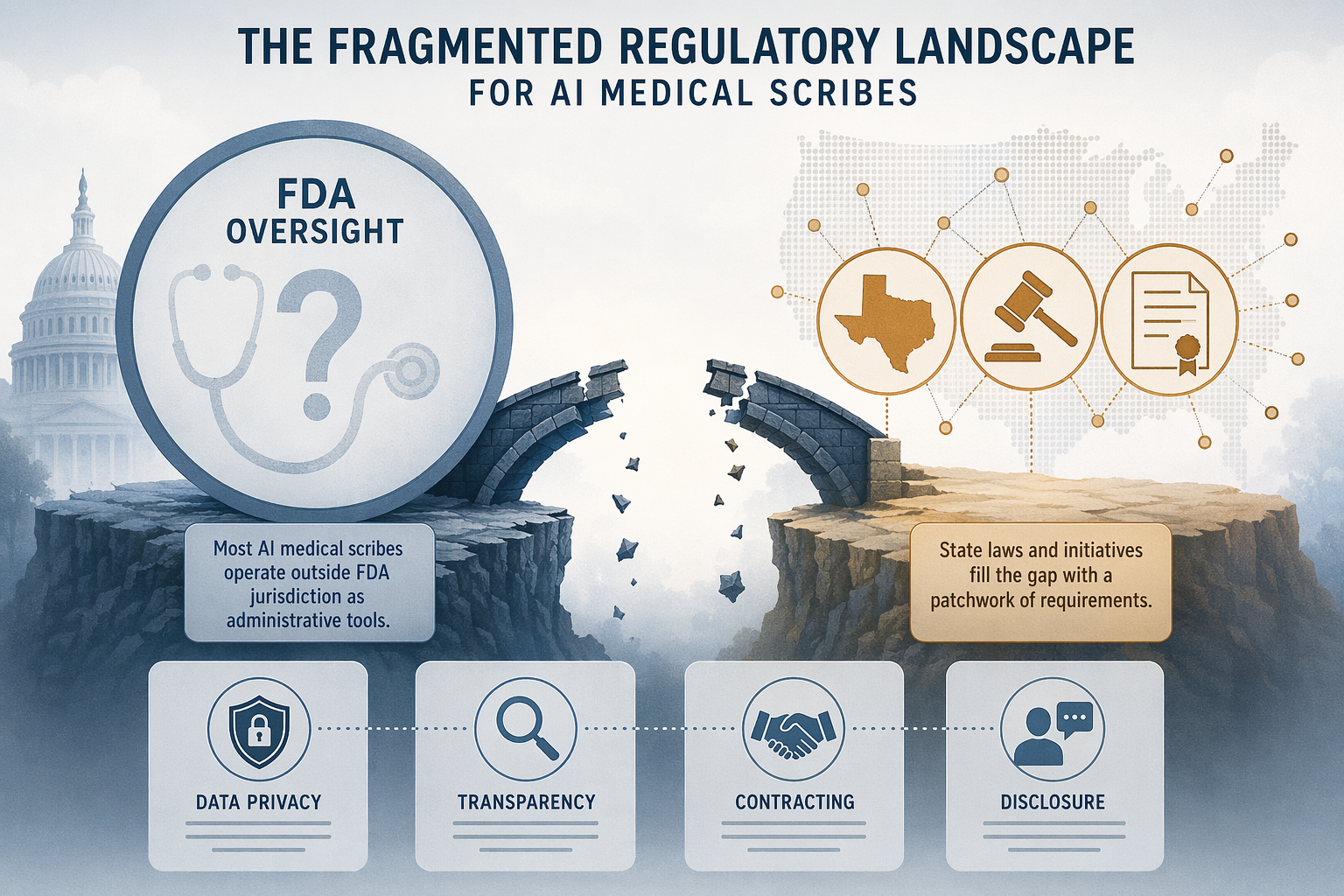
Texas shows why “not FDA-cleared” does not mean “unregulated.” In 2025, the state enacted SB 1188, addressing EHR data localization, and HB 149, known as TRAIGA, creating AI transparency requirements.[5] How these laws will be interpreted for every ambient scribe configuration is still developing. But the direction is clear enough for procurement: compliance duties can arrive through privacy, transparency, contracting, data residency, and disclosure law even when a product is not treated as an FDA-regulated medical device.
That fragmentation changes the implementation burden. A multi-state health system may not be able to rely on one national AI scribe policy and one patient notice. Data storage location, subcontractor access, retention rules, model-training restrictions, patient-facing disclosure, staff training, and audit rights may need jurisdiction-specific review. The hard part is not writing a policy that says clinicians must review AI-generated notes. The hard part is proving that the organization knows where the data went, what the patient was told, who edited the output, and which version entered the medical record.
What Compliance Review Should Separate
- FDA status: whether the product is being used only for administrative documentation or has moved into clinical decision support.
- Privacy and data flow: what audio, transcript, metadata, and note data are captured, stored, processed, shared, or deleted.
- Patient disclosure: when patients are informed, who documents consent or declination, and how exceptions are handled.
- Contract controls: audit rights, breach obligations, subcontractor terms, model-training limits, data return, and termination procedures.
- State obligations: data residency, transparency, consumer notice, and AI governance duties that may vary by jurisdiction.
This is also where health systems should resist two easy exaggerations. Vendors sometimes present note generation as harmless administration, as if documentation were detached from billing, quality reporting, clinical continuity, and malpractice exposure. Critics sometimes describe every ambient documentation tool as if it were already making autonomous diagnostic decisions. Both shortcuts obscure the real work. The risk profile depends on what the tool does, how deeply it is integrated, what clinicians are expected to review, and whether the organization can detect failure modes after deployment.
Evidence Is Improving, but Procurement Still Needs Its Own Proof
The strongest case for AI scribes is not that they produce perfect documentation. It is that enough clinicians appear willing to use them, enough patients appear willing to accept them when informed, and enough large systems are moving from pilot to routine deployment that the category deserves serious operational review.
But adoption is not the same as effectiveness. Access does not prove use. Use does not prove reduced burnout. A completed note does not prove a better note. A positive pilot does not prove that the same tool will work across emergency medicine, oncology, behavioral health, pediatrics, and multilingual primary care. Health systems that want the deeper burnout and workflow evidence should treat it as its own review, not as a footnote to the vendor selection process.
For procurement teams, the local proof should be concrete. Sample notes should be reviewed by specialty and visit type. Clinicians should track edits, not just satisfaction. Compliance teams should test patient-disclosure workflows, including declinations. Revenue-cycle leaders should inspect whether generated documentation changes coding risk. IT should measure latency, downtime, identity management, and support tickets. Legal should know whether the contract lets the vendor use customer data to improve models and whether the health system can say no.
A pilot that only asks whether physicians like the note is too thin for 2026. The enterprise question is whether the organization can operate the tool safely at scale.
The Procurement Stance for 2026
AI scribes are mature enough for serious deployment review and not mature enough for relaxed governance. That is the uncomfortable middle ground health-system leaders now occupy. The market has credible scale signals, a widening platform field, encouraging patient-acceptance evidence in at least one trial context, and enough clinician demand that ignoring the category may be harder to defend than evaluating it.
The same market also has opaque enterprise pricing, startup concentration, unsettled regulatory classification, and state-level compliance duties that will not wait for a clean federal framework. A buyer does not need to prove that AI scribes are the future of medicine. It needs to document why this platform, for these specialties, under these data controls, with this disclosure process, reviewed by these clinicians, monitored against these failure modes.
The question is no longer whether AI scribes are coming. They are already inside major health systems. The question is whether the health system can still explain the choice after the demo is over, the contract is signed, the law changes, and the first disputed note has to be reconstructed.
References
- “AI scribes save 15,000 hours and restore human side of medicine,” American Medical Association.
- “Take note: The AI scribe era is here,” Medical Economics.
- “UCLA NEJM AI randomized clinical trial,” NEJM AI.
- “Beyond human ears: navigating the uncharted risks of AI scribes in clinical practice,” npj Digital Medicine.
- “Ambient AI Medical Scribes: Efficiency Gains, Burnout Uncertainty, and Governance Risks,” IHS.
Comments
Join the discussion with an anonymous comment.