
The uncomfortable fact about AI medical technology in 2026 is not that hospitals are ignoring it. It is that many are already using it without the governance maturity that enterprise clinical deployment requires. One industry analysis reports that 71% of hospitals use AI somewhere in daily operations, while fewer than 20% have reached deep clinical integration.[1] Premier’s 2026 analysis adds the more troubling companion figure: roughly 80% of health systems lack internal AI governance standards.[2]
Those numbers should not be read as a simple adoption story. “AI is present” can mean an administrative tool, an ambient documentation product, a revenue-cycle model, a radiology workflow aid, or a clinical decision-support function used in one department. Deep clinical integration is different. It means the tool is embedded in care delivery, connected to workflow, relied on by clinicians, and subject to repeatable oversight. A pilot can survive on local champions and informal judgment. Enterprise deployment cannot.

That distinction matters because failure changes shape as AI moves out of the pilot lane. In a small test, the question may be whether a department found the output useful. At scale, the questions become harder: who approved the tool, what evidence was required, which population was it validated on, who is watching for drift, who can pause it, and who owns the incident when a model becomes part of clinical routine?
Why Informal Oversight Stops Working In 2026
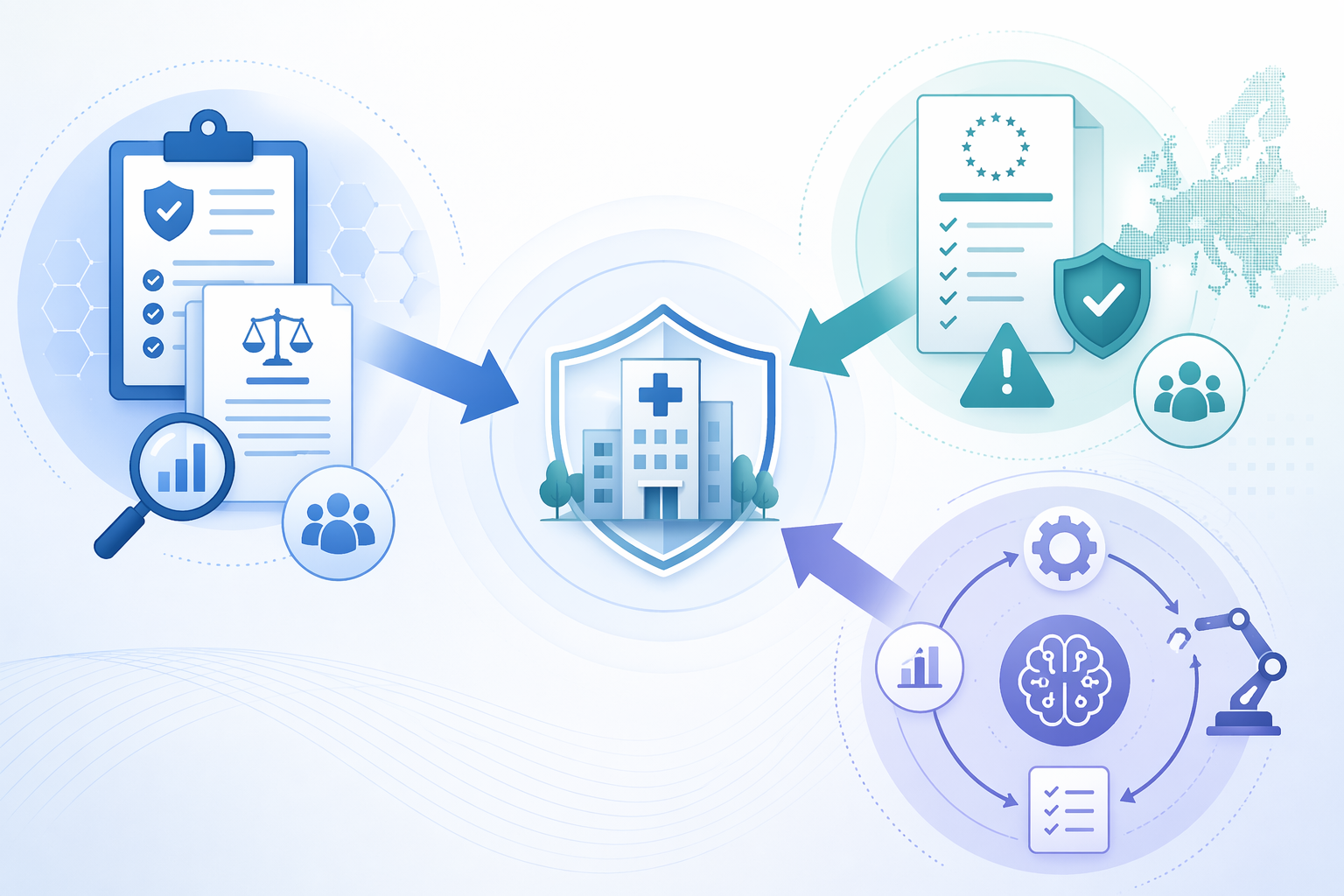
The pressure is not coming from one direction. It is coming from regulators asking for better evidence, European high-risk AI obligations moving toward enforcement, and a new class of systems that can do more than generate a recommendation. Each force exposes a weakness in the old model of AI oversight, where procurement reviews one issue, legal reviews another, IT checks security, clinicians assess usability, and no one owns the whole lifecycle.
| 2026 pressure | What changes for health systems |
|---|---|
| FDA TEMPO pilot | Health systems must be prepared to discuss measurable clinical benefit, not only technical model performance. |
| EU AI Act high-risk obligations | AI-enabled medical device oversight increasingly depends on documentation, risk management, and human oversight expectations. |
| Agentic AI | Oversight designed for passive decision support may not define enough control when systems can initiate actions. |
None of this means every AI tool carries the same risk. A scheduling model, a documentation assistant, a triage support tool, and an imaging algorithm do not deserve identical review. But proportional governance still needs a system. Without one, health systems end up making risk decisions through institutional habit: whoever finds the tool first, funds it first, or complains first determines how much scrutiny it receives.
The FDA Is Moving The Evidence Conversation Toward Clinical Benefit
The FDA’s TEMPO pilot, announced in February 2026, is important because it points beyond the familiar question of whether a digital health product performs technically. The pilot is framed around clinical benefit evidence for digital health devices, which changes what health systems need to be able to document when they evaluate AI-enabled tools.[3]
Technical performance still matters. Sensitivity, specificity, accuracy, workflow reliability, cybersecurity, and integration quality do not become optional. But a model that performs well on a benchmark can still fail to improve care in a real clinical pathway. It may alert too late, add review burden, widen disparities, change clinician behavior in unmeasured ways, or produce a benefit only under conditions the hospital cannot reproduce.
This is where governance becomes more than a document repository. A defensible AI review process asks what evidence is proportional to the tool’s risk and use. For a low-risk administrative application, that may mean security, privacy, bias, and workflow checks. For an AI-enabled clinical tool, it may require evidence that the product improves a meaningful process or outcome in the setting where it will be used, or at least a clear plan to measure whether it does after deployment.
The practical consequence is that health systems need source attribution and evidence discipline before procurement closes. Vendor summaries are not enough. Committees need to know whether support comes from peer-reviewed studies, regulatory submissions, internal validation, vendor-sponsored analyses, synthetic testing, or local quality-improvement data. Those categories are not interchangeable, and treating them as interchangeable is how weak evidence becomes operational dependency.
The EU AI Act Adds Real Pressure, Even With Policy Uncertainty
For organizations that develop, buy, deploy, or support AI-enabled medical technologies touching the European market, the EU AI Act is not a distant policy abstraction. High-risk AI system obligations are scheduled to take effect in August 2026, and most AI-enabled medical devices are expected to fall into the high-risk category under the Act’s structure.[4]
The hard part is that the policy picture is still unsettled. A Harvard Petrie-Flom analysis describes two competing regulatory directions: a Digital Omnibus simplification package that could streamline dual compliance, and a DG SANTE medical device regulation amendment that could remove high-risk AI safeguards for medical devices.[4] That uncertainty is real. It is also a poor reason to wait.
If the rules simplify, health systems with adaptable governance will be better positioned to map existing documentation to the new requirements. If the rules remain stricter, those same systems will already have the basic machinery: risk classification, technical documentation, human oversight descriptions, post-deployment monitoring, and escalation paths. The risky position is not choosing the wrong policy prediction. It is having no inventory, no approval trail, and no way to explain how an AI system is being supervised.
The European debate also matters outside Europe because it is forcing a more precise vocabulary. Health systems can no longer speak vaguely about “human-in-the-loop” oversight and assume that phrase answers the control question. Oversight has to specify who the human is, when the human sees the output, whether they can override it, whether override behavior is tracked, and what happens when users stop treating the output as optional.
Agentic AI Turns Accountability From A Policy Topic Into A Workflow Problem
Agentic AI is easy to overstate, but it should not be dismissed. NVIDIA’s 2026 healthcare survey found that 47% of healthcare organizations are using or assessing agentic AI systems.[5] Because that figure comes from a survey, it should be read as a signal of active market and organizational attention rather than proof of mature clinical deployment. Still, it is enough to raise the governance temperature.
The accountability question changes when a system can initiate actions rather than merely display information. A passive risk score may influence a clinician’s decision. An agentic tool might draft a message, queue an order for review, route a patient, trigger a follow-up task, summarize a chart for a handoff, or coordinate steps across systems. Some of those actions may be low risk. Some may not be. The dividing line depends less on the label “agentic” than on what the system can cause to happen without timely human correction.
This is where loose oversight language becomes dangerous. If the human reviewer sees only a completed task list, their oversight is retrospective. If they must approve every action, the tool may not be meaningfully autonomous. If they approve by default because the queue is too large, the human-in-the-loop control has become a ritual. Governance has to define the control point in operational terms, not procurement language.
For health systems, the first defensible move is to inventory what AI tools can do, not what vendors call them. Can the system generate content? Can it recommend a clinical action? Can it alter workflow priority? Can it send, schedule, route, or initiate? Can it learn or change after deployment? Can users bypass review? These are governance questions because they determine evidence expectations, monitoring needs, and incident response.
The Governance Gap Is Operational, Not Philosophical
Hospital leaders do not need another abstract debate about whether AI will transform healthcare. Market estimates for healthcare AI in 2026 vary widely, from roughly $31.97 billion to $56 billion depending on methodology, which is useful context but not a governance plan.[1][6] The more immediate problem is that AI purchasing and AI accountability often live in different rooms.
Procurement may focus on contracting and vendor risk. IT may focus on integration, cybersecurity, and data access. Legal may focus on indemnity, privacy, and regulatory exposure. Compliance may focus on policy alignment. Clinical leadership may focus on safety, workflow, and standard of care. Innovation teams may focus on feasibility and adoption. Each review can be reasonable and still fail to produce a single accountable decision.
That fragmentation explains why formal governance is not just bureaucracy. It is the mechanism that turns scattered review into traceable institutional judgment. A mature process records the use case, intended users, affected patients, data dependencies, evidence reviewed, known limitations, approval conditions, monitoring plan, and escalation owner. When something goes wrong, the organization should not have to reconstruct the decision from calendar invites and email threads.
Some health systems are already moving in this direction. HealthTech Magazine’s 2026 reporting describes organizations using assurance frameworks such as CHAI and highlights Duke Health’s governance approach, including cross-functional review and structured evaluation of AI tools.[7] Those examples should be read carefully: they show governance models in motion, not a universal template that every system can copy without resources, staffing, or local adaptation.
The resource problem is real. Smaller and resource-constrained systems may not be able to stand up a large AI office, hire specialized model auditors, or run extensive local validation for every tool. That does not make governance optional. It means the governance model has to be proportional: a clear inventory, risk tiering, standard intake questions, named decision rights, basic monitoring obligations, and a path for escalating higher-risk tools to deeper review.
What Effective AI Governance Has To Make Visible
The minimum viable governance system is not a standing meeting with an impressive name. It is a set of decisions that can be repeated, audited, and improved. The details will vary by institution, but the visible elements are consistent.
- A current AI inventory that distinguishes administrative, operational, and clinical uses.
- Risk-based intake that asks what the system can affect, who relies on it, and whether it can initiate or prioritize actions.
- Standard approval gates with named decision rights across clinical, compliance, legal, IT, security, privacy, and operational leadership.
- Evidence expectations that separate technical performance, clinical benefit, workflow fit, equity impact, and local validation.
- Post-deployment monitoring for drift, bias, user behavior, incident signals, and changes in the vendor product.
- Escalation rules that specify who can pause, restrict, retrain, replace, or retire an AI tool.
The committee structure matters because these elements need owners. A clinical AI governance committee should not become a symbolic checkpoint that approves tools after the commercial decision has effectively been made. It needs authority early enough to shape purchase, pilot design, validation expectations, monitoring obligations, and go-live conditions.
For readers building that operating model, ClinicalMind’s guide to the essential elements of a clinical AI governance committee charter goes deeper on membership roles, quorum rules, decision rights, and incident escalation paths. Those mechanics are not side issues. They are how governance survives contact with urgent implementation timelines.
Scaling Requires Proof Of Control
AI medical technology can scale safely only when the institution can prove control over the lifecycle. That does not mean governance eliminates risk. It means the organization can show why a tool was allowed into use, what evidence supported that decision, what limits were understood, and how the system is being watched after deployment.
This is also what separates useful innovation from permanent piloting. A health system that cannot classify risk, set evidence thresholds, and monitor performance will keep rediscovering the same questions tool by tool. A health system with a repeatable governance process can move faster where risk is low, slow down where patient impact is high, and explain both choices.
The 2026 inflection point is therefore narrower and more practical than the usual AI rhetoric suggests. Health systems do not need governance because AI is futuristic. They need it because AI is already present, unevenly integrated, and often insufficiently governed. Regulators are asking for clearer evidence, clinical users are inheriting operational risk, and more autonomous systems are testing whether oversight language means anything in workflow. Formal governance is the condition for scaling responsibly.
References
- Healthcare AI in 2026: Market Growth, Use Cases, and Outlook. Blott, 2026.
- The AI Wild West Is Over: Why 2026 Is the Year Health Systems Must Take Control. Premier Inc., 2026.
- FDA Updates AI List with New Clearances. The Imaging Wire, March 11, 2026.
- Simplification or Back to Square One? The Future of EU Medical AI Regulation. Harvard Petrie-Flom Center, March 5, 2026.
- Survey Reveals AI Is Delivering Clear Return on Investment in Healthcare. NVIDIA Blog, 2026.
- How AI Agents and Tech Will Transform Health Care in 2026. BCG, 2026.
- Tech Trends: Healthcare IT Leaders Get Real on the State of AI in 2026. HealthTech Magazine, January 2026.
Comments
Join the discussion with an anonymous comment.