The use of AI in medicine is no longer one question. By Q3 2026, it is at least six: whether the model performs well on a test set, whether regulators have cleared it, whether clinicians actually use it, whether workflow changes, whether patients do better, and whether the result survives outside the site that made it look promising. Mixing those questions is how an encouraging sensitivity result turns into a premature clinical claim, or an FDA clearance total gets mistaken for proof that outcomes improved.
That distinction matters because hospitals are not being asked to admire AI in the abstract. Radiology groups are deciding whether another detection overlay belongs in the reading room. Primary care leaders are deciding whether ambient scribes are worth the privacy, integration, and training work. Sepsis teams are deciding whether an alert should change who gets paged at 2 a.m. The useful map is not “AI works” or “AI is hype.” It is where the evidence is close enough to care delivery to guide adoption, and where it still belongs mainly in research planning.

A Better Evidence Ladder Than “AI in Medicine”
A practical evidence ladder starts with analytic performance and ends with patient or workforce outcomes. A model can move from one rung to the next, but it does not skip rungs just because the software is impressive.
| Claim being made | What it can support | What it cannot support by itself |
|---|---|---|
| High sensitivity, specificity, or AUC | The model can detect or classify a target in a defined dataset | That patients live longer, clinicians save time, or the health system should deploy it |
| FDA clearance | The product met a regulatory pathway for a specific intended use | That it has demonstrated broad clinical value across settings |
| Adoption survey | Clinicians say they are using or experimenting with a tool | That the tool improves diagnosis, safety, cost, or workload |
| Workflow study | A process changed in practice, such as documentation time or EHR time | That downstream clinical outcomes necessarily improved |
| Prospective or real-world outcome study | Patients or clinicians experienced a measured outcome change in a care setting | That the same result will transfer without local implementation work |
This ladder is not an argument against deployment. It is the reason some deployments now deserve serious attention. The strongest cases in 2026 are not the ones with the loudest claims; they are the ones where the measured outcome is close to the work being changed.
Radiology Has the Most Mature Evidence, but Clearance Is Not the Same as Clinical Value
Radiology is the easiest domain to overstate and the hardest to ignore. It has the clearest commercial momentum, the largest concentration of cleared AI/ML devices, and some of the more credible prospective evidence. Stanford HAI’s 2026 AI Index reports 258 FDA-cleared AI-enabled medical devices in 2025, while Innolitics counts 295 AI/ML medical-device clearances for the same year and reports that radiology accounted for 71.5% of them.[1][2]
The discrepancy is not a scandal; it is a warning label. Clearance counts depend on counting rules, device inclusion criteria, and database methods. They are useful for showing where product development has concentrated. They are not a substitute for asking whether a tool changed detection, reading behavior, follow-up, morbidity, mortality, or workload in the setting where it was used.
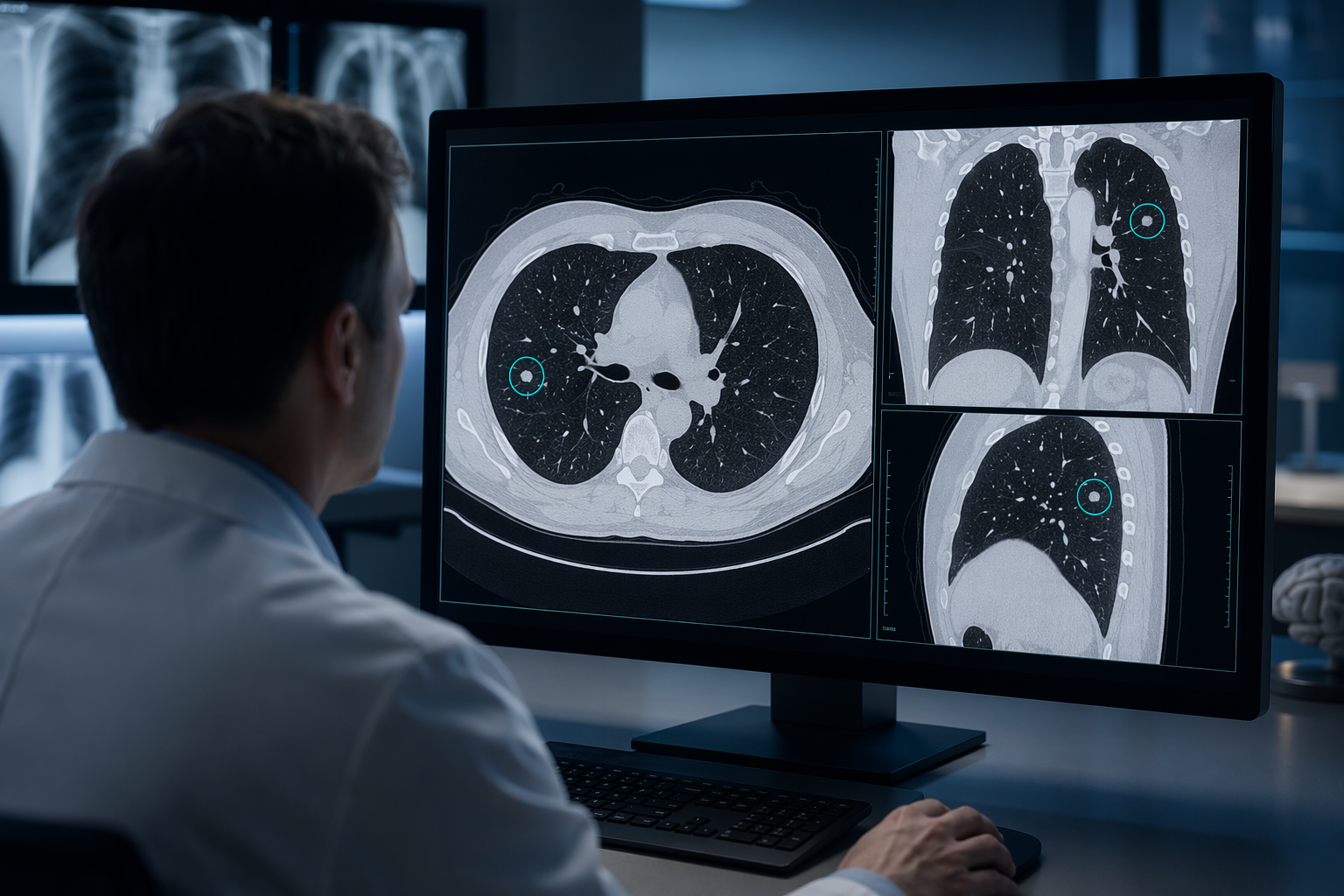
The PRAIM breast-screening result is the kind of imaging evidence that deserves more attention than another clearance tally. In the German prospective screening study, AI-supported screening in 463,094 women achieved a 17.6% higher cancer detection rate than double reading, with detection of 6.7 versus 5.7 cancers per 1,000 women screened.[3]
That does not prove every mammography AI product improves outcomes, and it does not answer every downstream question about recall patterns, interval cancers, overdiagnosis, or implementation burden. It does, however, move the conversation beyond “the model looks good” into a real screening workflow with a measured detection outcome. In imaging AI, that is the line worth crossing.
Lung cancer imaging shows the same need for precision. A 2025 systematic review in the European Journal of Medical Research reported AI sensitivity ranges of 56.4% to 95.7%, compared with radiologist sensitivity ranges of 23.2% to 76%, across included studies.[4] Those ranges are wide enough to discourage any single sweeping conclusion. They do support a narrower one: in selected lung cancer imaging tasks, AI systems can reach or exceed human-reader sensitivity, but the clinical meaning depends on study design, population, false positives, and how the output enters the radiologist’s workflow.
Radiology is therefore the most mature clinical AI domain, not because it has the most products, but because it has the best combination of deployable use cases, high-volume workflows, measurable detection tasks, and some prospective evidence. The products still need to be judged one intended use at a time.
Ambient Documentation Proves Value by Giving Clinicians Time Back
Ambient documentation is a different kind of evidence story. It does not usually claim to find cancer earlier or predict death. Its value claim is closer to the clinician’s day: less typing, less after-hours charting, less EHR time, and possibly less burnout. That makes the endpoint less dramatic than mortality, but not less important.

The stronger ambient-documentation results are valuable because they measure the work rather than asking clinicians whether they like the idea. Mass General Brigham reported a 21.2 percentage-point absolute reduction in burnout prevalence, from 52.6% to 30.7%, after ambient documentation use. UCLA’s randomized controlled trial reported a 10% reduction in documentation time. A Stanford pilot reported a 19.95-minute-per-day reduction in EHR time.[3]
Those outcomes are not interchangeable. Burnout prevalence is not the same as note quality. Documentation time is not the same as diagnostic accuracy. EHR minutes are not the same as patient trust. But they all sit close to a real operational pain point, and they are measured in units that physicians and health-system leaders understand.
This is why ambient documentation belongs near radiology in a 2026 evidence map. It may not have the same regulatory-device footprint as imaging AI, but it has a direct claim on clinical capacity. If a primary care physician spends less time reconstructing a visit after the patient leaves, the benefit is not theoretical. The hard questions shift to note accuracy, patient consent, specialty fit, language performance, EHR integration, and whether saved time becomes recovery time or simply another appointment slot.
It is also a useful corrective to the habit of treating “clinical value” as synonymous with mortality. Medicine runs on attention, documentation, handoffs, and cognitive load. A tool that reliably reduces documentation burden can be clinically meaningful even when it never classifies an image or predicts an ICU transfer.
Sepsis Prediction Looks Promising When the Alert Is Part of a Response System
Sepsis prediction is where enthusiasm has to travel with implementation details. The clinical target is compelling: a time-sensitive syndrome where earlier recognition can matter and where delayed escalation can be costly. But an alert alone does not treat sepsis. Someone has to receive it, trust it, act on it, and fit it into existing triage and escalation routines.
The reported outcome signals are still important. A prospective nine-hospital study reported a 39.5% reduction in in-hospital mortality, a 32.27% reduction in length of stay, and a 22.74% reduction in 30-day readmission associated with sepsis prediction deployment. UC San Diego’s COMPOSER program reported a 17% mortality reduction, and Duke Sepsis Watch reported a 27% reduction.[3]
Those are exactly the kinds of outcomes that make sepsis AI worth studying and, in some settings, worth piloting seriously. They are also the kinds of results that can be damaged by careless generalization. Local prevalence, alert thresholds, staffing models, order sets, clinician trust, and escalation pathways can all change whether the same model becomes a useful early-warning system or another ignored notification.
There is also a publication-bias problem to keep in view. Strong positive implementations are more likely to be written up than quiet failures, and many sepsis tools are evaluated as part of broader care processes rather than isolated interventions. The right conclusion is neither dismissal nor broad endorsement. Sepsis prediction has credible mortality and utilization signals, but the unit of adoption is the model plus the response system.
Drug Discovery Has an Early-Stage Signal, Not Late-Stage Proof
AI drug discovery is often discussed with a confidence that belongs to a later stage of evidence than the field has actually reached. The early signal is real enough to track. AI-discovered drugs have been reported to achieve 80% to 90% Phase I success, compared with an industry average of roughly 40% to 65%, and the AI-discovered molecule pipeline grew from 3 molecules in 2016 to 67 in 2023.[3]
That is not the same as proving that AI will raise Phase III success, reduce total development cost, or deliver better approved medicines at scale. Phase I mainly tests safety, tolerability, and early pharmacology in a limited setting. The brutal attrition in drug development often arrives later, when efficacy, comparative benefit, trial design, population selection, manufacturing, and commercial realities collide.
The fairest 2026 position is therefore bounded: AI appears to be expanding and possibly improving parts of early discovery and candidate selection, but late-stage clinical proof remains uncertain. For health systems deciding what affects patient care today, drug discovery belongs on the research-and-pipeline side of the map, not beside radiology screening or documentation relief.
Primary Care Shows the Fastest Adoption Signal, Not the Strongest Benefit Evidence
Primary care may be where AI becomes most visible fastest, partly because the burden it targets is everywhere: inboxes, notes, prior authorizations, patient messages, coding support, differential prompts, and visit preparation. Adoption data capture that velocity, but they should not be read as outcome evidence.
Doximity’s 2026 State of AI in Medicine Report surveyed 3,151 physicians and found that family medicine physicians who had adopted AI reported an 88% daily-use rate, with 50% using it multiple times per day.[5] The survey is useful because it shows how quickly AI can enter routine physician behavior among adopters. It is limited because Doximity draws from its physician member panel, so the results may not generalize cleanly to all U.S. physicians.
The AMA’s 2026 physician survey, reported by The ASCO Post, offers a complementary view: physician AI adoption rose from 38% to 81%, while concerns about issues such as deskilling remained part of the professional response.[6] That is a striking behavioral shift, but it still answers a different question from whether AI improves blood pressure control, diagnostic accuracy, referral quality, medication safety, or continuity.
Primary care is therefore the place to watch for spread, not the place to assume benefit. The most defensible deployments are the ones that start with constrained administrative or documentation tasks, measure time and quality effects, and keep clinical decision support under close review. If a tool is being used for diagnosis, triage, or treatment advice, the evidence bar should rise accordingly.
How to Triage an AI Claim in 2026
The practical question for a clinical leader is not whether the organization is “for” or “against” AI. It is whether the evidence matches the claim being made. A radiology detection tool with prospective screening data deserves a different conversation from a cleared device with only technical validation. An ambient scribe that reduces EHR time deserves a different conversation from a chatbot used for unsupervised clinical advice. A sepsis model tied to a trained response team deserves a different conversation from an alert dropped into a crowded inbox.
- For diagnostic AI, ask whether evidence shows analytic performance only, reader behavior change, detection improvement, or downstream patient outcomes.
- For workflow AI, ask whether time, burnout, note quality, inbox volume, or after-hours work changed in a real clinical setting.
- For prediction AI, ask who receives the alert, what action follows, how false positives are handled, and whether outcomes changed after implementation.
- For adoption claims, ask who was surveyed, who was excluded, and whether use was measured separately from benefit.
- For drug-discovery claims, ask which development phase the evidence reaches and whether late-stage attrition has actually been reduced.
On that standard, AI’s value in medicine is real but uneven. Radiology and ambient documentation have the strongest practical evidence because they pair measurable use cases with real-world or prospective outcomes. Sepsis prediction has promising mortality and utilization signals, provided the implementation is treated as part of the intervention. Drug discovery has an early-stage pipeline signal that should not be promoted into late-stage proof. Primary care has adoption velocity, which is important, but adoption is not benefit.
The safest sentence in 2026 is also the most useful one: judge the AI application by the level of evidence it actually has, not by the most impressive evidence available somewhere else in medicine.
References
- 2026 AI Index Report: Medicine, Stanford HAI
- 2025 FDA AI/ML Year in Review, Innolitics
- AI Healthcare Statistics, Dialog Health
- Artificial intelligence-based diagnosis of lung cancer: a systematic review, European Journal of Medical Research
- 2026 State of AI in Medicine Report, Doximity
- AMA Survey Finds Rapid Growth in Physician AI Adoption, The ASCO Post, March 2026
Comments
Join the discussion with an anonymous comment.