
The short answer is that AI in mental health screening and assessment often looks accurate inside the studies that develop it. Across review-level evidence, reported diagnostic accuracy commonly falls in the 78% to 92% range, and internal AUCs often cluster around roughly 0.80 to 0.88 depending on the disorder, data source, and model type.[1] A 2026 scoping review of reviews similarly reported 85% diagnostic accuracy across psychiatry-focused AI studies, alongside 84% therapeutic efficacy.[2] Those are not trivial figures.
They are also not the same thing as clinical readiness. Much of the strongest-looking performance comes from internal validation: the model is tested on data that are separated from training data but still drawn from the same development environment, recruitment pattern, measurement style, or population. The harder question is whether the signal survives when the tool is tested in a different clinic, health system, language group, device environment, or prospective workflow. That is where the evidence becomes thinner and less reassuring.
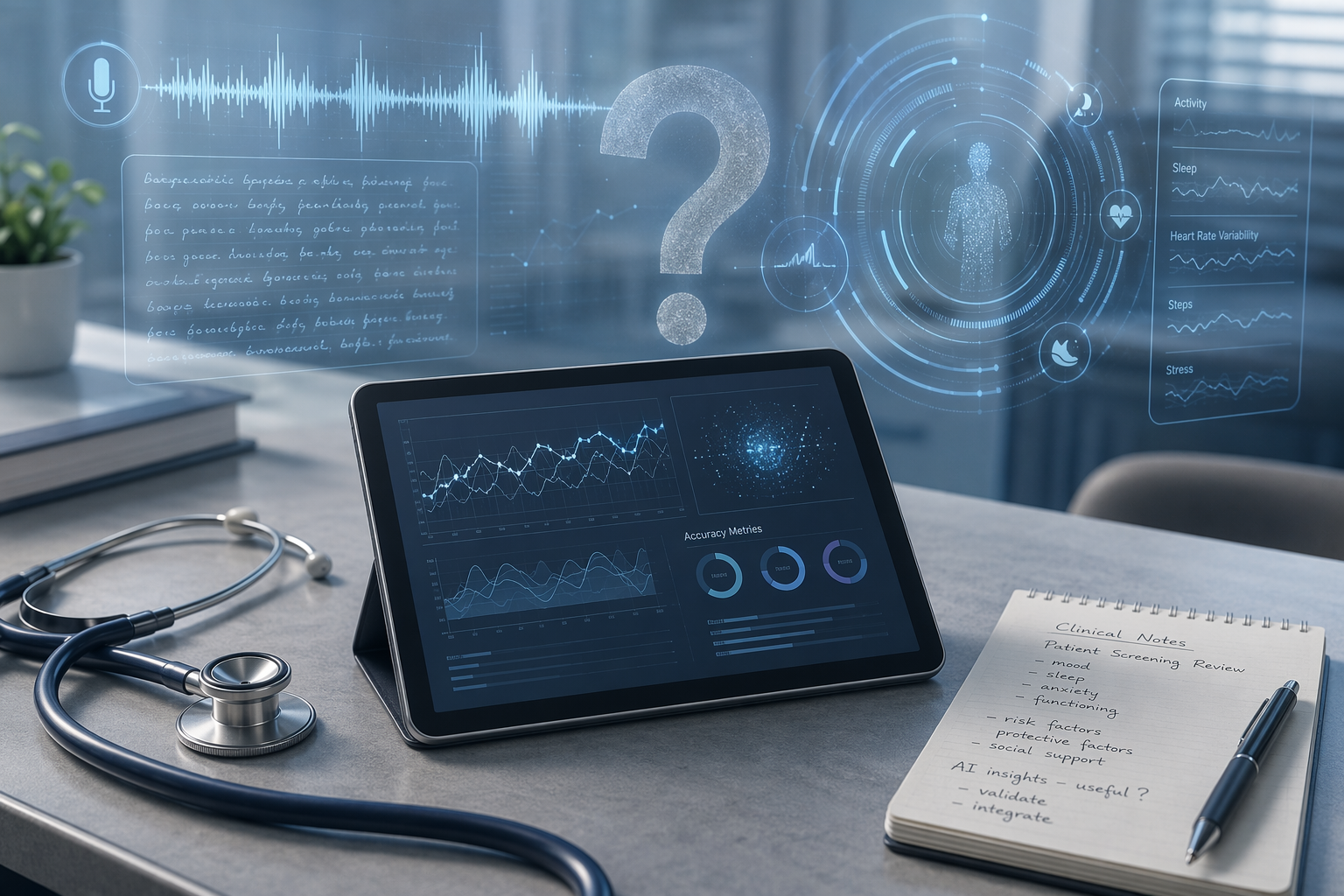
What the Accuracy Numbers Actually Measure
The umbrella review by Yeasmin and colleagues is useful because it puts many of the headline claims into one frame. It synthesized 29 reviews covering AI methods for mental health monitoring across natural language processing, voice, multimodal data, and wearable signals, and reported diagnostic accuracy ranging from 78% to 92%.[1] That range captures why the field attracts attention: speech patterns, text content, sleep and activity signals, and structured clinical data can all contain information that routine care may miss or collect too late.
But a range this broad should slow interpretation rather than settle it. It mixes conditions, methods, sample sources, and validation designs. A model trained to distinguish depressed from non-depressed participants in a curated dataset is not answering the same clinical question as an intake tool used in primary care among patients with pain, insomnia, substance use, trauma histories, and overlapping anxiety symptoms. In mental health assessment, the denominator matters: who was invited, who declined, who was already diagnosed, who was comorbid, and who was followed long enough to know whether the screening label held.
The 2026 Frontiers scoping review widens the picture. It reviewed 31 reviews and concluded that AI shows broad promise across psychiatric diagnosis, monitoring, and treatment, including the 85% diagnostic accuracy figure.[2] Its limitation is equally important: the review explicitly did not conduct an independent risk-of-bias assessment of the included reviews.[2] That does not make its synthesis unusable, but it does mean the headline estimate should not be treated as a clean pooled clinical truth.
Rony and colleagues’ 2025 systematic review and meta-analysis also supports the general conclusion that AI systems can perform well in psychiatric diagnostic and therapeutic tasks.[3] The useful reading is not that the field has crossed a deployment threshold. It is that enough signal exists to justify serious evaluation under conditions that resemble care, not just model development.
| Evidence layer | What it can support | What it cannot support by itself |
|---|---|---|
| Internal validation | A model can detect patterns in the development dataset and may separate cases from controls with strong apparent accuracy. | The model will perform similarly in another health system, culture, device setup, or clinical workflow. |
| External validation | Performance is tested outside the original development environment, giving a better estimate of portability. | The model improves outcomes or is safe to use without defined clinical governance. |
| Prospective deployment study | The tool can be observed inside a real workflow, including referral load, missed cases, clinician response, and follow-up. | The tool is appropriate for autonomous diagnosis unless the study was designed to test that use. |
| Regulatory clearance | A regulator has reviewed a defined device claim for a defined intended use. | The tool is universally valid across all psychiatric settings or populations. |
The Validation Gap Is the Main Clinical Issue
Internal validation is not meaningless. It can reveal whether a proposed signal is worth pursuing. If a voice model, language classifier, or wearable-derived feature set cannot perform in a controlled dataset, there is little reason to move it into a waiting room. The problem begins when internal performance is presented as though it were already portable.
The review literature repeatedly points to a shortage of external validation. Yeasmin and colleagues highlight the scarcity of externally validated performance across the AI mental health monitoring literature.[1] The broader evidence base is consistent on the same point: when models are externally or prospectively validated, performance is scarce and typically lower than internal estimates. That attenuation is not a technical footnote. It is the difference between a model that recognizes its own dataset and a tool that can be trusted when the next patient does not look like the training population.
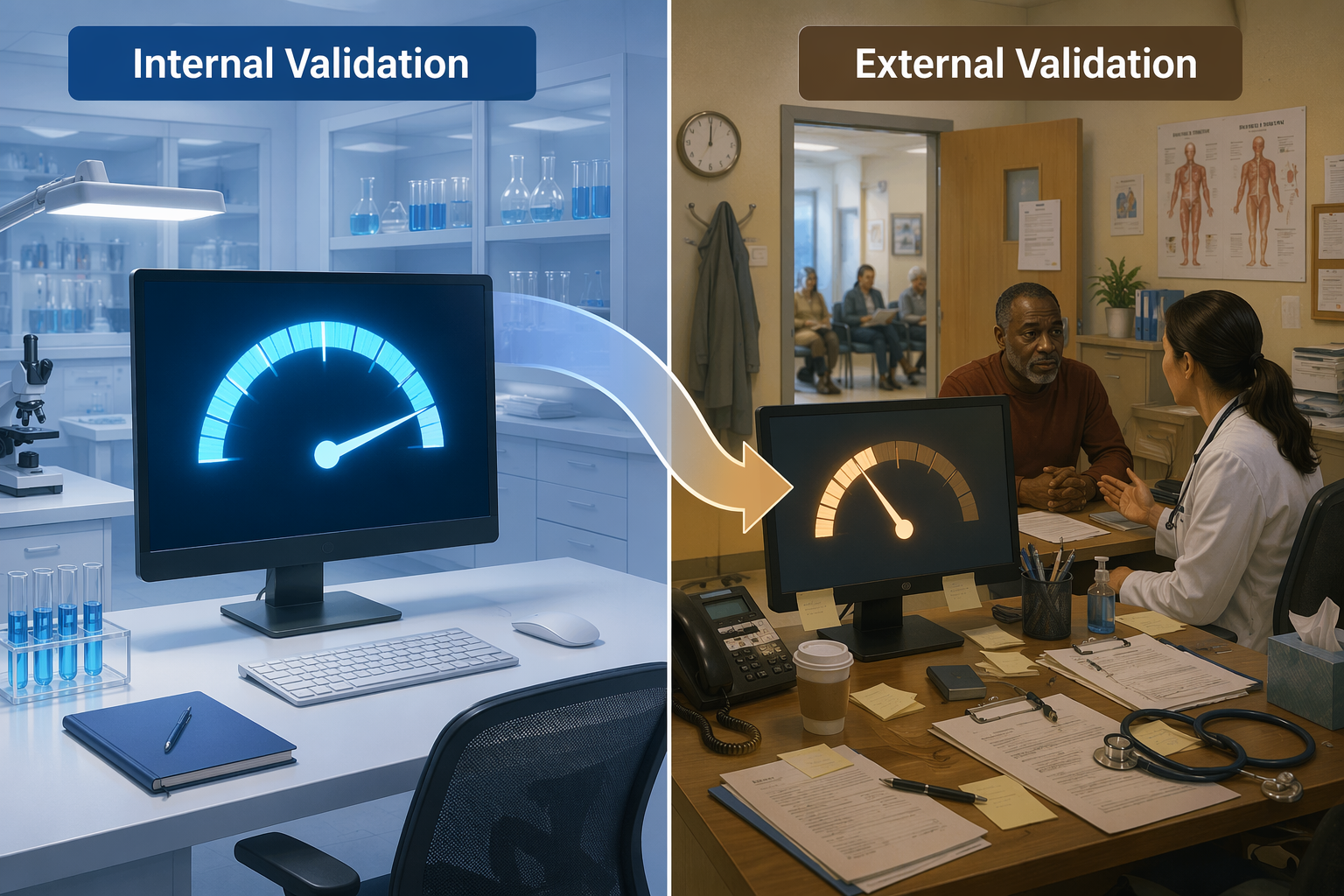
This matters more in psychiatry than in many narrowly bounded prediction tasks. Screening for depression, anxiety, psychosis risk, suicide risk, or eating disorder symptoms is not simply a pattern-recognition exercise. The same speech slowing may reflect depression, medication effects, neurological illness, sleep deprivation, intoxication, or cultural communication style. The same activity signal may reflect low mood, shift work, caregiving, chronic pain, or economic constraint. A model can be statistically impressive and still clinically under-specified.
False positives and false negatives also have different operational costs. A high-sensitivity screening tool may send more patients into already stretched assessment pathways. A high-specificity tool may miss people whose distress is atypical, masked, or underrepresented in the training data. In a paper, these trade-offs appear as threshold choices. In a clinic, they become calls to patients, safety planning decisions, referrals, waiting lists, documentation burdens, and sometimes reassurance that should not have been given.
External validation is therefore not a methodological luxury. It is the minimum test of whether an AI screening signal is still informative after the original study conditions have been removed. Prospective validation adds another layer: it can show whether clinicians act on the output, whether patients accept the process, whether follow-up confirms or contradicts the flag, and whether the tool changes care rather than merely scoring a dataset.
Modality Changes the Meaning of “Accurate”
The phrase AI in mental health screening and assessment hides several different technologies. They do not collect the same signal, fail in the same way, or belong at the same point in care.
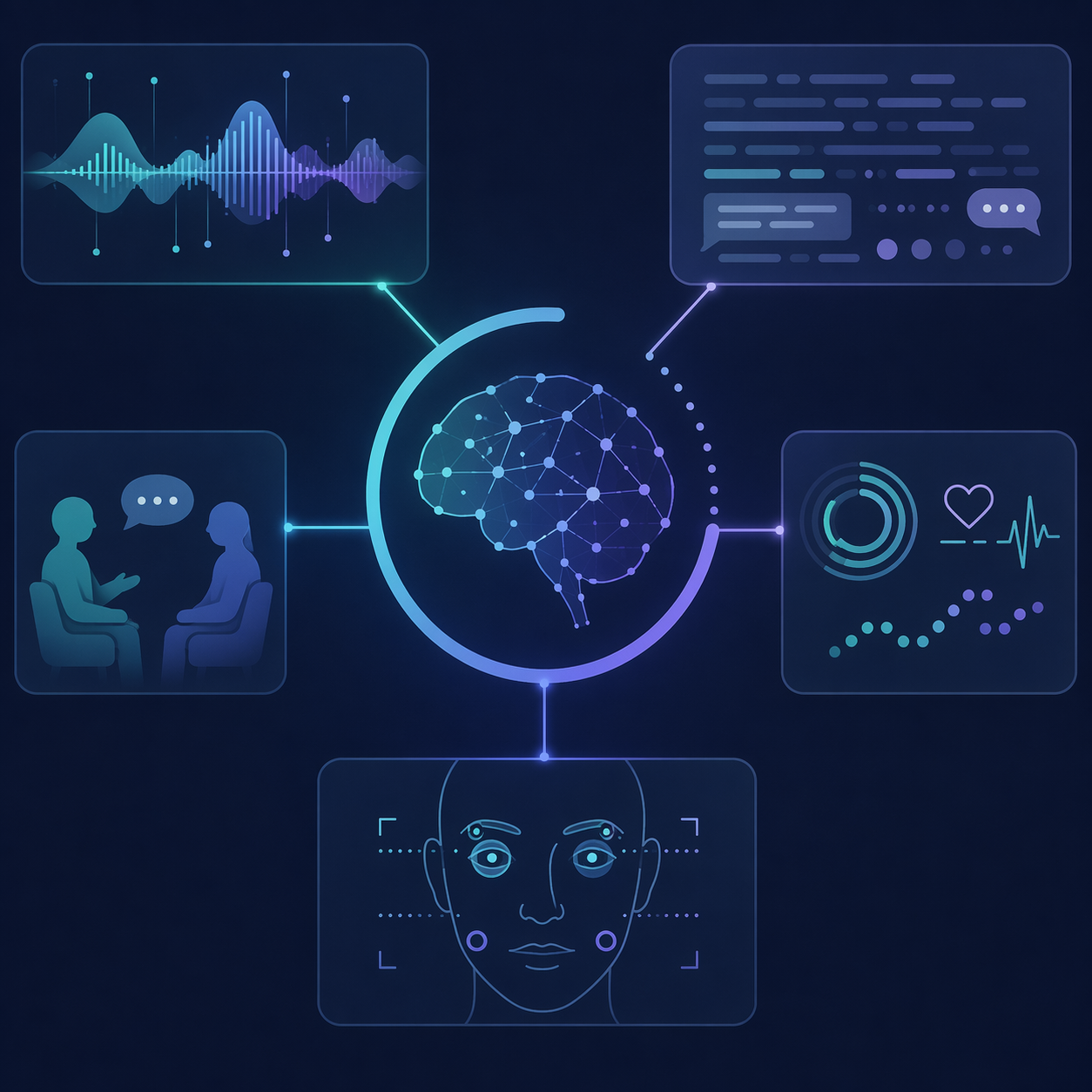
Natural language processing models analyze what people write or say: symptom descriptions, social media posts, intake narratives, journal entries, or responses to structured prompts. Their appeal is obvious. Mental health care is language-rich, and shifts in hopelessness, rumination, threat perception, or self-reference may appear before a formal visit. But language models are sensitive to context. Dataset source, prompt design, privacy constraints, dialect, age, culture, literacy, and platform behavior can all change what the model is really measuring.
Voice-based systems draw from acoustic features such as prosody, rhythm, pauses, pitch variation, and vocal energy. These signals may be clinically interesting, especially for depression, anxiety, and some neuropsychiatric states. They are also vulnerable to recording quality, microphone type, room noise, language, respiratory illness, medication effects, and conversational setting. A voice sample collected through a scripted research protocol is not equivalent to a hurried primary care screen or a telehealth intake with poor audio.
Wearable AI has a different evidentiary profile because it can capture longitudinal behavior rather than a single answer. A 2023 systematic review and meta-analysis of wearable AI for detecting anxiety reported 82% accuracy, 79% sensitivity, and 92% specificity.[4] A related 2023 scoping review reported wearable AI for depression reaching up to 89% accuracy.[5] Both reviews still concluded that these tools were not ready for routine clinical use.[4][5]
That caveat is not a contradiction. Wearables can record sleep, activity, heart rate, and related physiological or behavioral patterns at a scale that clinical interviews cannot. Yet those measures are indirect. Reduced activity can accompany depression, but it can also reflect injury, caregiving, unemployment, long work hours, religious observance, weather, unsafe neighborhoods, or device nonuse. High specificity in a study does not automatically translate into a clean clinical action when the patient population is more complex.
Multimodal systems attempt to combine several of these streams: language, voice, facial expression, movement, wearable data, and sometimes electronic health record variables. In principle, this is attractive because psychiatric assessment is already multimodal. A clinician listens to content, tone, posture, sleep history, functioning, medications, and collateral information. But multimodal AI can also make validation harder. When a model improves, it may be unclear which signal carried the performance, which subgroup benefited, and what happens when one input is missing or degraded.
| Modality | Clinical promise | Validation concern |
|---|---|---|
| Language and NLP | Captures symptom content, self-description, and possible early distress signals. | Highly dependent on prompt, platform, language, culture, and dataset source. |
| Voice | May detect acoustic changes associated with mood or anxiety states. | Sensitive to recording conditions, language, illness, medication, and context. |
| Wearables | Tracks sleep, activity, and physiological patterns over time. | Signals are indirect and may reflect social, medical, or environmental factors. |
| Multimodal models | Can combine behavioral, linguistic, and physiological signals. | Harder to interpret, externally validate, and deploy when inputs vary. |
| AI-assisted interviews | May standardize questioning and support symptom elicitation. | Needs evidence that the interview output improves assessment without missing nuance. |
AI-Assisted Interviewing Is Promising, but It Is Still an Assessment Aid
AI-assisted clinical interviewing deserves separate attention because it sits closer to familiar mental health practice than passive sensing does. A 2025 Scientific Reports study examined generative AI-assisted clinical interviewing of mental health, adding to evidence that conversational systems may help structure symptom collection or support screening workflows.[6] The clinically relevant question is not whether a model can ask plausible questions. It is whether the resulting interview improves case detection, preserves rapport, handles ambiguity, escalates risk appropriately, and avoids narrowing the patient’s story to what the model is prepared to classify.
A structured interview can reduce omissions. It can also create a false sense of completeness. Psychiatric assessment often turns on inconsistencies, hesitations, nonverbal shifts, family context, substance use, trauma exposure, and the patient’s reason for choosing one word instead of another. These are not impossible for AI systems to help organize, but the current evidence does not justify treating AI interview output as an autonomous diagnostic conclusion.
Treatment Chatbots Add Momentum, Not Diagnostic Proof
The treatment literature is relevant because it shows how quickly conversational AI is moving into mental health care, but it should not be folded into diagnostic accuracy claims. Therabot, a generative AI therapy chatbot, was tested in a randomized trial with 210 participants and 8 weeks of follow-up.[7] The trial reported effect sizes of d=0.85 to 0.90 for major depressive disorder and d=0.63 to 0.82 for eating disorder risk, with therapeutic alliance comparable to human therapists.[7] For a field with relatively little randomized evidence, that is notable.
It remains treatment evidence, not proof that AI screening and assessment tools are ready for routine autonomous deployment. The Therabot study was a single trial, not yet replicated, and its follow-up was short.[7] A 2023 systematic review and meta-analysis of AI-based conversational agents reported small-to-moderate effects for depression outcomes, with standardized mean differences around 0.2 to 0.6 across studies.[8] These findings suggest conversational agents can influence symptoms under study conditions. They do not establish that a chatbot can reliably diagnose, triage, or rule out mental illness in general clinical populations.
Regulatory Status Matches the Evidence Gap
The absence of FDA clearance for the tools described is not an isolated regulatory detail. It fits the evidence pattern: strong proof-of-concept performance, limited external validation, limited prospective deployment evidence, and uncertainty about intended use. A model that flags probable depression from a voice sample, wearable pattern, or intake response may sound clinically specific, but clearance depends on a defined device claim, a defined population, a defined workflow, and evidence that supports that use.
Vendor-reported data can be useful for understanding product direction, but it should not carry the same evidentiary weight as peer-reviewed validation. Company materials from voice or interview AI firms may report performance statistics, customer pilots, or workflow claims. Unless those claims are independently peer-reviewed and tested outside the development environment, they remain product disclosures rather than clinical evidence.
Generalizability is another unresolved boundary. Much of the AI mental health evidence base remains Western-centric, leaving open questions about performance across languages, cultures, socioeconomic groups, and care settings. This is not only a fairness concern. It is an accuracy concern. A screening model that performs well in one demographic context may change its error profile when language use, help-seeking behavior, symptom expression, device access, or baseline risk differs.
What the Evidence Supports Now
The defensible conclusion is narrower than the strongest accuracy figures suggest. AI tools for mental health screening and assessment can detect meaningful signals in research datasets, and some modalities report impressive internal performance. The review-level evidence supports continued development, careful assisted-screening research, and targeted evaluation in controlled clinical workflows.
It does not support routine autonomous clinical deployment. The gap is not simply that more studies would be nice. The missing evidence is the kind that tells a clinician what happens when the tool is used with real patients, real comorbidity, real recording conditions, real follow-up constraints, and real consequences for missed or overcalled distress.
So the most accurate answer to “How accurate is AI in mental health screening and assessment?” is conditional. In internal validation, published tools often look strong, with diagnostic accuracy commonly reported between 78% and 92%.[1] Under the validation standards needed for clinical trust, the evidence is less settled. Until external and prospective studies become routine, and until tools have cleared defined regulatory pathways for defined uses, AI belongs in mental health assessment as a promising research and assistive technology, not as an independent diagnostic authority.
References
- Artificial Intelligence for Mental Health Monitoring: A Solution for Digital Behavioral Health Care and Education—An Umbrella Review. PMC, 2025.
- Artificial intelligence in mental health care: a scoping review of reviews. Frontiers in Psychiatry, 2026.
- Artificial Intelligence in Psychiatry: A Systematic Review and Meta-Analysis of Diagnostic and Therapeutic Efficacy. PMC, 2025.
- Wearable Artificial Intelligence for Detecting Anxiety: Systematic Review and Meta-Analysis. PMC, 2023.
- Wearable Artificial Intelligence for Anxiety and Depression: Scoping Review. PMC, 2023.
- Generative AI-assisted clinical interviewing of mental health. Scientific Reports, 2025.
- Randomized Trial of a Generative AI Chatbot for Mental Health Treatment. NEJM AI, 2025.
- Systematic review and meta-analysis of AI-based conversational agents for promoting mental health and well-being. Nature Digital Medicine, 2023.
Comments
Join the discussion with an anonymous comment.