People are already asking large language models for help with panic, nightmares, dissociation, relationship fallout, and the long afterlife of trauma. That use is no longer a speculative edge case: the TRUST framework notes recent evidence that roughly 1 in 4 U.S. adults has used LLMs for mental health guidance.[1] The clinical evidence, however, has not moved at the same speed. For trauma survivors, that gap matters because an answer that sounds supportive can still mishandle risk, reinforce avoidance, miss coercion or suicidality, or give a clinician a harder repair job later.
The right question, then, is not whether AI in mental health support for trauma survivors is interesting. It clearly is. The question is whether the evidence supports using these tools as trauma care. As of Q3 2026, the strongest chatbot evidence comes from adjacent mental health populations, while the trauma-specific validation standard remains unmet.

Therabot is the trial that makes the field harder to dismiss
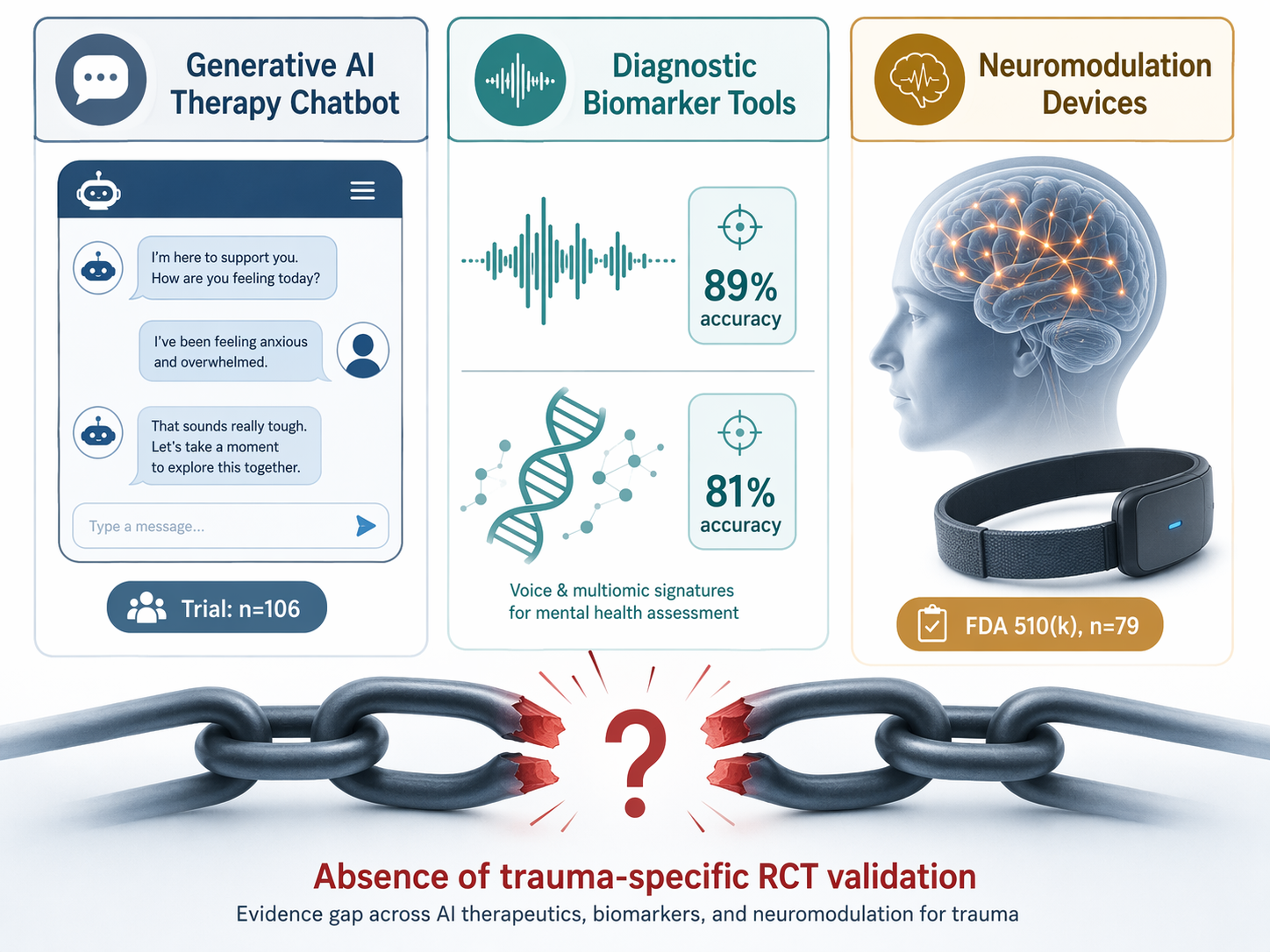
Therabot deserves early attention because it is not just another wellness chatbot announcement. Dartmouth described it as the first clinical trial of a generative AI therapy chatbot, tested over 8 weeks in 106 participants with major depressive disorder, generalized anxiety disorder, or eating disorder concerns.[2] Reported symptom reductions were substantial: depression symptoms fell by 51%, anxiety symptoms by 31%, and eating disorder symptoms by 19%.[2]
Those numbers are clinically relevant because they concern symptom domains that often overlap with trauma presentations. Many trauma survivors first present with depression, anxiety, sleep disruption, shame, somatic distress, or disordered eating rather than a neatly labeled PTSD complaint. A tool that helps a user describe internal states, tolerate distress long enough to seek care, or practice structured coping could reduce real friction in the path to treatment.
But the boundary of the Therabot evidence is just as important as the result. This was not a PTSD trial. It did not establish efficacy for trauma-focused treatment, did not test trauma-processing protocols, and did not answer whether a generative chatbot can safely manage the clinical contingencies that arise when trauma material emerges. The trial supports the narrower conclusion that a generative AI therapy chatbot can produce meaningful symptom reductions in selected general mental health conditions under study conditions. It does not validate a trauma intervention.
That distinction is not methodological fastidiousness. In trauma care, the problem is often not simply whether a patient reports fewer symptoms after contact with a supportive tool. It is whether the intervention handles avoidance, exposure, dissociation, shame, interpersonal threat, substance use, self-harm risk, and destabilization in a way that is consistent with trauma-informed clinical care. Adjacent improvement is encouraging; it is not interchangeable with trauma-specific efficacy.
The trauma-specific evidence gap is still the load-bearing fact
The clearest clinical anchor is the June 2026 TRUST framework in the Journal of Traumatic Stress. Its conclusion is blunt: no AI technologies for trauma have been evaluated in adequately powered randomized controlled trials.[1] That statement should sit in the foreground of any discussion about AI tools for trauma survivors, because it separates plausible use cases from validated care.
An adequately powered RCT is not the only way to learn about a technology, but it is hard to bypass when claims move from “support,” “triage,” or “engagement” into treatment. Trauma interventions need evidence about symptom endpoints, adverse events, dropout, subgroup effects, comparator conditions, and the clinical population actually being served. Without that, implementation risk falls downstream: on the survivor who may rely on the tool, the clinician who may inherit the consequences, and the health system that may mistake access for effectiveness.
Held and colleagues’ 2025 discussion of five AI use cases in PTSD treatment helps explain why interest is rational rather than merely commercial: AI might assist with screening, measurement-based care, personalization, clinical decision support, or between-session support.[3] Those are plausible application areas. They are not proof that any particular tool improves PTSD outcomes.
| Evidence category | What the evidence suggests | What it does not establish |
|---|---|---|
| Generative AI therapy chatbot | Therabot showed 8-week symptom reductions in depression, anxiety, and eating disorder symptoms among 106 participants. | It does not validate chatbot treatment for PTSD or trauma-specific clinical populations. |
| Trauma/PTSD AI intervention | Use cases are clinically plausible and actively discussed in the traumatic stress literature. | The TRUST framework reports no adequately powered RCTs of AI technologies for trauma. |
| Diagnostic AI biomarkers | Voice and blood-based markers show research-stage signal for PTSD classification. | They are not FDA-cleared PTSD diagnostic tools. |
| Neuromodulation / neurofeedback | GrayMatters Prism has FDA 510(k) clearance for PTSD-related use based on a 79-patient study. | It is not an AI therapy chatbot and should not be used as evidence that chatbots are cleared or validated. |
The field is not empty; it is fragmented
It is easy to make the evidence look larger than it is by grouping every AI-adjacent PTSD project into one bucket. That obscures the clinically relevant differences. A chatbot that delivers conversational support, a voice model that classifies PTSD likelihood, a blood-based multiomic marker, and a neurofeedback device do not answer the same question.
Voice biomarkers: promising classification, not a treatment pathway
NYU Langone researchers reported that an AI tool using voice features could distinguish PTSD from non-PTSD with 89% accuracy in a research study.[4] The signal is intriguing because speech can carry features related to affect, arousal, prosody, and cognitive load. If validated across settings and populations, voice-based tools could eventually support screening or measurement workflows.
The limitation is category-specific. Classification accuracy does not tell us whether a tool improves outcomes, prevents missed diagnoses, avoids false reassurance, or performs equitably across accents, languages, age groups, sex, race, and comorbid conditions. A diagnostic aid also does not become an intervention because it uses AI.
Blood-based multiomic markers: another diagnostic signal
A 2025 overview of AI in PTSD describes blood-based multiomic markers with 81% accuracy for PTSD classification.[5] That finding belongs in the same broad diagnostic landscape as voice biomarkers: it suggests measurable biological signal, not a deployable stand-alone clinical answer.
For trauma care, biomarker research may eventually help with stratification, risk prediction, or treatment matching. At present, the clinically conservative interpretation is narrower. These are research-stage markers, and the brief evidence available here does not support treating them as FDA-cleared PTSD diagnostics.
GrayMatters Prism: regulated, relevant, and not a chatbot
GrayMatters Health received FDA 510(k) clearance for Prism, described as a non-invasive self-neuromodulation digital therapy for PTSD, with clearance based on a 79-patient study.[6] This matters because it shows that regulated digital interventions for PTSD are not hypothetical.
It also needs to be kept in its lane. Prism is a neurofeedback or neuromodulation pathway, not a generative AI therapy chatbot. Its clearance cannot be borrowed to imply that conversational AI tools are FDA-cleared for trauma, or that chatbot support has met the same regulatory threshold.
Safety concerns are clinical applicability concerns
The safety issues around AI mental health tools are sometimes presented as abstract ethics problems. In trauma care, they are more immediate. Documented harms in the broader chatbot literature include unsafe eating disorder advice, suicide encouragement, and depressive symptom increases among high engagers; the TRUST framework treats safety monitoring as a central requirement for AI work in traumatic stress rather than a peripheral concern.[1]
Model drift is one practical reason. A tool evaluated at one point in time may change after updates to the base model, retrieval system, guardrails, or system instructions. If the intervention changes, the evidence may no longer describe the thing patients are using. Trauma care is especially sensitive to this problem because small changes in how a system responds to disclosure, blame, coercion, self-harm, or traumatic memory can alter risk.
Bias is another. A model that performs acceptably in an average sample can still fail people whose trauma histories are shaped by racism, migration, military service, incarceration, intimate partner violence, language barriers, disability, or distrust of institutions. The Lu et al. 2026 trauma-informed care chatbot survey is useful as a design signal, but its sample of 606 was predominantly White at 75.2%, English-speaking, and crowdsourced, which limits generalizability to clinically diagnosed trauma populations.[1]
Non-U.S. implementation data should be read with the same care. The IMHAS study in China reported reductions of 4.5 points on PHQ-9 and 3.8 points on GAD-7 among social assistance recipients, which is an encouraging signal for access-oriented mental health support.[1] It does not settle whether the same approach is effective, acceptable, or safe for U.S. clinical trauma populations.
What can be said in Q3 2026
The evidence now supports serious study of AI tools for trauma survivors. Therabot makes generative AI mental health intervention harder to dismiss. Voice and blood-based PTSD classifiers suggest measurable diagnostic signal. GrayMatters Prism shows that a regulated digital PTSD pathway can reach FDA 510(k) clearance. The application space is real.
The evidence does not support marketing AI chatbots as validated trauma care. As of Q3 2026, there is no adequately powered RCT validating an AI intervention for trauma or PTSD, no FDA-cleared trauma chatbot, and no settled answer to safety, equity, or model-drift risks. The clinically honest position is calibrated: study these systems, define their responsibilities, monitor their failures, and do not confuse adjacent mental health evidence with PTSD-specific proof.
References
- Trauma Research and Understanding Through Strategic Technology (TRUST) Framework. Journal of Traumatic Stress. June 2026.
- First Therapy Chatbot Trial Yields Mental Health Benefits. Dartmouth. March 2025.
- Five AI use cases in PTSD treatment. Journal of Traumatic Stress. 2025.
- Using Artificial Intelligence to Identify Post-Traumatic Stress Disorder. NYU Langone Health.
- Current Status and Future Directions of AI in PTSD. Behavioral Sciences. 2025.
- GrayMatters Health receives FDA 510(k) for PTSD neuromodulation therapy. MobiHealthNews.
Comments
Join the discussion with an anonymous comment.