
The first patient-rights question about AI monitoring in forced hospitalization is not whether the camera detects movement, the wearable notices agitation, or the model flags suicide risk. It is what refusal means for a person who is already behind a locked psychiatric door.
An involuntary patient may be told that a new system is being used for safety. They may be watched by AI-enabled CCTV, asked to wear a device, or have notes and observations analyzed for warning signs. The stated aim may be entirely serious: preventing self-harm, violence, missed deterioration, or death. Staff and families are often frightened for good reason. Psychiatric wards can become unsafe quickly, and a missed cue can have irreversible consequences.
But forced hospitalization changes the moral weight of every monitoring decision. A patient who cannot freely leave cannot be treated as though they are negotiating on ordinary clinical terms. If refusal leads to more observation, more suspicion, or a note that the patient is “noncompliant,” then consent has become a formality. The problem is not technology in the abstract. It is surveillance added to a setting where autonomy is already damaged.
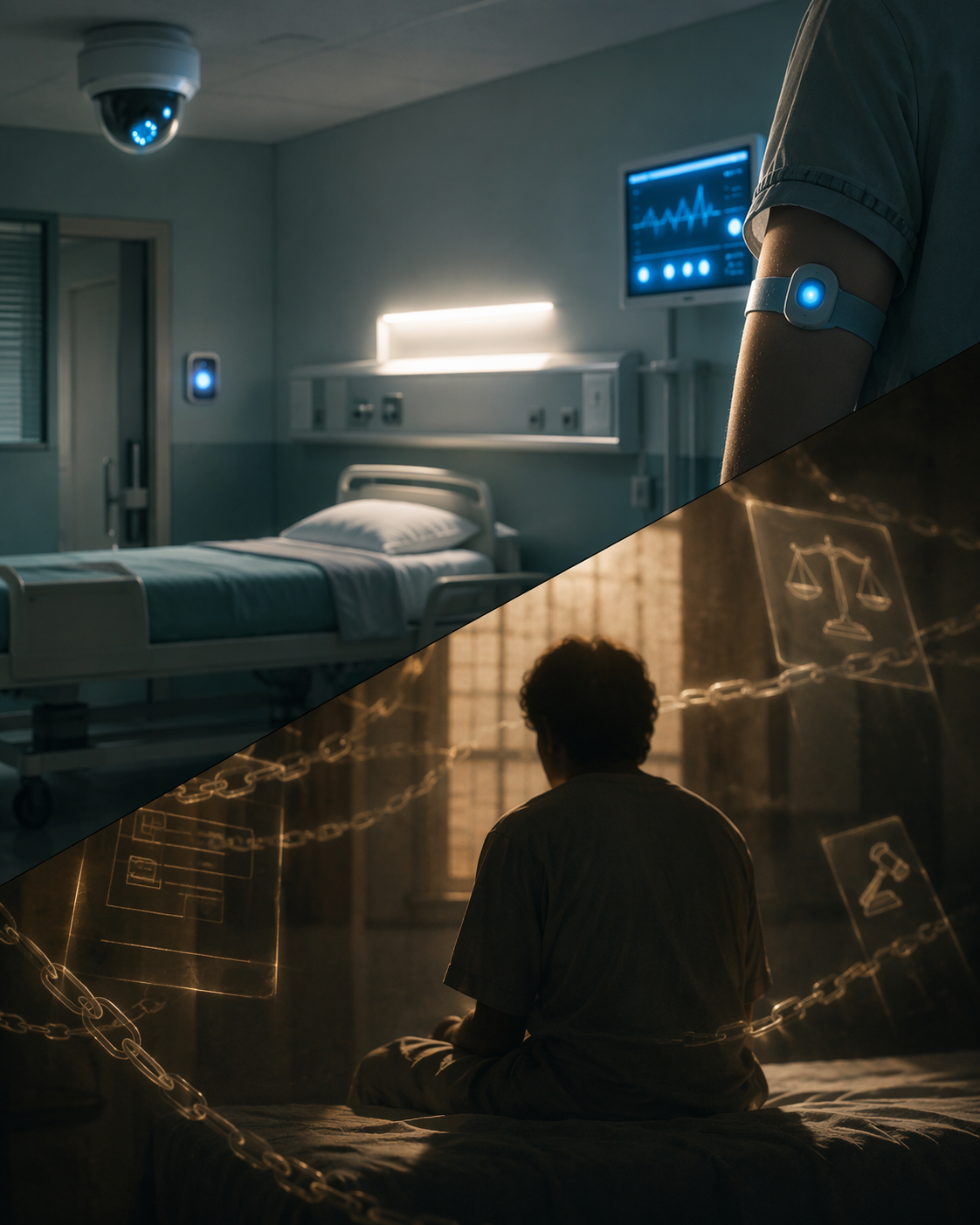
The patient may not even know the legal position they are in
Consent arguments often begin too late. They imagine a patient who understands their status, understands the technology, weighs the risks, and then says yes or no. In involuntary psychiatric care, that picture is often unrealistic before AI enters the room.
A 2024 scoping review of 112 studies found that 12% to 45% of involuntary psychiatric patients may not know their legal status.[1] That is not a minor paperwork defect. Legal status determines whether a person can leave, what review rights they have, how treatment can be imposed, and what kind of pressure they may reasonably feel when staff present a new monitoring system.
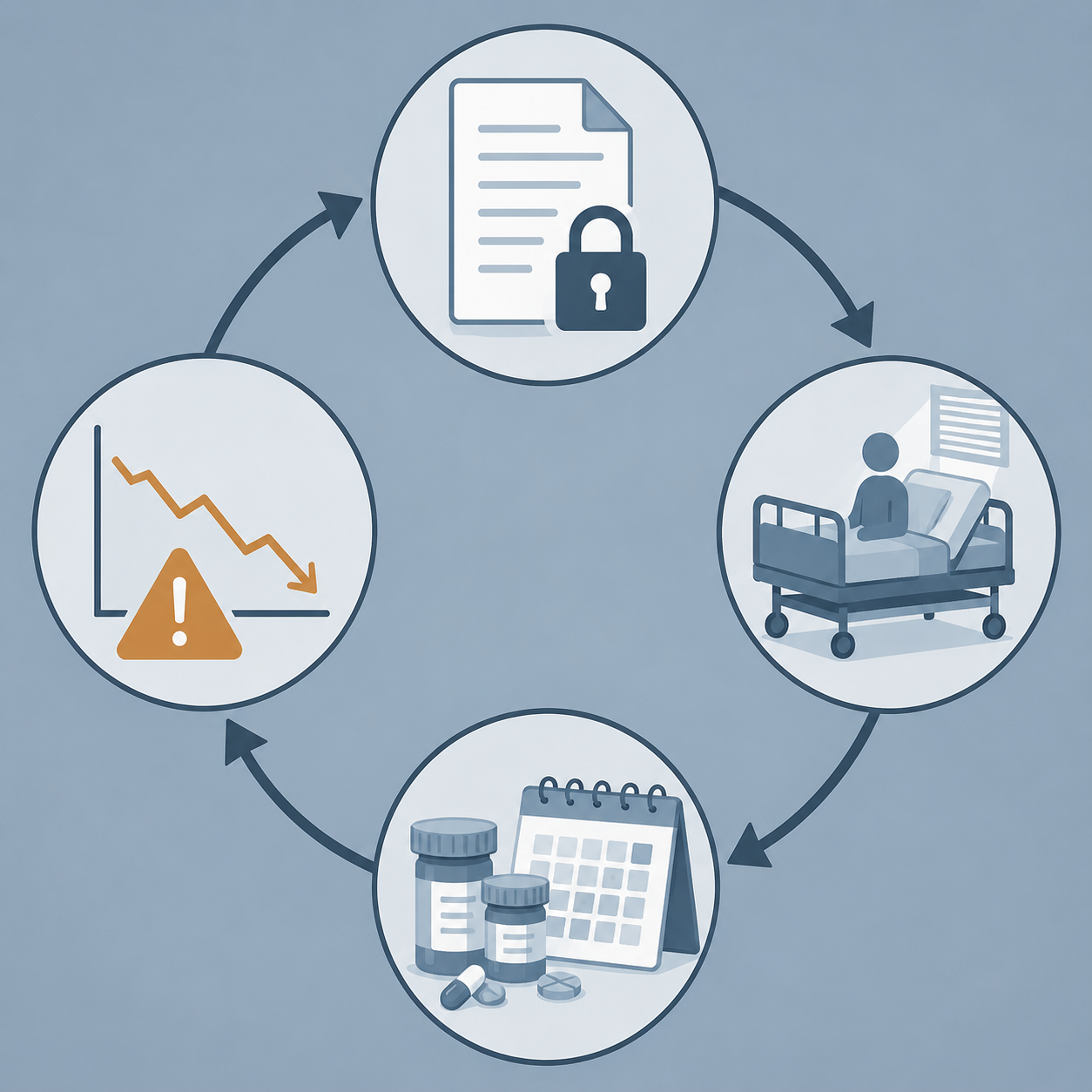
The same review describes a broader “cycle of coercion” after involuntary admission: more seclusion, more restraint, more polypharmacy, longer stays, and lower satisfaction.[1] These are not identical harms, and they should not be collapsed into a single grievance. Together, though, they show why consent in this setting is structurally fragile. The patient is not merely choosing among clinical options. They are living inside an institutional process that can tighten around them.
That matters because coercion is not only a legal category. The review cites a separate meta-analysis finding that involuntary admission was associated with an 87% increased suicide risk.[2] It also cites work by Jordan and McNiel reporting that perceived coercion during admission predicted post-discharge suicide attempt even after adjustment for legal status.[3] The distinction is crucial: what the patient experiences may matter beyond whether the chart says the admission was voluntary or involuntary.
AI monitoring enters this terrain carrying the language of safety, but safety language does not cancel the patient’s perception of being watched, classified, and managed. A system can be installed to prevent suicide and still deepen the very sense of coercion that patient-rights frameworks are supposed to restrain.
Why the prison-surveillance analogy is tempting, and why it is dangerous
The appeal of AI monitoring is easy to understand on a ward where staff cannot be everywhere at once. Solaiman et al. describe AI-CCTV, wearable systems, and suicide-prediction tools as technologies that resemble systems used in custody settings, including prison surveillance tools reported to detect self-harm up to 30 minutes before incidents.[4] If a similar warning could give nurses time to intervene before a patient dies, dismissing the technology outright would be too easy.
Yet the same analogy exposes the danger. Solaiman et al. warn that “inpatients are not inmates.”[4] A psychiatric ward is not a prison, even when doors are locked and liberty is restricted. Its purpose is treatment, not punishment. Its authority is justified by care, not sentence. Importing prison-style surveillance logic into that setting risks changing the meaning of the ward itself.
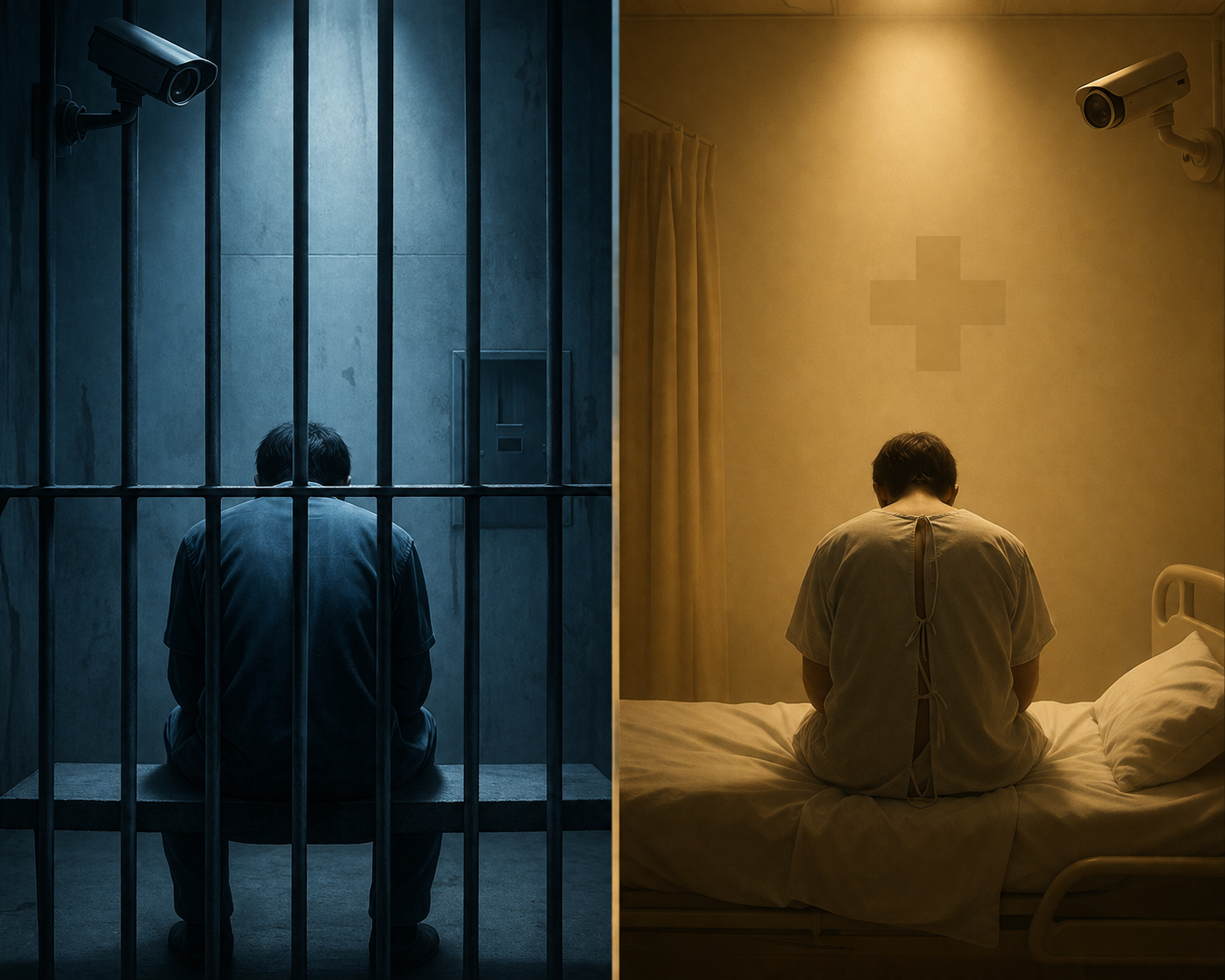
That change may be subtle. A camera is justified as observation. A wearable is justified as early warning. A risk score is justified as decision support. Then the patient who objects is described as lacking insight, increasing risk, or refusing safety measures. The technology has not formally removed a right, but it may have made the exercise of that right costly.
There is also a regulatory fact that should slow procurement enthusiasm. Solaiman et al. reported that, as of 2023, there were no FDA-approved AI systems specifically for psychiatric ward use.[4] That does not mean every pilot is unlawful or every tool is useless. It does mean that psychiatric inpatient deployment sits in a gap between clinical need, medical-device oversight, privacy law, mental health law, and institutional risk management.
Consent to care is not consent to surveillance, and surveillance is not consent to data reuse
In ordinary medical care, consent already has limits. Patients may agree to treatment without understanding every downstream administrative or analytic use of their data. In forced hospitalization, those limits become sharper. A detained patient may accept medication, therapy, observation, or ward rules because the alternative is not practically available. That acceptance should not be stretched into blanket permission for AI surveillance or secondary use of mental health data.
Larrauri et al. argue for separate and explicit opt-in consent for AI training on mental health data, distinguishing consent to receive care from consent to data reuse.[5] Their analysis concerns digital therapy platforms rather than inpatient wards, so it should not be treated as direct evidence about locked psychiatric units. Its value here is conceptual: it names a distinction inpatient institutions often blur. Treatment, safety monitoring, quality improvement, vendor model development, and AI training are not the same transaction.
For an involuntary patient, that distinction should be operational, not decorative. A hospital may decide that certain monitoring is necessary to prevent imminent harm. That does not automatically justify using the same footage, sensor streams, notes, or behavioral labels to train or refine commercial systems. Where meaningful consent is impossible because refusal has no practical force, the institution should not pretend it has obtained voluntary opt-in. It should rely on a different legal and ethical basis, narrow the use, document the necessity, and subject the decision to independent oversight.
The disclosure problem is not theoretical. A 2026 Censinet regulatory analysis reported that 63% of patients want to be informed when AI is involved in their care, while only 8% of healthcare organizations felt very confident in identifying new AI risks.[6] That combination is uncomfortable: patients want notice, while the institutions responsible for notice may not fully understand the systems they are deploying.
Weak prediction must not become a shortcut to detention
The most serious rights risk is not a false alarm that brings a nurse to the door. It is the gradual use of algorithmic risk as evidence for coercive decisions: continued detention, increased observation, seclusion, restraint, forced medication, or delayed discharge.
Research-grade prediction does not carry that burden well. Pan et al.’s meta-analysis of AI models distinguishing bipolar disorder from depression reported mean sensitivity of 0.84 and specificity of 0.82.[7] Those figures may be promising for research and may help frame future diagnostic-support tools. They are not the kind of certainty that should decide whether a person remains deprived of liberty.
Even strong-looking performance metrics can mislead at the bedside. Sensitivity and specificity do not tell staff how a model performs in their ward population, with their documentation habits, staffing levels, patient mix, medication practices, and thresholds for intervention. They do not say whether the model is equally reliable across diagnoses, race, language, disability, trauma history, or legal status. They also do not decide what should happen after an alert.
That last step is where rights are often lost. A risk score can look like a neutral fact when it is really an input into a judgment. If staff communicate an AI alert as “the system says you are high risk,” the patient may experience it as another accusation that cannot be answered. If the alert is used to justify a restriction without explanation, review, or appeal, the system has become more than monitoring. It has become part of the coercive machinery.
Existing law strains under this use case
Mental Health Acts, HIPAA, ECHR Article 8 privacy protections, and medical-device rules all touch parts of this problem, but none fits it cleanly. Mental health law explains when a person may be detained or treated without ordinary consent. Privacy law governs health information and, in some jurisdictions, the proportionality of interference with private life. Device regulation asks whether a tool is safe and effective for its intended use. AI monitoring in forced hospitalization crosses all of those boundaries at once.[4]
A hospital cannot solve that mismatch by choosing the most convenient frame. If the system is treated only as a security camera, its clinical influence may be underregulated. If it is treated only as clinical decision support, its surveillance character may be minimized. If it is treated only as a privacy issue, the liberty consequences may disappear from view. If it is treated only as an innovation project, the detained patient becomes the least powerful participant in a trial they may not recognize as one.
The regulatory question is therefore not simply whether AI monitoring is allowed. It is which uses require which safeguards. A fall-detection camera, a self-harm alert system, a diagnostic classifier, a staff-workflow dashboard, and a data pipeline for model training do not raise identical rights questions. Institutions should not hide that diversity under the single phrase “AI safety.”
What protections follow from the evidence
The minimum protections are procedural before they are technical. They do not require pretending that inpatient psychiatry can operate without observation. They require acknowledging that observation has a different moral status when the person observed cannot leave.
| Protection | What it must mean in forced hospitalization |
|---|---|
| Explicit disclosure | Patients are told when AI is involved, what it monitors, who sees outputs, and what decisions it can influence. |
| Status-aware consent | The hospital distinguishes voluntary agreement from notice, necessity, legal authorization, and refusal without practical force. |
| Separate data-reuse permission | Consent to treatment or safety monitoring is not treated as consent for AI training, product development, or secondary analytics. |
| Limits on coercive use | AI outputs do not independently justify detention, restraint, seclusion, forced medication, or delayed discharge. |
| Independent oversight | Ethics, legal, patient-rights, clinical, and lived-experience reviewers examine deployment before and after use. |
| Communication accountability | Staff receive guidance on how to explain alerts without turning model output into an unchallengeable accusation. |
Disclosure should be concrete. “We use technology for safety” is not enough. A patient should be told whether a camera is continuously recording, whether software analyzes movement or behavior, whether a wearable streams data, whether alerts are placed in the medical record, whether vendors can access data, and whether outputs may affect leave, observation level, discharge, or legal review.
Refusal needs an honest description. If a patient can decline a wearable without penalty, say so and honor it. If the hospital believes monitoring is required despite refusal, say that too, identify the legal basis, narrow the scope, and provide a route to challenge or review. Calling the process voluntary when the patient has no practical ability to refuse only corrodes trust further.
Data reuse should be separated from bedside safety. A detained patient’s crisis should not silently become training material because a contract defines improvement broadly. Where opt-in consent is meaningful, it should be explicit. Where it is not meaningful, institutions should not use consent language to sanitize extraction. They should use stricter governance, minimization, de-identification where appropriate, and external review of whether reuse is justified at all.
The limits on coercive use should be written into policy before deployment. Staff should know that an AI alert may prompt assessment, but it is not a substitute for clinical judgment, patient interview, legal criteria, or rights review. Patients and advocates should know the same. A model that cannot explain itself to the person affected by it should have no independent authority over that person’s liberty.
None of this removes the fear that leads hospitals to adopt monitoring systems. A nurse who has found a patient after a ligature attempt will not be reassured by abstract privacy language. A family that has begged a hospital to prevent another suicide attempt will not be comforted by a lecture on algorithmic governance. The safety claim deserves to be taken seriously. But in forced hospitalization, safety cannot be the word that ends the rights analysis.
AI monitoring may be ethically defensible in psychiatric wards when it is truly necessary for safety and tightly governed. It is not defensible as a quiet expansion of custody logic into treatment. The boundary is clear: involuntary psychiatric patients need protections designed for constrained status, including explicit disclosure, separate consent for data reuse where consent is meaningful, independent oversight, limits on use in detention and rights-restricting decisions, and accountability for how recommendations are communicated to the person who must live under them.
References
- Involuntary psychiatric admission: A scoping review, PMC, 2024.
- Meta-analysis of suicide risk after involuntary admission, Large et al., 2011.
- Perceived coercion during admission and post-discharge suicide attempt, Jordan & McNiel, 2020.
- Monitoring Mental Health, Cambridge Journal of Law & Medicine, 2024.
- Reclaiming Informed Consent, Nature Digital Medicine, 2026.
- Healthcare AI risk and regulatory analysis, Censinet, 2026.
- AI models distinguishing bipolar disorder from depression: A meta-analysis, Pan et al.
Comments
Join the discussion with an anonymous comment.