
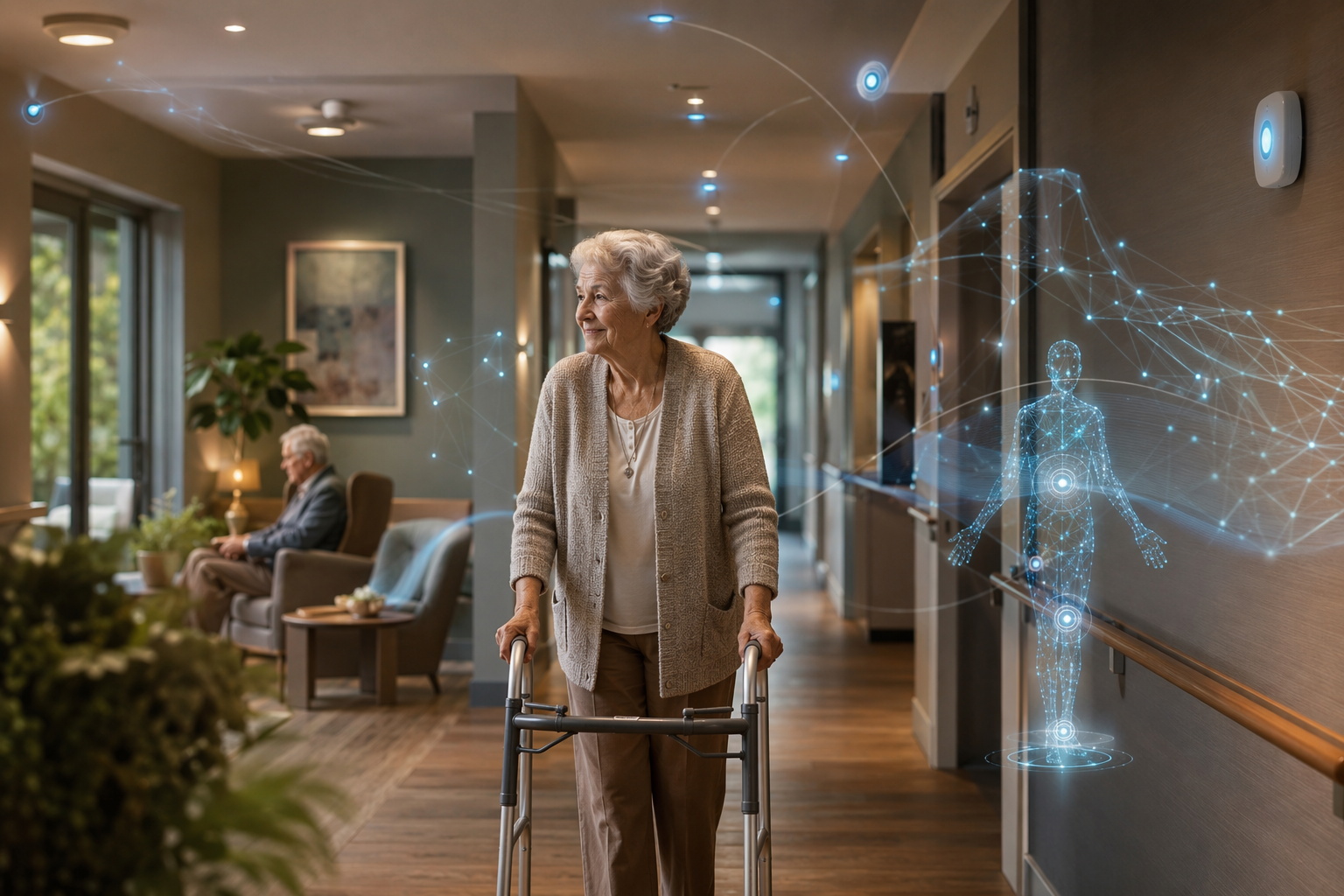
The phrase “AI applications in nursing home and elderly care” now covers a wide spread of tools: ceiling sensors that flag a resident’s changing gait, models that rank fall risk from assessment data, software that drafts nursing notes, medication dispensers that escalate missed doses, and companion robots that try to reduce loneliness or agitation. The activity is real. A LifeLoop survey of more than 100 senior living leaders reported AI use rising from 9% in 2024 to 36% in 2025, with another 35% planning adoption.[1] That is a sharp signal, though not a census of the sector; organizations willing to answer a senior living technology survey may already be more digitally prepared than the average nursing home.
The evidence is not distributed evenly. Fall prediction and detection sit on the firmest ground because that domain has actual nursing home studies, real-world sensor deployments, and a clinical outcome staff already track. Other domains are moving, but the support often comes from hospital studies, vendor disclosures, or adjacent home-care settings rather than prospective nursing home validation.
| Application area | What the AI usually does | Evidence position in nursing home and elderly care |
|---|---|---|
| Fall prediction and detection | Uses sensors, visual systems, radar, MDS data, vital signs, or ADL patterns to detect falls or estimate near-term risk | Strongest category in this brief, with modeling studies, prospective nursing home work, scoping-review caution, and real-world deployment reports |
| Predictive risk monitoring | Flags hospitalization, frailty, deterioration, infection, or readmission risk | Plausible extension of existing risk management, but much of the available material is deployment reporting or company-reported outcome data |
| Documentation and MDS coding | Drafts notes, summarizes encounters, or supports assessment and coding workflows | Operationally attractive, but current generative AI nursing evidence is mostly hospital-based |
| Medication management | Issues reminders, tracks missed doses, and escalates adherence problems | Useful workflow concept, with thin nursing-home-specific validation in the available material |
| Socially assistive robotics and companions | Provides therapeutic interaction, companionship, prompts, or passive monitoring | PARO has a distinct regulatory and peer-reviewed evidence base; newer companion AI claims are less mature and often company-reported |
Falls Are Where the Nursing Home Evidence Is Most Concrete
Falls are a natural proving ground for AI in long-term care because the event is visible, consequential, and already embedded in nursing home reporting, care planning, family communication, and quality review. A model that helps staff see risk earlier, or a sensor that shortens the time between a fall and assistance, has a clearer workflow destination than a general “resident deterioration” score with no owner.
Even within falls, the evidence should not be collapsed into one claim that “AI prevents falls.” The studies measure different things. Some estimate whether a resident is likely to fall in a future window. Some detect an event after it occurs. Some use simulated or laboratory falls. Some study actual nursing home populations. Some report model discrimination, while others report operational changes after deployment.
Mohan et al. tested a cooperative AI approach that combined fuzzy logic from vital signs with deep belief networks using activities of daily living data. Against the Morse Fall Scale, the meta-model reported 90% accuracy, 100% specificity, and 85.71% sensitivity.[2] Those numbers are worth attention because they join clinical-style inputs with machine learning rather than relying only on a black-box sensor stream. But they are still model-performance results. They do not by themselves show that a nurse receives a usable alert, that the alert is acted on, or that fall rates decline on a unit.
Kravchenko et al. is more directly interesting for U.S. nursing homes because the model used MDS 3.0 data from five nursing homes to predict 90-day fall risk. The recurrent neural network achieved an AUROC of about 0.74, outperforming a CART-logit baseline of 0.67.[3] An AUROC around 0.74 will not make a dramatic vendor slide, but the data source matters. MDS information is already collected, audited, and familiar to nursing home teams. A modest model built on existing assessment infrastructure may be more deployable than a higher-performing tool that requires new hardware, new documentation, and a second dashboard no one has time to open.
Prospective nursing home work adds another layer. Shao et al. conducted a prospective study in four nursing homes in Southern China, which is closer to real care than retrospective modeling alone, but still needs cautious translation to U.S. facilities because resident mix, staffing patterns, facility design, and documentation systems may differ.[4] That setting difference is not a reason to dismiss the study. It is a reason not to treat it as plug-and-play evidence for every skilled nursing operator.
A JAMDA scoping review gives the wider field some needed proportion. Across 73 studies in 33 countries, fall detection technologies clustered into four broad categories: motion or sensor systems, imaging or visual systems, environmental sensors, and robotic systems. The same review found that 83% of studies remained preclinical or experimental.[5] That 83% figure is the restraint that should sit beside any confident fall-tech pitch. Many systems still have not been tested in the messy places where falls happen: bathrooms, bedrooms at 2 a.m., cluttered hallways, rooms with visiting family, and units where one aide may be covering multiple high-risk residents.
The real-world deployment signal is encouraging but still needs careful reading. The New York Times reported in October 2025 that predictive AI radar sensor systems in senior homes were associated with a 40% decline in falls.[6] A reduction of that size matters because falls are not abstract utilization metrics; they can mean pain, hospitalization, fear of walking, family distress, and staff investigation time. The next questions are practical rather than philosophical: what counted as a fall, how baseline rates were established, whether resident acuity changed, how many alerts staff received, and whether the system reduced work or shifted work into a new queue.
Vision-based systems raise a slightly different implementation issue. A LeadingAge case study reported that SafelyYou’s system reached 99% fall detection accuracy and a 99.8% false alarm reduction.[7] Those are the kinds of operational measures nursing homes should care about, because false alarms determine whether staff keep trusting a system after the first month. Still, case-study evidence is not the same as a prospective controlled trial, and camera-based monitoring also has to pass facility, resident, family, and privacy review before it becomes routine care.
In practice, fall AI is not one product category. A facility choosing among these tools is choosing among different burdens: MDS-based prediction depends on data quality and assessment timing; radar or environmental sensing depends on room coverage and installation; visual systems depend on privacy governance and review workflows; wearable systems depend on resident tolerance and device management. The clinical promise is strongest when the alert has a named receiver, a plausible intervention, and a way to measure whether the intervention happened.
Predictive Risk Monitoring Is Promising, but the Proof Is Thinner
Once a facility can predict falls, it is tempting to extend the same logic to hospitalization, readmission, frailty, sepsis, urinary tract infection, or general decline. The operational appeal is obvious. Nursing homes already manage risk with incomplete information: a subtle appetite change, a new transfer pattern, a change in continence, a night-shift aide’s note that a resident “seems off.” AI could help assemble those weak signals earlier.
The available evidence in this brief, however, is less mature than the fall literature. Cera, a UK home-care company, has said its AI predicts hospitalizations and falls up to a week in advance and has claimed a 70% reduction in emergencies, with press coverage also citing independent estimates of about £1 million per day in UK government savings.[8] Those are deployment and company-reported signals, not independent nursing-home trial evidence. They may indicate where the market is heading, but they should not be read as proof that a U.S. skilled nursing facility can reproduce the same results with a different workforce, payer structure, and resident acuity profile.
The Good Samaritan Society’s use of predictive analytics for hospital readmission is a more setting-relevant example because readmission is already central to post-acute care operations.[9] But here, too, the important question is not whether a model can rank residents. It is what happens after the rank appears. Does the nurse practitioner see the alert before a transfer decision? Does the evening supervisor have authority to change monitoring? Does the medical director know which variables are driving the score? If the output only adds another red flag to an already saturated team, the model may be technically correct and operationally weak.
Documentation AI Has an Obvious Use Case and a Setting Problem
Clinical documentation is one of the most believable AI use cases in nursing homes because the pain is daily. Nurses document care, changes in condition, family calls, incident follow-up, skin checks, behavior notes, medication issues, and care-plan updates. MDS coordinators work inside a regulatory and reimbursement structure where a missing detail can become a payment, compliance, or survey problem. Ambient listening and generative drafting tools therefore do not need a futuristic story; they need to save time without creating notes staff cannot defend.
The evidence base is not yet nursing-home-centered. A 2026 BMC Nursing integrative review of 15 studies on generative AI in nursing found that 53.3% focused on workflow efficiency, 26.7% on clinical decision support, and 20.0% on patient education. Only three of the 15 studies included community settings, and the evidence was predominantly hospital-based.[10] That matters because hospital documentation AI can assume different staffing ratios, EHR maturity, device access, and clinician review patterns than a long-term care unit.
A tool such as Oler Health’s ambient listening for nursing documentation fits a recognizable need, but the nursing home version has to be judged by long-term care facts: whether it captures aide-to-nurse handoff information, whether it supports MDS-relevant language without upcoding, whether it handles family conversations appropriately, and whether nurses can correct generated text quickly enough to trust it. The danger is not only hallucination. It is a polished note that sounds complete while omitting the specific observation needed for care planning, reimbursement, or survey defense.
Medication Tools Fit the Workflow, but the Validation Is Limited
Medication management is an easier operational story than an evidence story. Reminder systems, automated dispensers, and escalation logic can help older adults who miss doses, especially in assisted living, independent living, or home-based care. Hero’s medication dispenser has reported 20% to 30% adherence improvement with AI reminder systems.[11] That is useful as a product-reported indicator, but it is not a developed nursing-home evidence base.
In skilled nursing facilities, medication administration is already a regulated staff workflow, not simply a personal adherence problem. The more relevant AI role may be exception management: which resident is repeatedly refusing, which new sedating medication may interact with fall risk, which pharmacy delay is likely to affect a time-sensitive dose, or which documentation pattern suggests a reconciliation gap. The available material does not yet support strong claims about those nursing-home-specific outcomes.
Robots and Companions Should Not Be Treated as One Evidence Tier
Socially assistive robotics is easy to trivialize if it is described only as “robot pets” or “AI companions.” That misses a real care problem. Loneliness, agitation, anxiety, and distress in dementia care affect residents and staff every day. A device that safely reduces agitation for some residents may be clinically meaningful even if it does not look like conventional medical technology.
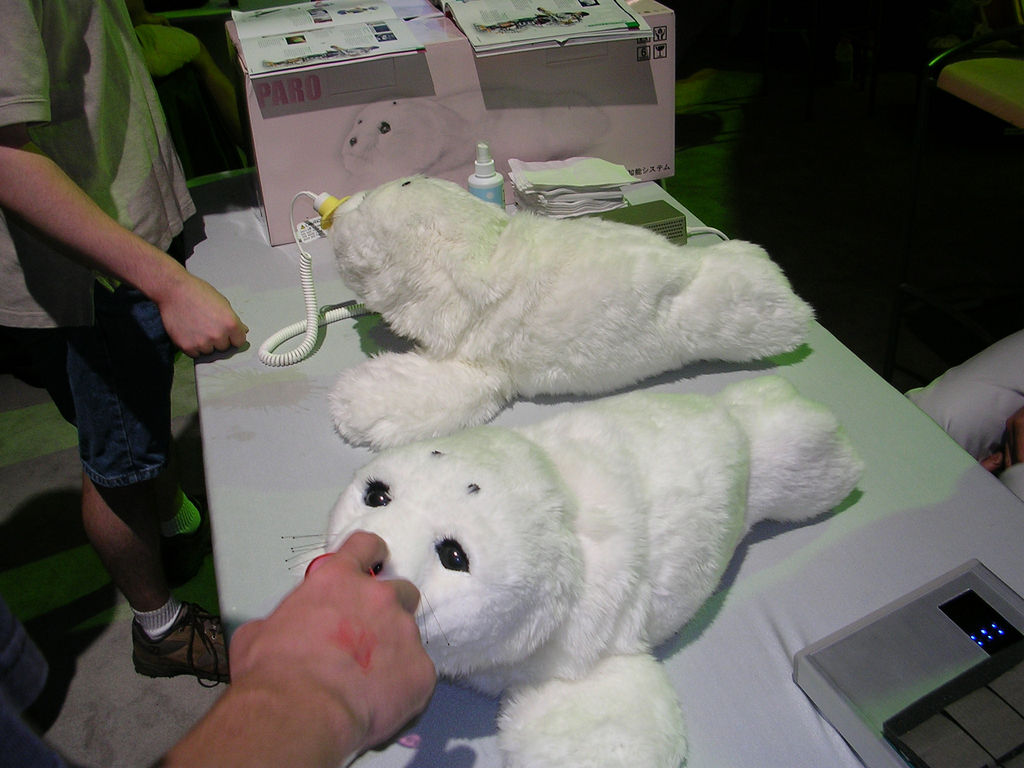
PARO belongs in its own category. The therapeutic seal robot has been an FDA Class II neurological therapeutic device since 2009, and a BMC Geriatrics scoping review described peer-reviewed evidence across countries including Japan, Denmark, Australia, and the United States, with studies reporting reduced agitation, lower anxiety, and decreased sedative medication in dementia-related care contexts.[12] RCT-level work and trial protocols around PARO make it more than a consumer companion claim.[13]
That does not make PARO a scalable answer to loneliness or behavioral symptoms across long-term care. Devices must be purchased, cleaned, assigned, introduced, monitored, and removed when a resident dislikes or mishandles them. Staff have to know whether the robot is part of a behavioral plan, a recreation activity, or a family-requested comfort item. A regulated device with supportive trials can still fail if it enters a unit as an orphaned gadget.
Newer companion and monitoring products sit on a different evidence tier. Forbes reported company-supplied ElliQ figures that more than 90% of users reported reduced loneliness and 94% felt healthier, along with Medicaid partnerships in multiple U.S. states.[14] Sensi.AI has described predictive audio monitoring trained on more than 1,000 years of in-home audio data, with claims around early signs of dementia, urinary tract infection, and pneumonia, and a privacy-first design without cameras or wearables.[15] These may be important deployment signals, especially outside institutional care, but they should remain visibly separate from PARO’s older regulatory and peer-reviewed evidence base.
Dr. Maja Matarić of USC put the broader social barrier bluntly: the biggest obstacle “isn’t the science — it’s a lack of empathy — and a lack of funding — for the populations who need this most.”[14] That observation lands in long-term care because the hardest part is rarely imagining a helpful robot. It is paying for it, fitting it into care plans, training staff, and deciding who is accountable when a resident’s response changes.
Infrastructure Is the Constraint That Decides Whether AI Scales
The most practical warning in the current AI-in-elder-care landscape did not come from a model paper. It came from provider groups talking about infrastructure. In February 2026, AHCA/NCAL and LeadingAge told HHS that AI adoption in senior living is “extremely challenging if not impossible” without addressing digital interoperability gaps.[16] That sentence captures what many nursing homes already know: an AI product can be impressive in a demo and still break against weak Wi-Fi, fragmented records, manual workarounds, and systems that cannot exchange usable data.
This is why deployment setting should come before model excitement. A hospital-trained documentation assistant may assume stable device access and a unified EHR. A fall-detection sensor may assume prompt alert routing to staff who are carrying the right device. A deterioration model may assume recent vitals, medication changes, lab data, diagnoses, and nursing observations are structured and available. In many facilities, those inputs live in separate places or are captured as free text, faxes, scanned documents, pharmacy portals, paper notes, or memory.
Interoperability also determines accountability. If a model flags a resident as high risk, the facility needs to know where the alert appears, who acknowledges it, whether it enters the clinical record, how it affects the care plan, and how overrides are documented. Without that chain, AI can create a liability trail without creating better care.
The staffing issue is similar. AI is often sold as relief for workforce pressure, but many tools initially create new work: device maintenance, alert review, family explanation, consent management, documentation correction, troubleshooting, and vendor meetings. A useful system eventually reduces avoidable work or improves resident safety enough to justify the added tasks. A poorly fitted system adds a second nervous system to a building that is already understaffed.
How to Read the Current Evidence Landscape
For procurement and clinical governance, the first split is not between “AI” and “non-AI.” It is between applications that have been tested in nursing home or closely related elderly care settings and applications whose evidence comes mainly from hospitals, home care, consumer use, or company reporting.
| Question | Why it matters in nursing homes |
|---|---|
| Was the tool tested in actual nursing homes or only in hospitals, laboratories, homes, or simulations? | Long-term care has different staffing, documentation, resident acuity, and alert-response capacity. |
| Does the study measure model performance, workflow adoption, or resident outcomes? | AUROC, detection accuracy, and fall reduction are not interchangeable endpoints. |
| Are outcomes independently studied or company-reported? | Vendor data may be useful for early screening but should not be treated as prospective trial evidence. |
| What data does the model require? | Tools using MDS or existing documentation may be easier to deploy than tools requiring new sensors and parallel workflows. |
| Who acts on the alert? | An alert without an accountable receiver becomes noise, not care. |
On that reading, fall-related AI has moved furthest into measurable use. It has the broadest mix of nursing-home-relevant modeling, prospective study, scoping-review synthesis, and deployment reporting. Predictive risk monitoring is plausible but still needs more independent validation in the facilities expected to use it. Documentation and MDS-related AI may become valuable quickly because the workload is so visible, but hospital-heavy evidence should not be imported casually into long-term care. Medication management remains operationally sensible but underdeveloped as a nursing-home evidence category. Socially assistive robotics is split: PARO has a mature, narrow evidence and regulatory profile, while newer companion and monitoring tools remain more dependent on company-reported or adjacent-setting claims.
AI in elderly care is not imaginary, and it is not all vaporware. The strongest current case is narrower than the market language: fall prediction and detection are the most evidence-supported applications in nursing homes. Broader adoption will depend less on whether another model can be built than on whether facilities can support the data flows, interoperability, staff training, consent practices, maintenance, and alert response that make the model usable on the floor.
References
- LifeLoop senior living AI adoption survey, LifeLoop.
- Cooperative Artificial Intelligence for Predicting Falls in Older Adults, Sensors, 2025.
- Machine Learning for 90-Day Fall Prediction Using MDS 3.0 Data in Nursing Homes, Journal of the American Medical Directors Association, 2024.
- Prospective Study of Fall Prediction in Four Nursing Homes in Southern China, Journal of the American Medical Directors Association, 2024.
- Fall Detection Technologies in Older Adult Care: A Scoping Review, Journal of the American Medical Directors Association.
- In Senior Homes, A.I. Technology Is Sensing Falls Before They Happen, The New York Times, October 2025.
- SafelyYou case study, LeadingAge.
- Cera AI predicts hospitalizations and falls up to a week in advance, Cera.
- Predictive analytics for hospital readmission, Good Samaritan Society.
- Generative artificial intelligence in nursing: an integrative review, BMC Nursing, 2026.
- Hero medication dispenser with AI reminder systems, Hero.
- The benefits of and barriers to using a social robot PARO in care settings: a scoping review, BMC Geriatrics, 2019.
- A randomized controlled trial of the effect of PARO on agitation and medication use in people with dementia in long-term care, PMC.
- AI Companions Are Redefining Elder Care: 3 Ways They Fight Loneliness, Boost Safety And Scale Support, Forbes, May 2025.
- Sensi.AI predictive audio monitoring, Sensi.AI.
- AI adoption in senior living requires infrastructure investments to fill in digital gaps, provider groups tell HHS, McKnight’s Senior Living, February 2026.
Comments
Join the discussion with an anonymous comment.