
What the evidence shows
For AI in predicting and preventing drug overdoses, the honest answer is yes, machine learning can separate higher from lower risk in retrospective claims and EHR data; no, that still does not prove the scores are ready to guide an individual intervention at the bedside.

The strongest head-to-head benchmark comes from Lo-Ciganic et al. In that Medicaid comparison, machine-learning models captured 66.1% of actual overdose cases, while the standard opioid quality measures used in practice captured 24.2%; the number needed to evaluate fell from 62 to 19.[1] That is a meaningful lift over usual practice, and it explains why the field keeps attracting attention.
Where the evidence stops
Published models can also look impressive on paper. Across claims and EHR studies, reported AUCs run from 0.81 to 0.97, and gradient boosting machines generally outperform logistic regression and random forests on discrimination.[2] But AUC only tells you how well the model ranks patients, not whether the score lands on a calibrated risk that a care team can trust when it is time to act.
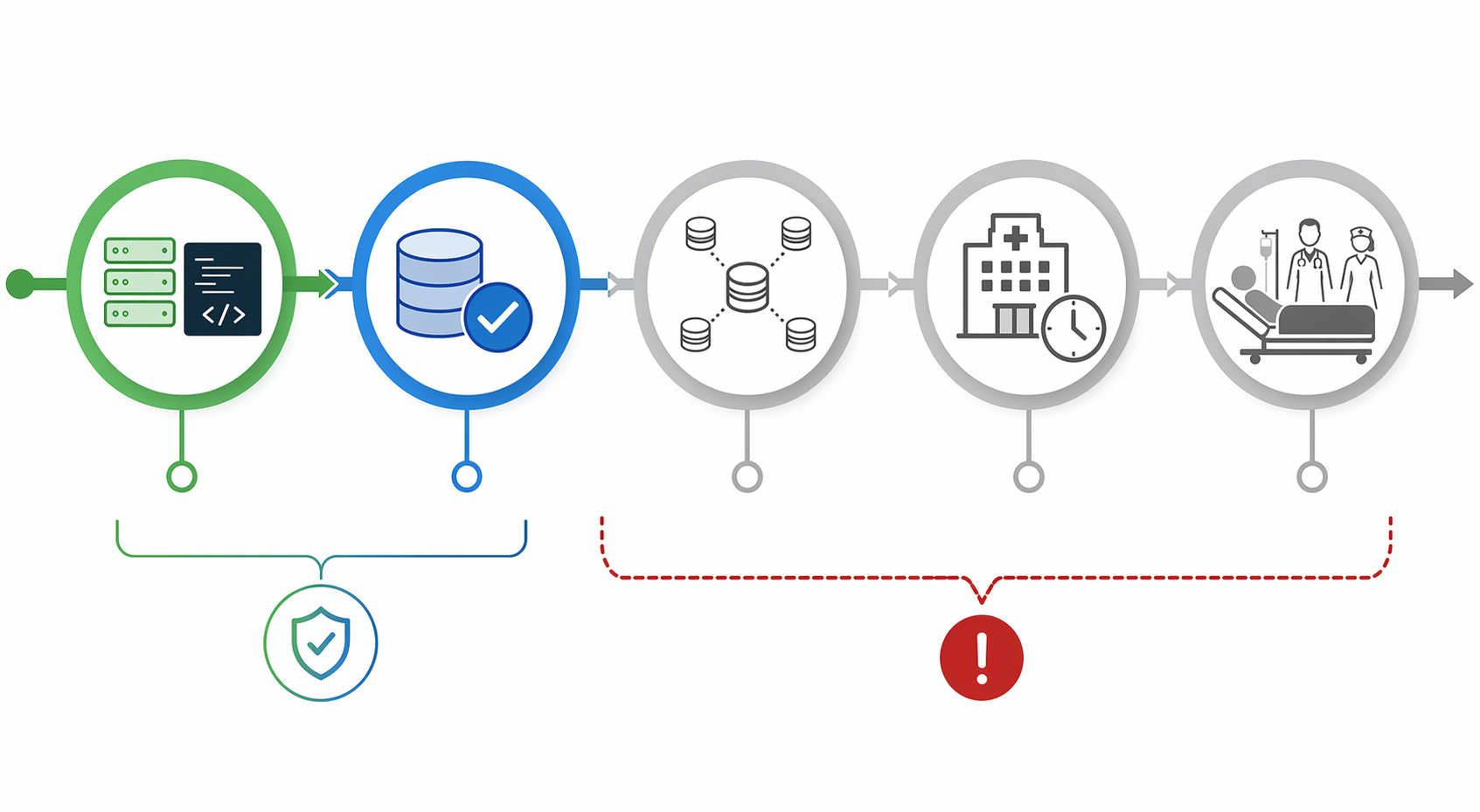
That gap matters because the methodological record is thin. In the 2025 systematic review by Ramírez Medina et al., only 7% of published models had external validation, 41% did not report calibration, and no prospective trial has yet shown that ML-guided intervention improves patient outcomes.[2] Most models are still built on single-state Medicaid or Medicare data, so transportability remains an assumption rather than a finding, and claims data also miss overdoses that never surface in the healthcare record.[2]
Parton et al. make the rare-outcome problem more concrete. In Alabama Medicaid, overdose prevalence ranged from 0.04% to 1.36%, and SMOTE resampling lifted recall from 0.43 to 0.69 but reduced precision.[3] That is the tradeoff clinicians feel immediately: the model may find more true cases, but it also pushes more false positives onto the people who have to sort the flags.
Broader reviews point in the same direction. The FAU review on AI for opioid use disorder highlighted reproducibility problems and other methodological pitfalls,[4] while the wider alert-and-response literature shows that prediction is only one piece of a larger workflow problem.[5]
What the evidence supports
So the evidence supports a narrower claim than many headlines imply. Machine learning can produce credible risk stratification in retrospective datasets, and in some settings it beats existing practice, but the field still lacks the external validation, calibration reporting, and prospective effectiveness evidence needed to call these tools clinically ready for targeted intervention decisions.[2][5]
References
- Machine-learning models outperform standard opioid quality measures for predicting opioid overdose among Medicaid beneficiaries. Lancet Digital Health, 2022.
- Systematic review of machine learning models for predicting opioid-related harms. npj Digital Medicine, 2025.
- Predicting opioid overdose in Alabama Medicaid with machine learning and SMOTE resampling. Scientific Reports, 2026.
- Pitfalls and Solutions for Using AI to Predict Opioid Use Disorder. Florida Atlantic University.
- Overdose Alert and Response Technologies: State-of-the-art Review. PMC.
Comments
Join the discussion with an anonymous comment.