
Standard inpatient practice for opioid use disorder often depends on a clinician recognizing the problem, deciding it needs specialty help, and placing an addiction medicine consult. The strongest recent evidence for AI in opioid crisis prevention starts by changing that sequence. In a UW Health study of 51,760 hospitalizations, an AI-assisted EHR workflow screened notes in real time and prompted a structured response; among consulted patients, 30-day readmissions fell from 14% during standard provider-led practice to 8% during the AI deployment period, a 47% relative reduction in a pre–post quasi-experimental study published in Nature Medicine in 2025.[1]
That result deserves attention because it is not just another model-performance story. The study did not ask whether a neural network could label historical charts with a high score. It asked whether a hospital could put AI between unstructured clinical documentation and a real consult pathway, then measure what happened to patient care.
The intervention was a workflow, not a model dropped into the chart
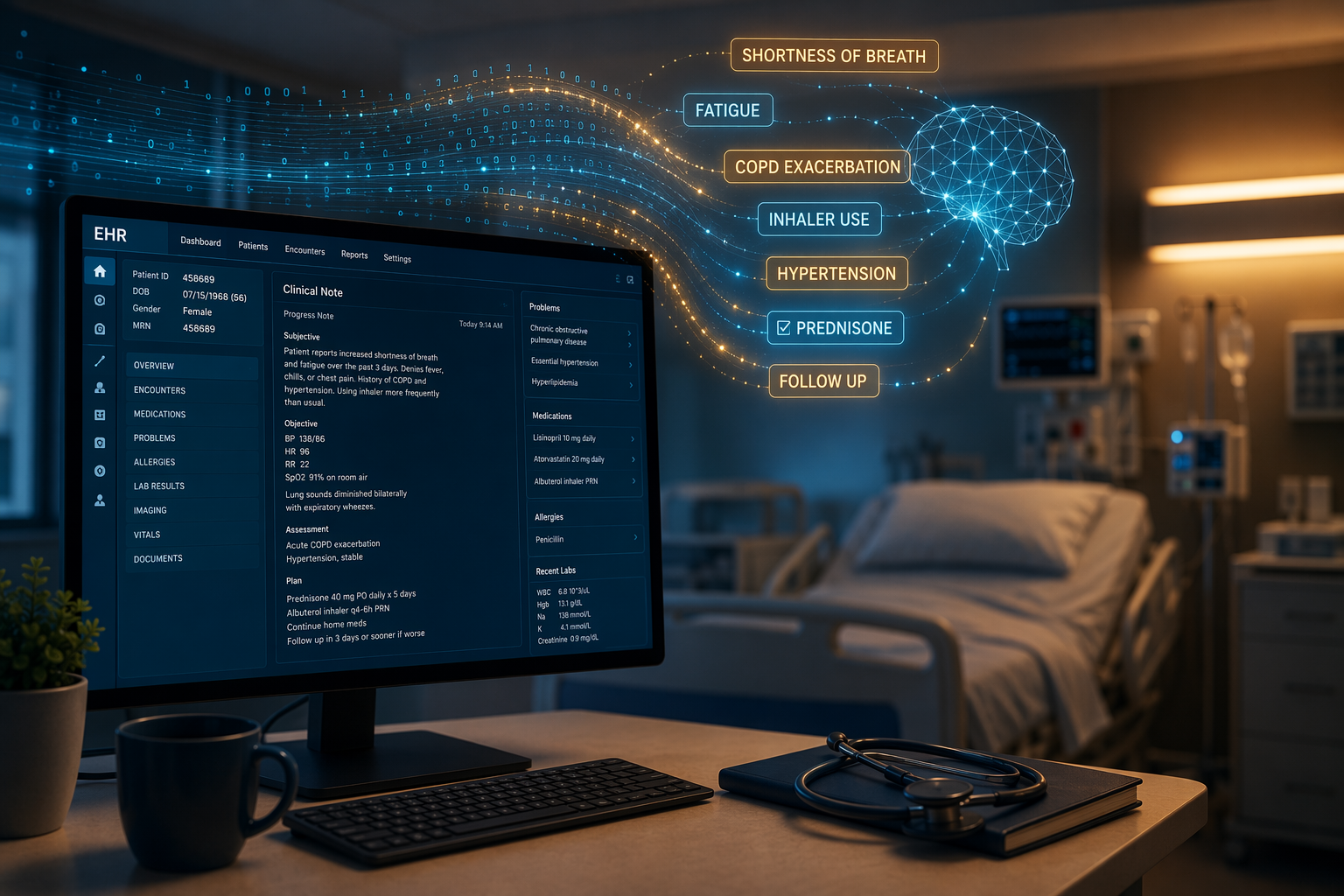
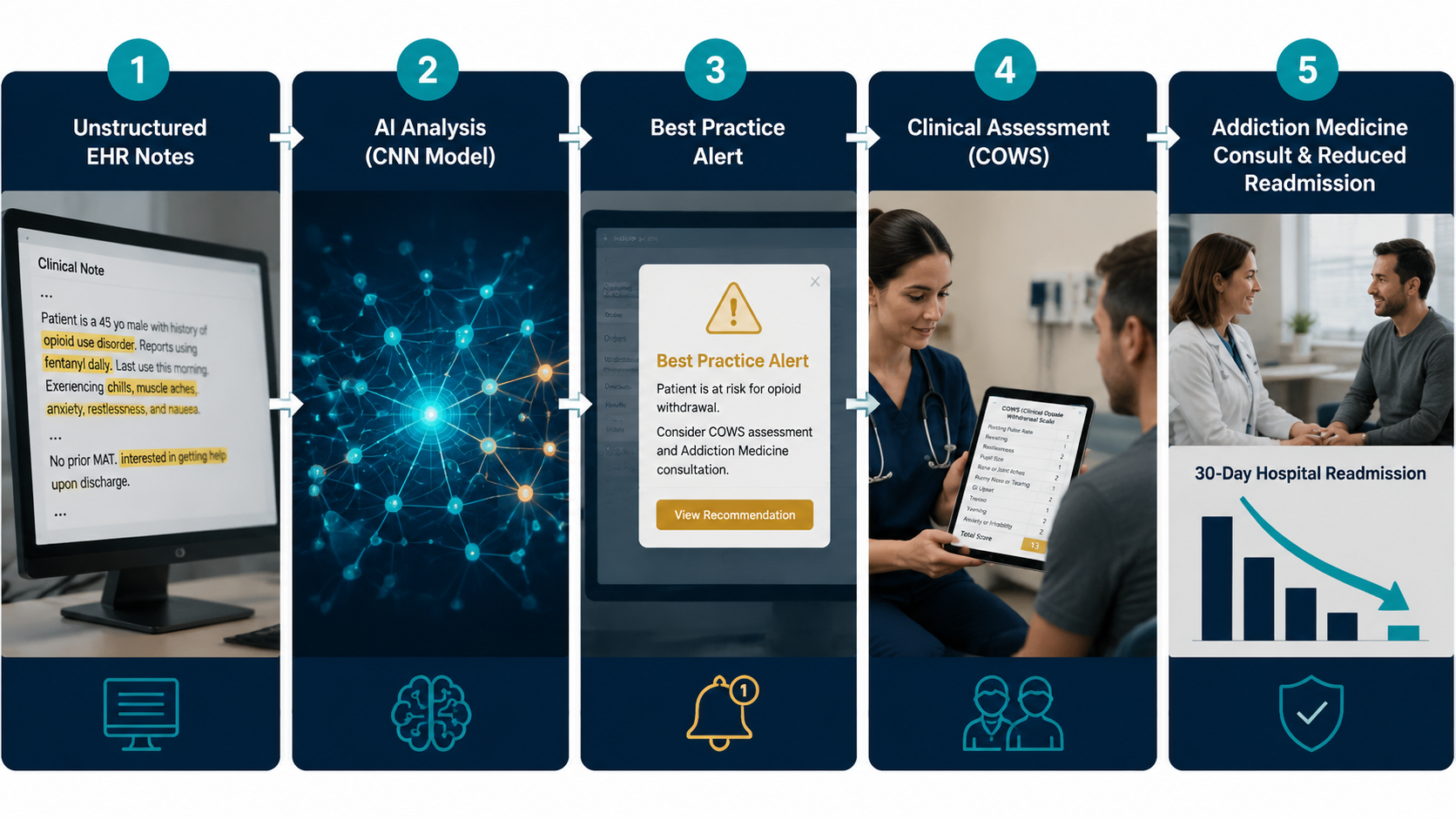
The AI system used a convolutional neural network to analyze unstructured EHR notes for signs of opioid use disorder risk. When the model flagged a hospitalized patient, the EHR generated a Best Practice Alert recommending a Clinical Opiate Withdrawal Scale assessment and offering a direct page to addiction medicine consultation.[1]
Those details matter. The model did not independently diagnose OUD, start medication, or replace a clinician. It found chart evidence that might otherwise remain buried in notes, then asked the care team to perform a structured next step. The alert also avoided firing for patients already under addiction medicine care, which is a small implementation choice with large practical value in an alert-heavy EHR environment.[1]
| Workflow point | What changed in practice |
|---|---|
| Unstructured notes | The system read free-text EHR documentation in real time rather than waiting for diagnosis codes or a clinician-initiated consult. |
| AI screen | A CNN-based NLP model flagged hospitalized patients at risk for opioid use disorder.[1] |
| Best Practice Alert | The EHR prompted the care team to complete a COWS assessment and offered direct paging to addiction medicine.[1] |
| Specialty response | Addiction medicine could evaluate patients surfaced by the screening pathway, including patients not already on the consult team’s radar. |
| Outcome measurement | The study compared an 8-month baseline period with an 8-month AI deployment period and measured consultation and 30-day readmission outcomes.[1] |
This is the part of the study that makes the readmission finding more credible as a clinical signal. The authors can trace a chain from note text to alert, from alert to assessment, from assessment to consult, and from consult population to readmission outcome. Many AI deployments fail in precisely those handoffs.
The consult rate did not simply surge
A less disciplined version of this story would say the AI reduced readmissions because it generated more addiction medicine consults. The study’s consultation data point in a narrower and more interesting direction. Consultation rates were non-inferior: 1.35% during baseline provider-led practice versus 1.51% during AI-assisted deployment.[1]
In plain terms, the AI workflow did not appear to win by flooding addiction medicine with a dramatically larger volume of consults. Its clinical value seems to come from changing which patients reached the consult pathway. That distinction is important for hospitals evaluating capacity. A tool that only works by doubling consult volume creates one kind of operational problem; a tool that redirects attention toward missed patients creates another, more manageable governance question.
It also fits the clinical reality of inpatient OUD. A patient may have suggestive documentation in progress notes, social history, toxicology discussion, pain management notes, withdrawal symptoms, or prior treatment references without OUD being placed cleanly into the active problem list. Provider-initiated consultation can miss that patient, especially during a busy admission for infection, trauma, pregnancy, psychiatric crisis, or another acute condition. AI screening is useful here only if it shortens the distance between scattered documentation and a care team action.
What the readmission result does and does not prove
The secondary outcome is the headline: 30-day readmissions among consulted patients dropped from 14% in the baseline period to 8% in the AI-assisted period, with an odds ratio of 0.53.[1] For hospital leaders, that is a substantial utilization signal. For patients, it suggests fewer returns to the hospital after an admission where OUD risk was recognized and addiction medicine became involved.
The study also estimated $109,000 in avoided readmission costs over the 8-month deployment period, or $6,801 per readmission avoided. The authors compared that figure with a national average readmission cost of about $16,300.[1] Those numbers are useful, but they should not be mistaken for a full business case. They do not settle the cost of integration work, alert maintenance, clinician training, governance review, or the staffing needed if the workflow is scaled into settings with different volumes.
The design also sets boundaries around interpretation. This was a pre–post quasi-experimental study, not a randomized controlled trial. The baseline and AI deployment periods each lasted 8 months, and the opioid landscape was changing over time.[1] A pre–post design can show that outcomes changed after implementation, and it can strengthen the case when the workflow mechanism is visible, but it cannot eliminate every secular trend or concurrent practice change.
That caveat should not flatten the finding into “interesting but unproven.” Prospective workflow evidence in clinical AI is still uncommon, and this study measured care delivery and readmissions rather than stopping at retrospective discrimination. The right reading is more precise: at one academic health system, embedding AI-based OUD screening into the inpatient EHR was associated with similar consultation volume, a different pathway into addiction medicine, and lower 30-day readmission among consulted patients.
Why note-based screening is both the strength and the risk
The tool’s dependence on unstructured notes is exactly what makes it clinically plausible. OUD risk is often documented before it is formally organized. A model that reads clinical text can surface patterns that diagnosis-code surveillance will see too late or not at all.
But note-based AI inherits the habits of the people and institutions writing those notes. Documentation varies by clinician, service line, patient trust, prior encounters, stigma, and how much attention a patient has already received. If some patients are less likely to have substance use history documented accurately, an NLP model may be less likely to identify them. If some patients are more likely to have stigmatizing language recorded, the model may route them differently. The study did not report outcomes stratified by race, ethnicity, or socioeconomic status, leaving an important fairness question unresolved.[1]
That missing analysis is not a minor appendix issue. In an inpatient screening system, false negatives may leave OUD unnamed during a high-risk hospitalization, while false positives may expose patients to sensitive conversations, stigma, or unnecessary documentation. Hospitals adopting similar tools need monitoring that goes beyond aggregate readmission and consult rates.
Deployment realism: open source, HL7, and alert fatigue
The implementation choices are unusually relevant for health systems considering whether this work is reproducible. The model was made available as open source through UW GitLab, and the integration used HL7 v2 standards.[1] That does not make deployment automatic, but it lowers one barrier compared with a closed vendor product requiring a custom interface and opaque maintenance process.
Open source also does not remove local validation. A CNN trained and deployed in one health system may behave differently where note templates, addiction medicine capacity, patient demographics, and opioid exposure patterns differ. A rural hospital, a safety-net hospital, and a large academic medical center may all use HL7 messaging, but they do not have the same documentation ecology or specialty response model.
The Best Practice Alert deserves the same scrutiny as the model. BPAs are familiar because they are easy to add and hard to live with. They can standardize a clinical action, but they also compete with medication warnings, sepsis prompts, discharge reminders, and administrative nudges. The study’s alert suppression for patients already under addiction medicine care is a sensible guardrail; hospitals would still need to watch firing frequency, override patterns, response time, and whether addiction medicine teams can absorb the work.[1]
This is not the whole category of AI in opioid crisis prevention
The phrase AI in opioid crisis prevention can cover many different systems: prescription drug monitoring analytics, population surveillance, overdose risk prediction, relapse support, outpatient care navigation, and inpatient case finding. Those tools should not be evaluated as though they are interchangeable. A model that flags prescribing anomalies is not doing the same job as a model that reads hospital notes to prompt a COWS assessment.
The UW Health study sits in a narrower lane: hospitalized patients with possible undiagnosed OUD risk documented somewhere in the EHR, where the system can route the care team toward addiction medicine during the admission. Its outcome is not community overdose prevention in general. It is inpatient detection and specialty engagement, with readmission reduction as the measurable downstream signal.
That narrower framing makes the evidence more useful. Hospitals can ask concrete adoption questions: Can our notes support this kind of screening? Who receives the alert? Is COWS already used reliably? How fast can addiction medicine respond? What happens on weekends? Which patients are missed? Are readmission reductions distributed equitably? Those are better questions than whether “AI solves” any part of the opioid crisis.
A strong adoption signal, with local proof still required
For clinical AI, the study clears a higher bar than model accuracy alone. It put screening into the EHR, connected the flag to a specific clinical action, preserved consultation rates, and reported lower 30-day readmissions in a large hospital cohort.[1] That is enough for health systems with addiction medicine capacity to study the workflow seriously.
It is not enough to assume generalization. A single-site pre–post study cannot answer how the tool performs in community hospitals, rural settings, non-North American health systems, or populations with different documentation patterns and opioid exposure. The absence of stratified race, ethnicity, and socioeconomic outcome reporting is especially important because the model acts on clinical text, and clinical text is not a neutral substrate.[1]
The disciplined conclusion is promising but bounded: AI-assisted inpatient OUD screening now has prospective evidence tied to a real care pathway and a meaningful readmission reduction. Hospitals should treat it less like a plug-in prediction engine and more like a clinical service redesign that happens to begin with NLP.
References
- Artificial intelligence-enabled screening for opioid use disorder in hospitalized patients, Nature Medicine, 2025.
Comments
Join the discussion with an anonymous comment.