The useful version of ai for substance abuse monitoring does not start with a dashboard. It starts in the hospital record, while a patient is still admitted, before the discharge summary is signed and before the readmission risk becomes another retrospective quality meeting. In the strongest available evidence, an EHR-embedded deep learning model screened 51,760 adult hospitalizations at UW-Madison from 2021 through 2023, using structured and unstructured clinical data in real time to identify patients at risk for opioid use disorder and prompt addiction medicine consultation.[1]
That setting matters. The comparison was not against an abstract model benchmark or a carefully curated test set. It was against provider-initiated referral, the usual path by which hospitalized patients with OUD risk become visible to addiction medicine. The AI-prompted consultation rate was 1.51%, compared with 1.35% for provider-initiated consultation, meeting non-inferiority in the pragmatic trial.[1] In practical terms, the model did not announce a flood. It produced a consultation rate in the same neighborhood as usual care, while creating a more systematic route for patients who might otherwise sit outside the consult team’s view.
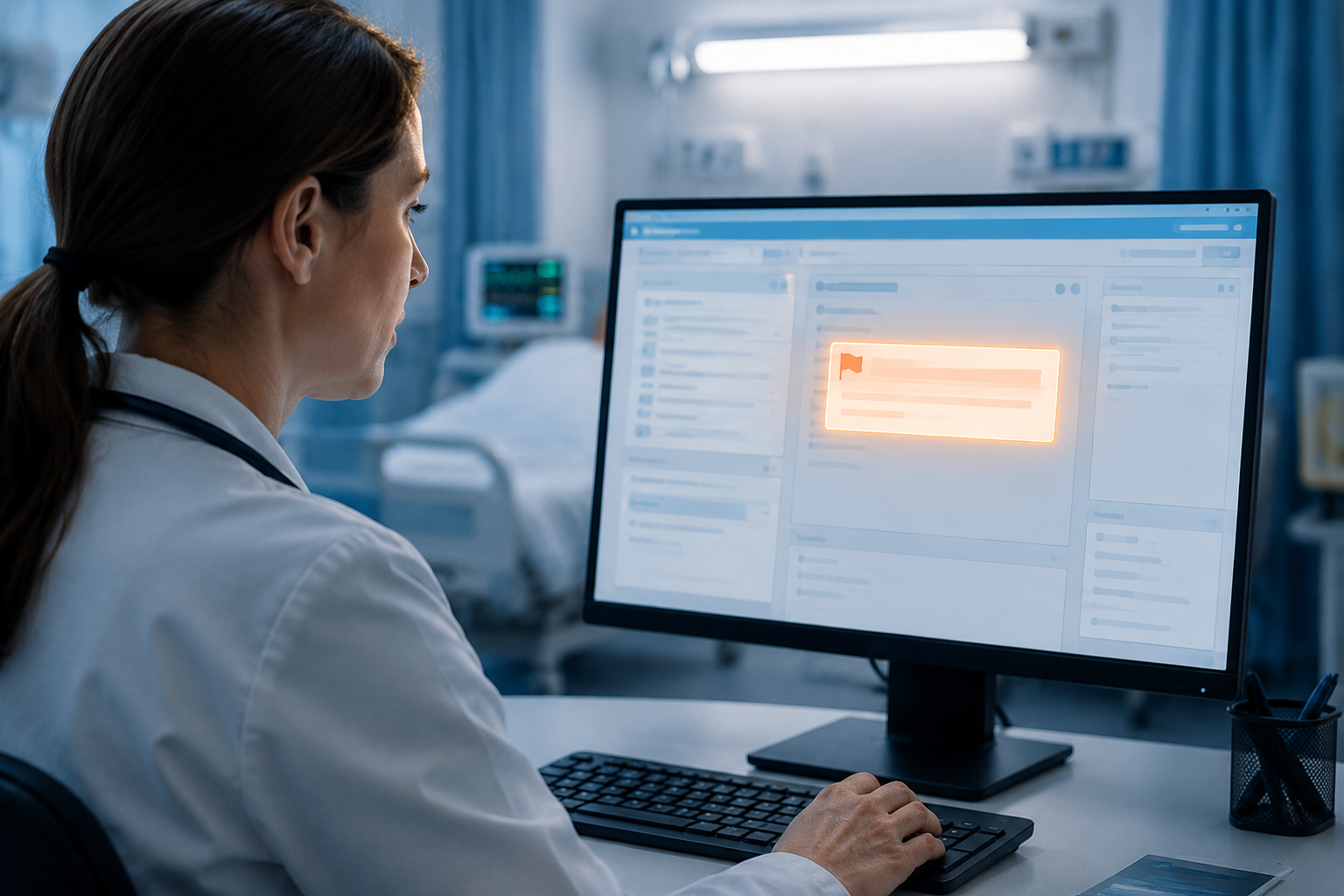
The more important result came after the consult. Patients who received AI-prompted addiction consultations had an 8% 30-day readmission rate, compared with 14% among patients whose consultations were provider-initiated, corresponding to 47% lower odds of readmission.[1] For a hospital team, that is the difference between a screening tool that merely identifies risk and one that appears to change what happens after discharge.
What the AI actually changed in the workflow
The trial’s design is the reason the finding deserves attention. The model sat inside the EHR workflow and analyzed clinical data as care was unfolding. It did not ask clinicians to open a separate application, manually score a questionnaire, or remember another screening protocol after the patient’s immediate medical problem had already taken over the day. When the model identified OUD risk, it prompted addiction medicine consultation.
That distinction is easy to undervalue. Many hospital OUD opportunities are not missed because no one cares. They are missed because the patient is admitted for infection, trauma, withdrawal-adjacent symptoms, pain, pregnancy complications, psychiatric comorbidity, or a medical consequence whose relationship to opioid use is not cleanly labeled at the top of the chart. The consult pager depends on someone recognizing the pattern, feeling authorized to act on it, and having enough time to place the order before the next instability arrives.
| Workflow question | Trial finding |
|---|---|
| Did AI screening overwhelm the consult pathway? | AI-prompted consultation occurred in 1.51% of screened adult hospitalizations, compared with 1.35% for provider-initiated referral.[1] |
| Did the prompted consults appear clinically meaningful? | AI-prompted consultations were associated with an 8% 30-day readmission rate versus 14% for provider-initiated consultations.[1] |
| Did the economics point in the same direction? | The net cost was $6,801 per readmission avoided, compared with a national average 30-day readmission cost of $16,300.[1] |
The consultation-rate result should be read carefully. A rate close to usual referral does not prove that every alert was perfectly calibrated, and it does not answer whether alert fatigue would remain low over years of deployment. It does show that, during the study period, the AI pathway did not win by simply escalating more patients into specialty evaluation. For an inpatient service already balancing sepsis alerts, fall-risk prompts, discharge barriers, and utilization messages, that is not a minor point.
Why the readmission finding carries the article
Consultation rates are process measures. They matter because they tell us whether a patient is seen, but they are still a step removed from the outcome a hospital has to live with. The 30-day readmission result is different. It suggests that the AI-triggered pathway identified a group of patients for whom addiction medicine consultation could alter the near-term course after hospitalization.
The trial reported 47% lower odds of 30-day readmission in the AI-prompted consultation group, with observed readmission rates of 8% versus 14%.[1] That number should not be inflated into a claim that AI treats OUD, prevents relapse, or guarantees engagement after discharge. The measured outcome was readmission, not long-term recovery, sustained medication adherence, abstinence, housing stability, or retention in outpatient addiction care. Still, readmission is not a soft endpoint. It is a hard operational consequence that shows up on the bed board, the quality report, the payer conversation, and the next admitting team’s census.
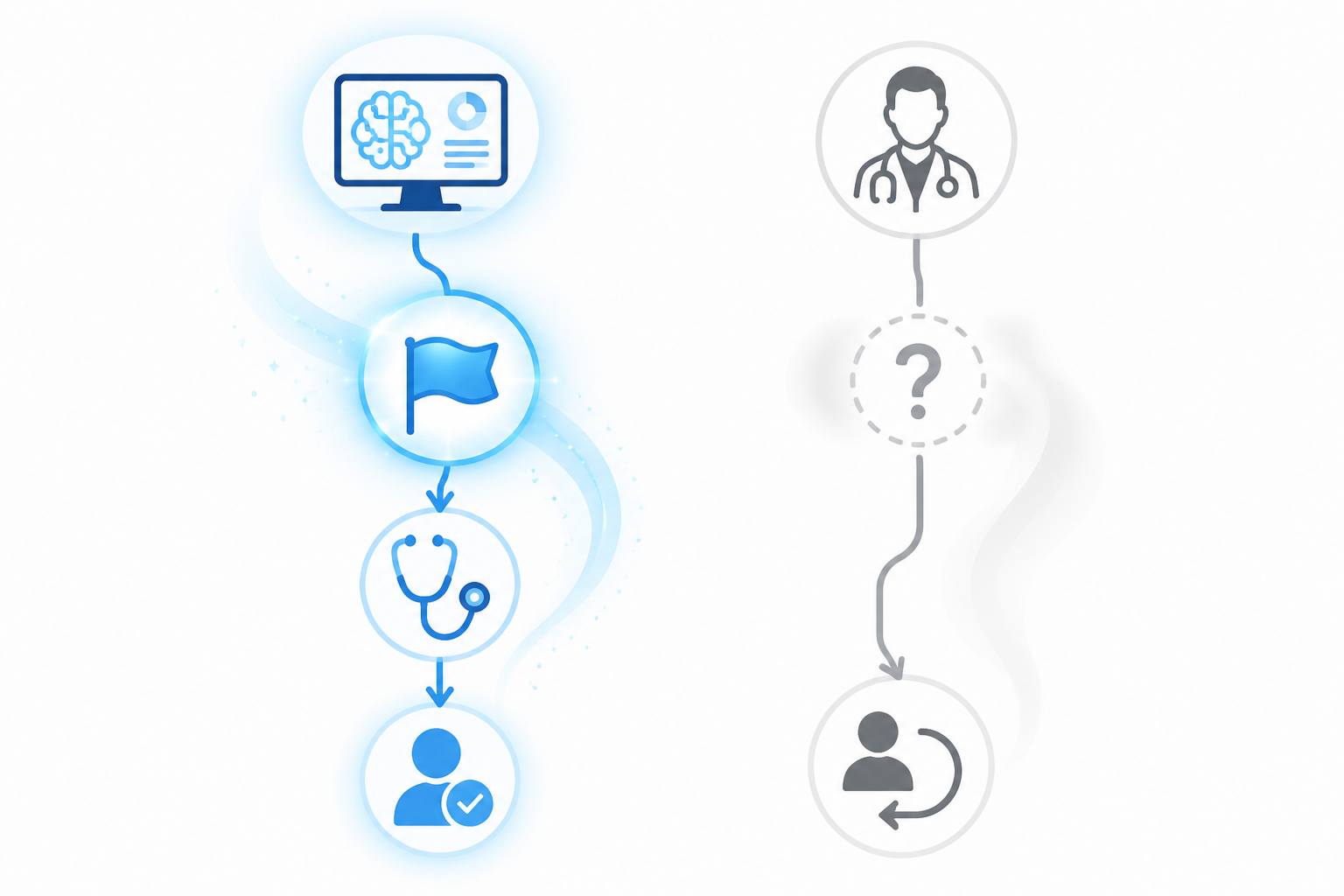
The plausible mechanism is not mysterious, although the trial result should not be reduced to a single causal step beyond what was measured. A patient flagged during hospitalization can receive addiction medicine assessment while still reachable. Medication treatment can be considered. Withdrawal, pain, harm reduction, discharge medications, follow-up, and social barriers can be handled before the patient leaves. The consult creates a chance to repair the discharge plan while the hospital still owns the handoff.
That is where an EHR-embedded screener has a different weight than a retrospective risk model. A beautiful prediction after discharge may be analytically interesting and clinically useless. A prompt during the admission can change who enters the addiction medicine workflow, which orders get placed, and what is documented before the patient is gone.
The cost result belongs next to the clinical result
The economic finding strengthens the same point rather than opening a separate finance story. The reported net cost was $6,801 per readmission avoided, while the national average cost of a 30-day readmission was $16,300.[1] Over eight months, the study estimated approximately $108,800 in healthcare savings.[1]
Hospitals do not adopt clinical decision support because a model has elegant architecture. They adopt it if the work required to run the intervention can survive staffing constraints, IT governance, clinician trust, and competing priorities. A lower cost per readmission avoided is not proof of universal affordability, but it gives the readmission result an operational contour. The tool did not merely shift work into the EHR; in this setting, it was associated with avoided utilization at a cost below the average cost of the event it helped prevent.
That does not mean every hospital can expect the same savings. The study was conducted at one academic medical center, with its own addiction medicine capacity, EHR configuration, patient population, staffing model, and discharge ecosystem.[1] A hospital with limited consultation coverage, fewer outpatient linkage options, different admission patterns, or a more fragmented post-discharge network could see a different economic result even if the model performs similarly.
What this does, and does not, prove about AI monitoring
The phrase ai for substance abuse monitoring can stretch too far if it is allowed to cover every prediction model, phone task, social signal, or risk score in the same breath. The UW-Madison trial supports a narrower claim: an EHR-embedded AI screener for OUD risk in hospitalized adults can prompt addiction medicine consultation at a rate comparable to provider-initiated referral and was associated with substantially lower 30-day readmission in a single-site pragmatic trial.[1]
It does not prove that AI can monitor substance use continuously across daily life. It does not establish broad effectiveness across substances, age groups, community hospitals, emergency departments, outpatient clinics, or carceral health settings. It does not show sustained recovery. It also does not remove the need for addiction medicine clinicians, social workers, pharmacists, nurses, peer support staff, and outpatient programs. If anything, the result depends on the existence of a care pathway worth triggering.
The lack of FDA clearance is also part of the current boundary. As of mid-2026, no AI-based substance use disorder monitoring tool has received FDA clearance for mental health indications, and FDA Digital Health Advisory Committee activity in 2025-2026 on AI in digital mental health had not produced authorizations for the tools discussed here.[2] That regulatory status does not negate the trial, but it should temper procurement language that treats these systems as settled clinical infrastructure.
Adjacent tools are interesting, but not in the same evidence class
Other AI approaches are exploring different parts of the substance use care problem. One NIDA Intramural study used BERT embeddings from pre-treatment Facebook posts to predict 90-day treatment dropout. In a sample of 269 people, the model achieved an AUC of 0.81, outperforming the standardized Addiction Severity Index, which had an AUC of 0.658.[3] That is a notable signal for passive, pre-treatment risk stratification, but it is not the same as an in-hospital, EHR-embedded intervention tested against usual consultation workflow.
The population fit also matters. The Facebook-language study was conducted in a specific treatment-seeking sample described as majority African American male and Philadelphia-based.[3] Those details do not weaken the study’s contribution; they define it. A model that predicts dropout in that context may help design earlier outreach, but it should not be treated as evidence that social media monitoring can generalize across health systems, platforms, patient groups, or treatment settings.
Another line of work uses computational judgment profiling. A 2026 npj Mental Health Research study reported that a 3- to 4-minute picture-rating task producing 15 judgment variables predicted SUD-defining behaviors with 83% accuracy across 3,476 participants.[4] The format is appealing because it is brief and potentially smartphone-ready, but it remains closer to classification or assessment than to demonstrated clinical outcome improvement. Accuracy on SUD-defining behaviors is not the same as fewer readmissions, better retention, or safer discharge.
Those studies belong in the conversation because they show where the field is moving: language, behavior, judgment patterns, and clinical records are all being turned into signals. They should not be flattened into one evidence pile. The hospital trial changed a live consultation pathway and reported a hard near-term outcome. The social media and picture-rating studies point toward possible assessment or risk-stratification tools that still need more validation before they carry the same clinical weight.
The adoption question is still local
For a health system considering this kind of tool, the first question is not whether AI can detect OUD risk in principle. The UW-Madison trial shows that it can be embedded into a real hospital workflow and associated with fewer 30-day readmissions in that setting.[1] The harder question is whether the local system can reproduce the conditions that made the alert clinically useful.
- Is there an addiction medicine consultation service with enough capacity to respond when the model identifies risk?
- Can the EHR integration surface the prompt at a point when clinicians can still change the plan?
- Will the consult lead to discharge actions, medication decisions, harm-reduction planning, and outpatient linkage rather than documentation alone?
- Can the hospital monitor alert burden, missed patients, consultation completion, readmission, and equity across patient groups?
- Does local cost accounting support the assumption that avoided readmissions offset the expense of the intervention?
A model can only hand work to a system capable of doing it. If the alert fires into a service without capacity, or into a discharge process that cannot arrange follow-up, the intervention may become another notification with a research pedigree. The trial’s strongest lesson is not that the algorithm alone reduced readmissions. It is that an algorithm tied to a consultation pathway, inside the admission workflow, was associated with fewer readmissions than usual provider-initiated referral in one large real-world deployment.
Credible enough to matter, not mature enough to universalize
The evidence now supports a serious, bounded conclusion. Among current research on ai for substance abuse monitoring, the UW-Madison pragmatic trial is the strongest case for AI-assisted OUD screening in hospitalized adults. It was large, embedded in real workflow, compared against provider-initiated referral, and linked to a 47% lower odds of 30-day readmission with a reported $6,801 net cost per readmission avoided.[1]
The same evidence also defines the stopping point. This was one academic medical center. The measured clinical outcome was 30-day readmission, not long-term recovery. The long-term alert-fatigue profile remains uncertain. No FDA-cleared AI-based SUD monitoring tool is available for mental health indications as of mid-2026.[2] Multi-site validation is needed before hospitals treat the readmission reduction and cost-effectiveness estimates as portable.
References
- Nature Medicine publication on EHR-embedded AI screening for opioid use disorder, Nature Medicine, 2025.
- FDA Digital Health Advisory Committee activity on AI in digital mental health, U.S. Food and Drug Administration, 2025-2026.
- Digital phenotyping via social media language analysis, Neuropsychopharmacology, 2023.
- Computational judgment profiling, npj Mental Health Research, January 2026.
Comments
Join the discussion with an anonymous comment.