BlueDot’s best-known outbreak signal is still the one procurement teams ask about first: on January 9, 2020, the company says its system flagged the emerging COVID-19 outbreak nine days before the World Health Organization’s public announcement, using natural language processing across more than 300,000 articles a day in more than 130 languages, combined with airline ticketing data to model possible spread.[1] That is exactly the kind of weak-signal detection that can matter in respiratory-virus season. It is also exactly where the hard questions begin.
In practice, AI in infectious disease outbreak detection is not a single capability. It is a procurement choice among systems that ingest different sources, expose different levels of evidence, require different human review models, and fit different jurisdictions. The useful question in mid-2026 is not whether AI can detect a signal. It is whether the signal can be checked, staffed, afforded, and acted on before it becomes another alert in an already crowded queue.
| Platform | What it appears best suited for | Data and language coverage | Automation and human review | Performance evidence and access model |
|---|---|---|---|---|
| BlueDot | Global commercial disease intelligence where speed, breadth, and travel-linked spread modeling are priorities | Company-reported NLP over 300,000+ articles daily in 130+ languages, combined with airline ticketing data for spread prediction.[1] | Automated detection and risk modeling, with validation details largely inside the proprietary workflow | COVID-19 early-signal case is notable; independent head-to-head validation remains limited. Proprietary subscription, reported in the research brief as costing tens of thousands per year.[1] |
| BEACON | Open-source global event-based surveillance for agencies and researchers that need inspectable methods | Launched in April 2025; published 1,300+ verified disease reports across 195 countries. Uses PandemIQ Llama trained on 5.8B tokens from 500K+ documents across 31 languages.[2] | AI-assisted classification with verified reports; open code supports external scrutiny | Free, open-source global platform under an MIT license for code. The open architecture enables validation, although the brief does not identify a published independent audit yet.[2] |
| WHO EIOS | Institutional surveillance and collaboration for WHO Member States and partner organizations | EIOS v2.0 monitors 12,000+ web sources refreshed every 5 minutes across 80 languages.[3] | AI capabilities include automatic radio transcription and translation; the platform is embedded in public health verification workflows | Serves 110+ Member States and about 30 organizations; free for WHO Member States and hosted at the Berlin Pandemic Hub.[3] |
| EPIWATCH | Research-grounded multilingual outbreak article filtering where published classifier performance matters | Published classifier work covers curated and non-curated sources across 42 languages.[4] | BERT-based filtering of relevant outbreak articles for expert review | Reported 88.2% accuracy for filtering relevant outbreak articles; access and implementation details should be checked against current deployment needs.[4] |
| HealthMap | Public-facing disease intelligence where a lightweight situational awareness layer is useful | The research materials for this article do not provide current source counts, language coverage, or refresh intervals | Should be evaluated on current documentation, review workflow, and export options rather than assumed equivalence with newer systems | Useful to include in comparisons, but the evidence base available here is thinner than for BEACON, WHO EIOS, and EPIWATCH |
The Same Word, Different Surveillance Jobs
A platform that watches global news in many languages, a platform that helps WHO Member States triage signals, and an open-source system that publishes verified reports are all called AI outbreak detection. They do not create the same burden for a health department.
The first operational distinction is data visibility. BlueDot’s published company description emphasizes large-scale article processing and travel-linked spread prediction.[1] WHO EIOS emphasizes institutional scale: more than 12,000 web sources, refreshes every 5 minutes, and 80 languages.[3] BEACON emphasizes open-source surveillance with published verified reports across 195 countries and a model trained on a large multilingual corpus.[2] EPIWATCH’s cited evidence is narrower but more testable: a BERT classifier evaluated for outbreak article relevance across 42 languages.[4]
Those differences matter because the receiving team has to know what kind of signal it is holding. A travel-informed commercial alert may help a national or large health system anticipate importation risk. An EIOS item may matter because it is already inside a WHO-linked event-based surveillance environment. An open BEACON report may be easier for an academic or regional team to inspect, reproduce, or challenge. A classifier score from EPIWATCH is useful in a different way: it speaks to filtering performance, not to final outbreak confirmation.
What the Platforms Ingest
Data ingestion is where the comparison becomes less glamorous and more important. Public health surveillance fails in the gaps between systems: languages not monitored, local media not indexed, radio broadcasts not transcribed, data feeds interrupted, and jurisdictions that report late because the local workforce is already stretched.
BlueDot’s described advantage is breadth plus mobility context. Processing more than 300,000 articles daily in more than 130 languages is a strong claim for global scanning, and airline ticketing data adds a plausible operational layer for anticipating cross-border spread.[1] The caveat is not that the architecture is unimportant. It is that the public evidence available to buyers is largely vendor-originated. A health department still needs to ask what sources are included, what is excluded, how local-language ambiguity is handled, and what data can be exported for review.
BEACON enters the comparison from the opposite direction. Its April 2025 launch was presented as the first open-source global surveillance platform, with 1,300+ verified disease reports across 195 countries and PandemIQ Llama trained on 5.8 billion tokens from more than 500,000 documents across 31 languages.[2] Open-source access does not automatically make a platform accurate, but it changes the evaluation posture. Analysts can inspect code, researchers can attempt external validation, and agencies can avoid treating the vendor’s black box as the only explanation available.
WHO EIOS is the institutional-scale comparison point. EIOS v2.0 monitors more than 12,000 web sources, refreshes every 5 minutes, and covers 80 languages.[3] The addition of automatic radio transcription and translation is not a novelty feature; it addresses a real surveillance problem. In many settings, radio can carry outbreak-relevant information before it appears in formal digital sources. The question for a Member State is less whether EIOS is technically impressive and more whether the national workflow has enough trained staff to use that volume without drowning in triage.
EPIWATCH’s cited evidence focuses on language-aware article filtering. Its BERT classifier achieved 88.2% accuracy in filtering relevant outbreak articles from curated and non-curated sources across 42 languages.[4] That is a meaningful metric because it sits close to an actual analyst task: separating potentially relevant outbreak material from noise. It should not be misread as proof that 88.2% of outbreaks are detected, or that downstream public health decisions are correct at that rate.
HealthMap belongs in the conversation because many public health and research users recognize it as a public disease intelligence resource. The available materials here, however, do not provide current source counts, language coverage, refresh rates, or classifier performance. That makes the practical recommendation simple: include it in a scan of available tools, but do not assume it has the same evidentiary footing as systems with current published metrics in hand.
Filtering Is Not Confirmation
The most persistent mistake in AI surveillance demos is the slide where detection, validation, and action collapse into one arrow. In a real health department, those are separate queues. Someone has to decide whether a signal is duplicate reporting, rumor, seasonal background, a coding artifact, a cross-border concern, or the first visible edge of something that needs escalation.
The base-rate problem is the reason human review cannot be treated as an optional safeguard. The Public Health AI Handbook summarizes that only about 5% to 10% of syndromic surveillance alerts correspond to true outbreaks.[5] Even if a model improves filtering, a low base rate means most alerts still do not become confirmed outbreak events. The cost of a false positive is not only embarrassment. It is staff time, calls to local partners, possible public messaging, and attention pulled from other signals.
That does not make AI surveillance futile. It means the best systems reduce the amount of irrelevant material reaching trained humans, enrich signals with context, and help teams prioritize. The final confirmation still belongs to epidemiological judgment, local reporting relationships, lab data when available, and the messy knowledge of what is normal for a place at a particular time.
Performance Evidence: Read the Metric Before the Claim
BlueDot’s COVID-19 signal is valuable evidence of speed, not a complete validation package. It shows that a commercial system can surface a weak signal before official public announcements, using large-scale multilingual text processing and travel data.[1] It does not, by itself, answer how often the platform alerts early, how often it misses events, how many false positives users receive, or how its outputs compare with open systems under the same conditions.
BEACON’s strongest evaluation advantage is inspectability. Its open-source code and free access lower the barrier for independent testing, including by agencies and researchers that could not justify a commercial subscription.[2] But open-source status should not be inflated into proven effectiveness. The research brief does not identify a published independent audit of BEACON’s outbreak detection performance. The right conclusion is narrower: BEACON is more externally examinable than a proprietary platform, not automatically more accurate.
EPIWATCH provides the cleanest published classifier metric in the supplied materials: 88.2% accuracy for filtering relevant outbreak articles across 42 languages.[4] That metric is useful because it can be placed into a workflow question: how many irrelevant articles does it keep away from analysts, and what kinds of relevant articles does it miss? Accuracy alone will not settle that. A procurement team should ask for confusion matrices, language-specific performance, examples of false negatives, and performance on sources that resemble its own jurisdiction.
WHO EIOS performance is harder to reduce to a single classifier number because it is not merely a model; it is an institutional surveillance environment. Its documented scale, refresh interval, language coverage, and user base are substantial: more than 12,000 sources, 5-minute refreshes, 80 languages, 110+ Member States, and about 30 organizations.[3] That scale has operational meaning, but it should be evaluated alongside governance, training, national focal-point workflows, and how signals move from platform review to field verification.
Access Is a Surveillance Feature
Access model is not an administrative afterthought. It determines who can see the signal, who can validate the method, who can afford continuity, and who is left dependent on secondhand summaries.
| Access question | Why it changes adoption |
|---|---|
| Can the agency inspect or test the model? | Open code, as with BEACON, makes external validation and local adaptation more plausible; proprietary systems may offer broader data partnerships but less methodological visibility.[2] |
| Is the platform free at the point of public health use? | BEACON is described as free and open-source, while EIOS is free for WHO Member States; BlueDot is proprietary and described in the research brief as costing tens of thousands per year.[2][3] |
| Does access depend on institutional eligibility? | WHO EIOS is designed for Member States and partner organizations, which is different from a public or commercial product open to any buyer.[3] |
| Can outputs enter local workflows? | Exports, APIs, audit logs, analyst queues, and escalation paths matter as much as dashboards during an active investigation. |
| Who bears the false-positive workload? | The platform may generate or prioritize signals, but local epidemiologists, analysts, and health system administrators carry the cost of verification. |
This is where equity becomes practical rather than abstract. Low- and middle-income countries often face the weakest data quality and reporting frequency, yet they are also least able to absorb expensive subscriptions or staff-heavy verification workflows. A free tool with weaker local data may still miss important events. A commercial tool with stronger feeds may still be unaffordable or impossible to validate independently. Either way, the limiting factor may be the surveillance system around the platform.
The U.S. context adds another reason agencies are looking at alternatives. The Public Health AI Handbook cites Jacobs et al. 2026 in Annals of Internal Medicine reporting that 38 of 82 federal databases paused during 2025-2026, and notes the September 2025 launch of the West Coast Health Alliance.[5] AI platforms cannot replace durable public data infrastructure, but disruptions like that make redundancy more attractive to health systems that need continuity.
How Each Platform Fits a Real Evaluation Meeting
BlueDot
BlueDot is the platform to examine when a buyer wants commercially packaged global disease intelligence, early weak-signal detection, and travel-informed spread modeling. Its early COVID-19 alert is a legitimate reason to take it seriously.[1] The evaluation burden is to separate speed from validated performance. Ask for current sensitivity, specificity or precision-recall evidence where available, false-alert workload, language-specific performance, source inclusion rules, and examples of how alerts have changed client decisions.
BEACON
BEACON is the strongest candidate when affordability, transparency, and external validation potential are central requirements. Its free, open-source model and global report base make it attractive for researchers, public agencies, and resource-constrained settings.[2] The unanswered question is not whether the code can be inspected; it is how well the system performs under local operational conditions, especially in places where source quality is thin or delayed.
WHO EIOS
WHO EIOS is best understood as shared public health infrastructure rather than a product demo. Its reach across Member States, organizations, languages, and high-frequency source refreshes makes it especially relevant for national public health authorities.[3] The adoption question is workflow capacity: who reviews the incoming items, who verifies across jurisdictions, and how quickly a signal becomes a public health action rather than a watched item.
EPIWATCH
EPIWATCH deserves attention from teams that want published classifier evidence and multilingual article filtering. The reported 88.2% accuracy is not a final-outbreak metric, but it is more concrete than a vague claim of AI-powered surveillance.[4] The next layer of evaluation should focus on operational fit: language mix, analyst review design, alert thresholds, and performance on the buyer’s likely sources.
HealthMap
HealthMap can be useful as part of a broader situational awareness review, especially for users who need a public-facing view of disease signals. With the evidence supplied here, it should not be oversold. A serious evaluation should request current documentation on sources, language coverage, update frequency, model methods, human review, and any recent validation work before comparing it directly with systems that have more detailed current evidence available.
Adoption Criteria That Matter More Than a Winner
A ranked list would be less useful than a constraint-based choice. A national public health institute with WHO access, trained event-based surveillance staff, and cross-border responsibilities may reasonably prioritize EIOS. A university group or regional agency that needs inspectable methods may start with BEACON. A large health system with international exposure and budget for proprietary intelligence may evaluate BlueDot. A research team focused on multilingual article triage may give EPIWATCH special attention. A smaller team may use HealthMap as one situational input while reserving formal investigation for signals confirmed elsewhere.
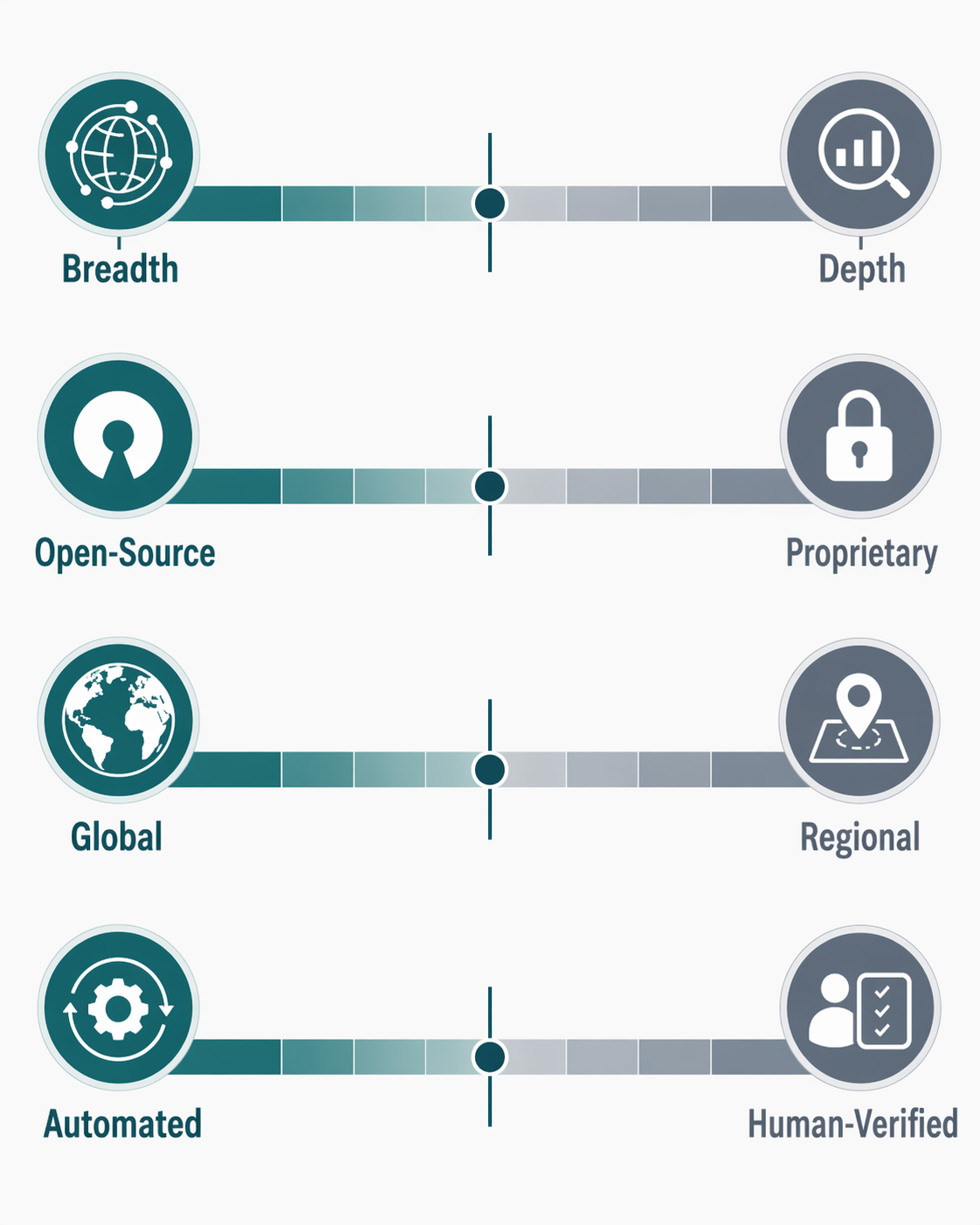
- Breadth versus depth: broad global scanning is useful only if the platform captures the places, languages, and diseases that matter to the jurisdiction.
- Open validation versus proprietary coverage: inspectable systems support external review, while closed systems may offer data partnerships or analytic layers that open tools lack.
- Global monitoring versus regional relevance: a worldwide alert stream still needs local baselines, reporting relationships, and field verification.
- Automation versus expert capacity: every model threshold becomes someone’s worklist, and the 5% to 10% true-alert base rate makes staffing central.[5]
- Access versus sustainability: free access, Member State eligibility, and commercial subscription costs shape whether a tool can be used continuously rather than piloted briefly.
The safest procurement language is specific. Do not ask whether the platform uses AI. Ask which sources it ingests, how often they refresh, which languages are measured rather than advertised, where humans verify outputs, what performance metric is being quoted, whether independent validation exists, and how many alerts a team should expect to review in an ordinary week.
These platforms are no longer prototypes. BlueDot, BEACON, EPIWATCH, WHO EIOS, and HealthMap all represent operational attempts to make outbreak signals visible earlier or more efficiently. None removes the need for human epidemiological judgment, local data quality, or equity-aware implementation. The platform that looks most impressive in a demo may not be the one a health department can validate, staff, and use when the next ambiguous signal arrives.
References
- Using LLMs to Detect Outbreaks Faster, BlueDot
- BEACON Delivers AI-Powered Global Disease Surveillance, Boston University, April 24, 2025
- Early detection, assessment and response to acute public health events: implementation of the Epidemic Intelligence from Open Sources initiative, Frontiers in Digital Health, 2025
- An automated system for filtering relevant outbreak articles using a BERT classifier, PMC
- Surveillance, Public Health AI Handbook
Comments
Join the discussion with an anonymous comment.