
What the published evidence actually shows
For AI in parasitic disease symptom tracking and diagnosis, the evidence is not evenly distributed. The strongest data are still image-based: blood smears for malaria, concentrated stool wet mounts for helminths, and clinical skin images for selected neglected tropical diseases. Symptom tracking tools exist, but they remain the thinner part of the literature and should be read as adjuncts to diagnosis rather than replacements [1].
| Modality | Best published signal | Practical read |
|---|---|---|
| Blood smears / malaria | 99.23% accuracy on 32x32 images with about 4,600 floating point operations; AIDMAN reported 98.62% cell-level, 97% smear-level, and 98.44% clinical validation accuracy [2][3] | The technical ceiling is already high, and the compute cost can be made small enough for phone-linked workflows. |
| Stool wet mounts / helminths | Positive agreement reached 98.6% versus manual microscopy, while AI-assisted screening raised helminth patient detection from 29 to 104 and client-level positivity from 4.5% to 12.3% [4][5] | This is the clearest example of workflow change, not just a better score. |
| Skin NTDs | ResNet-50 systems exceeded 70% accuracy on clinical images; a leprosy smartphone app reached 93.97% sensitivity and 87.09% specificity; trachoma models ran around 87% to 95% sensitivity/specificity [1] | Performance is clinically meaningful, but the evidence base is more heterogeneous. |
| Symptom tracking | Mobile apps for scabies screening and dengue symptom triage exist, but their published performance data are thinner than the imaging literature [1] | Useful as an adjunct, not yet the main evidentiary story. |
Malaria: the clearest proof
Malaria is where the case for AI stops looking speculative. Fuhad et al. reported 99.23% accuracy on 32x32 blood-smear images, with an autoencoder-trained model that needed about 4,600 floating point operations, roughly 4 million times fewer than ensemble models [2]. That matters because endemic settings do not only need good accuracy; they need models that can run without turning a phone or low-power device into a bottleneck.
AIDMAN pushes the same point from a different angle. In smartphone thin-blood-smear images, the system reached 98.62% cell-level accuracy, 97% blood-smear-level diagnostic accuracy, and 98.44% clinical validation accuracy [3]. The combination of object detection, clinical validation, and mobile capture is what makes the result hard to dismiss: this is not just a neat classifier sitting on a curated dataset.
Helminths in stool: where workflow changes
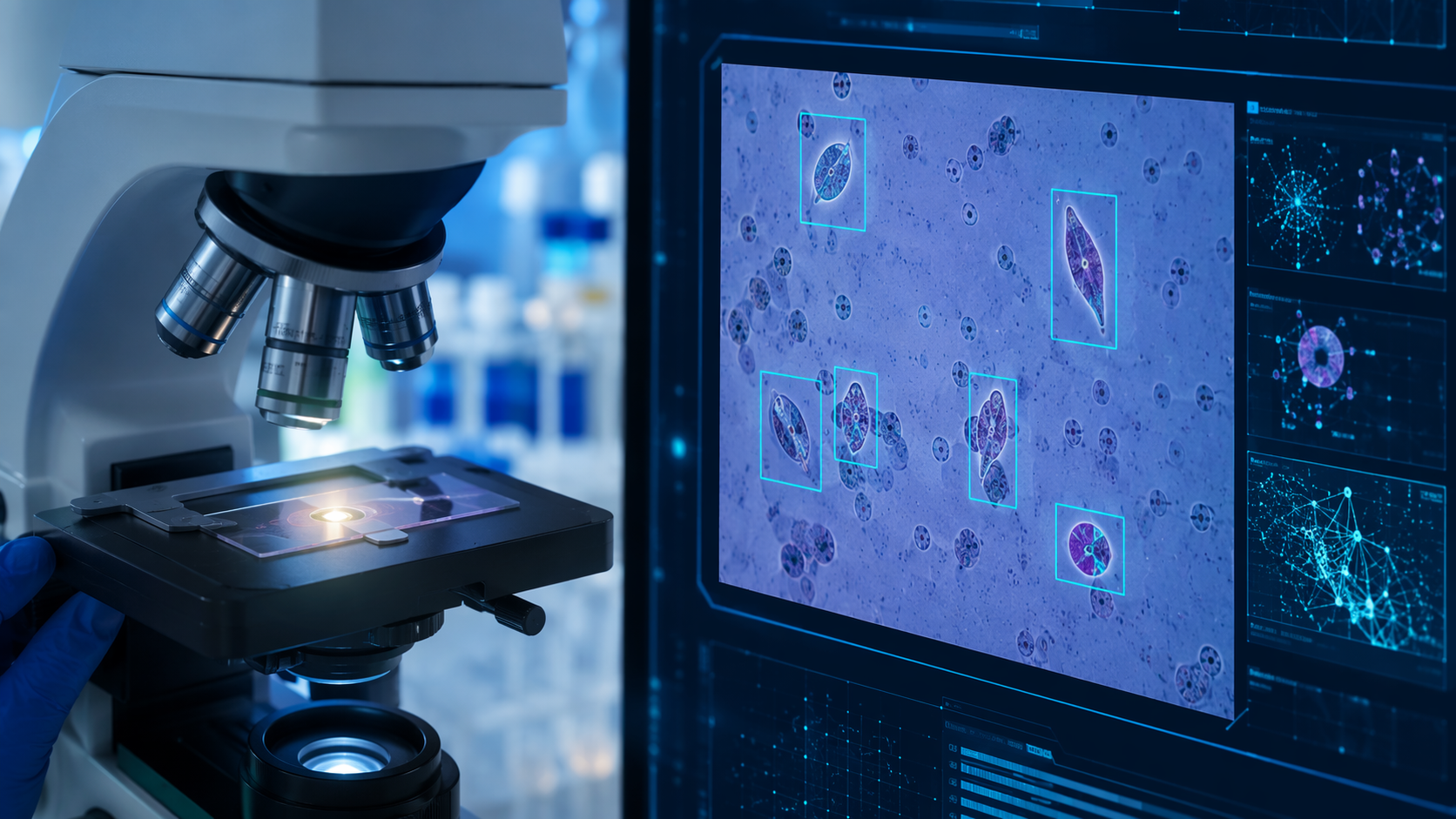
Stool screening is the place where AI looks most operationally useful. In a large United States reference lab, the WM-AI workflow reached 98.6% positive agreement against manual microscopy [4]. That is important, but the more persuasive result is what happened when the system sat inside routine screening: across 6-month pre- and post-implementation periods, helminth patient detection rose from 29 to 104, and client-level positivity went from 4.5% to 12.3% [5].
The burden distribution inside those positives explains why the score matters. Among AI-detected positives, 56.4% had five eggs or larvae or fewer, and 24.8% had only a single egg [5]. That is exactly the kind of specimen a reviewer can pass over when the tray is long and the day is already full.
Skin NTDs: real signal, more heterogeneity
The skin literature is less uniform, but it is no longer trivial. The review literature summarizes ResNet-50 models above 70% accuracy on clinical images, a leprosy screening app with 93.97% sensitivity and 87.09% specificity, and trachoma models in the 87% to 95% sensitivity/specificity range [1]. These are not interchangeable diseases or datasets, so the numbers should not be collapsed into a single headline claim. Still, they are high enough to justify continued clinical testing instead of shrugging them off as demonstrations.
Symptom tracking remains the weaker lane
The symptom-tracking side of the keyword remains much less mature. Mobile tools for scabies screening and dengue symptom triage do exist, but the published performance evidence is not nearly as rigorous or standardized as the imaging-based diagnosis literature [1]. That difference matters because tracking symptoms can help route patients, but it does not yet carry the same evidentiary weight as a model that can be checked against a smear or wet mount.
So the main question is no longer whether AI can read parasite images at clinically relevant levels. It can. The harder question is where these systems are actually landing. The best studies still cluster around reference laboratories, smartphone-linked validation workflows, and structured datasets, while the communities with the heaviest parasite burden remain the least likely to see these tools at scale [1][2][3][4][5]. That deployment gap is the clearest limit in the current literature.
References
- Artificial intelligence in parasitic disease control: A paradigm shift in health care — PubMed Central
- Deep Learning Based Automatic Malaria Parasite Detection from Blood Smear and Its Smartphone Based Application — PubMed Central
- AIDMAN: An AI-based object detection system for malaria diagnosis from smartphone thin-blood-smear images — PubMed Central
- Diagnosing helminth infections in a large reference laboratory in the United States: a 6-month pre- and post-implementation analysis of AI-augmented screening of concentrated fecal wet mounts — Journal of Clinical Microbiology — 2026
- Detection of protozoan and helminth parasites in concentrated wet mounts of stool using a deep convolutional neural network — Journal of Clinical Microbiology — 2025
Comments
Join the discussion with an anonymous comment.