
The more revealing AI health misinformation story is not a faceless chatbot giving poor advice. It is a patient seeing a familiar physician’s name, face, and voice in a video that appears to endorse a cure, a supplement, or a diagnostic claim the physician never made. That is where AI-generated parody and voice cloning stop looking like a content-moderation nuisance and start becoming a clinical trust problem.
In December 2025, Guardian and Full Fact reporting documented hundreds of AI-generated videos impersonating named physicians, including Prof David Taylor-Robinson, Duncan Selbie, Prof Tim Spector, and Dr Michael Mosley, across TikTok, Facebook, X, and YouTube. The videos directed viewers toward unregulated supplement vendors, and TikTok initially deemed some of the deepfakes “fine” before later action was taken.[1]
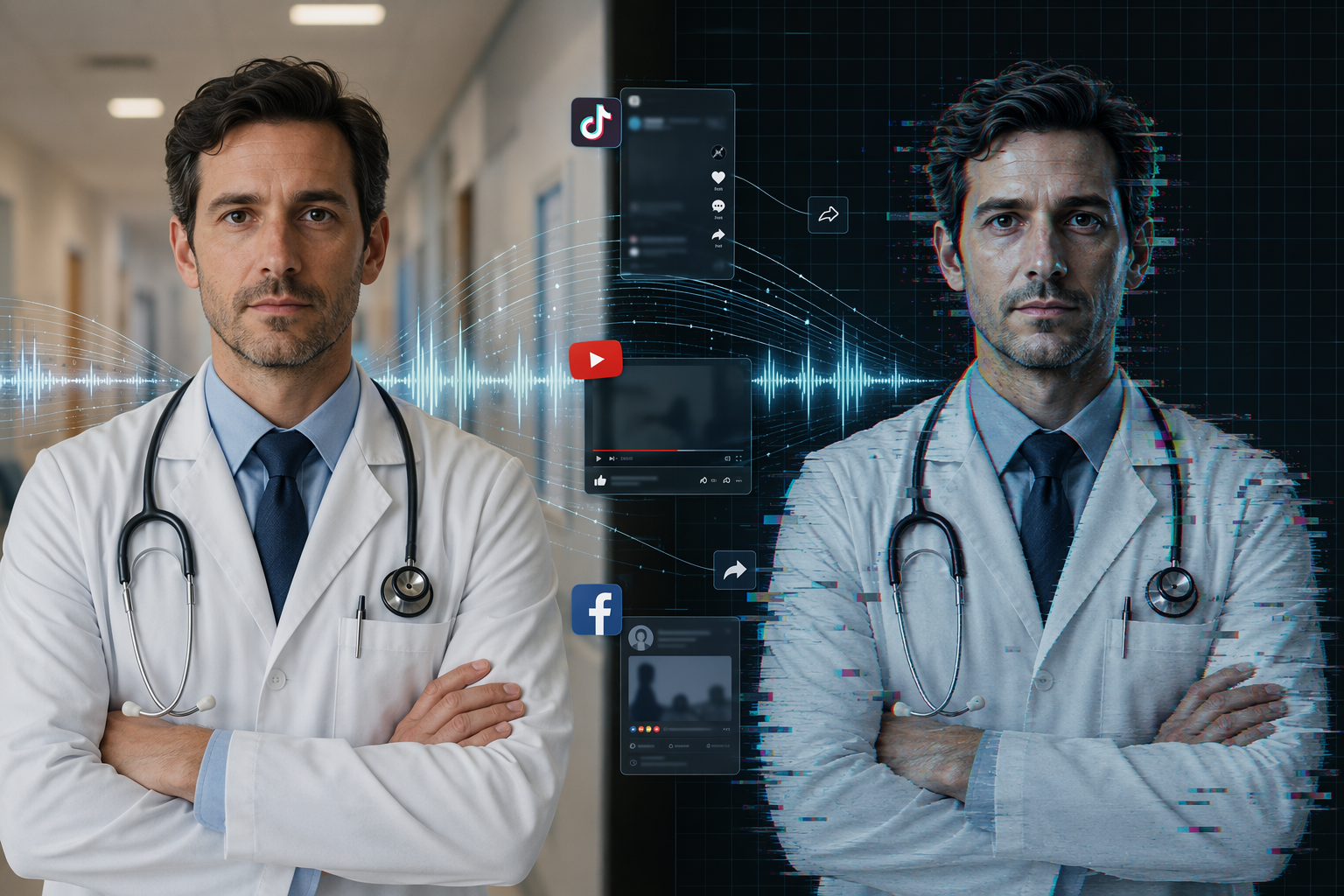
That detail matters. These were not generic cartoon doctors or obvious satire accounts. They were synthetic claims wrapped in the social signals medicine already relies on: a recognizable face, a professional title, a plausible voice, a platform feed, and enough circulation to make the viewer wonder whether the statement had some legitimate source. Once that package reaches a patient, the next stop may be a portal message, a delayed treatment conversation, a complaint to a clinic, or a purchase from a vendor no clinician has reviewed.
Voice cloning itself is not the villain. The same family of tools can support speech restoration and voice banking for people with ALS, aphasia, or after laryngectomy. In those settings, the ethical center is consent, therapeutic purpose, and clinical governance. The problem here is different: a physician’s identity is copied without authority, attached to medical claims, and used to move patients toward commercial behavior.
The Attack Is on Verification
STAT News recently framed deepfakes in medicine as a threat to “epistemic security,” with three layers under pressure: identity, record, and evidence.[2] That framework is useful because it names what hospital teams feel when a patient arrives with a screenshot or a video and asks whether it is real. The question is not only whether the claim is medically wrong. It is whether the institution can still establish who spoke, where the authoritative record lives, and what counts as evidence.
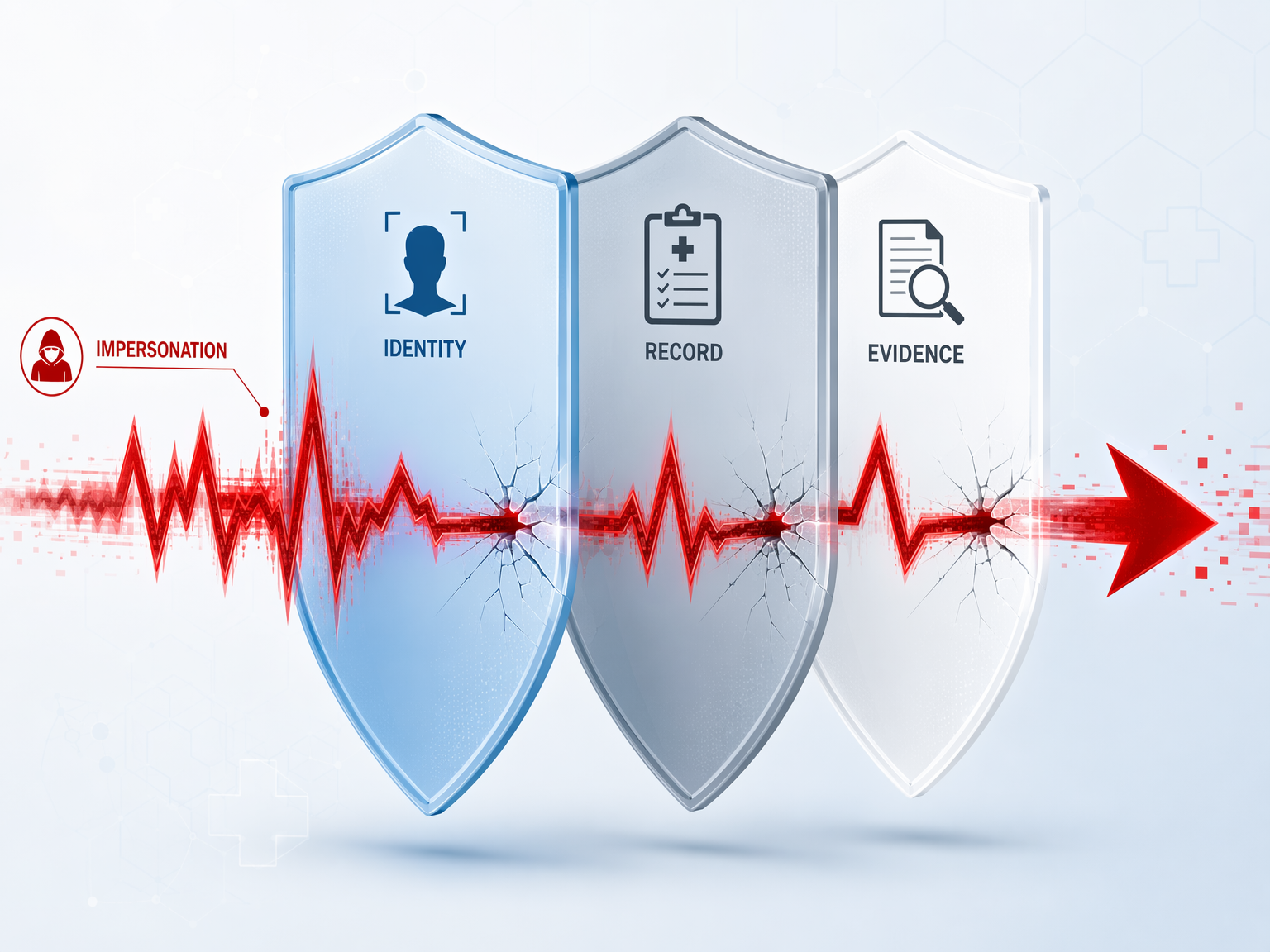
Identity is the first layer. Medicine has always used imperfect but practical identity rituals: the badge on the coat, the name on the clinic door, the voice on the phone, the institutional website profile, the portal signature. Deepfake physician videos exploit the same rituals in public feeds. A patient does not need to believe in AI. They only need to believe that the doctor they recognize probably said the thing that appears on the screen.
The record is the second layer. In clinical operations, a claim matters differently depending on whether it appears in a chart note, discharge instruction, after-visit summary, patient portal message, media interview, or social media clip. A deepfake collapses those boundaries. The patient may treat a platform video as if it were advice from their care team, while the clinician has no corresponding documentation, no opportunity to correct the context, and no durable institutional record showing what was actually said.
Evidence is the third layer. A video used to carry a rough presumption that a person appeared and spoke. That presumption was never perfect, but it was operationally convenient. Synthetic media makes the presumption unsafe, especially when a clip is combined with product claims, edited testimonials, or fake before-and-after narratives. The patient is left to authenticate media artifacts that even trained teams may need time and tools to assess.
The same dynamic creates the “liar’s dividend,” a term STAT applied to the medical deepfake problem: authentic statements can become easier to dismiss as possible fabrications.[2] That is a quieter but serious harm. If every damaging recording can be plausibly waved away as synthetic, accountability weakens in both directions. Fake doctors can sell false claims, and real professionals can find it easier to deny real statements.
Why the Fake-Doctor Case Is More Than Reputation Damage
Physician impersonation often gets filed under reputational harm, and reputational harm is real. Axios reported in May 2026 that doctor deepfakes are feeding broader fraud schemes, including insurance fraud and reputational damage.[3] But in a health system, the loss does not stay with the impersonated physician’s name or search results.
It travels into workflow. Someone has to triage the patient message. Someone has to decide whether a safety alert is needed. Someone has to preserve evidence for a platform report or law enforcement referral. Someone has to reassure staff who are being harassed online. Someone has to tell patients, without sounding dismissive, that a video that looked convincing was not clinical advice.
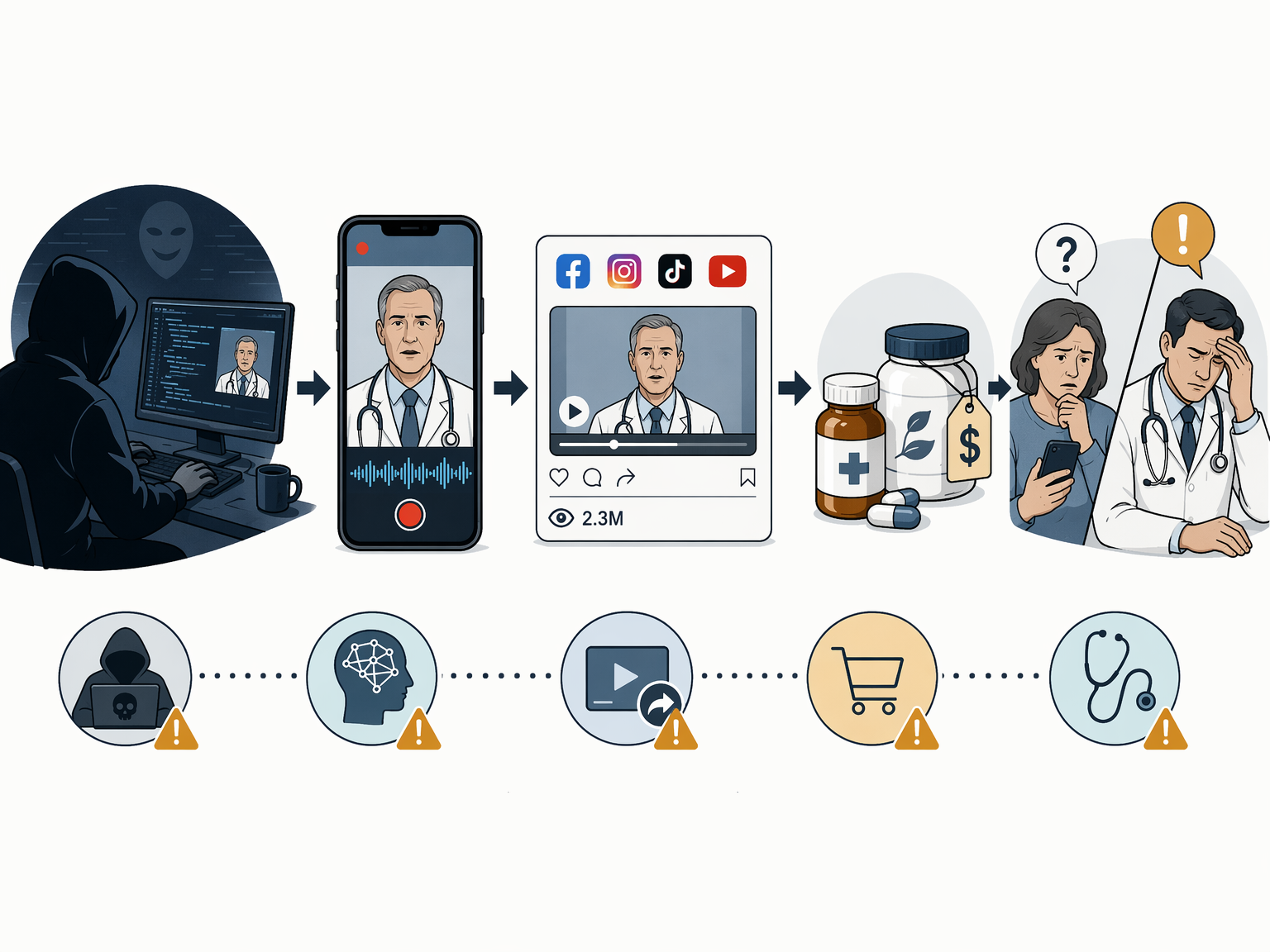
The Guardian and Full Fact reporting is especially troubling because the pathway was so ordinary: impersonated clinicians, major platforms, product funnels, and unregulated supplement sellers.[1] No exotic breach of a hospital system is required. A public-facing physician may already have interviews, lectures, podcasts, headshots, and profile pages online. Those assets are part of modern medical communication; they are also raw material for impersonation.
A health system that treats this only as a social media problem will respond too late. By the time a fake video is widely shared, a clinic may already be dealing with patients who postponed care, bought a product, distrusted a clinician’s correction, or demanded an intervention based on a forged endorsement. The operational injury is not just that the lie exists. It is that legitimate clinical time is spent repairing the verification failure.
The U.S. Enforcement Gap Is Real
The United States does not have a single comprehensive federal law specifically governing AI voice cloning. Current responses depend on a patchwork of consumer protection authority, fraud law, state publicity or impersonation claims, platform rules, professional regulation, and, in some settings, healthcare privacy or cybersecurity obligations. STAT’s recent reporting places that gap at the center of the medical deepfake problem.[2]
The FTC’s impersonation work is an important partial lever, especially when scams trade on a person’s or organization’s identity. The agency’s Voice Cloning Challenge also shows that regulators understand voice cloning as a consumer harm, not merely a novelty.[4] But the fit is incomplete for healthcare. A fake physician video may be an ad, a scam, a medical misinformation event, an identity abuse incident, a platform enforcement matter, and a patient-safety concern at the same time. No single authority cleanly owns that whole chain.
That fragmentation affects speed. A hospital may be able to report an impersonation to a platform, send a takedown demand, notify a physician, warn patients, and preserve evidence. It may not be able to force rapid platform review, identify the seller behind the funnel, or stop the same asset from reappearing under another account. Enforcement after the fact does not undo the first wave of patient exposure.
The EU AI Act points in a different direction by imposing transparency obligations for certain AI-generated or manipulated content. Article 50 disclosure requirements are described as taking effect on August 2, 2026, and the law can matter beyond Europe for organizations and vendors operating across borders.[5] Disclosure and watermarking rules can help, but only if they are implemented upstream and enforced against the actors most likely to omit them.
Policy also has to avoid a familiar trap: requiring disclosure from responsible developers while leaving malicious impersonators to ignore the rule. The healthcare test should be practical. Does the rule reduce the chance that a patient encounters a forged physician endorsement before harm occurs? Does it make platforms remove impersonations faster? Does it give health systems a clearer escalation path? If not, it may still be useful, but it is not sufficient.
Detection Helps, but It Does Not Carry the Whole Burden
Technical countermeasures are improving. In 2024, the FTC announced winners of its Voice Cloning Challenge, including Pindrop, which reported real-time synthetic voice detection with 99% accuracy on two-second audio chunks.[6] That is a meaningful signal that detection is not imaginary or purely aspirational.
It is also not a complete answer. A patient watching a video in a social feed is not running forensic analysis. A clinic receiving a worried portal message may not have the original file, the account metadata, or the distribution history. A platform may remove one clip while copies or screen recordings continue to circulate. Detection can support investigations and platform enforcement, but it cannot substitute for trusted channels, rapid communication, and institutional ownership.
CISO teams are right to pay attention. Deepfakes are now discussed as part of the broader cyber risk landscape, including social engineering, fraud, and identity compromise.[7] For healthcare, the point is not to relocate the entire problem into cybersecurity. It is to recognize that physician identity, patient trust, media evidence, and fraud response now sit closer to the same risk surface than most hospital playbooks assumed.
What Health Systems Should Own Now
Hospitals and medical groups cannot wait for a perfect federal statute or universal platform compliance. They control several parts of the verification layer patients actually use. The starting point is not a glossy AI policy; it is an operational answer to a simple question: if a patient sees a video of one of our physicians making a medical claim, where can they verify whether it is real?
- Maintain authoritative clinician profile pages that clearly state official roles, accepted public channels, and how patients should verify medical claims attributed to that clinician.
- Create a public verification page for suspected fake physician content, with a plain-language warning that clinicians do not endorse products through unofficial social media videos.
- Route impersonation reports through a defined intake path that includes communications, legal, compliance, cybersecurity, clinical leadership, and patient safety when needed.
- Preserve evidence before takedown requests: URLs, account names, screenshots, video files where lawful, timestamps, product links, and patient reports.
- Prepare platform-specific takedown templates that identify the impersonated clinician, the forged medical claim, the commercial destination, and the patient-safety concern.
- Support the impersonated clinician with messaging, documentation, and security guidance rather than leaving them to negotiate directly with platforms or angry viewers.
The verification page is especially important because it gives staff somewhere to send patients. Without it, every correction becomes a one-off explanation from a nurse, scheduler, physician, or social media manager. A standing page also helps avoid overpromising. It can say what the organization can verify, what it cannot verify, how patients should report suspicious content, and where official medical advice will appear.
Health systems should also decide when an impersonation becomes a patient-safety event rather than a communications incident. A fake video selling a supplement under a physician’s name may need a different response if it targets oncology patients, people with diabetes, pregnant patients, or other groups likely to make treatment decisions based on the forged claim. The threshold should be based on foreseeable patient harm, not merely on view count.
Medical education and marketing teams have a role too. Public clinicians should not be told to disappear from the internet; that would punish legitimate education and leave lower-quality voices with more space. But organizations can track where official appearances are posted, retain original files, document consent for edited clips, and avoid scattering physician media assets across unmanaged accounts.
What Clinicians Can Do Without Becoming Their Own Trust-and-Safety Department
Individual clinicians need concise habits, not a second job. They should keep their institutional profile current, know where to send suspected impersonations, and avoid resolving serious cases through informal replies from personal accounts. If they make public educational content, they should keep copies of original recordings and note where official versions are posted.
When a patient brings in a suspected fake, the clinician’s first task is not to debate AI. It is to bring the patient back to the trusted record: what their care plan says, what the clinician is actually recommending, and which channels the patient should use for future medical decisions. A short correction inside the visit may prevent a longer downstream conflict.
- Do not confirm or deny suspicious media casually if the facts are unclear; route it for review.
- Do document clinically relevant patient decisions influenced by suspected impersonation.
- Do redirect patients to official institutional channels and patient-specific medical advice.
- Do report product links, account names, and screenshots through the organization’s defined pathway.
What Platforms and Regulators Should Be Measured Against
Platforms should not be judged only by whether they eventually remove a fake. In healthcare, delay is part of the harm. A useful platform policy would treat named-physician impersonation tied to medical claims or product sales as a high-risk category requiring rapid review, preservation of evidence, repeat-upload controls, and clear reporting channels for verified institutions.
Regulators should be judged by the same operational standard. Punishing fraud after money changes hands is necessary, but too narrow. The harder question is whether rules make forged medical authority less distributable in the first place. That may require clearer impersonation prohibitions, stronger platform duties for high-risk medical deception, and better coordination among consumer protection, health, privacy, and cyber authorities.
The American Medical Association’s developing policy framework may help professional organizations describe the problem in terms medicine understands: consent, attribution, patient harm, and accountability. But professional policy cannot remove videos on its own. It needs to connect to platform reporting pathways, legal remedies, and health-system incident response.
The Practical Line
Fake doctors are not just another misinformation format. They are a direct attack on the verification layer of digital medicine: identity, record, and evidence. The patient cannot be expected to authenticate every convincing video before deciding what to believe, and the clinician should not have to spend scarce visit time undoing an impersonation that platforms, sellers, and weak governance allowed to circulate.
Until law, platform enforcement, and technical detection catch up, health systems need to treat physician identity protection as part of patient-safety and cybersecurity governance. The question is no longer whether synthetic media can imitate medical authority. It can. The question is whether healthcare institutions can make the real authority easier to find, faster to verify, and harder to forge.
References
- AI deepfakes of real doctors spreading health misinformation on social media, The Guardian, December 5, 2025.
- Deepfakes, AI-generated medicine misinformation, regulation, video, STAT News, July 14, 2026.
- Doctors’ AI deepfakes are a misinformation problem, Axios, May 6, 2026.
- FTC Voice Cloning Challenge, Federal Trade Commission.
- The EU AI Act: What Generative AI Companies Need to Know in 2026, Resemble AI.
- FTC Announces Winners of Voice Cloning Challenge, Federal Trade Commission, April 2024.
- Deepfake Dilemma: AI Cyber Risks for CISOs, Censinet.
Comments
Join the discussion with an anonymous comment.