
Patients are already arriving with reports from microbiome tests, AI-generated food scores, and subscription supplement packs. The clinical question is no longer whether AI in digestive health supplements is interesting. It is whether a gastroenterologist or dietitian can responsibly say, “Yes, buy this,” rather than “This may be worth watching.”
The most defensible answer in 2026 is cautious: AI-personalized digestive health tools have promising proof-of-concept evidence, especially for personalized nutrition, but they are not ready for routine clinical recommendation as supplement regimens. The evidence is strongest where AI helps tailor diet and interpret microbiome patterns. It becomes thinner when the claim shifts to a specific probiotic, prebiotic, gummy stack, or digestive supplement protocol improving patient outcomes.
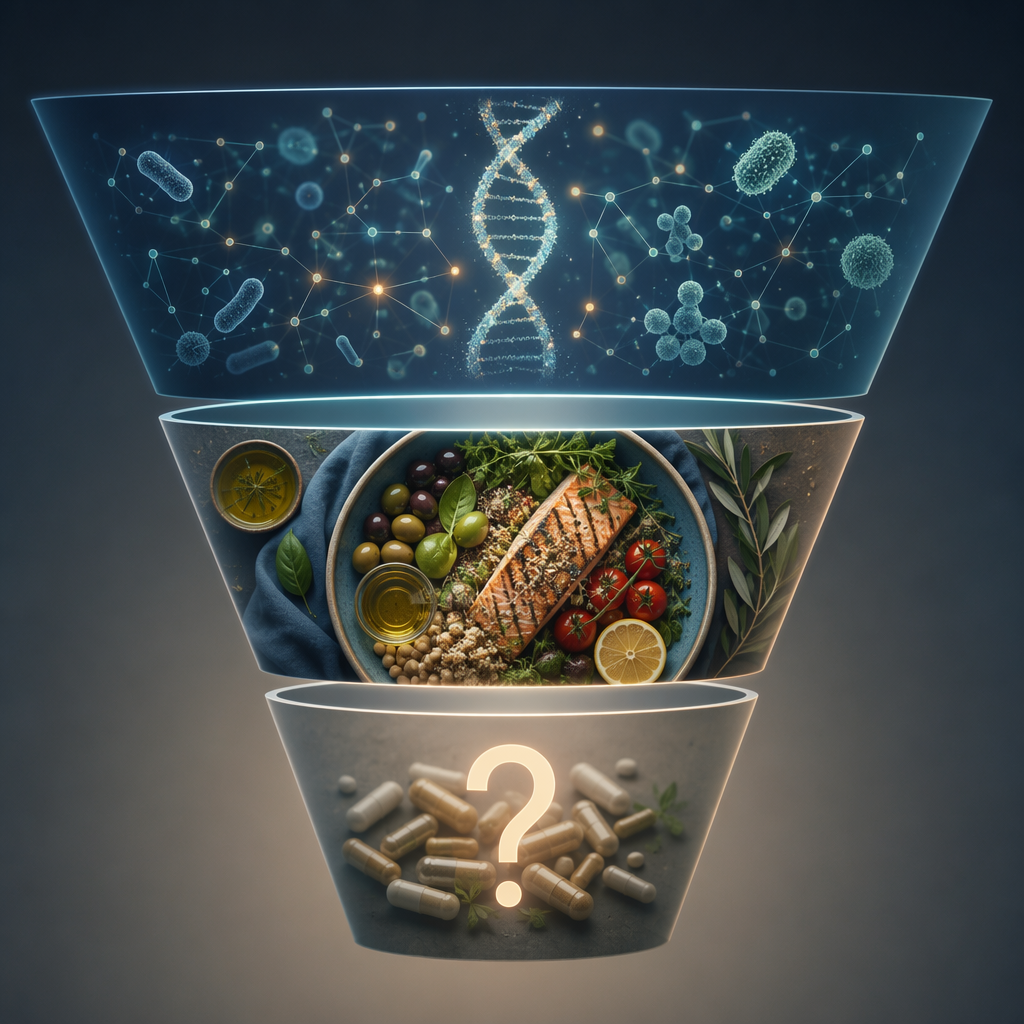
That distinction matters. A platform may accurately identify microbial features, then use those features to recommend foods, and then also sell supplements. Those are three different evidentiary claims. Technical classification does not prove clinical benefit. Diet response does not prove supplement efficacy. A microbiome shift does not automatically mean a patient’s bloating, bowel pattern, metabolic risk, or quality of life has improved.
The best clinical signal comes from personalized nutrition, not supplement stacks
The PROTEIN pilot trial is the most useful place to begin because it shows both why this field deserves attention and why clinicians should not overstate it. In that study, 29 participants received a 6-week AI-personalized Mediterranean diet intervention. The intervention was associated with measurable microbiome changes, including increases in Faecalibacterium and Subdoligranulum, along with metabolic changes such as an approximately 1.2 cm reduction in waist circumference and an 18.1% reduction in carbohydrate intake.[1]
Those are not trivial signals. Faecalibacterium is often discussed in gut health research because of its relationship to intestinal ecology, and a dietary intervention that changes both intake patterns and microbial composition within 6 weeks is clinically plausible. The trial also points toward a practical advantage of AI-guided care: personalization may help move patients away from generic advice and toward choices that fit their own baseline biology and behavior.
But the same trial also sets the boundary. It was small, short, and uncontrolled. With 29 participants and no control group, it cannot separate the AI-personalized component from attention, motivation, Mediterranean diet counseling, regression to the mean, or ordinary short-term behavior change.[1] It tested an AI-personalized diet intervention, not a validated digestive supplement regimen. A clinician can reasonably cite it as proof that AI-personalized nutrition can move measurable endpoints. It should not be used as proof that an AI-recommended probiotic or prebiotic stack improves digestive symptoms.
| Claim | What current evidence supports | What it does not yet support |
|---|---|---|
| AI can identify microbiome features | High technical performance has been reported under research conditions | That identification improves patient outcomes in routine care |
| AI can personalize diet | Small clinical studies show feasibility and measurable shifts in diet, microbiome composition, and selected markers | Routine clinical use across broad digestive disorders |
| AI can recommend digestive supplements | Commercial platforms can generate personalized formulations and ingredient combinations | Large controlled evidence that those supplement regimens improve digestive outcomes |
For a dietitian, the PROTEIN result is more than a curiosity. It suggests that personalization may help with adherence and biologic targeting, two persistent weak points in nutrition counseling. For a gastroenterologist being asked about a commercial supplement plan, however, it leaves the central question unanswered: which ingredient, at what dose, for which patient group, against what comparator, and with which clinical endpoint?
IBS research shows feasibility, but not a shortcut around endpoint standards
The IBS evidence is important because it moves the conversation closer to the clinic. Tunali and colleagues conducted a multicenter randomized controlled trial comparing a microbiome-based AI-assisted personalized diet with a low-FODMAP diet in IBS.[2] That comparator matters. Low-FODMAP care is not a vague wellness standard; it is a familiar, structured dietary intervention that many gastroenterology practices already use with dietitian support.
The trial supports the idea that AI-assisted personalization can be tested in a real digestive condition rather than only in healthy volunteers or broad wellness populations.[2] It also helps keep the field honest. IBS is symptom-defined, heterogeneous, and vulnerable to expectation effects. A tool that claims relevance here needs patient-centered endpoints, adequate follow-up, and a comparator that reflects actual care.
Even so, this study does not close the supplement gap. It examined personalized diet, not an AI-selected supplement regimen. That does not make the study weak; it makes the inference narrower. Clinicians can take it as evidence that microbiome-based AI dietary strategies are entering controlled digestive disease research. They should not translate it into confidence that a commercial supplement packet will reduce IBS symptoms unless that packet has been tested on its own terms.
The technical foundation is plausible, but clinical deployment is a different test
The strongest technical argument for these platforms is that AI can process microbiome data at a level of detail that would be difficult to operationalize manually. Han and colleagues reported AI models achieving greater than 97% accuracy in bacterial strain identification from metagenomic data.[3] That kind of performance helps explain why microbiome personalization has become more than a marketing fantasy.
Still, strain identification is infrastructure evidence. It says something about analytic capability under the conditions described in the review; it does not say that the downstream recommendation is correct, safe, durable, or clinically useful for a patient with constipation-predominant IBS, post-infectious symptoms, antibiotic exposure, or multiple dietary restrictions. The clinical chain has several links: sample collection, sequencing quality, model interpretation, recommendation logic, patient adherence, supplement composition, and outcome measurement. A high-performing model at one link does not validate the full chain.
This is where clinicians should be especially careful with platform language. “Microbiome-based,” “AI-driven,” and “personalized” can all be true while the product remains unproven for a specific digestive indication. The meaningful question is not whether the algorithm detects something real. It is whether acting on that detection changes a patient-relevant outcome beyond what good dietary care, standard symptom management, or non-personalized supplementation would have achieved.
Consumer platforms are ahead of clinical evidence
Commercial deployment is moving faster than clinical validation. Platforms such as Viome, DayTwo, ZOE, and Nourished have made microbiome or nutrition personalization familiar to consumers. The most sophisticated examples no longer stop at a report; they produce continuing recommendations and, in some cases, customized supplement products.
Nourished illustrates the direction of travel. A 2025 NutraIngredients report described AI-driven personalized gummy supplements, including AI agents that continuously read clinical trial databases and a formulation system with more than 5,000 possible layer combinations.[4] That is operationally impressive. It also shows why the evidence burden becomes more complicated. When the product can be reformulated across thousands of combinations, clinicians need to know which combinations were tested, in whom, and against what.
Published evidence around consumer platforms has been more convincing for dietary or nutritional personalization than for supplement-specific digestive outcomes. That distinction should appear in patient conversations. If a patient asks whether a platform may help them think more systematically about food response, the answer can be cautiously open. If the patient asks whether the platform’s proprietary supplement stack has been proven to improve their digestive condition, the answer is usually no, or at least not by the kind of large, controlled, supplement-specific trial that would justify routine recommendation.
Patient demand is real, and so is the transparency problem
None of this means patients are foolish for being interested. Many have already tried standard probiotics without a clear benefit, and many have been given generic dietary advice that is hard to follow. Personalization offers a coherent promise: less guessing, fewer abandoned trials, and recommendations that feel connected to the patient’s own biology.
Survey data suggest that supplement users may be receptive to AI, but not uncritically so. In a 2024 Ingredient Communications survey reported by SupplySide, 64% of supplement users viewed AI positively compared with 40% of non-users, while 87% wanted label transparency for AI-developed products.[5] The methodology and population behind any survey still matter, but the direction is clinically familiar: patients may accept AI assistance while still wanting to know what is in the product and how the recommendation was made.
That transparency is not a cosmetic issue. If a patient develops diarrhea, constipation, nausea, bloating, or interacts with other therapies, the clinician needs more than a brand name and a personalization score. They need ingredient identity, dose, rationale, expected duration, safety cautions, and whether the recommendation changed over time. A black-box supplement plan is hard to evaluate clinically, even if the front-end report looks precise.
Regulation has not caught up with the recommendation engine
The regulatory gap is straightforward: no FDA clearance or dedicated regulatory framework currently establishes that AI-developed or AI-recommended digestive health supplements are clinically effective for digestive conditions. That leaves clinicians evaluating them largely as consumer supplement products with added algorithmic claims, not as cleared clinical decision tools.
Industry discussions acknowledge that AI adoption in supplements is still developing. A SupplySide Global 2025 panel described the sector as still reshaping innovation with AI and noted that supplement companies have been slow to fully adopt AI capabilities.[6] Slow adoption is not inherently bad; in clinical contexts, speed is less important than validation. The concern is uneven evidence: rapid consumer-facing personalization on one side, limited controlled clinical outcome data on the other.
For now, the absence of a clear regulatory pathway puts more burden on ordinary clinical judgment. Was the product tested in the target population? Were symptoms or validated quality-of-life measures assessed? Was there a comparator? Was the supplement formula fixed enough to interpret? Were adverse events collected? Did the trial last long enough to matter for the condition being treated? These are basic questions, but many AI-personalized supplement claims still do not answer them.
How clinicians can discuss these products without overendorsing them
A practical clinical stance does not need to be dismissive. Patients may be using these products already, and a flat refusal to engage can leave them without safety guidance. The more useful approach is to separate curiosity from recommendation.
- Ask what the platform recommended: diet changes, probiotics, prebiotics, enzymes, vitamins, fibers, or a combined stack.
- Ask what outcome the patient expects: less bloating, improved stool form, fewer IBS flares, weight change, metabolic improvement, or general wellness.
- Review the ingredient list and doses, especially for patients with restrictive diets, pregnancy, immunocompromise, severe illness, or multiple medications.
- Set a defined monitoring window and stop criteria rather than allowing an indefinite rotating supplement subscription.
- Document that evidence for AI-personalized diet is not the same as evidence for the specific supplement regimen.
The conversation changes if a company can provide controlled, supplement-specific evidence in the relevant condition. A credible trial would not merely show that the microbiome changed after using the product. It would test a defined AI-recommended regimen against an appropriate comparator, measure symptoms or validated clinical outcomes, report adherence and adverse events, and follow participants long enough to distinguish a durable effect from short-term fluctuation.
Until then, the cleanest answer is also the most clinically useful: AI-personalized digestive health platforms are plausible and worth monitoring; AI-personalized nutrition has early human evidence; AI-recommended digestive supplement stacks have not yet earned routine clinical endorsement.
References
- PROTEIN pilot trial. Nutrients. 2025. link
- Microbiome-based AI-assisted personalized diet vs. low-FODMAP diet for IBS. American Journal of Gastroenterology. 2024. link
- AI accuracy in bacterial strain identification. Trends in Food Science & Technology. 2025. link
- AI-driven personalized gummy supplements, collagen, gut health, global expansion. NutraIngredients. July 15, 2025. link
- Supplement users more trusting of AI, survey finds. SupplySide. 2024. link
- Smarter, faster, cleaner: How AI is reshaping supplement innovation. SupplySide. 2025. link
Comments
Join the discussion with an anonymous comment.