
Start with the medical itself. A transfer medical is not a quiet annual screen. It is a compressed clinical negotiation: cardiovascular screening, musculoskeletal imaging, bloodwork, physical examination, functional testing, and a same-day risk position delivered while executives, agents, and registration deadlines wait outside the room.
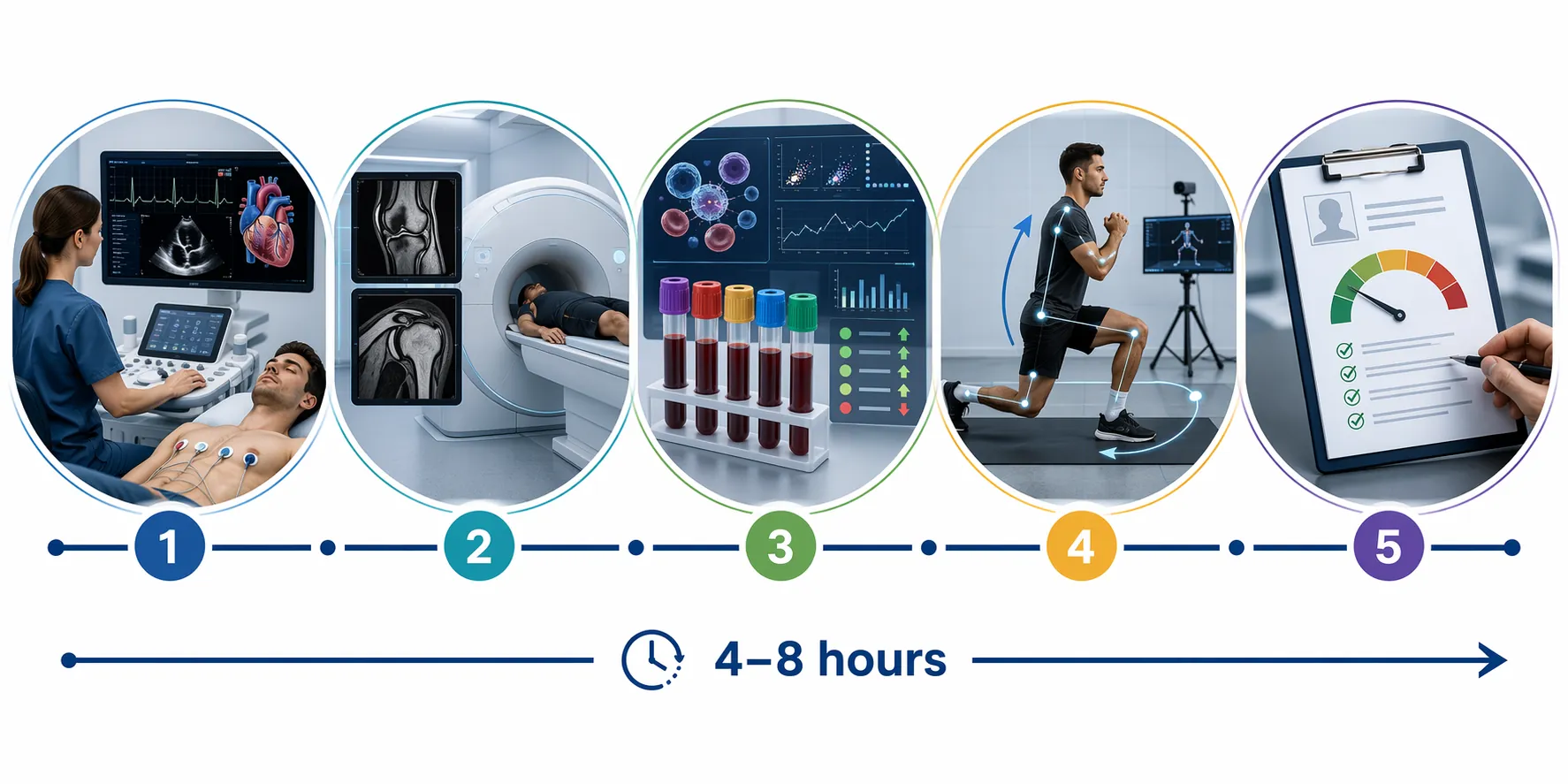
BBC Sport describes the modern football medical as a 4-to-8-hour process that can include ECG, echocardiogram, full-body MRI, blood tests, functional assessments, and rapid verbal reporting from specialists, with blood results potentially available in about 4 hours.[1] The Athletic’s first-person account of undergoing a transfer-style medical reinforces the same practical point: the player moves through stations, the clinicians collect different kinds of evidence, and the final conversation is about what those findings mean for a club about to assume risk.[2]
That distinction matters. The useful question is not whether AI can “pass” or “fail” a player. Dr. Charlotte Cowie’s description of transfer medicals as “one man’s fail is another man’s pass” is closer to the actual clinical and commercial terrain.[1] A club buying a squad player on modest wages, a club investing a record fee in a striker expected to play twice a week, and a club taking a short-term loan after an injury crisis may look at the same knee scan and reach different decisions.
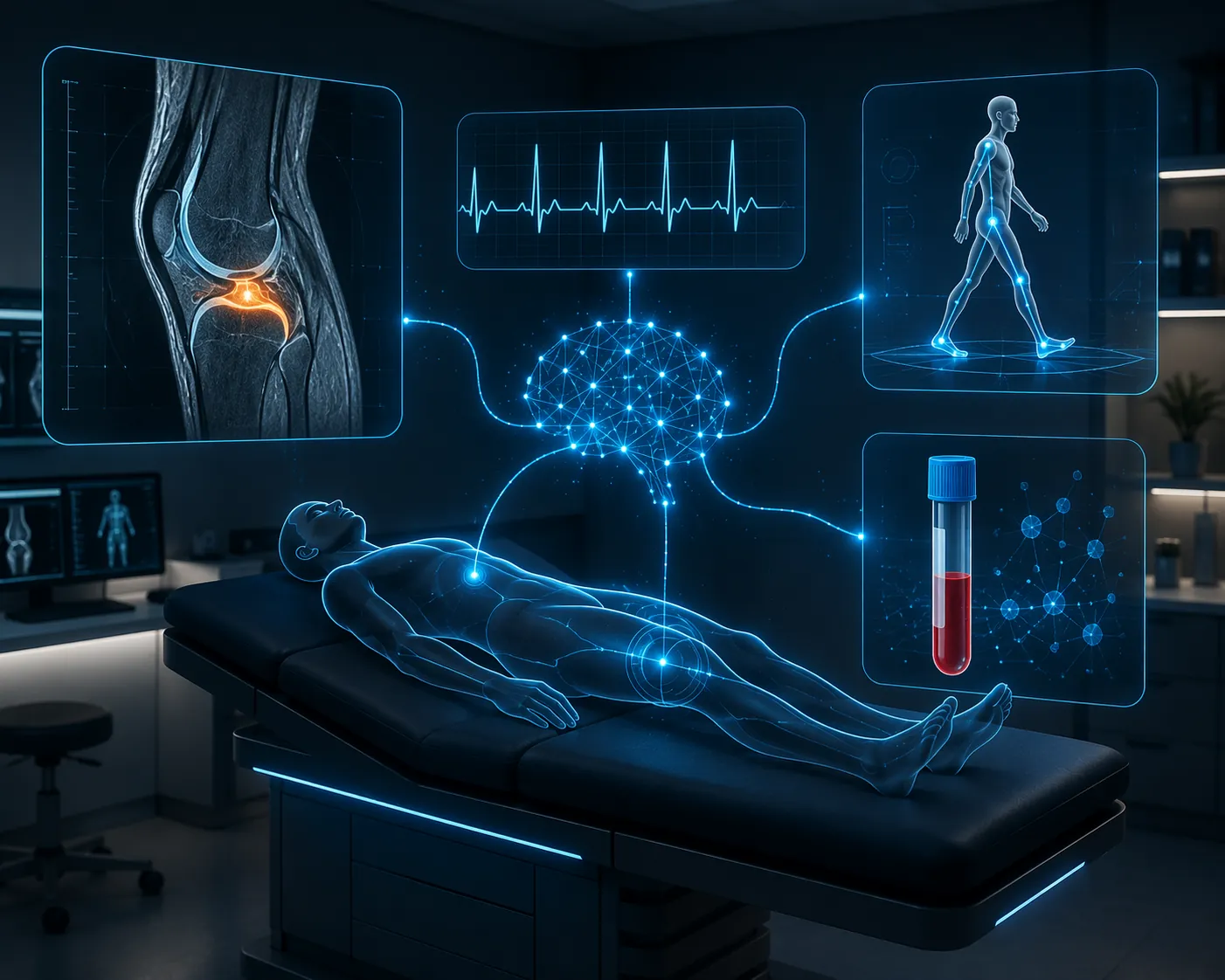
AI can help inside that process, but only if each tool is attached to a real handoff point. MRI support belongs with musculoskeletal imaging. ECG analysis belongs with cardiac screening. Computer vision belongs with functional movement assessment. Biomarker pattern recognition belongs with bloodwork. Once the tools are placed on the transfer-day map, the current boundary becomes clearer: in Q3 2026, clubs can assemble AI-assisted components, but there is no well-documented, peer-reviewed, integrated AI platform built specifically for the complete pre-signing medical workflow.
The transfer medical is already a data-rich workflow
The medical team is not short of information. The problem is that the information arrives in different formats, from different rooms, at different speeds, and with different clinical weight.
| Transfer medical component | What the club is trying to clarify | Where AI can realistically assist |
|---|---|---|
| ECG and echocardiogram | Whether there is a cardiac condition that changes participation risk | Pattern recognition, rhythm interpretation support, triage of concerning ECG features |
| Full-body MRI and targeted imaging | Whether prior or current musculoskeletal pathology changes availability risk | Image interpretation support for structures such as ACL, tendon, cartilage, bone, and muscle |
| Blood tests | Whether markers suggest illness, inflammation, deficiency, endocrine issue, or other concern | Pattern detection across panels, flagging combinations that merit review |
| Physical and functional testing | Whether strength, range, control, pain response, or movement quality matches expected demands | Markerless motion capture, asymmetry measurement, repeatable movement metrics |
| Same-day clinical readout | How the findings translate into a signing risk position | Structured aggregation, traceable reporting, uncertainty communication |
The final row is the hardest. A tool can identify a meniscal signal, flag an ECG abnormality, quantify a landing asymmetry, or notice a blood marker pattern. It still has to be converted into a risk-benefit judgment: Can this player tolerate the expected training load? Is the abnormality old, stable, and already priced into the deal? Does the club need more imaging, more history, a specialist opinion, a price adjustment, an insurance discussion, or a withdrawal?
MRI is the clearest fit for AI assistance
If one part of the transfer medical is ready for serious AI augmentation, it is MRI interpretation. The fit is practical rather than fashionable. Transfer medicals already use imaging to interrogate knees, ankles, hips, hamstrings, adductors, shoulders, spine, and prior surgical sites. The scan may be full-body, but the clinical questions are often very specific: Is the reconstructed ACL intact? Is there active bone stress? Is a tendon thickened, partially torn, or reactive? Does the imaging match the player’s reported history and current function?
A 2025 Scientific Reports study on AI-driven medical image analysis for sports injury diagnosis and prevention found that deep learning with transfer learning achieved diagnostic accuracy comparable to musculoskeletal radiologists for ACL tears and other sports injuries on MRI.[3] That is not the same as saying an algorithm should clear a player to sign. It is saying that, for certain image-recognition tasks, AI can perform close enough to specialist interpretation to be clinically interesting as a second reader, triage layer, or consistency check.
On transfer day, that could matter in several modest but valuable ways. AI could flag a subtle abnormality for priority radiologist review. It could compare structures against trained injury patterns. It could help standardize reporting language when multiple joints are being reviewed under time pressure. It could also reduce the chance that attention is captured by the obvious old injury while a quieter but relevant finding sits elsewhere in the scan.
The restraint is important. MRI findings often require context that is not in the pixels. A professional player may have imaging changes that would alarm a general population clinician but are stable, asymptomatic, and already known to the player’s medical team. Another player may have a visually modest finding that becomes important because of position, contract length, recent minutes, recurrent symptoms, or a planned fixture load. AI can sharpen image interpretation; it does not own the residual risk.
For clinicians who want the imaging evidence separated from the broader AI discussion, the relevant question is whether AI imaging diagnostics can be trusted for sports injury assessment. In the transfer room, the better formulation is narrower: can AI make the MRI read more consistent, faster to triage, and easier to reconcile with exam findings? For selected musculoskeletal questions, the answer is already leaning toward yes. For the signing decision, the answer still belongs to the clinical team.
AI ECG analysis is useful only if it stays in the cardiac lane
The cardiovascular part of the medical carries a different kind of pressure. A hamstring risk affects availability and value. A serious cardiac condition can affect eligibility, emergency planning, and the ethics of participation. That is why ECG and echocardiogram are not administrative boxes in the transfer workflow; they are high-stakes screens that need experienced interpretation.
AI ECG analysis has been reported to achieve up to 90% sensitivity for detecting serious cardiac conditions in athletes.[4] Clinically, that figure is meaningful because sensitivity speaks to the ability to catch cases that should not be missed. It does not, by itself, settle false positives, population fit, workflow cost, medicolegal responsibility, or how the model performs across different athlete demographics and ECG adaptation patterns.
In a transfer medical, AI ECG support is most defensible as augmentation. It can highlight patterns that deserve cardiologist review, provide a second-pass interpretation, or help prioritize same-day escalation when the clock is tight. It may also be helpful when a player’s ECG sits near the boundary between expected athletic remodeling and a pattern that requires further investigation.
The procurement mistake would be to treat a sensitivity number as a clearance mechanism. A club still needs to know who reviews the flagged ECG, whether echocardiography agrees, whether prior cardiac records are available, whether further testing is needed, and whether the transfer timeline can tolerate that uncertainty. AI in cardiology, including echocardiography and ECG interpretation, is advancing quickly, but the transfer decision remains a clinical governance problem as much as a pattern-recognition problem.
Movement analysis adds objectivity, not certainty
Functional testing is where the medical becomes visibly athletic. The player squats, jumps, cuts, balances, resists, accelerates, or repeats position-specific tasks while clinicians watch for pain, asymmetry, control, fatigue response, and compensation. This is also where computer vision and markerless motion capture have an obvious role: they can quantify what the eye estimates.
The practical value is repeatability. If a player returning from an ACL injury shows a persistent landing asymmetry, or if a groin-history player shifts away from one side during deceleration, a computer vision layer can turn the observation into a measurable signal. That does not make the signal automatically predictive of future injury in a transfer setting. It makes it easier for the medical team to discuss what they saw, compare it with imaging, and decide whether the finding is tolerable, modifiable, or disqualifying for that club’s situation.
The public evidence is weaker here than it is for MRI and ECG in this specific context. Computer vision is plausible and increasingly useful for movement assessment, but transfer-specific validation is limited. A club adopting it should be honest about that status: useful measurement layer, not a proven pre-signing injury oracle.
Bloodwork is ready for pattern support, but not automated interpretation
Blood tests in a transfer medical are often less dramatic than the scan, but they can change the conversation. The BBC Sport workflow notes that blood results may return within about 4 hours, which makes them part of the same-day decision rather than a later administrative add-on.[1] The panel can raise questions about infection, inflammation, endocrine status, deficiency, organ function, or other medical issues that need context before a contract is signed.
AI-driven biomarker analysis is attractive because clinicians rarely interpret a single value in isolation. The pattern matters: one marker mildly abnormal may be unremarkable; several markers moving together may deserve a different level of attention. Pattern-recognition tools could help flag combinations that are easy to miss when bloodwork arrives late in a busy medical day.
This is also where overclaiming is easy. A model that flags an unusual lab pattern has not diagnosed the player’s future availability. Hydration, recent travel, training load, illness, supplements, medication, altitude exposure, and timing can all affect interpretation. Bloodwork AI belongs as a prompt for clinician review, especially when time is compressed, not as a replacement for medical history and judgment.
Why the integrated AI transfer medical still has not arrived
The pieces exist. MRI algorithms can assist with musculoskeletal injury interpretation. AI ECG tools can support cardiac screening. Computer vision can add objective movement data. Bloodwork models can look for patterns across markers. The missing element is not imagination; it is integration into a traceable, club-ready, transfer-specific workflow.
A credible integrated system would need to do more than display a dashboard. It would need to receive imaging, ECG, echo findings, blood results, physical exam notes, functional test outputs, injury history, position demands, expected workload, and uncertainty statements. It would need to show which data came from the club’s examination, which came from prior records, which came from model inference, and which came from clinician interpretation. It would also need audit trails robust enough for the uncomfortable day when a signing breaks down and the medical reasoning is revisited.
That is a much harder product than a strong MRI model or an ECG classifier. It crosses data governance, medicolegal responsibility, interoperability, model validation, and club confidentiality. It also has to fit a workflow measured in hours, not weeks. A tool that produces a beautiful report the next morning is already late for many transfer decisions.
Public evidence is limited for a predictable reason: club medical practice is confidential, and transfer outcomes are commercially sensitive. No peer-reviewed study was identified in the provided research base that evaluates an integrated AI system across the complete transfer medical workflow. That absence should not be exaggerated into proof that clubs use no AI at all. It should be treated more carefully: public, peer-reviewed evidence supports component-level assistance, while transfer-specific integration remains largely undocumented.
Comparisons with broader sports technology platforms need the same caution. Systems such as the NFL Digital Athlete involve overlapping data types used for injury prevention during active play, but that is not the same as a pre-signing medical. A platform built for monitoring rostered athletes over time does not automatically validate a same-day acquisition decision in another sport, under different governance, with different incentives.
What a clinically useful version would look like
The most useful AI-assisted transfer medical would not begin with a pass/fail output. It would begin with the workflow the club already runs and make each handoff cleaner.
- Before imaging review: triage MRI series and flag structures or regions that merit priority specialist attention.
- During cardiac screening: provide AI ECG interpretation as a second reader while preserving cardiologist responsibility for escalation.
- During functional testing: quantify asymmetry, control, and movement variability without pretending those metrics alone predict availability.
- When blood results return: surface unusual multi-marker patterns and link them to review questions rather than automatic conclusions.
- At the final readout: separate observed findings, model-generated flags, clinician interpretation, missing information, and residual risk.
The last function may be the most valuable. Executives often want a clean answer. Medical teams rarely have one. A traceable system that says, in effect, “the ACL graft appears intact, the ECG requires no escalation after cardiology review, the landing asymmetry is measurable but consistent with current rehab status, bloodwork has one pattern to recheck, and the remaining risk is workload-related” would be far more useful than a green icon.
That kind of output would also respect the reality behind Dr. Cowie’s framing. The same player may be acceptable for one club and unacceptable for another because the deal structure, medical tolerance, squad depth, playing schedule, and rehabilitation resources differ. AI can make the risk description sharper. It cannot decide the club’s appetite for that risk.
The current boundary in Q3 2026
AI already has a legitimate place in player transfer medical checks when it is used as component-level clinical support. MRI assistance has the strongest direct fit with the imaging-heavy transfer workflow. AI ECG analysis is clinically relevant in a high-stakes cardiac screen, provided its sensitivity is treated as one property of a broader governance process. Computer vision and blood biomarker pattern recognition are useful extensions, especially for objectivity and pattern detection, but they have less public transfer-specific validation.
The integrated AI transfer medical remains the gap. Clubs are still assembling separate tools around a human-led risk-benefit process rather than adopting a unified, validated platform that carries the player from ECG to MRI to bloodwork to movement testing to final sign-off. That is not a failure of AI; it is a reminder that the transfer medical is not one test. It is a time-pressured clinical judgment assembled from imperfect signals, and the person who signs off still has to defend the uncertainty after the deal is done.
References
- What happens during a football medical? - BBC Sport
- First-person account of undergoing a transfer medical - The Athletic
- AI-driven medical image analysis for sports injury diagnosis and prevention - Scientific Reports - 2025
- AI ECG analysis in athletes - SPRY and supporting literature
Comments
Join the discussion with an anonymous comment.