
AI-powered pool drowning prevention sits in an uncomfortable evidence position. The public-health problem is severe and time-sensitive: the World Health Organization estimates 236,000 drowning deaths globally each year, and the U.S. Consumer Product Safety Commission reported an average of 376 child drowning deaths annually for 2021–2023.[1][2] At the same time, the strongest peer-reviewed computer-vision systems now report technical performance that would have looked ambitious only a few years ago. The problem is that the evidence still stops before the clinical question begins.
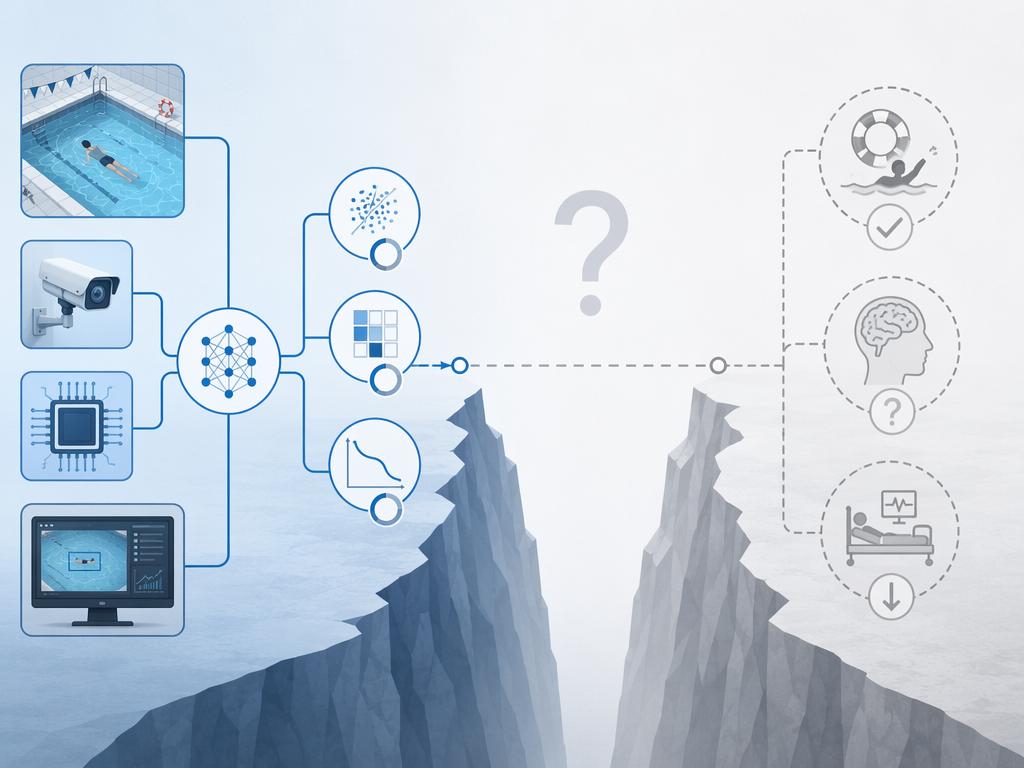
The short evidence grade is therefore split: strong simulated technical performance, weak real-world clinical validation. Published models can detect simulated drowning-like behavior in controlled pool footage with high precision and recall. They have not yet shown, in prospective studies, that AI-assisted surveillance improves rescue success, neurological outcome, morbidity, or mortality compared with human-only surveillance.
The best current evidence is technically impressive—and still simulated
The clearest performance case is Amer et al.’s 2025 YOLOv11-based real-time drowning detection system. The authors reported 97.7% precision, 92.6% recall, and mAP@50 around 0.98–0.99. They also emphasized model compactness: roughly 2.58 million parameters, with deployment on Raspberry Pi 5-class hardware and inference of about 260–310 ms per frame.[3]
Those numbers matter. Precision describes the proportion of model-positive detections that were correct in the test setting; recall describes the proportion of target events the model detected; mAP@50 summarizes object-detection performance at an intersection-over-union threshold of 0.50. In a pool-safety context, recall is especially consequential because a missed event is the failure mode everyone fears. Precision also matters because a system that repeatedly alarms without a true event can train lifeguards, caregivers, or operators to distrust it.
Edge deployment is not a decorative engineering detail. A model small enough to run near the pool can reduce dependence on continuous cloud connectivity, lower latency, and make deployment more realistic in facilities where network conditions are imperfect. A 260–310 ms per-frame inference time does not by itself prove that a person will be rescued faster, but it does show that the detection step can plausibly operate within a real-time alerting workflow rather than as an offline analysis tool.[3]
The same study also defines the main limit of interpretation: the system was trained and tested on a 1,519-image dataset of simulated drowning scenarios enacted by professional lifeguards.[3] That does not make the work unserious. It does mean the result is evidence of performance under those visual and behavioral conditions, not evidence of performance across actual pediatric, residential, distracted-supervision, passive-submersion, crowded, glare-heavy, low-light, or otherwise messy drowning events.
| Evidence question | What the peer-reviewed evidence currently supports |
|---|---|
| Can computer-vision models identify simulated drowning-like behavior in controlled pool footage? | Yes, with high reported technical performance in the strongest published study. |
| Can compact models run near the pool rather than only in the cloud? | Yes, Amer et al. reported Raspberry Pi 5-class deployment with sub-second per-frame inference. |
| Do published systems detect actual drowning incidents with known sensitivity and specificity? | Not established in the peer-reviewed detection literature summarized here. |
| Does AI-assisted surveillance improve rescue success, neurological outcome, morbidity, or mortality? | Not established; prospective outcome trials are not yet available. |
The field is broader than one YOLOv11 paper
Amer et al. is not an isolated technical curiosity. A 2024 review in Information describes a field that includes YOLO variants, CNN-based frameworks, transformer-based approaches such as ViViT, and systems distributed across edge and cloud architectures.[4] A separate peer-reviewed system paper on an AI-based swimming-pool drowning prevention strategy adds to that broader architecture-level literature.[5]
For clinical evaluation, the exact model family is less important than the evidentiary pattern. These systems are moving from proof-of-concept toward deployable surveillance pipelines: camera input, frame processing, object or posture detection, classification, and alert generation. That is meaningful progress. It still leaves unanswered whether the pipeline performs when the swimmer is not acting for the camera, when the event is subtle, when the water surface obscures the body, or when the responsible adult is already divided between other tasks.
AI is also appearing in drowning research outside real-time pool detection. A 2026 Baylor College of Medicine study used natural language processing to identify drowning risk and protective factors in media reports from metropolitan Houston.[6] That belongs in the same public-health neighborhood, but it answers a different question. Extracting risk factors from text can support surveillance and prevention research; it does not validate whether a poolside detection system prevents injury or death.
The simulated-to-real gap is structural, not cosmetic
The central methodological problem is not that researchers forgot to collect more realistic data. Real drowning events are rare relative to ordinary pool use, dangerous, unpredictable, and ethically impossible to stage with true risk. A study cannot deliberately allow a child to approach a neurologically consequential submersion event for the sake of cleaner labels. That is why controlled pool footage and trained lifeguards simulating distress appear so often in the literature.
The limitation is still serious. Professional lifeguards simulating drowning may produce clearer, more stereotyped motion patterns than actual victims. Controlled pools may have cleaner sightlines than residential pools with toys, shadows, glare, irregular camera placement, or intermittent obstruction. Simulated active distress may not represent passive submersion, silent sinking, fatigue, or events involving very young children. The 2024 review’s conclusion that reviewed studies rely on simulated data is therefore not a small footnote; it is the boundary around the whole evidence base.[4]
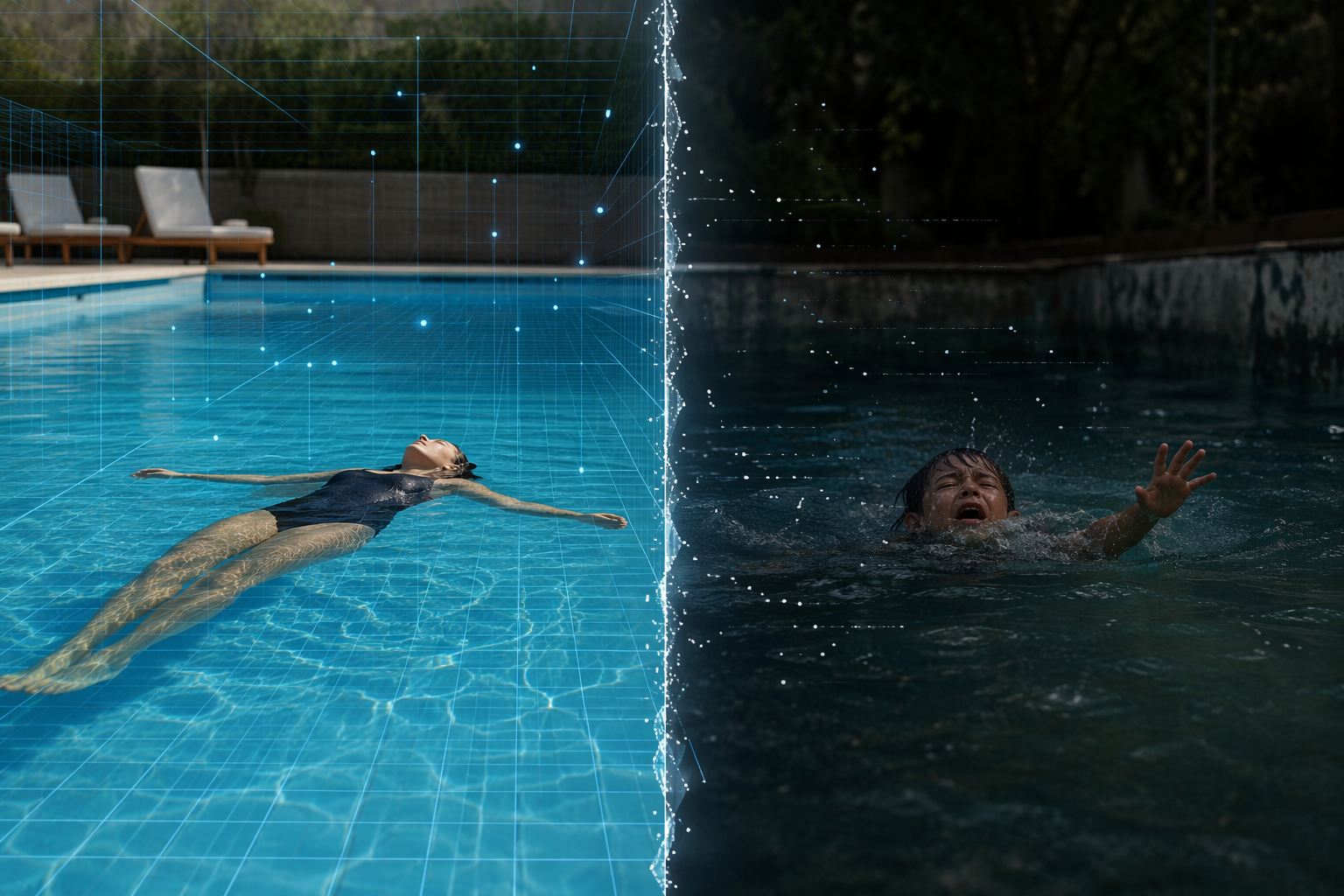
This is also where high mAP can mislead if it is detached from study design. A model can localize or classify target patterns extremely well in a custom dataset and still have unknown performance when the target distribution changes. In medical AI, that distinction is familiar: internal test performance is not the same as external validation, and external validation is not the same as improved patient outcome. Pool drowning detection is not a diagnostic device in the usual clinical sense, but the evidence ladder is similar enough to matter.
The person who carries the uncertainty is not the model developer. It is the lifeguard who must decide whether to interrupt scanning and move toward an alarm, the parent who may be drawn away from one child toward another, the pool operator who must set alarm thresholds, or the clinician and public-health professional asked whether this technology should be treated as a mature prevention intervention. A false negative is obvious in its danger. A false positive has quieter consequences: alarm fatigue, delayed response to future alerts, and confusion about who is responsible when the system calls for attention.
Vendor performance claims belong in a separate evidence drawer
Commercial pool-safety systems sometimes report very high accuracy or faster response times. Those claims may be useful for understanding what vendors believe their products can do, but they should not be merged with peer-reviewed validation. Examples include Pool Angel’s 99.7% accuracy claim and Lynxight’s claim of a sixfold faster response, but these figures are vendor-reported rather than independently confirmed by the peer-reviewed detection studies discussed here.
That distinction is not a dismissal of commercial engineering. Fielded systems may contain practical design choices—camera placement, user interface, alarm routing, maintenance checks—that academic prototypes underdescribe. But clinical confidence requires knowing who tested the system, against what reference standard, in which pool environments, with what event definitions, and with what consequences after the alert.
What clinical maturity would need to show
The missing evidence is not another slightly higher mAP score on a similar dataset. The next maturity step is prospective evaluation of the whole safety chain: detection, alert delivery, human response, rescue, and outcome. A poolside model that detects a frame correctly still has to notify the right person, at the right time, in a way that produces action rather than hesitation. The outcome of interest is not only whether the bounding box was correct; it is whether the person in the water was helped sooner and harmed less.
A clinically useful study would not have to wait for large numbers of fatal events to be informative. It could compare AI-assisted and human-only surveillance on response time to validated distress simulations, missed-event rates, alarm burden, rescuer workload, and escalation reliability across different pool types. But claims about morbidity, neurological outcome, or mortality would still require stronger designs and careful interpretation, because drowning deaths and severe neurological injuries are uncommon enough that single-center demonstrations are unlikely to settle the question.
The standards environment is beginning to recognize that detection systems need more than attractive demonstrations. ASTM F3698-24, published in May 2024, is identified as the first dedicated computer-vision drowning detection standard and includes requirements such as a 30-second alert window and low-visibility indication.[7] A standard can shape testing expectations and governance. It is not proof that deployed systems improve clinical or public-health outcomes.
As of Q3 2026, AI-powered pool drowning prevention has credible technical momentum. The best peer-reviewed work shows high performance in simulated conditions and practical movement toward edge deployment. The clinical maturity case remains unestablished because the field has not yet crossed the gap from detecting staged events to demonstrating better rescue and health outcomes in real use.
References
- Drowning, World Health Organization.
- CPSC Warns: Child Drownings Continue to Rise; Families Urged to Keep Kids Safer in and Around Water This Summer, U.S. Consumer Product Safety Commission.
- Intelligent eyes on water: YOLOv11-based real-time drowning detection system, Journal of Supercomputing, 2025.
- Advances and Challenges in Automated Drowning Detection: A Comprehensive Review, Information, 2024.
- Next-Generation Swimming Pool Drowning Prevention Strategy: AI-Based Drowning Detection System, ScienceDirect.
- Using artificial intelligence to identify drowning risk and protective factors present in media reports in metropolitan Houston, Texas, Injury Prevention, 2026.
- ASTM F3698-24 Standard Specification for Computer Vision Drowning Detection Systems, ASTM International, May 2024.
Comments
Join the discussion with an anonymous comment.