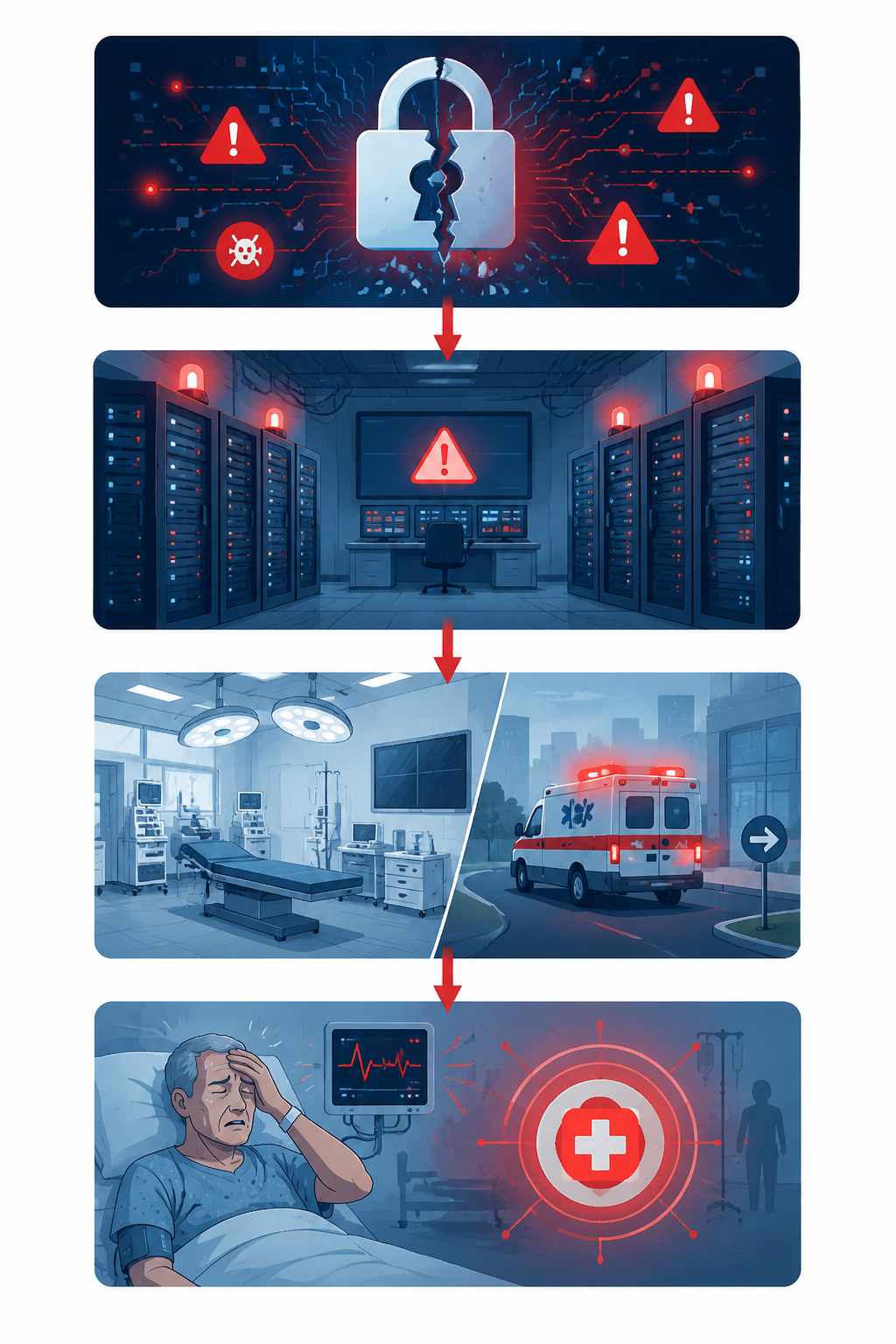
If you run a hospital, the reason to care about an AI-powered healthcare cybersecurity breach is not abstract privacy loss. It is the patient who waits longer for a procedure, the ambulance that is told to go elsewhere, and the bedside team that has to work around a system that suddenly cannot be trusted. A 2025 Ponemon Institute/Proofpoint study reported that nearly 1 in 4 healthcare organizations saw increased patient mortality after a ransomware attack [1]. In the Düsseldorf University Hospital case, a patient who was diverted because of the attack died en route, and German authorities opened a negligent manslaughter investigation [2]. Ascension's 2024 ransomware event affected 5.6 million patients, forced ambulance diversions for 5 days across 24 hospitals, and left the system with a $1.1 billion net loss [3].
The Harm Is Already Clinical
The mortality finding should be read carefully. It is an association, not proof that ransomware alone caused those deaths [1]. But the same study also found that 64% of respondents experienced procedure or test delays and 59% reported longer patient stays [1]. That is the mechanism clinical leaders recognize: care slows down, the schedule slips, handoffs get messier, and the risk moves from data loss into throughput, exposure, and delay.
Düsseldorf matters because it shows how a cyber event can become a bedside event without any dramatic technical language. The patient was not harmed by a file encryptor in the abstract; the harm came through diversion, routing failure, and the loss of an intended destination during a time-sensitive transfer [2]. One case does not prove frequency, but it does prove that the causal chain is not hypothetical.
Ascension shows the scale problem. Once emergency routing, scheduling, and access controls are interrupted across a system of that size, the damage is no longer contained within the security team or even the hospital campus [3]. The operational consequence is shared across the region: ambulances reroute, procedures move, and clinicians absorb the uncertainty.
Why AI Makes The Problem Harder
The AI part does not replace the older ransomware playbook. It makes deception faster, more scalable, and harder to verify. Peer-reviewed research cited by Vectra notes that manipulating only 0.001% of tokens can trigger catastrophic diagnostic errors in some medical AI settings, while data poisoning, prompt injection, and deepfakes that impersonate clinicians create new entry points into clinical workflows [4]. That is not a futuristic threat model. It is a warning that the inputs a care team trusts can now be forged, nudged, or poisoned with much less effort than before.
ECRI's designation of AI as the number one health technology hazard for both 2025 and 2026 underscores how seriously the field is taking those failure modes [5]. That does not mean every AI tool is unsafe. It does mean the attack surface is now large enough, and the potential consequences serious enough, to sit at the top of the risk agenda.
The Governance Gap
The persistent failure is organizational, not just technical. Cybersecurity still tends to be managed as an IT domain, while the consequences land in the operating room schedule, the ED bay, the ICU, and the ambulance queue. That split is too neat for the reality on the ground. If a breach delays a scan, blocks a transfer, or forces diversion, the clinical harm belongs in patient safety governance whether or not the root cause sits on a server.
A narrative review in PMC argues for folding AI-specific cyber threats into existing Clinical Risk Management frameworks [6]. That is the right bridge because it moves the conversation away from abstract cyber fear and toward the structures hospitals already use to manage harm: incident review, escalation, accountability, and board oversight. It also keeps the distinction clear between proven harm and strong evidence of harm, which matters when leaders are deciding how much operational change a risk warrants.
Raw breach counts are useful only up to a point. Healthcare logged 772 large breaches in 2025, but the number that matters to a CMO is not the count itself; it is which events interrupted care, which ones delayed treatment, and which ones changed the path of a patient through the system [7].
That is why cybersecurity now belongs in patient safety oversight, incident review, and board-level risk governance. The evidence does not say every breach causes harm, but it does show that breach events can become patient events [1][2][3][6].
References
- Study Confirms Increase in Mortality Rate and Poorer Patient Outcomes After Cyberattacks - HIPAA Journal
- Cyberattacks in Healthcare and Patient Safety: Narrative Review - PMC
- Healthcare Cybersecurity Statistics - Swif.ai
- Healthcare Cybersecurity - Vectra
- AI Cybersecurity Risks in Healthcare - Forbes, 2026-06-09
- Healthcare Data Breach Statistics - HIPAA Journal
Comments
Join the discussion with an anonymous comment.