
The strongest published evidence for AI predictive modeling in healthcare is not spread evenly across the hospital. In a systematic review of 22 peer-reviewed studies published from 2021 to 2025, the most convincing results cluster in data-rich, high-acuity settings, especially ICU and critical care environments, where structured physiologic data are abundant and clinical deterioration is a natural prediction target.[1]
That matters before any discussion of model architecture. The review found that tree-based ensemble models, including Random Forest, XGBoost, and LightGBM, dominated structured EHR prediction tasks and achieved AUROC values above 0.9 in ICU settings. Deep learning models, including CNNs and LSTMs, were more prominent where the input data were images or time-series signals. Classical statistical and machine learning models appeared mainly as comparators rather than as the leading edge of reported performance.[1]
Those findings are useful, but they are also easy to overread. A clean AUROC curve from an ICU cohort does not tell a health system whether a model will survive outpatient data sparsity, oncology treatment heterogeneity, primary care follow-up gaps, or the everyday problem of who is expected to act when a risk score appears. The review is most valuable because it lets the optimism be sorted: some model-data pairings look genuinely strong, while the evidence base supporting broad deployment remains much thinner than the headline promise suggests.

What the 22 studies actually show
The review’s study pool is modest: 22 studies, all peer-reviewed and published between 2021 and 2025.[1] That is enough to identify patterns in the recent literature, but not enough to treat every underrepresented specialty as settled or every model family as fully tested across care settings.
Within that pool, the taxonomy is fairly coherent. Tree-based ensembles are the practical workhorses for structured EHR data: medications, lab values, diagnosis codes, vital signs, comorbidity indicators, and encounter-level features. Their appeal is not mysterious. They handle nonlinear relationships, tolerate mixed feature types, and often perform well without the infrastructure burden of very large neural architectures.
Deep learning occupies a different role. The review describes CNNs and LSTMs as leading approaches for imaging and time-series tasks, where raw or sequential data can carry patterns that are difficult to compress into conventional tabular variables.[1] This is an important distinction because “AI model” is too broad a category to judge without the data modality. Models built for chest imaging, continuous vital-sign streams, and structured EHR mortality scoring are not solving the same engineering problem.
| Model family | Where it appears strongest in the review | Practical interpretation |
|---|---|---|
| Tree-based ensembles | Structured EHR prediction tasks, especially ICU settings | Strong fit for tabular clinical data with mixed variable types |
| Deep learning | Imaging and time-series prediction tasks | Better matched to high-dimensional or sequential inputs |
| Classical models | Comparator roles across studies | Useful baselines, especially when interpretability or implementation simplicity matters |
The reported performance signal is strongest in critical care. The review states that ICU and critical care accounted for more than 60% of the included studies, and tree-based ensembles in ICU settings achieved AUROC values above 0.9.[1] That is not a trivial result. In an ICU, physiologic deterioration can unfold quickly, data are collected repeatedly, and earlier recognition may plausibly change the clinical pathway. A prediction made six hours earlier can mean a different handoff, a different escalation decision, or a different level of surveillance.
But the same fact also limits the conclusion. The review does not show that predictive AI is equally mature across oncology, cardiology, diabetes care, chronic disease management, and primary care. It shows that the recent published literature is concentrated where hospitals already produce dense streams of machine-readable data.[1]
The ICU concentration is a finding, not a map of clinical need
The ICU is a friendly environment for predictive modeling in a way that primary care often is not. Vital signs are frequent. Laboratory testing is dense. Medication changes and device data can be temporally close to clinical deterioration. Outcomes such as mortality, sepsis, mechanical ventilation, or clinical worsening are often recorded within a bounded episode of care. That does not make ICU prediction easy, but it does make the data substrate unusually rich.
Primary care has a different shape. Risk may accumulate over years. Outcomes can happen outside the network. Social, economic, behavioral, and access factors may be incompletely recorded. A missed appointment, an unaffordable medication, or a delayed referral can matter as much as a lab trend, yet these signals are not always structured cleanly enough for model development. Oncology and chronic disease prediction face their own complications: treatment pathways vary, molecular and imaging data may sit outside the core EHR, and patient trajectories can be long, heterogeneous, and interrupted by transfers of care.
So the review’s domain imbalance should not be read as evidence that critical care is where predictive AI is most needed. It more likely reflects where publishable prediction studies are easier to assemble: high-frequency data, clearer short-term endpoints, and institutional incentives to model acute deterioration. The review identifies oncology, cardiology, diabetes, and primary care as underrepresented relative to the breadth of clinical need.[1]
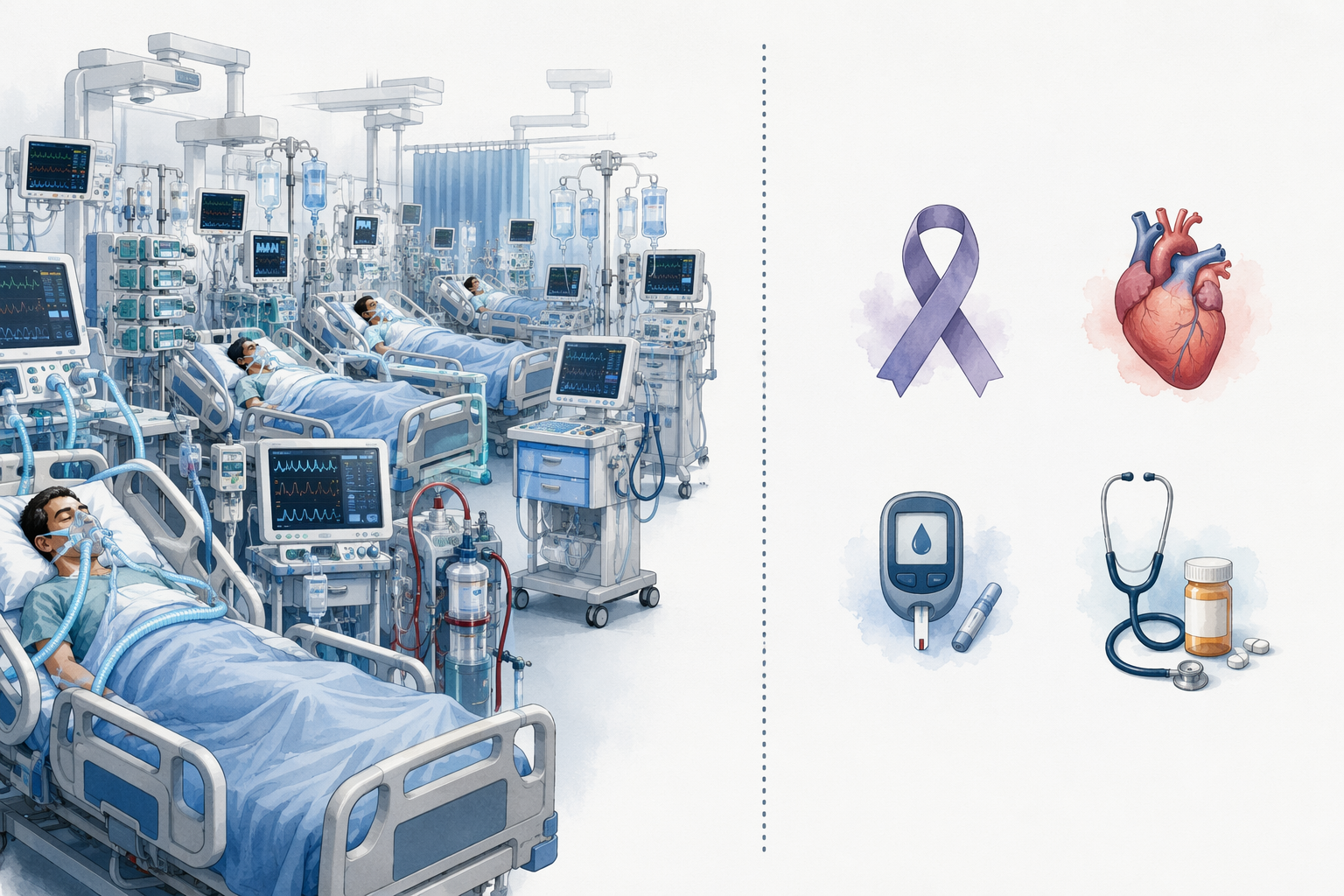
This distinction changes how a health IT team should read the literature. If a model reports excellent ICU performance, that may support further evaluation for a similar high-acuity, data-dense environment. It should not be casually generalized to ambulatory risk stratification, cancer care navigation, or population health management. The operational question is not whether the algorithm is “AI,” but whether the training population, measurement cadence, endpoint definition, and intervention pathway resemble the intended use case.
AUROC is doing too much work
The metric pattern is as important as the model pattern. AUROC was reported in 15 of the 22 studies, F1 score in 8, and calibration in only 4.[1] That distribution tells clinicians what the literature is comfortable reporting, not necessarily what clinical deployment requires.

AUROC answers a ranking question: across possible thresholds, how well does the model tend to assign higher scores to patients who experience the outcome than to those who do not? That is useful for model comparison. It is not the same as knowing whether a nurse should be paged at a score of 0.72, whether a care manager should open a chart, or whether an attending should change the plan during morning rounds.
The missing pieces are the ones that determine whether the prediction can be acted on. Sensitivity affects missed cases. Specificity affects false alarms. Positive predictive value tells a team what proportion of flagged patients are likely to become true events in that setting. Calibration asks whether a predicted 20% risk actually behaves like a 20% risk in the population using the tool. Net benefit, often evaluated through decision curve analysis, asks whether acting on the model improves decisions compared with reasonable alternatives.
This is not statistical fastidiousness. In a low-prevalence condition, a model can rank patients well and still generate a large number of false positives at the threshold a hospital chooses. In a busy ICU, that may mean alert fatigue or unnecessary review. In primary care, it may mean care managers spend limited time on the wrong panel of patients. In oncology, it may mean a triage pathway is triggered for patients whose risk is overestimated because the model was trained on a different treatment mix.
Calibration is especially hard to skip. A model that is well ranked but poorly calibrated may still sort higher-risk patients above lower-risk patients, yet the absolute probability it presents can mislead clinical judgment. If a dashboard displays a risk percentage, clinicians will often read that number as a probability, not merely as an ordering device. The review’s finding that calibration appeared in only 4 of 22 studies is therefore a clinical usability problem, not only a reporting gap.[1]
What a deployment-ready metric set would need to answer
- At the chosen threshold, how many true cases are captured and how many are missed?
- How many patients are flagged for every true event, and who reviews those flags?
- Does the predicted probability match observed risk in the local population?
- Does acting on the model improve decisions compared with existing clinical practice?
- Does performance hold across racial, ethnic, socioeconomic, age, and disease-severity subgroups?
A study does not need to answer every operational question at once. A retrospective development paper has a different job from a prospective implementation study. The problem is when retrospective discrimination metrics are treated as if they already answer the implementation questions. The review’s metric distribution shows that the field is still publishing many models in the first category while discussing them in the language of the second.[1]
Model type matters less than model-data fit
There is no single winning architecture in the review, and that is the right result. Tree-based ensembles look strong for structured EHR risk prediction because the data are already arranged as variables that can be split, ranked, and combined. Deep learning has a clearer rationale when the input is spatial, sequential, or otherwise high-dimensional. Classical models remain useful when a simpler baseline provides nearly comparable performance, easier explanation, or a lower maintenance burden.
The more practical question is whether the model’s output maps onto a clinical decision. A mortality prediction model that produces a score no one is assigned to review is a dashboard decoration. A readmission model that flags patients after the discharge planning window has closed is late, even if its retrospective AUROC is respectable. A sepsis model that alerts frequently but has poor positive predictive value may shift work toward bedside teams without improving care.
This is where evidence from high-acuity settings can be both compelling and misleading. ICU prediction tasks often have a plausible action pathway: more monitoring, earlier evaluation, escalation, treatment review, or handoff attention. In lower-acuity settings, the intervention pathway can be more diffuse. A risk score may need to trigger outreach, scheduling, medication review, social support, specialty referral, or shared decision-making. The same statistical model quality may have very different operational value depending on whether the downstream action is real.
Generalizability remains the quiet weakness
The review identifies limited generalizability across populations as a major barrier, especially across racial, ethnic, and socioeconomic groups.[1] That weakness is not solved by a strong internal validation result. EHR data are local artifacts: coding practices, care pathways, lab ordering behavior, referral patterns, insurance mix, and patient access all shape the variables a model sees.
A model trained in one hospital may learn relationships that are partly clinical and partly institutional. A lab value may appear predictive because it reflects disease severity, or because only certain patients receive the test. A missed outpatient follow-up may mean low risk in one system because the patient received care elsewhere, or high risk in another because care access is genuinely poor. Without external validation and subgroup reporting, users cannot tell how much of the model’s performance belongs to biology, workflow, documentation, or local access patterns.
Interpretability also appears in the review as a barrier to clinical trust.[1] The point is not that every clinician needs to inspect every split in a tree or every weight in a neural network. The point is that users need enough explanation to decide whether a score is plausible in the patient in front of them. If the model is driven by variables that are proxies for access, documentation intensity, or prior utilization, an explanation layer may reveal a reason to be cautious rather than reassured.
Prospective validation is the other missing bridge. Retrospective studies can show whether a model would have ranked patients well in historical data. They cannot fully show whether clinicians will respond, whether alerts will be ignored, whether workflows will absorb the extra work, or whether outcomes will change. The review identifies the lack of prospective validation studies as a documented barrier.[1]
Deployment success is still uncommon
The review’s deployment statistic is sobering: fewer than 20% of institutions report sustained high-success use of AI in core clinical diagnosis.[1] The phrasing needs care, because “success” can vary across studies and institutions. Still, the direction is clear. Published model performance has not translated smoothly into durable clinical use.
That gap should not be used as a lazy dismissal of predictive modeling. Some models do catch risk earlier. Some high-acuity workflows are plausible targets. Some engineering teams have done careful work on messy EHR data. But deployment is not a ceremonial last step after publication. It is a second evidence problem with its own failure modes: integration into the EHR, alert routing, clinician trust, threshold governance, monitoring for drift, retraining decisions, and accountability when the model is wrong.
The most dangerous version of AI adoption is the one that treats validation as a property the model permanently owns. In clinical systems, validation is conditional. It depends on the patient population, the data pipeline, the endpoint definition, the workflow, and the action taken after prediction. When any of those change, performance can change with them.
Future directions should be judged by the barriers they solve
The review points to federated learning, AutoML, and clinician-in-the-loop workflows as future directions.[1] Each is plausible, but none should be treated as a general remedy.
Federated learning is relevant when privacy, data-sharing restrictions, or institutional reluctance limit multi-site model development. Its promise is not that it automatically produces fair or generalizable models, but that it may make broader training and validation possible without centralizing all patient-level data. That is a response to a specific barrier, not a guarantee of clinical transportability.
AutoML may lower technical barriers for organizations that lack large machine learning teams. That can help with model development, but it can also make it easier to generate models whose clinical assumptions are thin. The hard parts still include cohort definition, endpoint selection, missingness, leakage, subgroup evaluation, calibration, and workflow design.
Clinician-in-the-loop workflows are the most directly tied to deployment. They force the model to be evaluated as part of care rather than as a detached score. The clinician does not need to become the model’s safety net for every weakness, but the workflow does need to specify who sees the score, when they see it, what action is expected, and how disagreement with the model is handled.
The disciplined reading
The 22-study review supports a narrower, more useful conclusion than the usual broad claim about predictive AI. Tree-based ensembles are well matched to structured EHR prediction tasks and can perform strongly in ICU settings. Deep learning has a clearer role in imaging and time-series data. The strongest evidence sits in critical care, where data density and short-term deterioration endpoints make modeling more tractable.[1]
The same review also shows why readiness is overstated when the field leans on ICU-heavy samples and AUROC-heavy reporting. More than 60% of the included studies concentrate on ICU or critical care, AUROC appears in 15 of 22 studies, and calibration appears in only 4.[1] Those are not minor presentation choices. They shape what readers think has been proven.
AI predictive modeling in healthcare is most convincing where the data are dense, the model family fits the input, and the prediction connects to a real clinical decision. The published evidence is much less convincing as proof of broad deployment readiness across disease domains, patient populations, and everyday care settings.
Comments
Join the discussion with an anonymous comment.