The awkward fact about AI and public health surveillance in 2026 is not that the tools are imaginary. They are not. Systems can flag unusual disease signals from open-source reports, extract key fields from free-text laboratory results, and help sort duplicate or incomplete case records. The awkward fact is that only 14% of U.S. state and territorial health agencies reported using AI for disease surveillance or anomaly detection in the 2025 ASTHO Profile, while 34% reported no AI use at all. Another 50% used AI only for administrative tasks, not core surveillance work.[1]

That adoption pattern changes the question. The useful question is no longer whether AI can identify patterns in public health data. It can. The harder question is why the agencies responsible for receiving reports, validating cases, notifying partners, and answering local epidemiologists’ questions still have so little AI in their surveillance workflows.
| AI use reported by state and territorial health agencies | Share of agencies |
|---|---|
| Use AI for disease surveillance or anomaly detection | 14% |
| Use AI only for administrative tasks | 50% |
| Report no AI use | 34% |
The 14% figure is the load-bearing number. It says that AI has reached public health as a topic, a procurement conversation, and an administrative convenience, but only rarely as part of the machinery that turns messy incoming data into a usable disease picture. For surveillance, that distinction matters. A model that looks promising in a review article still has to survive legal review, data-sharing constraints, staffing shortages, and the daily work of correcting records that arrive late, duplicated, misclassified, or missing fields.
Early Signals Are Real, but They Are Only the First Hand-Off
The most visible promise of AI in surveillance is early outbreak detection. BlueDot is the case most often used to show why. A review in Frontiers in Public Health describes BlueDot as detecting the COVID-19 cluster in Wuhan 9 days before the World Health Organization’s official notification, using sources that included air travel data, news reports, and real-time climate conditions.[2]
That kind of signal matters. A credible early alert can buy time for situational awareness, risk communication, laboratory coordination, and case definition work. It can also point analysts toward places or syndromes that deserve closer review. But the signal is not the surveillance system. Someone still has to decide whether the alert is plausible, whether it matches clinical or laboratory evidence, whether it duplicates something already under investigation, and whether the agency has authority to connect the relevant data sources.
WHO’s Epidemic Intelligence from Open Sources system, EIOS, belongs in the same practical family: it uses open-source intelligence to support early detection of disease outbreaks from unstructured online sources.[2] Platforms like this expand the field of view beyond formal case reports. That is useful, especially when official reporting lags. But open-source detection introduces its own workload. Analysts have to separate noise from signal, assess source reliability, and decide when a finding should trigger outreach rather than remain a watched item.
For a state health department, the value of early detection is not measured only by how many days a tool beats an official notice. It is also measured by whether the alert enters a workflow where a person can validate it, document it, route it, and act on it. Otherwise, the agency has a faster warning layer sitting on top of the same constrained response capacity.
The Less Glamorous Surveillance Work Is Where AI May Matter Most
The strongest near-term case for AI in public health may be less dramatic than outbreak prediction. It is the use of natural language processing to turn unstructured laboratory reports into structured surveillance data. Healthbeat described AI tools that scan free-text lab reports and extract the pathogen, test type, result, and patient demographics into surveillance databases, addressing a manual data-entry bottleneck identified by a former New York City health official.[3]
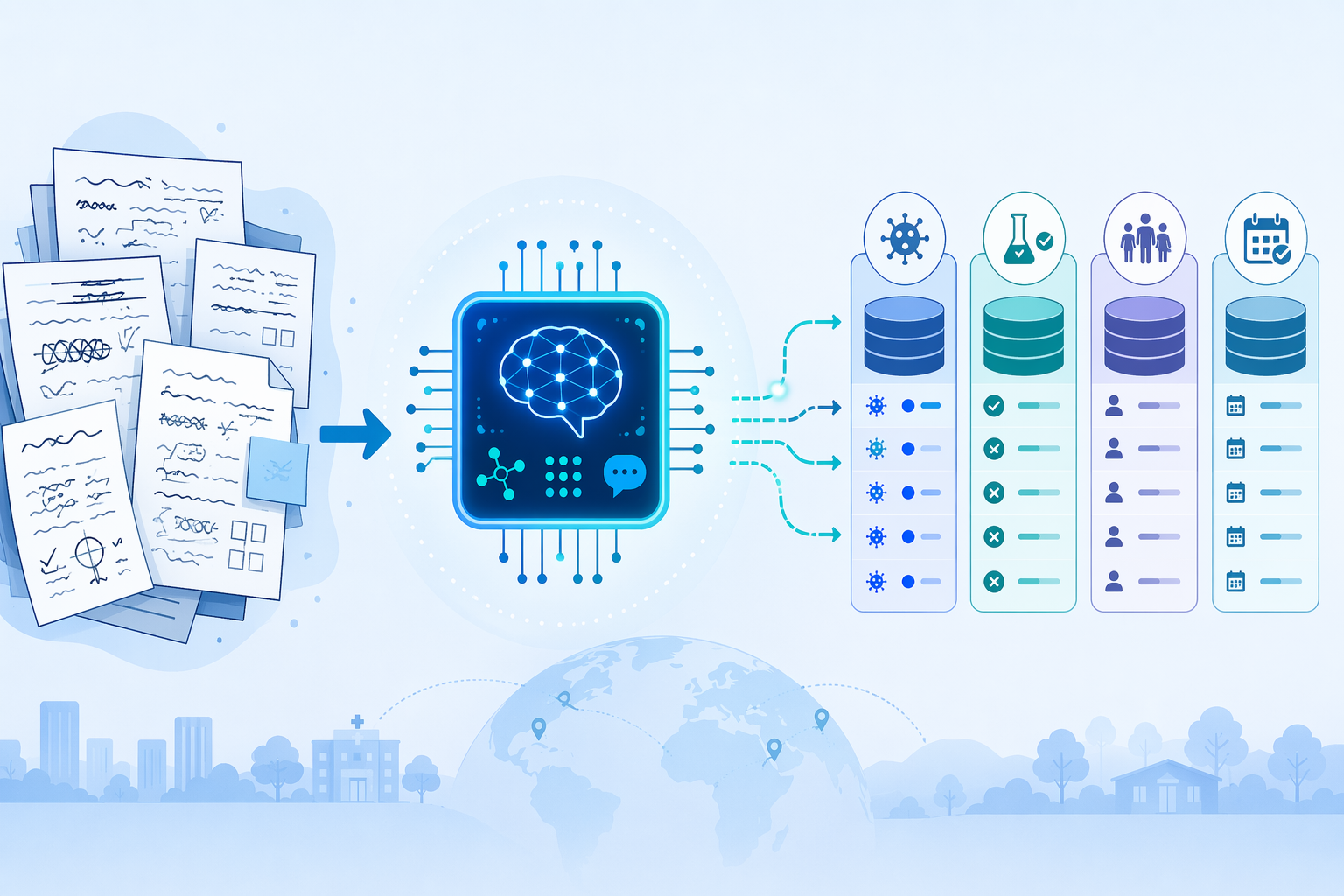
This is the kind of problem that does not need to sound futuristic to be important. A surveillance program cannot act on a positive test that is buried in text, routed inconsistently, or waiting for manual abstraction. If an NLP tool reliably moves the pathogen, test type, result, and demographics into the right fields, it reduces the amount of staff time spent retyping information and increases the chance that a case record becomes usable while it is still operationally relevant.
The operational gain is also easier to evaluate than a broad claim about AI transformation. A health agency can ask concrete questions: Did the tool reduce the queue of unprocessed lab reports? Did it lower the number of records needing manual correction? Did it preserve the information needed for case classification? Did staff trust the extracted fields enough to use them, and was there a review process for uncertain entries?
That last point is not a minor implementation detail. Public health data are not clean training examples arriving in neat columns. They include misspellings, changed test names, partial demographic fields, inconsistent facility identifiers, and reports that arrive through different channels. An NLP system that performs well on clean examples may still need local tuning, exception handling, and a visible audit trail before it can be used in a reportable disease program.
What the Lab-Report Example Gets Right
- It targets an existing bottleneck rather than inventing a new analytic product.
- It works on data that agencies already receive, even if the format is inconvenient.
- It produces fields that surveillance staff can inspect, correct, and use.
- It creates a measurable before-and-after workflow: fewer reports waiting for manual abstraction, faster case creation, and more complete structured records.
Those are modest words, but they describe the work that decides whether surveillance data become useful. Faster signal detection is easier to admire. Faster case processing is easier to operationalize.
Case Follow-Up, Compliance, and Duplicate Resolution Are Not Side Issues
Healthbeat also describes AI agents supporting case follow-up through automated reminders and compliance monitoring workflows.[3] In a surveillance office, that can mean less time spent checking whether expected information has arrived and more time spent investigating records that actually need human judgment.
The same logic applies to duplicate resolution. Duplicate case records are not just a database nuisance. They can inflate counts, confuse case investigation, and force staff to reconcile records across laboratories, providers, jurisdictions, and reporting systems. AI-supported matching can help identify records that probably refer to the same person or event, but it has to be conservative enough to avoid merging distinct cases and transparent enough for staff to understand why a match was suggested.
Compliance monitoring is similarly practical. If a reporting rule requires a facility, laboratory, or program to submit certain data, an automated workflow can flag missing or late elements, send reminders, and escalate unresolved items. That does not replace public health authority. It gives staff a cleaner view of who is waiting on whom.
These uses are easy to understate because they sound administrative. In disease surveillance, however, administration is often where timeliness is lost. A case that waits for a missing field, a duplicate that must be reviewed by hand, or a lab report that has to be copied into a structured record is part of the surveillance system. AI that reduces those steps can improve the system without ever producing a dramatic outbreak forecast.
Forecasting Models Show Capability, Not a Universal Template
Predictive models are still part of the picture. The Frontiers review describes multiple approaches tested against real outbreak data, including LSTM, Prophet, SIRVD-DL, and graph-structured recurrent neural networks.[2] These methods can help forecast trends, estimate near-term burden, or identify unusual movement in disease activity when the input data are strong enough and the analytic question is well specified.
One reported influenza forecasting result is especially useful because it is specific rather than sweeping: graph-structured RNN models achieved accuracy equivalent to standard benchmarks while reducing network weights by 70%.[2] That is evidence of technical progress. It does not mean the same architecture will perform equally well for every disease, in every geography, with every reporting delay and testing pattern.
This is where public health agencies have to keep the evaluation question narrow. A model can be valuable if it improves a defined decision: when to staff a hotline, where to prioritize specimen collection, which counties need closer review, or whether a trend deserves escalation. It is less useful if it produces a polished forecast that no one is assigned to validate or that cannot be explained when local conditions change.
Accuracy also depends on inputs that are outside the model’s control. Testing access, reporting delays, coding changes, holiday effects, and jurisdictional data practices can all affect the apparent disease curve. A forecast trained on one setting may be informative elsewhere, but it should not be treated as portable without local testing.
Federal AI Capacity Is a Contrast Case, Not the Baseline
CDC’s own AI activity shows what a mature federal environment can support. CDC reported that its internal generative AI tool saved an estimated 41,000 staff hours annually in FY25, and CDC listed 103 AI use cases in HHS’s 2025 AI Inventory.[4] Those figures are important because they show that public health agencies can move beyond pilots when they have infrastructure, governance, and an enterprise environment.
They should not be read as a proxy for ordinary state or territorial capacity. A federal agency can support internal platforms, centralized review, security controls, and specialized technical staff in ways that many health departments cannot reproduce. The result may be real productivity at CDC and still very limited surveillance adoption across the agencies that receive and process much of the nation’s reportable disease data.
That distinction is easy to lose in national discussions of AI. A federal success story can make the technology feel settled. At the state level, the unresolved questions are often more basic: Which tools can be used with sensitive public health data? Who approves them? Who monitors output quality? Who maintains the data connections? Who is responsible when an automated process misroutes, misses, or overstates a case?
The Barrier Stack Is Institutional
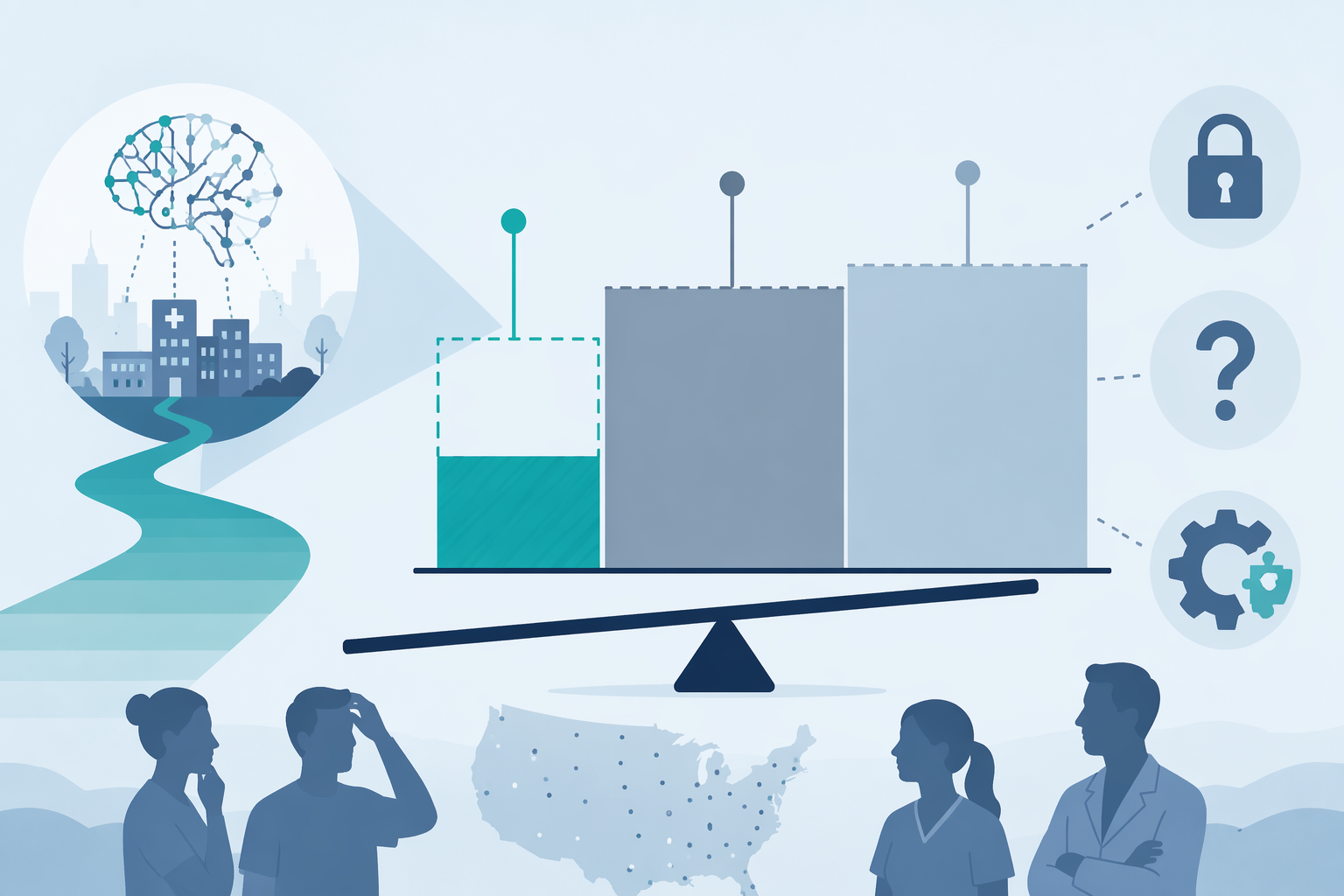
ASTHO’s barrier data explain why adoption remains thin even though the technology is available. Among responding agencies, 64% cited lack of established guidance around public health use of AI as the top barrier, 55% cited lack of workforce skills or knowledge, and only 23% reported using enterprise-grade AI tools suitable for sensitive public health data.[1]
Those are not cosmetic barriers. Guidance determines whether a program knows what it is allowed to do. Workforce capacity determines whether staff can evaluate vendor claims, monitor model behavior, and recognize failure modes. Enterprise-grade tooling determines whether sensitive surveillance data can be handled in an environment that meets security, privacy, and procurement requirements.
| Barrier reported by agencies | Share of agencies |
|---|---|
| Lack of established guidance around public health use of AI | 64% |
| Lack of workforce skills or knowledge | 55% |
| Use enterprise-grade AI tools suitable for sensitive public health data | 23% |
The guidance gap is especially important for surveillance because the data are sensitive and the consequences are public. Agencies need rules for permissible data use, human review, documentation, bias and error monitoring, procurement language, retention, auditability, and public communication. Without that scaffolding, a technically useful model may never leave a pilot environment, or it may be adopted unevenly in ways that staff cannot defend.
The workforce gap is just as concrete. Surveillance staff do not need every epidemiologist to become a machine-learning engineer. They do need enough shared literacy to ask whether a model was tested on comparable data, whether its errors are acceptable for the use case, whether the system exposes confidence or uncertainty, and whether there is a process for reverting to manual review. Informatics staff need time to maintain interfaces and data quality, not just connect a new tool once.
The enterprise-tooling gap limits what agencies can safely try. Public health surveillance data can include identifiers, laboratory results, demographic details, addresses, dates, and clinical context. If only 23% of agencies are using enterprise-grade AI tools suitable for sensitive public health data, then many agencies are either avoiding AI for appropriate reasons or confined to low-risk administrative uses that do not touch surveillance operations.[1]
What Transformation Would Actually Look Like
A transformed surveillance system would not be defined by a single impressive alert. It would be visible in the routine flow of work. Lab reports would arrive and be converted into structured records with fewer manual touches. Probable duplicates would be queued for review with clear match explanations. Missing reporting elements would trigger reminders before a case stalls. Analysts would see anomaly signals with enough context to decide whether follow-up is warranted. Forecasts would support defined planning decisions rather than sit apart from operations.
That version of AI in public health is less theatrical than the usual story, but it is more durable. It treats automation as part of a governed surveillance process, not as a substitute for one. It also recognizes that human review is not a failure of AI. In public health, human review is often the mechanism that makes automation acceptable.
The adoption numbers make the current state plain. AI is already capable of meaningful gains in outbreak detection, laboratory-report processing, case follow-up, duplicate resolution, and forecasting. In Q3 2026, however, the U.S. public health system is not yet organized, guided, or staffed to make those gains routine. The bottleneck is no longer basic technical feasibility. It is deployable governance, workforce capacity, and secure infrastructure inside the agencies that have to use the tools on Monday morning.
References
- The State of AI in Public Health: New Data from the 2025 ASTHO Profile — ASTHO, 2026.
- Harnessing artificial intelligence for enhanced public health surveillance: a narrative review — Frontiers in Public Health.
- How AI can make infectious disease surveillance smarter, faster, and more useful — Healthbeat, July 2025.
- Considerations for Generative AI in Public Health — CDC, March 2026.
Comments
Join the discussion with an anonymous comment.