
Radiology now carries the largest regulatory footprint in medical AI. As of March 2026, radiology accounted for 1,163 FDA-cleared AI algorithms, roughly 76% of all AI-enabled medical devices listed in the FDA’s AI device database, according to industry reporting.[1][2] That number explains why AI radiology triage device evidence has become more than a research question. It is now a procurement question, a staffing question, and, in some hospitals, a daily worklist question.
The uncomfortable part is that clearance volume has grown faster than the kind of clinical pathway evidence that governance committees usually need before changing care delivery. A 2025 rapid scoping review in The Lancet eClinicalMedicine identified 140 studies of radiology AI implementation, but among 53 quantitative studies, only 23 evaluated AI in a live clinical pathway. Its conclusion was blunt: implementation is often based on “experiential learning rather than being informed by rigorous evidence.”[3]
That does not make AI triage ineffective. It means the evidence has to be read at the level where the intervention actually works: the queue, the reader, the alert, the reporting interval, and the consequence of a wrong prediction. A device can move a pulmonary embolism study up the list and still fail to reduce overall reporting time in a reproducible way. It can improve sensitivity for some readers and still degrade performance when its own prediction is wrong.

The Evidence Base Is Large, but the Live-Workflow Evidence Is Smaller
The most useful synthesis for triage is not a device catalog. It is the npj Digital Medicine systematic review and meta-analysis of 48 studies evaluating AI triage in radiology workflows. The review found a literature that is active but fragile: using ROBINS-I, 62.2% of included studies were rated as having serious risk of bias.[4]
That matters because triage is unusually sensitive to study design. Offline accuracy can show that a model detects a target finding on stored images. It cannot show whether an urgent case was opened sooner, whether a radiologist trusted the flag, whether another queue slowed down, or whether the night service had enough volume for reprioritization to matter. Retrospective and single-center studies can still be informative, especially when they describe the workflow clearly, but they are a weak basis for broad claims about time savings.
The same review reported that, across 12 pooled studies, AI triage did not produce a statistically significant reduction in turnaround time.[4] That pooled result should sit beside, not erase, individual deployment studies that show large local gains. The correct reading is narrower: AI triage can improve turnaround time in specific settings, but the current pooled evidence does not support a general statement that it reliably saves reporting time across radiology.
Turnaround Time Is Not One Outcome
Turnaround time is often treated as if it were a single clean measurement. In practice, it can mean time from image acquisition to preliminary report, scan completion to final report, order to report, or flag to radiologist review. A triage device may shorten one interval while leaving the broader patient pathway unchanged. It may help only when there is a queue dense enough for reordering to matter.
The Lunit INSIGHT CXR Triage study is a good example of why individual studies attract attention. In 20,944 chest radiographs, the system was associated with a 77% reduction in report turnaround time for urgent cases and 99% specificity for urgent cases.[5] Those are operationally meaningful figures. They suggest a plausible mechanism: urgent chest X-rays are identified with high specificity and moved to the top of a worklist where waiting time otherwise accumulates.
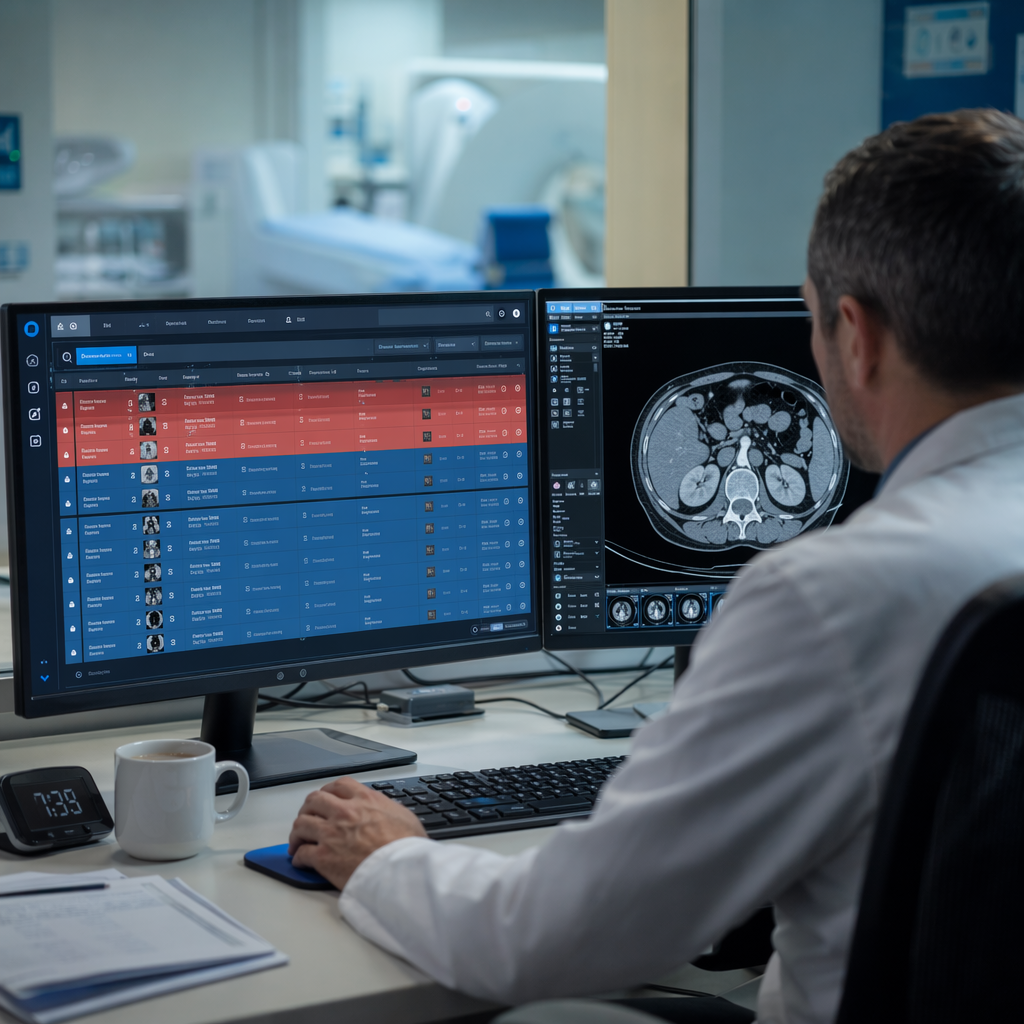
The Aidoc BriefCase pulmonary embolism triage study adds an important constraint. In more than 11,000 CTPA scans, AI triage was associated with a 32.2% report turnaround-time reduction during work hours, while the off-hours reduction was not statistically significant.[6] That split is not a minor subgroup curiosity. It says the benefit depends on the operating conditions around the model: staffing, volume, competing examinations, and the presence of a queue that can be usefully reordered.
This is where pooled and local evidence can appear to disagree without either being irrelevant. A high-volume emergency chest X-ray service may see a real improvement when urgent cases are brought forward. A lower-volume off-hours service may see little measurable gain because the next case would have been read soon anyway. A pooled analysis that combines heterogeneous settings can fail to show a statistically secure effect even when some hospitals experience a visible operational improvement.
| Evidence Signal | What It Supports | What It Does Not Support |
|---|---|---|
| Large single-site turnaround-time reductions | A device may improve queue position and urgent-case reporting in a defined workflow | A general claim that AI triage saves time across radiology departments |
| Work-hours benefit with non-significant off-hours effect | Triage benefit may depend on volume, staffing, and queue density | Assuming the same device effect at all times of day |
| Non-significant pooled turnaround-time effect | The overall evidence remains uncertain across heterogeneous studies | Dismissing all local workflow gains as meaningless |
Diagnostic Performance Improves Unevenly
The evidence for diagnostic performance is easier to overstate because sensitivity gains are attractive and familiar. The npj Digital Medicine review found that AI triage was associated with improved sensitivity, particularly for less experienced readers, but that finding sits inside the same study-quality problem: many included studies had serious risk of bias, and relatively few quantified downstream workload savings.[4]
Sensitivity is not the same as safer workflow. If a device increases detection while adding false-positive prompts, radiologists may spend more time checking regions they would otherwise dismiss. If the false positives cluster in common normal variants, the burden may be cognitive rather than numerical. If a radiologist becomes more cautious after seeing repeated AI flags, the cost may appear as longer reads, more second looks, or more defensive reporting rather than as a missed diagnosis.
Only three of the 48 studies in the npj Digital Medicine review quantified workload savings.[4] That absence is more than a reporting gap. For a triage product, workload is part of the intervention. A hospital buying a device is not just buying a sensitivity increment; it is buying a change in how cases, attention, interruptions, and accountability move through the reading room.
The Safety Question Changes When the AI Is Wrong
A Nature Medicine study published in 2024 makes the safety question sharper. In a study of 140 radiologists, inaccurate AI predictions adversely affected radiologist performance, and experience-based factors did not predict who benefited from or was harmed by AI assistance.[7]
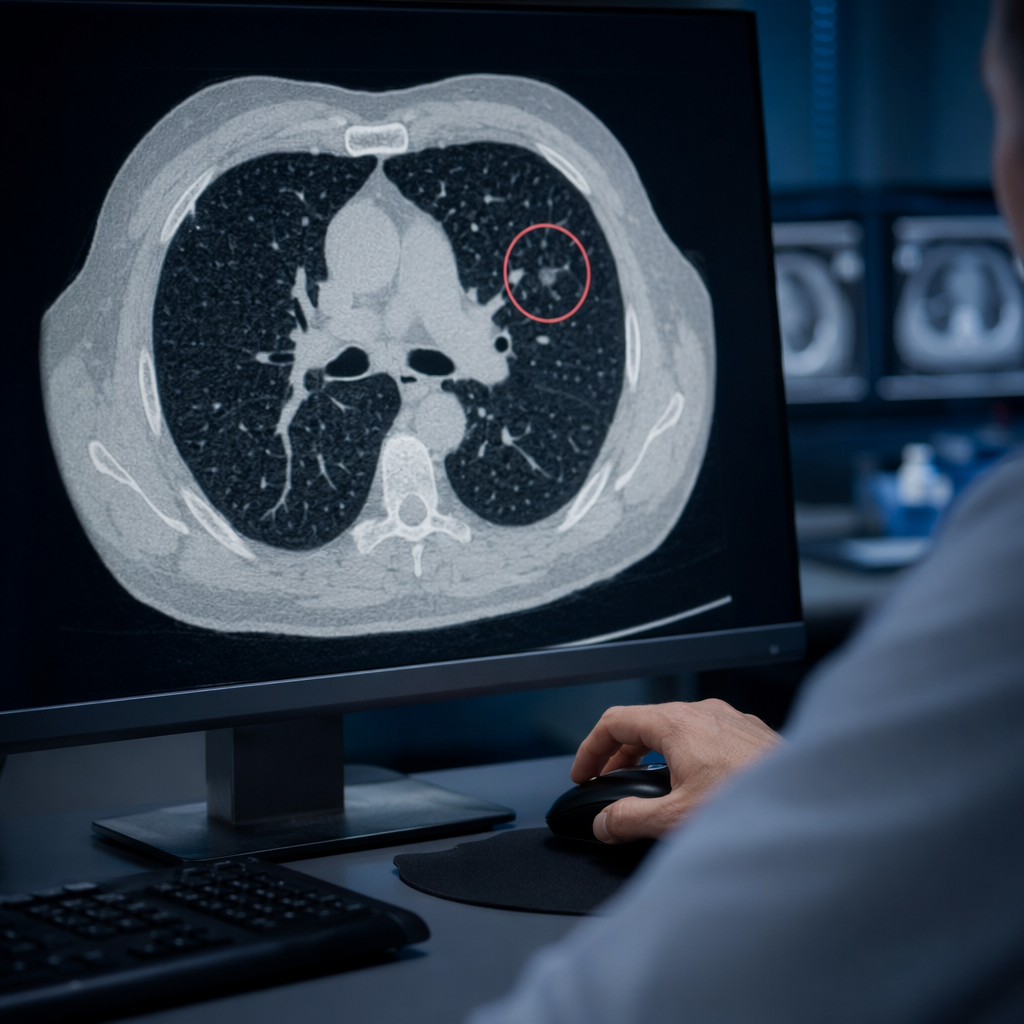
That finding should disturb any local assurance process that relies too heavily on seniority or subspecialty confidence. A department may reasonably expect experienced radiologists to handle AI outputs with skepticism. The study’s result is that experience-based characteristics did not reliably identify who would be helped or harmed.[7] Credentialing, therefore, cannot simply assume that expert readers are immune to automation bias, distraction, or overcorrection.
The practical implication is not to hide AI outputs from radiologists. It is to measure what happens when those outputs are wrong. False positives and false negatives are not only model-performance categories; they are reader-performance exposures. A wrong AI flag can redirect attention. A missed AI flag can falsely reassure. A confident-looking output can change the threshold for calling a finding, even when the radiologist ultimately remains responsible for the report.
This is one reason live monitoring has to include more than aggregate report turnaround time. Departments need to know whether AI-discordant cases are reviewed, whether radiologists override the system, whether errors cluster by shift or case type, and whether reader behavior changes after deployment. None of that is settled by a standalone performance table.
Vendor-Affiliated Evidence Needs a Narrow Reading
Several of the most concrete studies in this field are tied to commercial products, including work involving Aidoc, Lunit, and Qure.ai. Vendor involvement does not invalidate a study. Vendors often have the deployed software, the integration knowledge, and the operational data needed to study real workflows. But it does change how far the conclusion should travel.
A product-specific study can answer a product-specific question: what happened in this institution, with this worklist, this staffing model, this disease target, and this alert design? It is weaker evidence for a class-wide claim that AI triage improves radiology efficiency. That distinction becomes especially important when the pooled meta-analysis does not confirm a statistically significant turnaround-time reduction across studies.[4]
Hospitals should also be careful with evidence that reports accuracy without describing behavior. If the radiologist never saw the AI output, the study is not evidence about AI-assisted reading. If the worklist was not actually reordered, it is not evidence about triage. If the outcome is detection on retrospective images, it may be useful model evidence, but it is not implementation evidence.
Cost-Effectiveness Is Mostly an Empty Shelf
The procurement case is thinner than the adoption pressure suggests. The Lancet eClinicalMedicine review found only six cost-effectiveness studies across the radiology AI implementation literature; five showed monetary benefit and one did not.[3] Six studies are not enough to support confident purchasing assumptions across modalities, indications, and health systems.
This matters because the economic argument for triage is usually indirect. A device may reduce urgent-case turnaround time, but the hospital still has to ask whether that translates into shorter emergency department length of stay, fewer adverse events, better bed flow, lower outsourcing costs, or more efficient radiologist allocation. If the benefit is mainly a redistribution of waiting time inside the reporting queue, the financial case may be weaker than the operational story.
There is also a missing patient endpoint. The Lancet review reported no studies examining patient or carer experiences.[3] For triage, that is a measurable absence. Patients may care less about an abstract reporting interval than about whether treatment started sooner, whether communication improved, or whether an AI-driven escalation created confusion. Current evidence says little about those experiences.
What a Careful Adoption Decision Can Claim
The defensible claim is specific. AI radiology triage devices have evidence of benefit for certain outcomes, in certain settings, especially where high-volume queues allow urgent cases to be moved forward. Individual studies show large turnaround-time reductions, and systematic review evidence suggests sensitivity can improve, particularly for less experienced readers.[4][5][6]
The indefensible claim is broad. The current evidence does not prove reliable time savings across radiology departments, does not establish mature cost-effectiveness, and does not show that radiologists are uniformly improved by AI assistance. The pooled turnaround-time result remains statistically uncertain, live clinical pathway studies are a minority of the quantitative implementation literature, and inaccurate AI predictions can harm reader performance.[3][4][7]
A reasonable deployment boundary follows from that. Use AI triage where the clinical problem is narrow, the queueing mechanism is plausible, the local baseline delay is measured, and the post-deployment audit is planned before the contract is treated as success. The monitoring plan should include urgent-case and all-case turnaround time, false-positive and false-negative review, radiologist override behavior, shift-level effects, and downstream clinical consequences where they can be measured.
The practical test is simple to state and hard to satisfy: does the device improve this local workflow under live conditions, do its errors measurably influence radiologists, and is the health system willing to keep measuring after implementation? If the answer is yes, careful deployment is justified. If the answer rests mainly on clearance, vendor claims, or an attractive single-site turnaround-time result, the evidence has not yet done the work being asked of it.
References
- Radiology gets 68 new FDA-cleared algorithms, Radiology Business.
- Numbers from the FDA Show Radiology is Maintaining Its Lead, The Imaging Wire, March 11, 2026.
- Artificial intelligence in radiology: a rapid scoping review of implementation in clinical practice, The Lancet eClinicalMedicine, 2025.
- Artificial intelligence triage in radiology: a systematic review and meta-analysis, npj Digital Medicine.
- Lunit INSIGHT CXR Triage study, European Journal of Radiology.
- AI triage software significantly reduces radiology report turnaround times — with a caveat, Radiology Business.
- Heterogeneity and predictors of the effects of AI assistance on radiologists, Nature Medicine, 2024.
Comments
Join the discussion with an anonymous comment.