
By mid-2026, SSA's initial disability claims backlog had fallen by more than 30%, from roughly 1.27 million in June 2024 to about 830,000 in March 2026, average initial processing time was down by more than 42 days, and the agency cleared 2.3 million initial claims in FY2025, a 10% year-over-year increase. [1] Those gains are real, but they are cumulative. Staffing changes, workflow redesign, and narrow automation tools all contributed, so the number should not be read as proof that every day saved belongs to AI alone.

The useful way to read SSA's program is as a claims workflow with several separate chokepoints. Some tools pull obvious allowances out of the queue, some surface severe conditions earlier, some turn long medical records into usable facts, some score draft decisions before release, some transcribe hearings, some auto-adjudicate simpler entitlement work, and one helps employees find policy guidance without hunting through manuals.
The seven systems and the bottlenecks they remove
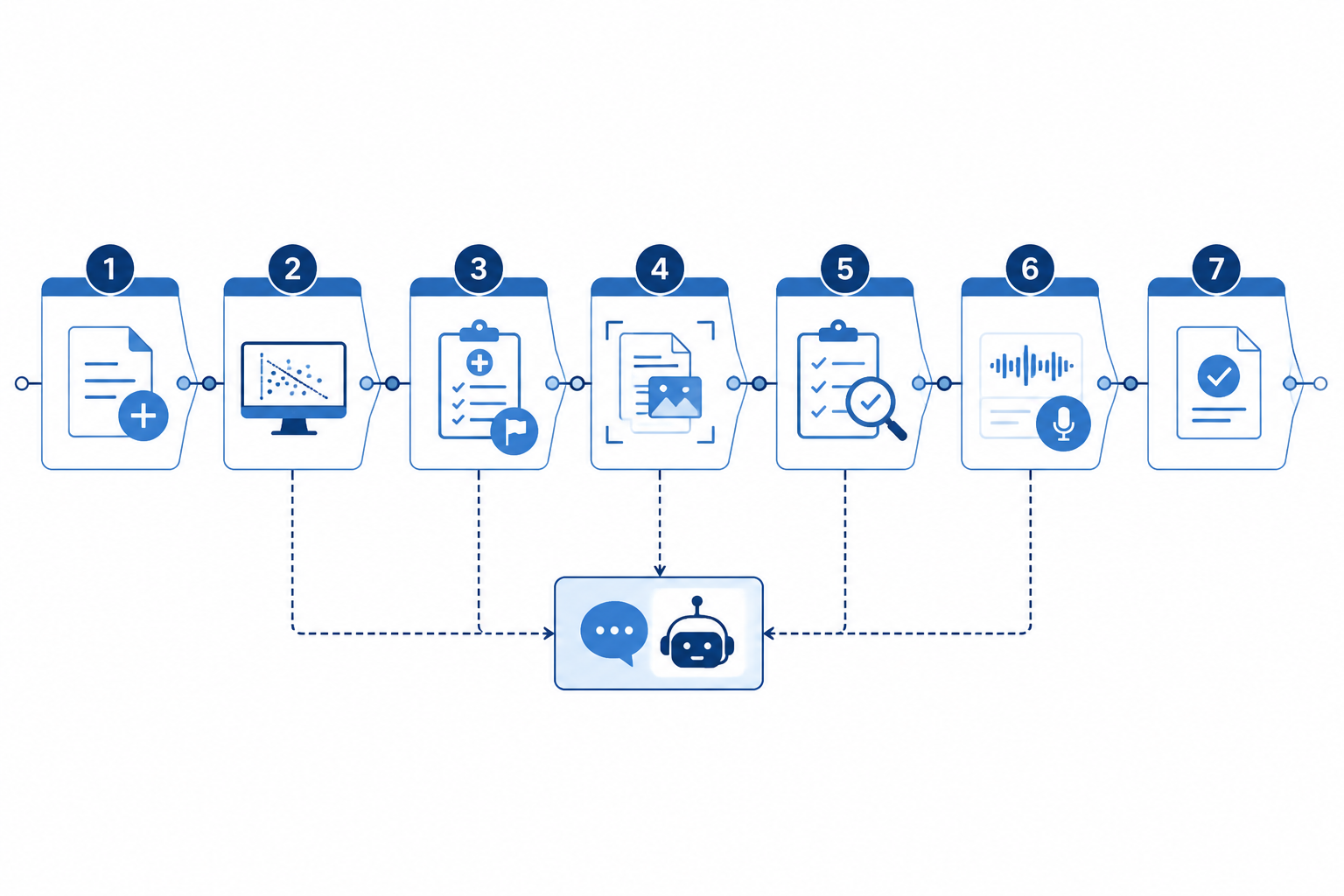
| System | Workflow bottleneck | Automation type | Measured result | What the public record leaves open |
|---|---|---|---|---|
| QDD | Front-end triage for cases likely to be allowed quickly | Predictive routing model | Median processing time of 13-14 days for QDD-flagged cases versus 83-100 days for non-QDD cases; about 7% of annual applications flagged [2] | Public data are from FY 2015-2020, not current internal performance |
| CAL | Severe-condition screening | Fast-track program for clearly disabling conditions | More than 1.1 million people accelerated since inception [3] | Operationally important, but not the same kind of model-driven AI as QDD or IMAGEN |
| IMAGEN | Extracting usable facts from long medical records | NLP system for unstructured clinical text | Turns hundreds of pages of records into structured, searchable clinical profiles [4] | Public validation details such as architecture, training data, and error rates are thin |
| Insight Software | Checking draft decisions before release | Quality-scoring tool | Checks about 30 quality issues per draft decision and gives adjudicators a quality score before release [5] | Public reporting does not show a time-saved estimate |
| HeaRT | Hearing transcription | Generative AI transcription | Nationwide since March 2025; about $5 million in annual savings [6] | Reported through agency-facing and trade reporting, with limited public technical detail |
| Straight Through Processing | Manual touches in simpler claims | Automation for simpler entitlement work | More than 340,000 Medicare claims auto-adjudicated [1] | Applies to simpler Medicare claims, not disability determinations |
| Internal RAG chatbot | Policy lookup for frontline employees | Retrieval-augmented internal assistant | Used daily; Brian Peltier said it had "exploded in use" [6] | Public evidence is adoption and workflow relief, not accuracy metrics |
That mix is the point. SSA is not relying on one model to decide disability. It is using different tools on different tasks, and the public evidence is strongest where the task is narrow and the output is easy to count.
QDD still has the cleanest public time signal
QDD is the clearest example of AI changing routing speed rather than medical judgment. In SSA's FY 2015-2020 research note, the median processing time for QDD-flagged cases was 13-14 days, compared with 83-100 days for non-QDD cases, and about 7% of annual applications were flagged. [2] That is a visible workflow effect: a small slice of cases is separated early enough to move much faster. It does not imply that every claim gets the same benefit, and the most recent public data stop short of current internal performance.
The rest of the stack is narrower, but still consequential
CAL matters because it strips obvious allowances out of the normal queue. SSA says more than 1.1 million people have been accelerated through Compassionate Allowances since the program began. [3] It is a fast-track mechanism for conditions so severe they clearly meet disability standards, not a machine-learning score in the same sense as QDD or IMAGEN. Still, the operational effect is the same kind of delay reduction readers care about: fewer cases waiting for work they do not need.
IMAGEN is the most clinically familiar piece of the stack. The ACT-IAC case study describes it as turning unstructured clinical text from hundreds of pages of medical records into structured, searchable clinical profiles for adjudicators. [4] That is useful because disability delay is often not just waiting for records; it is waiting for someone to find the one usable fact hidden inside them. The public record is still thin on model architecture, training data, and independent validation, so the safest claim is about workflow transformation, not hidden performance.
Insight Software sits at the quality-control end of the process. SSA said it checks about 30 quality issues per draft decision and gives adjudicators a quality score before release. [5] That is not a headline-grabbing speed metric, but it attacks a different source of delay: errors that cause remands, rework, or preventable cleanup after the file has already moved too far. The public evidence supports its role in quality checking, not a specific day-count savings figure.
HeaRT is closer to classic back-office automation, but it still matters because hearing transcription is pure clerical drag. SSA's AI chief said the generative transcription tool had been deployed nationwide since March 2025 and was saving about $5 million annually. [6] That does not change the merits of a case; it shortens the time before a transcript exists, which is often the point at which the file can move again.
Straight Through Processing is even more bounded. GovCIO reported that SSA had auto-adjudicated more than 340,000 Medicare claims through the system. [1] The value here is not a broad promise about disability determinations. It is the simpler lesson that SSA is willing to remove manual steps when the claim structure is clear enough to support it.
The internal RAG chatbot solves a different bottleneck entirely: policy lookup. Brian Peltier said it had "exploded in use" and that frontline employees now use it daily for guidance. [6] That matters because policy search is a real hidden delay inside adjudication. If an employee can find the right rule faster, the decision writer is less likely to stall on a manual search or lean on an outdated interpretation. The public reporting shows adoption and workflow relief, not a published accuracy rate.
What the public record actually supports
The most defensible conclusion is operational, not mystical. SSA's delay reduction seems to come from distributed automation across triage, extraction, quality control, transcription, auto-adjudication, and policy retrieval. QDD has the strongest public processing-time comparison, IMAGEN has the most relevant medical-record use case, and the newer tools are supported more by reported adoption and savings than by full technical validation. The program looks consequential because it attacks many small bottlenecks at once, not because it has replaced disability adjudicators with an autonomous decision engine.
References
- SSA Cuts Wait Times, Claims Backlog Through Tech Modernization — GovCIO Media, July 2, 2026
- Quick Disability Determination (QDD) — Social Security Administration, policy research note
- Compassionate Allowances — Social Security Administration
- Intelligent Medical Language Analysis Generation (IMAGEN) — ACT-IAC, October 2022
- SSA 100-Day Accomplishments press release on Insight Software — Social Security Administration, April 29, 2025
- SSA AI Chief: Agentic AI Is Ready With Governance Testing — MeriTalk, June 29, 2026
Comments
Join the discussion with an anonymous comment.