
The 2026 evidence on AI scribe burnout is finally strong enough to take seriously, and still too young to treat as settled. Three peer-reviewed studies published or reported across 2025 and 2026 now point in the same direction: ambient AI scribes can reduce physician burnout over short follow-up periods. The harder question is how much, for whom, and whether the relief survives once the tool becomes part of ordinary clinical throughput.
That distinction matters because physician burnout was not a niche complaint waiting for a gadget. In the AMA’s 2025 survey, physician burnout was about 42%, lower than prior peaks but still affecting nearly half the workforce.[1] A tool that moves that number even modestly is worth attention. A tool that merely converts reclaimed documentation time into additional work is a different story.

The clearest burnout drop came from Yale, but it was not randomized
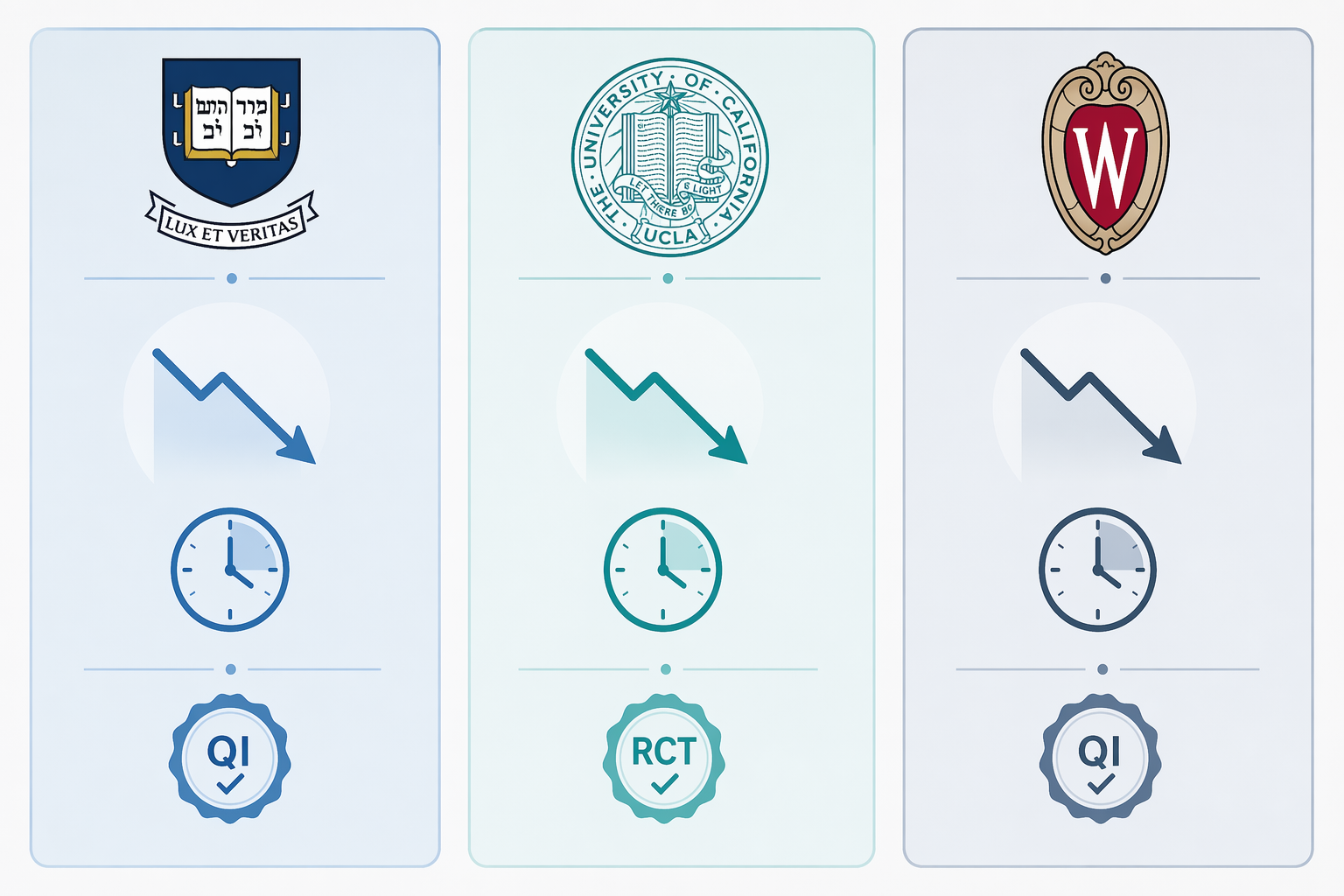
The most immediately legible result comes from the Yale-led multicenter quality-improvement study published in JAMA Network Open in March 2026. Across 263 clinicians in 6 primary care clinics, burnout fell from 51.9% before ambient AI scribe use to 38.8% after 30 days. The study reported 74% lower odds of burnout after use.[2]
That is the sort of absolute change that gets clinicians’ attention because it is not just a small movement on an abstract scale. It describes fewer physicians crossing a burnout threshold after a month of using a tool intended to remove a despised portion of the visit. The operational image is easy to understand: the physician is less tethered to the keyboard, the visit can unfold with more eye contact, and some of the after-hours cleanup may be reduced.
But the study design matters. This was a quality-improvement initiative, not a traditional randomized controlled trial. It does not provide the same protection against selection effects, novelty effects, local implementation enthusiasm, or concurrent workflow changes. A 30-day improvement is meaningful, especially when the baseline burden is high, but it is not evidence that the same reduction would persist through staffing changes, template drift, payer documentation demands, or increased patient volume.
The randomized trials are positive, but not interchangeable
The two NEJM AI randomized trials are what move the field beyond promising implementation anecdotes. They do not simply repeat the Yale result under cleaner conditions. They ask a narrower and more useful question: when ambient AI scribes are introduced into real clinical practice, what changes compared with usual care?
| Study | Design and setting | Burnout or well-being result | Documentation-time result |
|---|---|---|---|
| Yale / JAMA Network Open | Multicenter quality-improvement study; 263 clinicians across 6 primary care clinics; 30 days | Burnout fell from 51.9% to 38.8%; 74% lower odds of burnout [2] | Administrative burden was the target, but the core reported burnout result should not be read as randomized evidence [2] |
| UCLA / NEJM AI | Pragmatic randomized trial; 238 physicians; more than 72,000 encounters | About 7% improvement in burnout for both DAX Copilot and Nabla versus usual care [3] | Nabla reduced documentation time by about 10%, approximately 41 seconds per note [3] |
| UW Health / NEJM AI | Stepped-wedge randomized trial; 66 practitioners across 16 departments; more than 71,000 notes | Clinically meaningful reduction in work exhaustion and interpersonal disengagement, reported as -0.44 on a 5-point scale [4] | Documentation time decreased by 0.36 hours per day [4] |
UCLA: statistically significant, clinically modest
The UCLA pragmatic randomized trial enrolled 238 physicians and covered more than 72,000 encounters. It compared two ambient AI scribe products, DAX Copilot and Nabla, with usual care. Both products were associated with about a 7% improvement in burnout versus usual care.[3]
That result is important because it comes from randomization in clinical practice, not from a voluntary satisfaction survey after a pilot. It is also modest. A 7% score improvement can be statistically significant and still leave open the question of whether an individual physician experiences it as meaningful relief. The trial supports the claim that AI scribes can improve burnout measures over the study window. It does not support a broad claim that ambient documentation reliably transforms clinicians’ working lives.
The documentation-time result is similarly useful but easy to overread. Nabla reduced documentation time by about 10%, or roughly 41 seconds per note.[3] Across a busy clinic week, that may accumulate. At the level of a single encounter, it is not the same thing as returning a physician’s evening. If burnout improves more than the visible time savings seem to explain, the mechanism may include cognitive relief, less task switching, better visit presence, or simply the feeling that one hated task has become less punishing.
UW Health: a more direct look at exhaustion and disengagement
The UW Health stepped-wedge randomized trial has a different texture. It included 66 practitioners across 16 departments and more than 71,000 notes, and it reported clinically meaningful reductions in work exhaustion and interpersonal disengagement, including a -0.44 change on a 5-point scale.[4]
Those endpoints matter. Generic productivity language often flattens burnout into a throughput problem: fewer minutes documenting, better physician. Work exhaustion and interpersonal disengagement are closer to what burned-out clinicians describe when the visit, the inbox, the note, and the next unfinished task all begin to feel like the same obligation. Improvement there suggests the tool may be affecting more than clerical duration.
UW Health also reported 0.36 fewer hours per day spent on documentation.[4] That is more intuitively meaningful than seconds-per-note savings, but it still does not answer what happens to the recovered time. A health system can let that time become margin, mentoring, chart review, or a normal lunch. It can also fill it with more visits, more messages, and more expectations.
Why burnout may improve even when time savings are not dramatic
The tempting story is linear: AI scribes save documentation time, saved time reduces burnout, therefore more automation means healthier clinicians. The studies do not support that simple a chain. They support a more cautious version: ambient AI scribes may reduce several forms of documentation-related strain, and those reductions can appear as lower burnout over short follow-up periods.
The distinction is not academic. A JAMA Network Open invited commentary by Shah and Johnson, described in MedPage Today coverage, questioned whether the large reduction reported in the Yale study could be explained by EHR time savings alone and warned that improvements could wash out over time.[5] That skepticism fits the pattern in the trial data: the well-being measures move in favorable directions, but the measured documentation-time savings do not always look large enough to carry the entire psychological effect.

One plausible explanation is that ambient documentation changes the shape of attention during the visit. A physician who is no longer half-facing the screen may leave the room with less cognitive residue, even if the final note still requires review. Another is that the tool reduces the anticipatory burden of knowing that every encounter will generate another chunk of after-hours composition. Neither explanation proves durable benefit. Both are more realistic than treating a minute saved as a unit of wellness created.
Implementation data widen the lens, but they do not replace trial evidence
Broader implementation evidence is encouraging, provided it is kept in its lane. The Peterson Health Technology Institute’s AI Taskforce analysis, drawing on organizations including CommonSpirit, Mass General Brigham, Intermountain, and Yale New Haven, concluded that AI scribes reduce clinician burnout while finding that the financial impact remains unclear.[6]
The Permanente Medical Group’s real-world implementation data are also striking at scale: AMA coverage reported 7,260 physicians, more than 2.5 million encounters, 15,791 documentation hours saved, and 84% of physicians reporting improved patient communication.[7] Those figures are useful because they show that ambient scribes can be deployed beyond a small innovation clinic. They do not, by themselves, prove sustained burnout reduction, nor do they settle whether saved time became rest, access, or additional workload.
Adoption pressure is real as well. Doximity’s 2026 State of AI in Medicine Report surveyed 3,151 physicians and described adoption rates and usage patterns by specialty.[8] That helps explain why health systems are asking for evidence now rather than waiting for perfect longitudinal data. It should not be confused with effectiveness evidence. Usage tells us that clinicians and organizations are trying the tools; it does not tell us whether burnout benefit persists.
The work-time paradox is the unresolved implementation problem
The most important operational risk is not that ambient AI scribes save no time. The stronger evidence now suggests they often do save some time, reduce some burden, or improve some well-being measures over short horizons. The risk is that recovered time is immediately absorbed by expanded clinical demands.
An Institute for Homeland Security analysis described this as a “work-time paradox”: efficiency gains can be converted into more work rather than recovery.[9] In clinical operations, that is not a theoretical concern. If a physician’s notes close faster, the schedule may become denser. If inbox time decreases, message volume may rise. If documentation feels easier, the organization may view the relief as capacity.
This is where burnout evidence and procurement logic can quietly diverge. A health system buying ambient AI for workforce well-being needs to decide what protected benefit looks like before the efficiency shows up. Otherwise, a short-term improvement in exhaustion can become a transition phase on the way to a higher baseline of expected output.
What the evidence still does not show
The current evidence base has four major limits that should stay visible in any 2026 interpretation of AI scribe burnout evidence.
- No cited study has demonstrated burnout reduction beyond 6 months. The strongest evidence is short-term, ranging from 30 days to 6 months.
- The Yale result is large and clinically easy to understand, but it came from a quality-improvement study rather than a randomized trial.
- The UCLA randomized result is positive but modest, so statistical significance should not be inflated into a claim of large clinical transformation.
- Specialty-specific evidence remains uneven. The strongest peer-reviewed evidence is concentrated in primary care and broad ambulatory settings, while many specialty claims still depend on narrower or less independent evidence.
- Financial value remains unsettled. Reduced burnout and saved documentation time do not automatically establish return on investment.
There is also a source-access limitation in interpreting the literature from outside the journals themselves. Some full-text study details were not directly available through open access at the time of synthesis, so certain design and implementation specifics depend on publisher pages, institutional summaries, and reputable medical news coverage. That does not erase the convergence across studies, but it argues against overconfident claims about subgroup effects, specialty differences, or exact causal pathways.
A disciplined 2026 verdict
As of Q3 2026, the peer-reviewed evidence supports a cautious affirmative answer: ambient AI scribes can reduce physician burnout over short follow-up periods. The Yale quality-improvement study showed the largest and most concrete burnout drop after 30 days. The UCLA randomized trial showed a statistically significant but modest improvement. The UW Health stepped-wedge randomized trial showed clinically meaningful improvement in work exhaustion and interpersonal disengagement, with a measurable reduction in documentation time.
What the evidence does not yet establish is just as important. It does not show durable benefit beyond 6 months. It does not prove that every specialty will see the same effect. It does not show that financial value is clear. And it does not justify the tidy causal story in which saved documentation seconds automatically become restored clinician well-being. The better reading is narrower and more useful: AI scribes appear capable of repairing a real piece of clinical workflow, but whether that repair becomes lasting relief depends on what health systems do with the time and attention the tools give back.
References
- Physician burnout rate continues decline, falling to nearly 42%, AMA, 2025.
- Use of Ambient AI Scribes to Reduce Administrative Burden and Professional Burnout, JAMA Network Open, March 2026.
- Ambient AI Scribes in Clinical Practice – A Randomized Trial, NEJM AI.
- A Pragmatic Randomized Controlled Trial of Ambient Artificial Intelligence to Improve Health Practitioner Well-Being, NEJM AI.
- AI Scribes Reduce Physician Burnout, Return Focus to the Patient, MedPage Today.
- AI Scribes Reduce Clinician Burnout, Peterson Health Technology Institute.
- AI scribes save 15,000 hours and restore human side of medicine, AMA.
- State of AI in Medicine Report, Doximity, 2026.
- Ambient AI Medical Scribes: Efficiency Gains, Burnout Uncertainty, and Governance Risks, Institute for Homeland Security.
Comments
Join the discussion with an anonymous comment.