
Wall Street’s cleanest AI hardware story begins with hyperscalers: hundreds of billions of dollars moving into data centers, accelerator clusters, high-speed networking, and power systems. Healthcare’s version is messier. A hospital does not buy AI capacity because a capex chart is rising. It buys when a stroke workflow cannot wait on variable cloud latency, when a digital pathology program starts producing storage volumes that overwhelm the archive, or when a security review decides that a model touching protected health information needs to run closer to the clinical system.
That distinction matters for ai server hardware and healthcare infrastructure stock analysis. The investable question is not simply which company sells the most AI chips. It is which vendors sit in parts of the infrastructure stack where healthcare workloads create real purchasing pressure: silicon, servers, networking, power and cooling, storage, and deployment services.
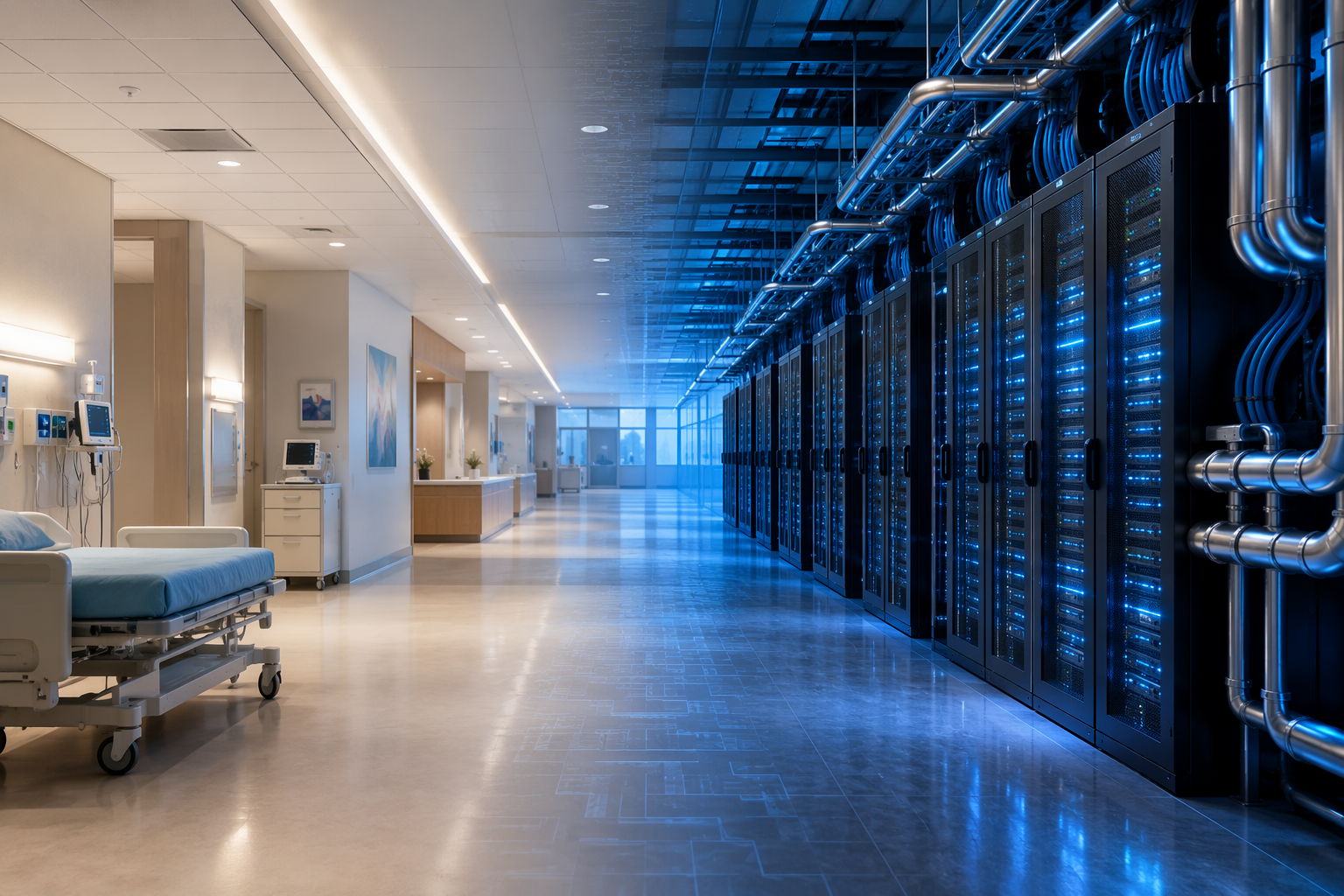
The top-down numbers are large enough to take seriously, but they need boundaries. Intellectia cites $602 billion of 2026 combined capex from the top five hyperscalers, with about $450 billion directed at AI infrastructure.[1] Fortune, citing JPMorgan, uses a different scope and puts 2026 AI infrastructure spending at $650 billion, with $1.1 trillion projected for 2027.[2] Those are not interchangeable figures; they are different estimates with different coverage. Both point to the same broad direction, but neither proves that a hospital will buy a specific rack, storage array, or inference appliance.
Healthcare-specific spending also needs careful reading. Menlo Ventures reported $1.4 billion of 2025 spending on healthcare-specific generative AI solutions, nearly triple 2024, but that figure does not capture all healthcare AI spending, non-LLM imaging AI, general-purpose AI tools, or the infrastructure cost behind API usage.[3] NVIDIA’s 2026 healthcare survey found that 70% of healthcare organizations actively use AI, up from 63% in 2024, and that 85% expect AI budget increases.[4] Grand View Research projects the artificial intelligence in healthcare market at $50.7 billion in 2026, growing at a 38.9% CAGR to $505.6 billion by 2033, but that market definition includes software, hardware, and services.[5] GM Insights estimates the AI server hardware market at $128 billion in 2024 and projects a 28.2% CAGR to $1.56 trillion by 2034.[6]
Those figures establish the seriousness of the buildout. They do not settle the stock analysis. For that, the better starting point is the workload that forces the infrastructure decision.
Healthcare Demand Does Not Map Cleanly To Generic Cloud AI
Some healthcare AI will remain cloud-heavy. Ambient documentation, revenue-cycle automation, coding assistants, and many administrative SaaS tools can be delivered through managed platforms without a hospital owning specialized GPU capacity. Those workloads may still benefit hyperscalers, software vendors, and AI API providers, but they do not support an on-premises server thesis in the same way imaging and pathology do.
Medical imaging is different because latency and workflow placement matter. Arc Compute, citing Precedence Research, reports that on-premises deployment accounts for 58% of medical imaging AI.[7] That figure should not be generalized to all healthcare AI, but it is highly relevant to radiology, stroke triage, pulmonary embolism detection, and other imaging workflows where inference delays can change the operational value of the tool.
Arc Compute describes acute stroke triage workflows requiring results in under 5 minutes and pulmonary embolism workflows in under 10 minutes, arguing that variable public-cloud latency is a poor fit for these use cases.[7] A hospital does not need every model to be local. It needs the right models to be close enough to the scanner, PACS, and clinical notification workflow that the AI result arrives while the care team can still act on it.
Pathology pushes the same conclusion from the storage side. A mid-size lab with 3 to 5 scanners can generate about 500 slides per day, or roughly 180 TB per year, and a single 40x whole-slide image can reach 30 GB uncompressed.[7] This is not a dashboard problem. It is an archive, network, compute, and migration problem that has to fit into existing retention policies and clinical uptime expectations.
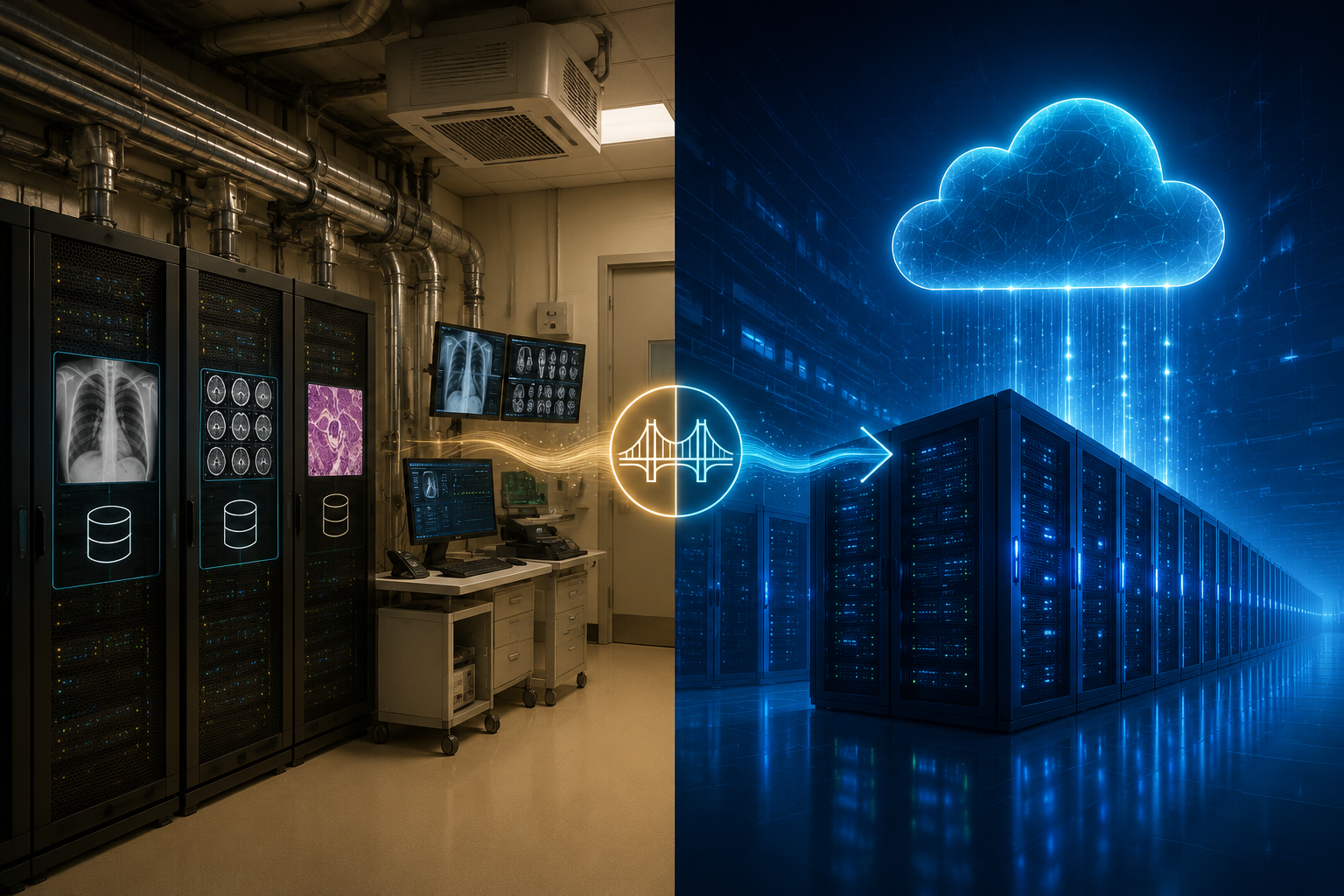
Compliance adds another constraint. Arc Compute points to the January 2025 proposed HIPAA Security Rule overhaul as the first major update in 20 years and notes that it explicitly addresses dynamic AI compute environments.[7] The practical consequence is not that cloud is disallowed. HIPAA-compliant cloud infrastructure is already central to healthcare IT. The consequence is that data movement, auditability, access controls, vendor responsibilities, and disaster recovery become part of the AI infrastructure purchase, not paperwork added after the model demo.
The Infrastructure Stack Investors Should Actually Map
The cleanest way to evaluate healthcare AI hardware exposure is to move layer by layer. Each layer has a different healthcare demand driver and a different set of public-company signals. A chip vendor, server OEM, switch supplier, thermal-management company, and storage platform may all benefit from the same hospital AI strategy, but they do not face the same procurement trigger or risk.
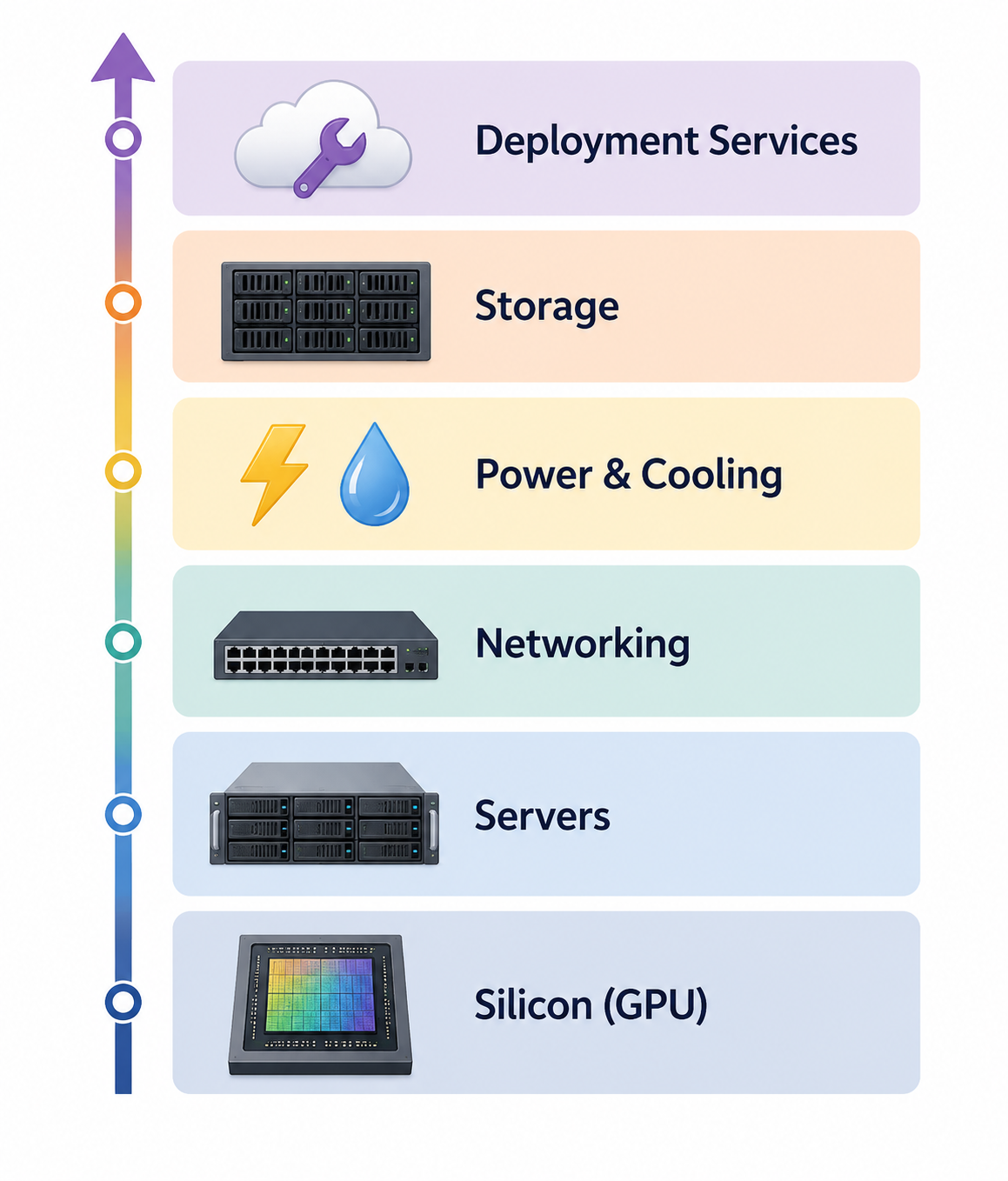
| Layer | Healthcare demand driver | Investor lens |
|---|---|---|
| Silicon | Imaging inference, multimodal models, local GPU capacity for protected data | Accelerator revenue, inference mix, software ecosystem, custom silicon risk |
| Servers | On-premises AI appliances, HIPAA-sensitive workloads, radiology and pathology integration | AI server backlog, healthcare reference customers, margin quality, services attachment |
| Networking | Fast movement between scanners, PACS, archives, GPU nodes, and hybrid cloud | AI networking targets, deferred revenue, Ethernet adoption, cluster scale |
| Power and cooling | High-density racks that exceed ordinary hospital server-room assumptions | Liquid-cooling orders, thermal partnerships, backlog conversion, facility constraints |
| Storage | Whole-slide imaging, longitudinal imaging archives, AI training and inference data locality | NVMe and scale-out storage exposure, healthcare archive integration, data-management software |
| Deployment services | Security review, migration, model validation, workflow integration, uptime planning | Hybrid-cloud partnerships, managed services, implementation capacity, procurement timing |
Silicon: NVIDIA Still Sets The Baseline, But Inference Is The Battleground
NVIDIA remains the obvious starting point because its data center business has become the financial reference point for the AI hardware cycle. Exoswan describes NVIDIA data center revenue rising from about $3 billion in FY2020 to about $90 billion in FY2025, with projections above $150 billion in FY2026.[8] For healthcare, the question is how much of that scale becomes sticky through clinical workflows rather than temporary training demand.
The strongest healthcare argument for NVIDIA is not merely GPU share. It is the combination of accelerators, CUDA, healthcare frameworks, and partner distribution. NVIDIA says its MONAI framework is deployed on more than 15,000 clinical devices through Siemens Healthineers.[4] That kind of footprint matters because hospitals rarely buy infrastructure in isolation. They buy around devices, imaging platforms, validated applications, cybersecurity policies, and vendors already inside the clinical environment.
Still, investors should separate training from inference. A research hospital fine-tuning large models and a regional health system running FDA-cleared imaging inference at the edge are both AI customers, but they pull on different parts of the silicon market. Training favors large GPU clusters. Inference may favor lower-cost accelerators, optimized GPUs, cloud instances, or custom chips if latency, volume, and price line up.
That is where custom silicon becomes a real risk rather than a footnote. AWS Trainium and Inferentia, Microsoft Maia, and other in-house accelerator programs could reduce dependence on NVIDIA GPUs for some healthcare inference over time. The risk is not that hospitals suddenly become chip designers. It is that cloud platforms and managed AI vendors abstract the accelerator away from the buyer. If a clinical AI application runs well enough on a hyperscaler’s internal silicon, the hospital may never create a line item that benefits an external GPU supplier.
The healthcare signal to watch is workload placement. On-premises imaging AI, pathology AI, and protected-data model development strengthen the case for GPU servers sold into or near the health system. Cloud-delivered ambient documentation and administrative automation strengthen the case for hyperscaler infrastructure and SaaS vendors, but they weaken the direct read-through to hospital-owned AI servers.
Servers: The Purchase Happens When AI Becomes A Facility Constraint
Server OEMs become more interesting when healthcare AI moves from pilot budgets into infrastructure planning. A radiology group can test an algorithm through a cloud sandbox. A health system deploying imaging AI across hospitals has to decide where inference runs, how it connects to PACS, how failover works, who patches the host, and whether the server room can power and cool the hardware.
That is the appeal of Dell-style on-premises AI factory positioning. Arc Compute and Inferrence describe Dell AI Factory adoption by health systems for on-premises, HIPAA-oriented GPU deployment.[7] The investment relevance is not the branding. It is that server OEMs can bundle GPU systems, storage, networking, support, and deployment patterns into procurement vehicles that look familiar to hospital IT committees.
Hospitals are not hyperscalers. They do not optimize around the same depreciation schedules, data center design standards, or model-training roadmaps. Their capital committees want a specific operational case: reduce turnaround time, support a digital pathology launch, keep protected data within defined controls, or meet a clinical service-line requirement. A server vendor that can translate GPU capacity into those terms has a better shot at durable demand than one relying on generic AI enthusiasm.
Procurement timing is improving, but it is not frictionless. Menlo Ventures found that health systems now take 6.6 months for AI procurement compared with 8.0 months for traditional IT procurement.[3] Faster is not the same as fast. Security review, integration testing, contracting, business-owner signoff, and change-management planning still determine when a server order becomes revenue.
For server-hardware stock analysis, the most useful signals are not only headline AI backlog. Investors should look for healthcare-specific design wins, repeatable validated architectures, attach rates for storage and services, and evidence that GPU systems are landing outside the largest cloud customers. A server business that depends only on hyperscaler digestion cycles is different from one that is being pulled into hospitals by imaging, pathology, and compliance-driven local deployment.
Networking: Necessary, But Usually A Second-Order Healthcare Signal
Networking matters because AI infrastructure turns data locality into a performance issue. Scanners, PACS, vendor-neutral archives, GPU nodes, storage arrays, and cloud environments all have to move images and metadata without creating new clinical bottlenecks. In larger deployments, Ethernet switching and low-latency fabric design become part of the AI buildout.
Arista is the public-company name most often tied to AI Ethernet networking. Intellectia cites a $3.25 billion 2026 AI networking target and $5.4 billion of deferred revenue.[1] That is a serious AI infrastructure signal, but investors should be careful about healthcare attribution. Most AI networking demand still comes from cloud and large enterprise clusters. Healthcare can contribute, especially through large academic systems and hybrid imaging environments, but the current evidence supports a broader AI networking thesis more than a healthcare-specific one.
Power And Cooling: The Hidden Line Item That Makes The Thesis Less Generic
Power and cooling are where AI hardware stops being a slide and starts becoming a facilities meeting. Ordinary hospital server rooms were not designed around the rack densities now associated with advanced AI systems. Arc Compute cites 120 to 150 kW rack densities as a planning reality for AI infrastructure, and Intellectia notes Vertiv’s co-engineering work with NVIDIA around thermal systems for the Rubin architecture.[7][1]
Vertiv’s relevance comes from that pressure point. Intellectia cites 252% order growth and projected 2026 revenue of $13.5 billion for Vertiv.[1] Those are company-level growth signals tied to the broader AI data center cycle. The healthcare angle is narrower but important: hospitals that bring GPU capacity on site must reconcile AI racks with power redundancy, chilled water or liquid-cooling options, uptime requirements, and physical space that may already be contested by clinical systems.
This layer is often overlooked because it is less glamorous than silicon. It may also be more durable in some deployment cycles. Once a health system upgrades power distribution, cooling, monitoring, or containment to support AI infrastructure, those investments can support multiple model generations and server refreshes. For investors, the useful question is whether power and cooling vendors are converting AI orders into backlog and whether that backlog is diversified beyond a small number of hyperscale projects.
Storage: Pathology Turns AI Into A Data Gravity Problem
Storage is the most healthcare-specific part of the AI infrastructure thesis. Digital pathology and imaging AI do not merely require a place to store files. They require fast access to large clinical objects, retention policies that satisfy care and legal requirements, metadata that remains searchable, and enough throughput to feed AI workloads without starving the clinical archive.
The pathology math is blunt: about 500 slides per day and roughly 180 TB per year for a mid-size lab with 3 to 5 scanners, with individual 40x whole-slide images reaching 30 GB uncompressed.[7] Compression, tiering, and lifecycle policies help, but they do not erase the infrastructure consequence. A pathology AI program creates demand for storage capacity, storage performance, backup strategy, archive integration, and often co-location of compute near the data.
This is where investors should be skeptical of any stock pitch that treats healthcare AI as only a GPU market. The GPU may run the model, but the hospital still needs the slides, prior studies, labels, reports, and audit trails. Storage vendors with healthcare archive relationships, high-performance NVMe offerings, scale-out file systems, or hybrid-cloud data-management tools may capture value even when they are not the face of the AI deployment.
Deployment Services: The Weekend Migration Plan Is Part Of The Market
The last layer is services: design, implementation, validation, cybersecurity, integration, support, and migration. It is easy to dismiss this as lower-multiple labor attached to higher-multiple hardware. In healthcare, that would miss a key buying constraint. A hospital AI system is not live until it is connected to the systems clinicians actually use and governed in a way the security and compliance teams can defend.
Menlo Ventures reported that Advocate Health evaluated 225 AI solutions and selected 40.[3] NVIDIA’s survey cites Mayo Clinic’s more than $1 billion AI investment across more than 200 projects.[4] Those examples show two different sides of the same market: selection discipline on one side, portfolio-scale experimentation on the other. Both create demand for partners that can move projects from evaluation into controlled deployment.
For infrastructure vendors, services are not just an add-on. They reduce deployment risk, help justify capital spending, and create the operating pattern that makes later hardware refreshes easier. For investors, the signal is whether a company can turn one AI project into a repeatable platform sale across departments rather than a one-off appliance.
What To Monitor Before Treating Healthcare AI As A Hardware Tailwind
The strongest healthcare AI infrastructure companies will show evidence at three levels: workload fit, financial conversion, and risk control. A vendor can have impressive AI exposure and still be a weak healthcare read-through if its revenue depends mostly on cloud training clusters or consumer AI workloads.
- Workload fit: Look for exposure to imaging inference, digital pathology, protected-data model development, and hybrid clinical AI workflows rather than vague references to healthcare AI.
- Procurement trigger: Favor vendors tied to a concrete hospital decision, such as PACS-adjacent inference, GPU server refresh, archive expansion, liquid-cooling retrofit, or HIPAA-driven deployment architecture.
- Financial signal: Track AI server backlog, data center revenue mix, order growth, deferred revenue, services attachment, and whether healthcare wins are repeatable across health systems.
- Deployment proof: Distinguish surveys showing AI interest from production deployments that require racks, power, storage, security review, and clinical workflow integration.
- Risk exposure: Watch custom silicon substitution, cloud inference economics, utilization assumptions, hospital budget timing, and upstream power constraints.
Utilization assumptions deserve particular care. Arc Compute cites an on-premises cost advantage of 55% to 65% at 17% server utilization, with a one-year breakeven versus cloud, based on Lambda analysis.[7] That is useful, but it is not a universal law. A hospital with uneven workloads, limited AI operations staff, or rapidly changing model requirements may still prefer cloud or managed services. A system with high imaging volume, predictable inference demand, and strict data-locality requirements may reach a different conclusion.
Power is another constraint that can cut both ways. It supports demand for electrical, cooling, and infrastructure vendors, but it can also slow deployments. Data center moratoriums, transmission-line disputes, and local power constraints can delay the upstream capacity that cloud and colocation providers need. The same bottleneck that makes infrastructure vendors valuable can stretch revenue timing.
Budget timing is the healthcare-specific risk that does not show up cleanly in semiconductor models. Hospitals can approve an AI strategy before they approve the capital project that supports it. A radiology leader may want faster inference, an innovation office may fund pilots, and an infrastructure director may still be waiting for the next budget cycle to replace power distribution or expand storage. Adoption is not the same as hardware conversion.
A Practical Investment Frame
Healthcare AI infrastructure can create more durable server-hardware demand than a pure hyperscaler-cycle view suggests, but the durability is workload-specific. Medical imaging, pathology, local inference, and protected-data AI development can push hospitals toward on-premises or hybrid infrastructure. Ambient documentation and many administrative AI tools will often remain cloud-delivered and should not be counted as hospital server demand without evidence.
The discipline is to follow the deployment constraint before following the stock narrative. If a healthcare AI workload changes where data must live, how fast inference must run, how much heat a room must remove, or who owns compliance risk, then it can create hardware demand. If it only changes a software subscription, it belongs in a different model.
References
- AI Infrastructure Investment 2026: The $600 Billion Hyperscaler Boom Reshaping Global Markets — Intellectia
- AI spending boom accelerates as Big Tech pours trillions into infrastructure — Fortune
- 2025: The State of AI in Healthcare — Menlo Ventures
- Survey Reveals AI Is Delivering Clear Return on Investment in Healthcare — NVIDIA Blog
- Artificial Intelligence In Healthcare Market Report 2026-2033 — Grand View Research
- AI Server Market Size & Share, Statistics Report 2025-2034 — GM Insights
- GPU Infrastructure for Medical Imaging AI: 2026 Guide — Arc Compute
- Top AI Infrastructure Stocks 2026: A Trillion-Dollar Plumbing Problem — Exoswan
Comments
Join the discussion with an anonymous comment.