
The hard part of AI in severe weather health risk forecasting is not predicting that a heatwave, flood, or smoke episode may occur. It is predicting who is likely to become ill, which emergency department will feel it first, which patients need outreach before symptoms escalate, and what public health team can act before the surge is already in the waiting room.
That distinction matters because the evidence base for AI weather prediction is much larger than the evidence base for AI health-impact prediction. A model that improves a temperature forecast has not, by itself, shown that it can forecast heat-related mortality, pediatric asthma visits, ambulance demand, dialysis risk, medication complications, or excess admissions. The clinically relevant bridge runs from environmental exposure to health outcome to operational decision. As of Q3 2026, that bridge is still being built.

The evidence base is small enough to count study by study
The most important finding is not that AI has begun to appear in climate-health research. It is how little validated evidence exists when the question is narrowed to machine learning that predicts health risks from climate-sensitive extreme weather events.
A 2024 PLOS Climate scoping review by Ssebyala and colleagues searched the literature through October 2022 and identified only 7 validated machine learning studies worldwide that predicted health outcomes from climate-sensitive extreme weather events; 6 addressed heatwaves and 1 addressed floods.[1] For a topic that touches emergency preparedness, population health, climate adaptation, and clinical decision support, that is not a maturing evidence base. It is a starting line.
A later and broader review focused specifically on extreme heat reached a similar conclusion about scale. Boudreault and colleagues’ 2025 Environment International review, covering literature through December 2024, found 25 papers on machine learning for modeling heat-health impacts. Random Forest was the most common algorithm, and the studies came from high-income countries: Japan, Canada, South Korea, and the United States.[2]
Those two reviews define the field more clearly than any single prototype can. Depending on how narrowly the question is framed, the current peer-reviewed base is either 7 validated studies across climate-sensitive extreme weather events or 25 heat-health machine learning papers. Neither number supports the idea that AI weather-health forecasting is ready to become routine clinical infrastructure.
| Review | Scope | What it found | What that means clinically |
|---|---|---|---|
| Ssebyala et al., PLOS Climate, 2024 | Machine learning tools predicting health risks from climate-sensitive extreme weather events; search through October 2022 | 7 validated studies globally: 6 on heatwaves, 1 on floods | Very limited validated evidence outside heat, and almost no validated flood-health ML evidence |
| Boudreault et al., Environment International, 2025 | Machine learning for health impacts of extreme heat; literature through December 2024 | 25 papers; Random Forest most common; studies from Japan, Canada, South Korea, and the United States | Heat-health modeling is the most developed branch, but evidence remains geographically narrow |
Most of the evidence is about heat, and most of it comes from high-income settings
Heat deserves attention. It is common, measurable, and clinically consequential, especially for older adults, children, outdoor workers, pregnant patients, people with cardiopulmonary disease, and patients taking medications that interfere with thermoregulation or hydration. Heat also lends itself to time-series analysis because exposure and health outcomes can be linked across days.
But the dominance of heat in the literature leaves other severe weather hazards underdeveloped. In the PLOS Climate review, only 1 of the 7 validated studies addressed floods, while 6 addressed heatwaves.[1] The available evidence does not identify a comparable validated AI evidence base for hurricanes, wildfire smoke, extreme precipitation, or compound events that combine heat, poor air quality, power outages, and disrupted access to care.
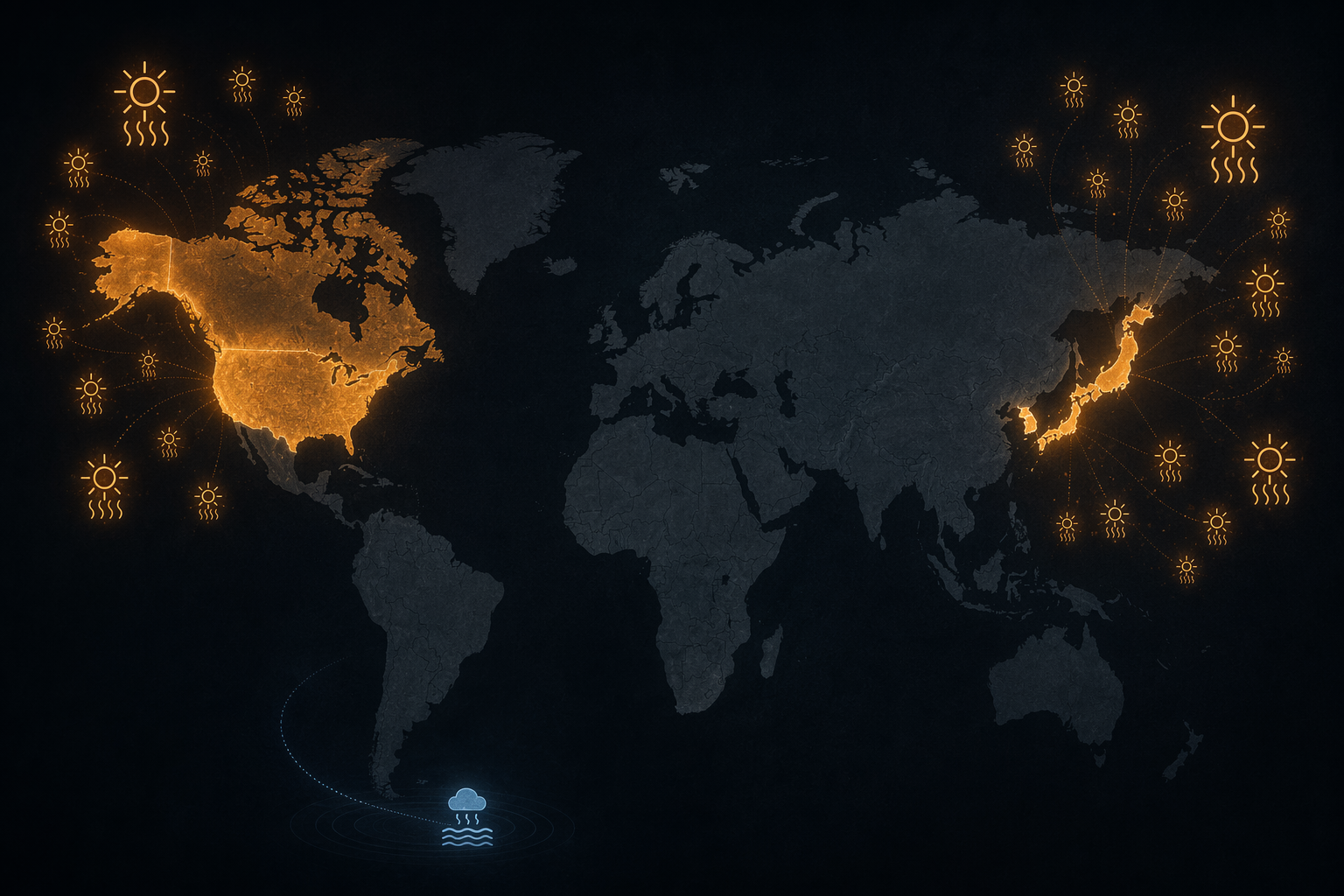
The geographic skew is just as important. The 2025 heat-health review found studies concentrated in Japan, Canada, South Korea, and the United States.[2] That means much of the available evidence comes from settings with relatively strong health data infrastructure, weather monitoring, emergency response systems, and research capacity. Those are useful settings for model development, but they are not interchangeable with the places where climate-sensitive health burdens may be greatest and health-system buffers may be thinnest.
This is not a cosmetic equity concern. A model trained and validated in a high-income urban system may learn relationships shaped by air conditioning prevalence, housing quality, baseline disease coding, emergency department access, ambulance availability, occupational exposure, medication access, and local warning systems. Transporting that model to a low-resource setting without recalibration would not simply perform less well; it could misidentify who is at risk and when action is needed.
Why the weather-to-health bridge is technically hard
A severe weather health-risk model has to do more than ingest meteorology. It has to connect an external hazard to a biologic and system-level consequence. That usually means combining environmental exposure data, location, demographic vulnerability, baseline disease burden, health care utilization patterns, and sometimes EHR-derived clinical features. The output must also be expressed at a scale someone can use: a patient list, a neighborhood alert, an ED volume forecast, an ambulance deployment signal, or a public health outreach priority.
A 2026 Innovation perspective describes the kind of architecture the field is moving toward: heterogeneous data fusion, lag-structured exposure-response modeling, and uncertainty propagation to link extreme weather forecasting with health impact prediction.[3] That is a useful conceptual map, but it is not evidence that such systems have been validated or deployed. Its value is in clarifying why this problem is different from a conventional weather forecast.
The lag problem is especially easy to underestimate. Some health effects appear during the same day as exposure; others rise after a delay. Heat may worsen renal, cardiovascular, respiratory, or medication-related risk on different timelines. Flooding may affect injury, infection, displacement, medication continuity, and behavioral health through different pathways. A model that treats the weather event and the health event as occurring in a simple same-day relationship will miss part of the clinical signal.
Uncertainty also has to travel through the pipeline. A weather forecast has uncertainty. Exposure assignment has uncertainty. EHR data have missingness and coding variation. Population vulnerability indices can be stale or too coarse. Health utilization is affected by access, not only illness. If a model collapses those uncertainties into a single risk score without showing confidence, local calibration, or failure modes, the person receiving the alert is left to guess how much operational weight it deserves.
For a hospital, that distinction is not academic. A same-day pediatric respiratory surge forecast might affect staffing and bed management. A patient-specific heat alert might trigger outreach, medication counseling, cooling-center referral, or remote monitoring. A city-level heat-mortality forecast might change ambulance positioning or neighborhood messaging. These are different thresholds, different accountable actors, and different consequences if the alert is wrong.
Emerging technical work is promising, but still early
One example of the technical direction is a 2026 medRxiv preprint by Tegenaw and colleagues on climate-informed deep learning for spatio-temporal forecasting of climate-sensitive diseases. The paper describes a two-stage pipeline: Transformer models forecast climate variables, and XGBoost hurdle models address zero-inflated disease incidence for malaria and dysentery in Ethiopia using 2010–2022 data.[4]
The reported model comparisons are interesting but should be kept in proportion. In the preprint, Transformer models had statistically significant wins in 25% of 72 experiments, compared with 12.5% for LSTM and 6.9% for TCN.[4] That may help method developers think about architectures for climate-sensitive disease forecasting. It does not make the work a clinical decision support tool, and the preprint status means it had not yet gone through peer review at the time described in the source.
The Ethiopia focus is notable because the broader reviewed heat-health machine learning literature is concentrated in high-income countries.[2] Still, one technical preprint cannot solve the field’s representativeness problem. It does point toward a necessary expansion: models need to be built and tested where climate-sensitive disease burdens, data constraints, and public health operations differ from the settings that dominate current publications.
Operational examples show the direction, not clinical readiness
Several projects show how AI weather-health forecasting might eventually enter care delivery or public health operations. They are worth watching because they focus on the handoff from prediction to action. They should not be mistaken for evidence that the field has already reached routine deployment.
Mass General Brigham and IBM have described an AI tool that uses EHR data such as age, comorbidities, medications, and location to identify patients at risk during extreme heat and generate personalized mitigation alerts, with testing planned for summer 2026.[5][6] The clinically relevant premise is clear: a heat alert becomes more useful if it can identify which patients may need counseling, outreach, or practical support. The missing evidence, at least in the available public material, is performance, safety, clinician workflow impact, and patient outcome data.
At Boston Children’s Hospital, John Brownstein’s group has been described as using machine learning with environmental and infectious disease data to predict pediatric respiratory emergency visits and admissions and forecast capacity needs “to the day.”[7] That is closer to an operational health-system question than a general weather forecast: who will need beds, staff, and respiratory care capacity, and when?
The HE2AT Center in Africa is another important directional example, using IBM geospatial foundation models with health outcome and socioeconomic vulnerability data to support localized heat alerts.[8] Its relevance is partly technical and partly geographic. If the field remains anchored only in high-income health systems, it will be least developed in many of the settings where climate-health warning systems are most needed.
EXTREMA Global, associated with the National Observatory of Athens, has been described as a machine-learning-powered digital twin that predicts heat-related mortality in real time and helps guide ambulance deployment, with expansion planned to Prague and Budapest.[7] That example makes the operational endpoint concrete: the model is not just estimating danger; it is meant to influence where scarce emergency resources wait.
| Example | Health-risk use case | Status that can be supported from available sources |
|---|---|---|
| Mass General Brigham + IBM | Patient-specific extreme heat risk identification and mitigation alerts | Development/testing example; testing planned for summer 2026, with no public clinical outcome evidence in the cited material |
| Boston Children’s Hospital / John Brownstein group | Pediatric respiratory ED visit and admission forecasting | Operationally oriented ML platform described in institutional reporting, not evidence of broad deployment or regulatory clearance |
| HE2AT Center | Localized heat alerts using geospatial, health outcome, and vulnerability data in African settings | Platform and research-infrastructure example addressing an underrepresented geography |
| EXTREMA Global | Real-time heat-mortality prediction to support ambulance deployment | Operational planning example with reported expansion plans |
Better AI weather models do not automatically answer the clinical question
The broader AI-in-weather literature is moving quickly. Reviews have described expanding use of AI for modeling and understanding extreme weather and climate events, and for prediction and response across extreme weather topics.[9][10] That context matters because weather forecasting is one input into health-risk forecasting.
But the clinical question is narrower. A health system does not only need to know whether tomorrow will be dangerously hot. It needs to know whether a specific panel of older adults taking diuretics needs outreach, whether a neighborhood with low cooling access needs targeted public health messaging, whether the ED should expect a respiratory surge, or whether ambulance staging should shift before calls rise. Those outputs require health data, local vulnerability data, validation against health outcomes, and a workflow that assigns responsibility for action.
That is where many AI claims become too loose. “Could identify vulnerable patients” is a reasonable development hypothesis. “Can prevent harm” requires a much higher standard: external validation, prospective testing, monitoring for bias and false reassurance, integration into clinical or public health workflow, and evidence that someone acted on the signal in time to change an outcome.
What would make the evidence clinically stronger
The current literature is not weak because machine learning is inherently unsuitable for this problem. It is weak because the hardest parts of the problem have not yet been solved at scale.
- Outcome specificity: models need to predict health outcomes or operational health-system demand, not only weather variables.
- External validation: performance needs to be tested outside the development site, climate zone, health system, or country.
- Event diversity: heat is only one severe weather hazard; floods, wildfire smoke, hurricanes, and compound events need stronger evidence.
- Population diversity: models should include settings with different housing, occupational exposure, access to care, public health infrastructure, and baseline disease burden.
- Uncertainty handling: forecasts should communicate confidence and limits in a way that supports operational decisions.
- Workflow testing: an alert has to reach a person or team that can change staffing, outreach, counseling, resource positioning, or public messaging.
- Regulatory and governance clarity: patient-specific decision support, public health surveillance, and emergency operations tools may face different oversight requirements.
The workflow point is often the least glamorous and the most decisive. A neighborhood-level alert that arrives after outreach staff have gone home is not equivalent to one that triggers same-day door-to-door checks, cooling-center transportation, pharmacy counseling, or ambulance redeployment. A patient-specific risk list that is not reconciled with clinician workload may become another inbox burden. A mortality forecast without an emergency operations playbook may be accurate and still unused.
Status as of Q3 2026
As of Q3 2026, AI-based severe weather health risk forecasting is best classified as an important early-stage research and pilot domain. The use case is real. The clinical and public health need is not speculative. Heatwaves, floods, smoke, and other severe weather events already stress emergency departments, public health teams, and vulnerable patients. The question is whether AI systems have been validated well enough, across enough populations and hazards, to guide care or preparedness as dependable infrastructure.
The answer remains no. The strongest review evidence shows a very small validated study base, dominated by heat and concentrated in high-income countries.[1][2] The conceptual frameworks are maturing, and the operational examples are becoming more concrete, but the available evidence does not identify any AI weather-health prediction tool with regulatory clearance or broad clinical deployment. The frontier is visible; it is not yet practice-ready.
References
- Use of machine learning tools to predict health risks from climate-sensitive extreme weather events: A scoping review. PLOS Climate. January 2024.
- Machine learning for modelling the health impacts of extreme heat: A comprehensive literature review. Environment International. 2025.
- Artificial intelligence for linking extreme weather forecasting and health impact prediction. Innovation. April 2026.
- Climate-Informed Deep Learning for Spatio-Temporal Forecasting of Climate-Sensitive Diseases. medRxiv. 2026.
- Mass General Brigham AI extreme heat. WBUR. July 2025.
- AI battle extreme heat. IBM.
- Machine learning can predict weather and human health. Harvard Medicine Magazine. October 2024.
- HE2AT Center. DSI Africa.
- Artificial intelligence for modeling and understanding extreme weather and climate events. Nature Communications. 2025.
- AI in extreme weather events prediction and response: a systematic topic-model review (2015–2024). Frontiers in Environmental Science. 2025.
Comments
Join the discussion with an anonymous comment.