
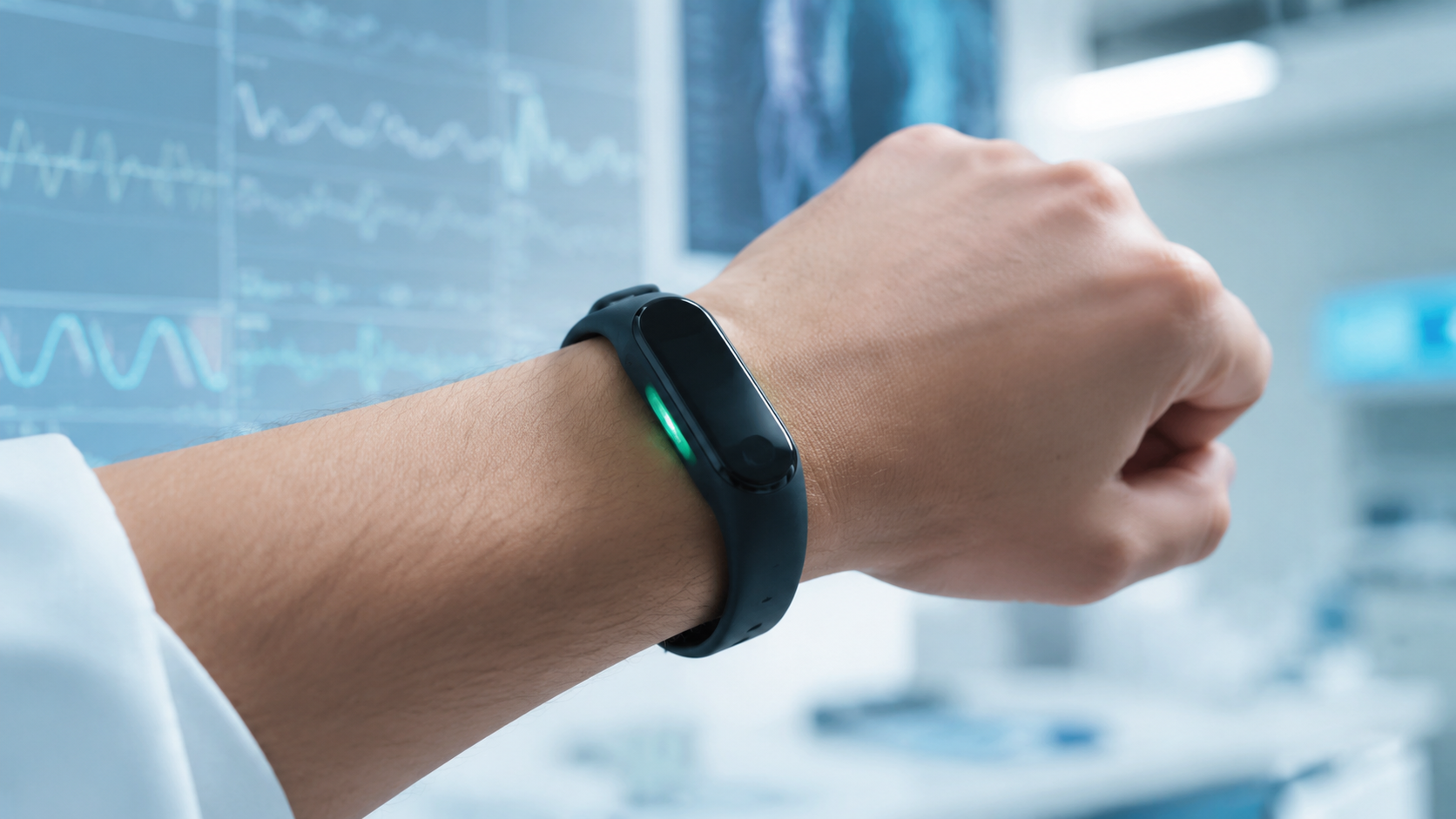
AI-powered smart bands for health tracking are already producing data that patients bring into clinic, but the useful question is narrower than the marketing copy: which signals survive the trip from wrist sensor to clinical action. The evidence is strong for a few narrow tasks, encouraging but still preliminary for prediction use cases, and plainly weak for cuffless blood pressure. The important distinction is not whether a device has AI in it; it is whether independent validation exists for the exact device, population, and intended use.
Where the evidence actually sits
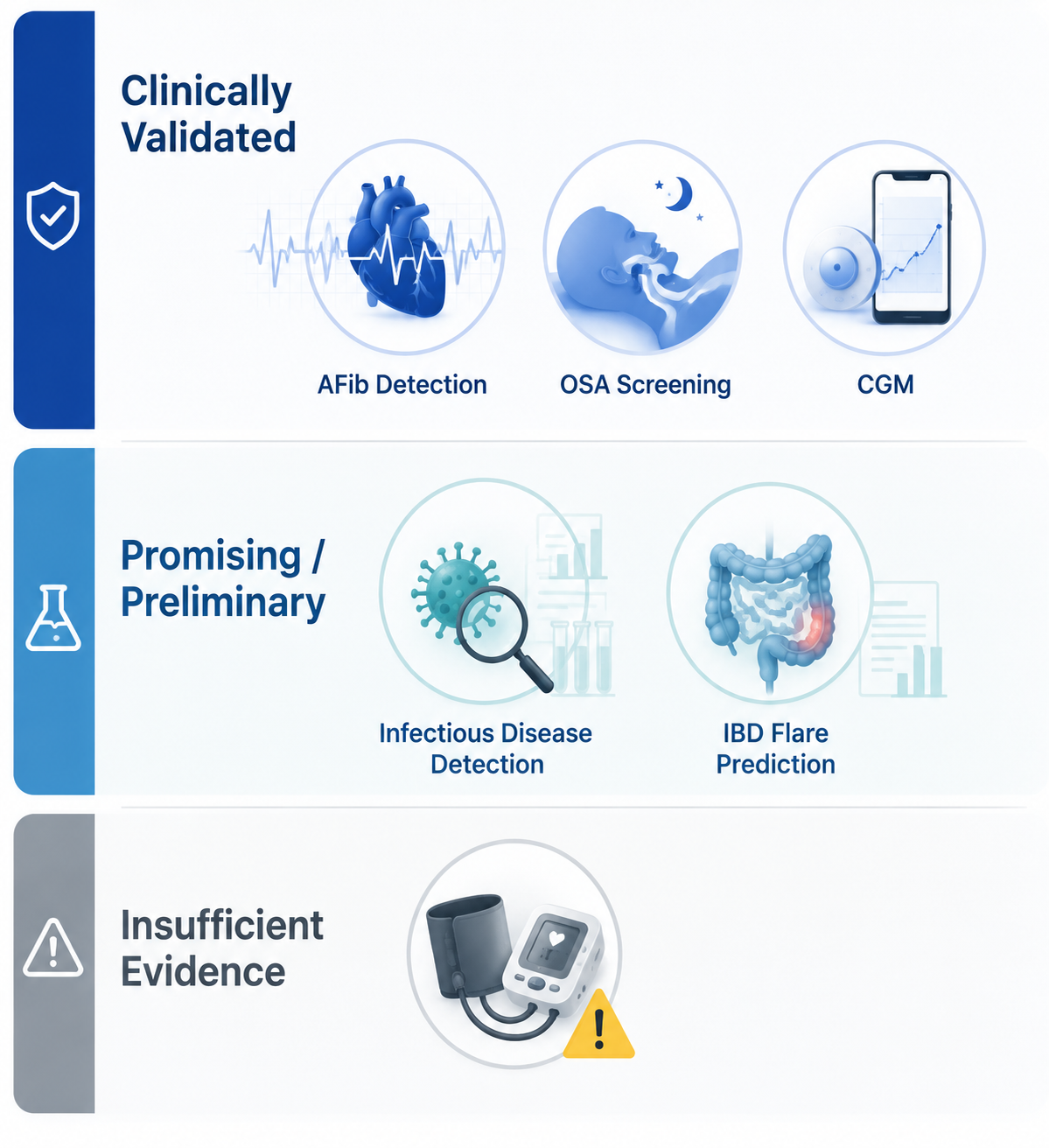
- Clinically validated: AFib detection has the clearest evidence, with a systematic review of 11 studies and 4,241 participants reporting pooled 94.8% sensitivity and 95% specificity for Apple Watch ECG [1]. Moderate-to-severe OSA screening also reaches clinically meaningful performance, with AI-enhanced algorithms at 92.3% sensitivity and 92.6% specificity, although mild disease is systematically underestimated [2]. Regulated CGM-class monitoring is the most mature adjacent category, with Dexcom G7 MARD at 8.0%, FreeStyle Libre 3, Eversense 365, and iCGM clearance supporting non-adjunctive insulin dosing [3][4].
- Promising but preliminary: wearable signals have detected IBD flares up to 7 weeks before symptoms, and one COVID study reported 63% to 88% pre-symptomatic detection from resting heart rate changes across 5,262 participants, with 0.66 false alarms per month [5][6]. Those results justify attention, not routine dependence.
- Insufficient: cuffless blood pressure remains the clearest evidence-to-claim gap. In Samsung Galaxy Watch Active 2 testing, the bias pattern overestimated low blood pressures and underestimated high ones, which is the wrong direction for clinical decision-making [7].
AFib detection is the clearest clinical win
Among AI-powered smart bands for health tracking, AFib is the use case that most clearly behaves like a screening tool rather than a wellness guess. The meta-analytic numbers matter because they come from a defined clinical problem with an actionable next step: when a wearable flags an irregular rhythm, the response is confirmatory ECG review or ambulatory monitoring, not blind trust in the wrist device itself [1].
That is also why the form factor caveat matters. The strongest evidence sits in smartwatch-based ECG workflows, not in every band that claims rhythm intelligence. A clinician can take that seriously without overgeneralizing it to every device on a pharmacy shelf. The validated signal is narrow, but it is real.
OSA screening helps most when the question is severity
Sleep-disordered breathing is another area where a wrist-worn signal can do useful triage work, as long as its boundaries are respected. The reported 92.3% sensitivity and 92.6% specificity for moderate-to-severe OSA are clinically meaningful because they identify the disease level most likely to matter for downstream testing and treatment [2].
The same result becomes less impressive once the goal shifts to ruling out all OSA. The systematic underestimation of mild disease is exactly the sort of detail that gets lost in product demos and matters a great deal in practice. A device that sees the severe end reasonably well can help prioritize patients; it does not replace polysomnography, and it does not make a normal reading equivalent to absence of disease.
CGM is the most mature neighboring category
Continuous glucose monitoring is not always what people mean by a smart band, but it is the clearest example of wearable sensing that has crossed into regulated clinical use. Dexcom G7 at 8.0% MARD, FreeStyle Libre 3, and Eversense 365 show what mature monitoring looks like when accuracy, labeling, and workflow all line up [3].
The clinically important step is not the presence of a trend graph. It is iCGM status, which supports non-adjunctive insulin dosing under defined conditions [4]. That is a much higher bar than a dashboard that helps someone feel more informed. It also highlights why the evidence cannot simply be copied from CGM to a wrist band: glucose sensing has already been through a regulatory and clinical gauntlet that most general wellness wearables have not.
Promising signals are not the same as validated monitoring
The attractive part of the field is that passive sensing can sometimes find physiologic change before the patient can describe it. In one IBD study, wearable heart rate variability, heart rate, steps, and SpO2 patterns detected flares up to 7 weeks before clinical symptoms [5]. That is a meaningful signal, but it is still a single-study result. It suggests lead time; it does not yet prove a durable care pathway.
The same caution applies to pre-symptomatic COVID detection. A study of 5,262 participants reported 63% to 88% detection from resting heart rate changes and 0.66 false alarms per month [6]. That is interesting enough to keep watching, and structured enough to deserve replication. It is not yet the kind of evidence that should be treated as routine surveillance in clinical care.
Blood pressure remains the clearest evidence gap
Cuffless blood pressure is the case where the marketing language runs far ahead of the data. The Samsung Galaxy Watch Active 2 showed a systematic bias pattern that overestimated lower pressures and underestimated higher ones [7]. That is not a small calibration nuisance. It means the device can push readings toward the middle and miss the extremes clinicians care about most.
For hypertension management, that direction of error is difficult to defend. A device can be incomplete and still useful if the failure mode is obvious; a device that is consistently wrong across the pressure range is far harder to trust. Until accuracy is externally demonstrated in the intended use setting, cuffless BP belongs in the research bucket, not the clinical one.
The adoption pressure is real, but so are governance problems
The category is impossible to ignore. A 2025 analysis found transparency issues in 76% of 17 wearable manufacturers' data practices, and consumer wearable data do not automatically receive HIPAA protection [8]. A separate 2026 market report estimated a $70.3 billion wearable AI market, 614 million units shipped, and AI functions in 40% of new devices [9]. None of that proves clinical readiness; it does explain why clinicians are seeing more of these data in patient conversations whether they asked for them or not.
The governance issue is not abstract. When a device claim sits inside consumer wellness language, the user may assume the data are clinically interpretable, durable, and protected in ways they are not. That is where workflow friction starts: someone has to decide whether to ignore the alert, verify it, or act on it.
A practical way to judge a wearable signal
- Check the intended use first. A screening claim, a monitoring claim, and a wellness claim are not interchangeable.
- Ask whether the evidence comes from the same device and form factor. A smartwatch result does not automatically transfer to a smart band with different sensors, fit, or battery strategy.
- Separate detection from diagnosis. A good flag still needs a clinical confirmation path.
- Look for external validation and a stated failure mode. If you cannot tell where the signal breaks, you cannot tell when to trust it.
Clinical use in Q3 2026 is narrower than the marketing suggests
The defensible position now is straightforward. AFib detection, moderate-to-severe OSA screening, and regulated CGM-class monitoring can be taken seriously when they are tied to the validated device and the intended use. Predictive applications such as IBD flare and pre-symptomatic infection detection are worth watching as research signals. Cuffless blood pressure, and any broad promise of generalized health prediction, are still too uneven to treat as clinically dependable.
References
- Systematic review and meta-analysis of Apple Watch ECG for atrial fibrillation detection — Nature Digital Medicine.
- AI-enhanced wearable screening for obstructive sleep apnea — Nature Digital Medicine.
- Continuous glucose monitoring accuracy review covering Dexcom G7, FreeStyle Libre 3, and Eversense 365 — AEI report.
- Integrated continuous glucose monitor database and non-adjunctive dosing clearance information — U.S. Food and Drug Administration.
- Wearable biomarkers for early detection of inflammatory bowel disease flares — study report.
- Wearable resting heart rate changes for pre-symptomatic COVID-19 detection — study report.
- Systematic evaluation of cuffless blood pressure estimation with Samsung Galaxy Watch Active 2 — Nature Digital Medicine.
- 2025 wearable data transparency analysis — Sahha.
- 2026 wearable AI market report — Sahha.
Comments
Join the discussion with an anonymous comment.