
AQI can be accurate and still miss the window
When smoke alerts land at the same time as the smoke itself, the operational work has already shifted from anticipation to triage. That is why same-day AQI guidance can be too blunt to drive clinical action; one JAMA Network Open analysis found that following AQI guidance on sensitive-group days would require more than 5 million ASCVD patients to restrict activity to prevent one event [1]. The problem for health systems is not whether the alert is real. It is that the alert arrives after the staffing decisions, outreach lists, and resource checks should already be in motion.

Ten days is the first horizon that can change a roster
The APL/NOAA deep-learning emulator is the clearest example of a forecast window that lines up with real hospital work. It produces 10-day PM2.5 forecasts from about 21 hours of input data, compressing a months-long computational process into something planners can use before the week is over [2]. That difference matters because ten days is enough time to move call schedules, pre-position respiratory supplies, prepare high-risk patient outreach, and decide whether a respiratory surge plan needs to be activated.
| Forecast horizon | What health systems can use it for | What it should not be sold as |
|---|---|---|
| Same-day AQI | Reactive messaging and emergency department awareness after smoke is already present | A staffing or outreach planning tool |
| 10-day PM2.5 forecast | Staffing changes, high-risk patient outreach, inhaler and access checks, respiratory surge preparation, and resource allocation [2] | A guarantee of who will need care |
| 35–45 day emissions outlook | Regional public health coordination, readiness planning, and broader messaging [3] | A bedside or shift-level clinical signal |
Longer horizons shift from bedside work to coordination
The CIRES/NOAA/George Mason system belongs in a different operational lane. By combining seven global fire emission inventories, it forecasts wildfire emissions 35–45 days ahead and distinguishes average from extreme fire seasons [3]. That kind of lead time is useful when the decision is regional coordination: public health messaging, mutual aid, community readiness, and shelter planning. It is not a substitute for next-shift staffing, and it should not be described as one.
Wildfire smoke carries more clinical weight than generic PM2.5
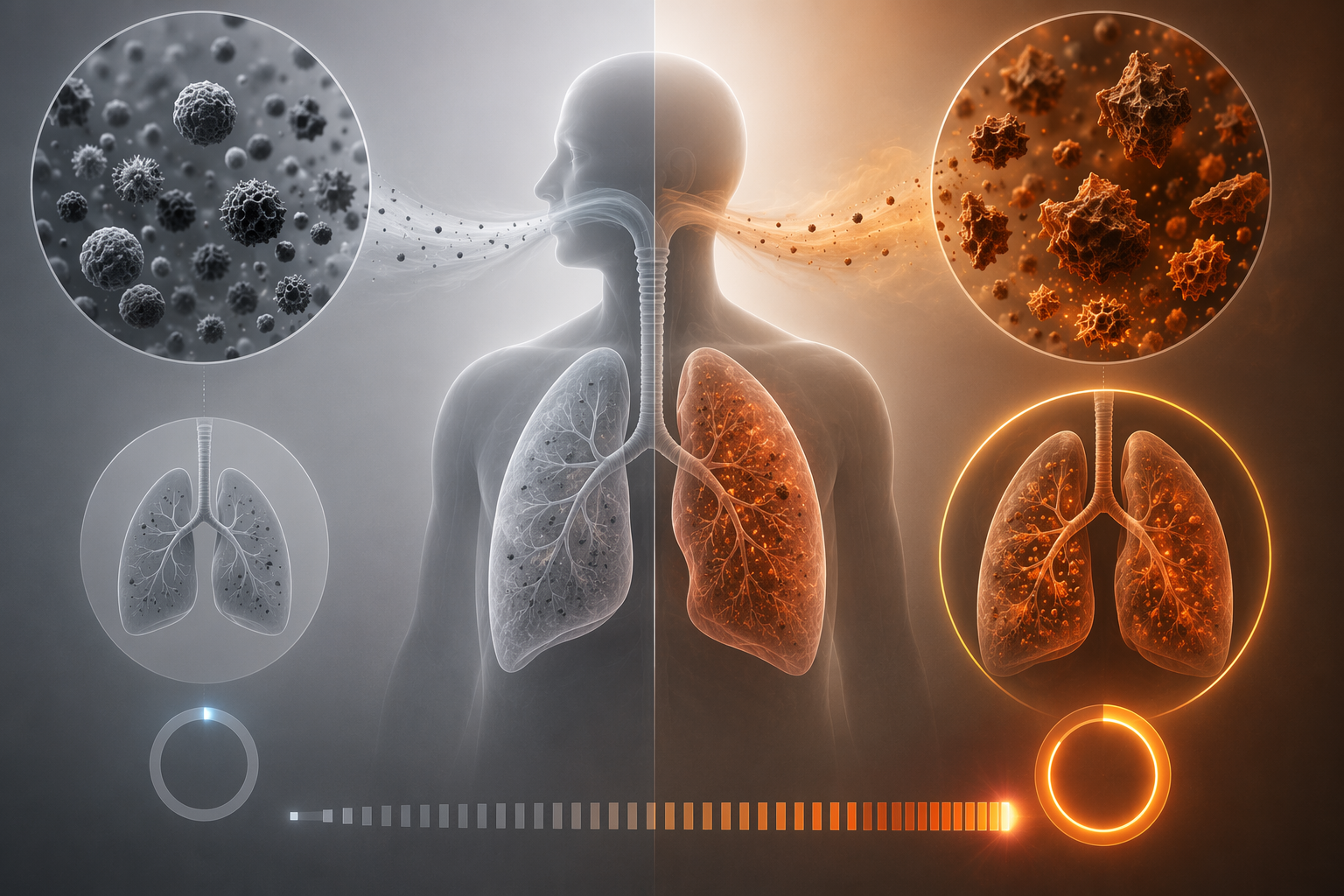
The reason forecast horizon matters so much is that wildfire smoke appears to have a stronger respiratory signal than PM2.5 in general. In Aguilera et al., wildfire-specific PM2.5 was associated with up to a 10% increase in respiratory hospital admissions per 10 µg/m³, roughly 10 times the estimated effect of non-wildfire PM2.5; the study was based in Southern California, so the magnitude may not transfer unchanged to every region [4].
The research signal is growing, but implementation is still local
A refined Penn State deep-learning model evaluated during the June 2023 Canadian wildfire smoke events reported a 0.160 µg/m³ prediction error versus -6.872 µg/m³ for the baseline model, and the study framed that gain as a way to identify areas for public health intervention [5]. NOAA’s Climate Program Office has also highlighted an AI modeling study on heightened health risks due to wildfire pollutants, which shows that smoke forecasting and health linkage are becoming a real research agenda rather than a one-off claim [6].
None of that removes the implementation burden. The APL/NOAA and CIRES/NOAA/George Mason examples are institutional announcements rather than completed peer-reviewed clinical validations, and the Penn State result is research rather than an operational forecasting product. These systems are atmospheric science and epidemiology tools, not FDA-regulated medical devices, and their usefulness depends on local IT infrastructure, data pipelines, dashboard rules, and who owns the workflow when a forecast threshold is crossed. AI for wildfire smoke health forecasting becomes clinically valuable only when each horizon is tied to a specific decision, the health system can actually act on that decision, and model performance is treated as one ingredient rather than the endpoint.
References
- AQI guidelines and ASCVD activity restriction analysis — JAMA Network Open
- Using Artificial Intelligence, Better Pollution Predictions Are in the Air — Johns Hopkins Applied Physics Laboratory / NOAA
- Artificial intelligence takes on wildfire emissions: A new frontier in forecasting — CIRES / NOAA / George Mason University
- Wildfire smoke impacts respiratory health more than fine particles from other sources — Nature Communications, 2021
- Improved wildfire smoke model identifies areas for public health intervention — ScienceDaily, 2024
- Heightened Health Risks Due to Wildfire Pollutants: Results from an AI Modeling Study — NOAA Climate Program Office
Comments
Join the discussion with an anonymous comment.