
The difficult part of AI in Social Security disability claims processing is not that a federal agency wants software to move cases faster. The difficult part is that disability adjudication depends on clinical evidence that arrives as operative reports, consultative exams, imaging summaries, medication histories, lab values, progress notes, and sometimes thin or fragmented documentation. A disability examiner may need to find the decisive medical fact inside hundreds or thousands of pages. A claimant may be waiting because a longitudinal history is vague, a key specialist note is missing, or an impairment is severe but poorly translated into the language of eligibility.
That is the clinical evidence bottleneck SSA is trying to change. The agency processes more than 2 million disability claims annually, and reporting on its modernization work notes that about 60% of initial disability claims are denied, often in a documentation environment where medical evidence is incomplete or hard to assemble.[1] In that setting, AI is not a single robot deciding benefits. It is a set of tools that help locate, structure, prioritize, and review medical evidence before or around human adjudication.

SSA’s public AI inventory names several disability-related AI and machine-learning systems, including IMAGEN, QDD, CAL, Insight, HeaRT, and Pre-Effectuation Review.[2] Four matter most for medical evidence review in initial disability processing: IMAGEN structures clinical records, QDD predicts which claims are likely to qualify quickly, CAL routes certain severe conditions into expedited processing, and Insight supports quality review.
| System | Main function | Clinical evidence role |
|---|---|---|
| IMAGEN | Natural language processing and analytics | Extracts and displays structured clinical information from unstructured medical records |
| QDD | Predictive modeling | Flags initial claims likely to receive a favorable determination quickly |
| CAL | Condition-based fast tracking | Identifies claims tied to listed severe conditions that meet SSA criteria |
| Insight | Machine-learning quality review | Helps review disability determinations for consistency and potential errors |
The Record Has To Become Usable Before It Can Become Faster
IMAGEN is the part of SSA’s AI work that most directly resembles clinical natural language processing. The ACT-IAC case study describes it as using natural language processing, data modeling, and predictive analytics to extract structured information such as diagnoses, laboratory results, and treatment patterns from unstructured medical records, then visualize those findings for adjudicators.[3] In practical terms, the promise is not that IMAGEN understands a claimant the way a treating clinician does. The promise is that it can make a sprawling chart less opaque to the person responsible for deciding whether the evidence meets disability criteria.
That distinction matters. A clinical record is not a clean database waiting to be queried. It may contain repeated problem lists, copied-forward medication histories, contradictory functional descriptions, scanned forms, older imaging reports, and notes written for billing or care coordination rather than disability adjudication. NLP can reduce the time spent hunting for facts, but it can also make weak documentation look more orderly than it deserves. The public sources describe IMAGEN’s purpose and technical approach; they do not provide a quantified public accuracy study for handwritten notes, ambiguous narratives, unusual disease presentations, or the kinds of mixed evidence that often make disability files hard.
SSA’s modernization investment confirms that IMAGEN is not merely a concept. The Technology Modernization Fund recorded a $1.98 million investment in October 2024 to enhance the National Case Processing System and IMAGEN, with the stated goal of improving the timeliness and accuracy of disability decisions.[4] That is useful evidence of active deployment and institutional priority. It is not, by itself, evidence that IMAGEN reliably extracts the clinically decisive elements from difficult records.
QDD Is Where The Public Performance Evidence Is Strongest
Quick Disability Determinations, or QDD, is the SSA system with the clearest public performance record. QDD uses a predictive model to identify initial disability claims that are likely to receive a favorable determination and can be processed quickly. In SSA’s research note covering fiscal years 2015 through 2020, the model identified about 1.5 million claims, representing 6.3% to 7.4% of initial claims depending on the year.[5]
That identification rate is important because it keeps the system’s claims in proportion. QDD is not sorting most disability applicants into an expedited lane. It is pulling a minority of cases out of the ordinary process because the available information suggests a high probability of allowance and severe impairment. Roughly speaking, most claims still remain in standard processing, with all the usual dependence on medical records, examiner review, consultative evidence, and documentation quality.
The operational difference is large. SSA reported that QDD allowances were processed in a median of 13 to 14 days during fiscal years 2015 through 2020, compared with 83 to 100 days for non-QDD allowances.[5] For a claimant with an advanced malignancy, a devastating neurologic condition, or another clearly severe impairment, that difference is not an abstract efficiency gain. It can mean benefits arrive while the medical and financial consequences are still unfolding, rather than after months of avoidable waiting.
The most clinically interesting part of SSA’s QDD research is its mortality comparison. Among adults allowed through QDD, 32.1% died within one year of award, compared with 4.5% of adults allowed outside QDD.[5] Mortality is a blunt outcome, but in this context it is not trivial. A fast-track model that disproportionately identifies people with very high near-term mortality is probably not just finding administratively convenient files. It is capturing many claims involving severe medical illness.
The comparison also has to be read carefully. One-year mortality among allowed adults is an indirect validation signal, not a complete accuracy study. It does not tell us how many medically severe claimants QDD failed to flag. It does not establish that the model works equally well across race, ethnicity, language, geography, income, or healthcare access patterns. It does not distinguish model performance from downstream examiner behavior once a case has been labeled QDD. And because the analysis comes from SSA’s own retrospective administrative data, it is not the same as independent external validation.
Still, the mortality result should not be dismissed. In clinical informatics, many deployed models never offer even this kind of outcome-linked public evidence. QDD’s public record supports a narrow but meaningful conclusion: SSA has evidence that its fast-track predictive model identifies a small subset of initial claims that are allowed much faster and that include a substantially higher proportion of adults who die within one year of award.
CAL Uses A Different Logic: The Diagnosis Has To Fit The List
Compassionate Allowances, or CAL, is sometimes grouped with AI-enabled fast tracking, but its logic is different from QDD. CAL is condition-based. It identifies claims involving diseases and conditions that, by SSA’s criteria, are severe enough to warrant expedited processing when the medical evidence supports the listing. SSA announced in August 2025 that CAL had expanded to 300 conditions, with 13 conditions added in that update, and that the program had helped approve more than 1.1 million people since inception.[6]
CAL is clinically appealing because it gives certain diagnoses a more direct route through the system. It also has obvious boundaries. A claimant benefits from CAL only if the condition is included and the evidence supports the severity threshold. People with disabling combinations of common conditions, poorly documented rare presentations, or functional impairment that does not map neatly onto a CAL condition still need the ordinary evidence review process. That is not a defect in CAL so much as a reminder that a diagnosis list cannot carry the full burden of disability adjudication.
How The Four Systems Fit Into One Evidence Workflow
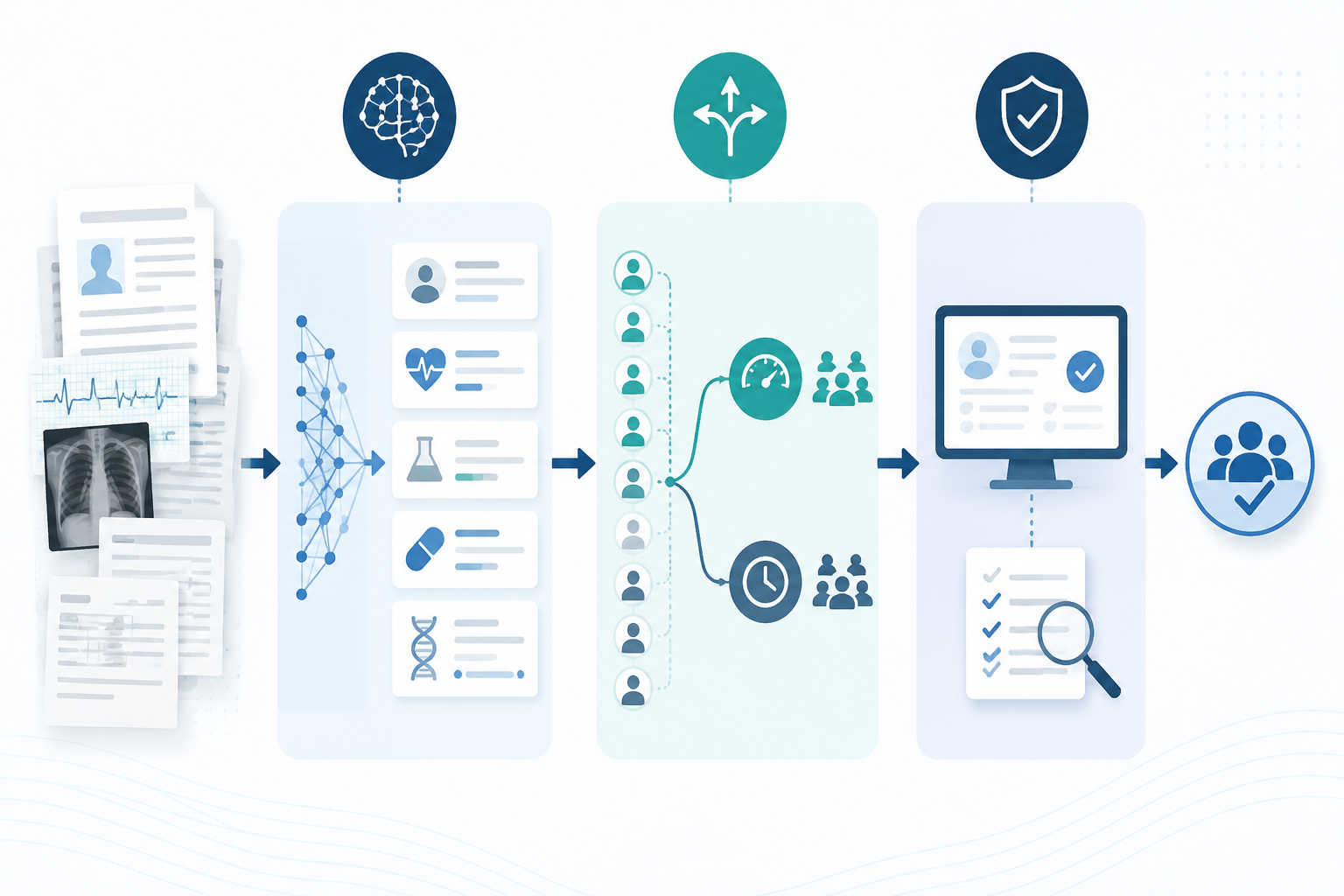
The systems make more sense when viewed as a workflow rather than as separate AI products. A claimant submits an application and medical evidence arrives from clinicians, hospitals, imaging centers, and other sources. IMAGEN helps turn unstructured medical records into structured, visible evidence elements. QDD evaluates whether an initial claim appears likely to be allowed quickly. CAL provides a separate expedited pathway when a severe listed condition is present. Insight then supports quality review of determinations through machine-learning methods listed in SSA’s AI inventory.[2]
In that sequence, AI is acting at several different points of pressure. It reduces search burden, changes queue priority, creates condition-based acceleration, and checks aspects of decision quality. Those are not interchangeable tasks. A system that extracts a lab value from a note is doing something different from a system that predicts likely allowance, and both are different from a system that reviews adjudicative quality. Lumping them together under a single claim that “SSA uses AI” obscures the specific risks that need to be measured.
For healthcare professionals, the workflow framing also makes the documentation stakes clearer. The clinician is rarely writing for IMAGEN, QDD, CAL, or Insight directly. The clinician is documenting care. But those notes may become the substrate for extraction, prioritization, and review. If the record buries functional limitations under repeated boilerplate, omits treatment response, or leaves the duration of impairment ambiguous, an AI-assisted workflow may not rescue the claim from weak evidence. It may simply process the weak evidence more efficiently.
Speed Is A Benefit Only If The Right Cases Move
The strongest humane argument for SSA’s AI systems is waiting time. QDD’s median processing-time difference shows that some severe cases are being moved far faster than comparable allowed claims outside the QDD lane.[5] CAL’s reported reach also shows that condition-based acceleration has affected a large number of people over time.[6] In a benefits program where delay can compound medical, housing, and caregiving instability, faster recognition of clearly severe disability has real value.
But speed has to be assigned, and assignment is where accountability lives. If QDD flags about 7% of initial claims, the question is not only whether those claims move faster. It is also what happens to severe claims outside that 7%, especially claims from people whose records are sparse because they had inconsistent access to specialty care, fragmented treatment, or less complete documentation. A predictive model trained on administrative patterns may perform well overall while still missing groups whose medical evidence looks different from the historical cases it learned from.
The public evidence does not resolve that concern. The QDD research note provides strong descriptive statistics on identification, processing time, allowance, and mortality, but it does not publish differential model performance by race, ethnicity, socioeconomic status, or other equity-relevant groupings.[5] Public materials identify no published independent validation study for IMAGEN, QDD, CAL, or Insight, and no public study that quantifies differential accuracy across disadvantaged populations.
The Adjacent Warning From Hearing Transcription
HeaRT, SSA’s hearing recording and transcription tool, sits outside the main medical-record review pathway, but it is a useful caution for healthcare readers. SSA announced in March 2025 that HeaRT was expected to save about $5 million per year and affect about 500,000 annual beneficiaries. In the same announcement, Professor Daniel Ho, associated with the National AI Advisory Committee, warned that transcription systems can hallucinate and insert words that were never spoken.[7]
That warning will sound familiar to anyone following ambient clinical documentation. Transcription errors are not merely typographic when the transcript becomes part of an administrative or legal record. The relevance to IMAGEN and related tools is not that all SSA AI systems hallucinate; the public materials do not show that. The relevance is that AI-generated or AI-structured artifacts need review mechanisms proportionate to their consequences. If an output changes what an examiner sees first, which cases move first, or how a determination is checked, error discovery cannot depend on a claimant noticing the problem months later.
Governance Is Not A Side Issue
External policy groups have begun to press on the governance layer. The National Academy of Social Insurance task force’s phase one report called for safeguards around SSA’s AI use, including meaningful human review, bias prevention, and adequate governance.[8] Those are ordinary-sounding requirements, but in disability adjudication they have concrete meaning: who can override a model signal, how overrides are recorded, how false negatives surface, and whether quality review examines cases the model did not prioritize.
The National Academies also scheduled an April 2026 workshop on “Artificial Intelligence and the Medical Record in the Context of Social Security Disability Evaluations,” which signals that the evidence base around AI and disability medical records is still being actively assembled rather than settled.[9] That is the right posture. These systems are already operational enough to matter, but the public validation record remains thinner than clinicians and informaticians would expect for tools that influence evidence review in a federal benefits program.
What Confidence Is Reasonable?
A reasonable reading of the public evidence gives SSA credit for task-specific AI rather than vague automation. IMAGEN addresses the record-review burden. QDD targets a small subset of likely allowances for expedited processing. CAL accelerates claims tied to specified severe conditions. Insight applies machine learning to quality review. These are bounded uses, and the QDD data show a substantial processing-time difference with an outcome signal that aligns with medical severity.[2][5]
The same evidence does not justify broad confidence that SSA’s AI systems are accurate across all difficult disability files. IMAGEN’s public accuracy on messy, handwritten, contradictory, or clinically unusual records is not quantified. QDD’s mortality comparison is meaningful but retrospective and internal to SSA. CAL’s expansion to 300 conditions improves reach but remains limited to listed conditions and severity criteria. Insight is officially listed, but public materials do not provide the kind of independent performance evaluation that would let outsiders judge how often it catches or misses adjudicative problems.[2][5][6]
For healthcare professionals, the practical implication is modest but important. SSA’s AI systems appear to improve speed and consistency in parts of disability evidence review, especially for severe cases flagged by QDD. The public record also leaves unresolved questions that matter clinically and ethically: independent validation, extraction accuracy on difficult records, false negatives among severe but poorly documented claims, and differential performance by race, ethnicity, and socioeconomic status. Until those gaps are filled, confidence should be specific to the task and proportional to the evidence.
References
- SSA Cuts Wait Times, Claims Backlog Through Tech Modernization, GovCIO Media.
- Artificial Intelligence at SSA, Social Security Administration.
- Intelligent Medical Language Analysis Generation IMAGEN, ACT-IAC.
- Timely and Accurate Decisions for Americans with a Disability Benefits Claim, Technology Modernization Fund, October 2024.
- Quick Disability Determination (QDD) Claims and Mortality, Social Security Administration Office of Research, Evaluation, and Statistics, 2022.
- Social Security Adds 13 New Compassionate Allowances Conditions, Social Security Administration, August 11, 2025.
- Social Security Launches Innovative Hearing Recording Technology, Social Security Administration, March 13, 2025.
- NASI Task Force Issues Report on AI at SSA, Empire Justice Center, April 2025.
- Artificial Intelligence and the Medical Record in the Context of Social Security Disability Evaluations, National Academies, April 2026.
Comments
Join the discussion with an anonymous comment.