
The useful question about AI in sports injury rehabilitation is not whether it works. It is where it works well enough to influence a clinical judgment, and where the output still looks more settled than the rehabilitation problem underneath it.
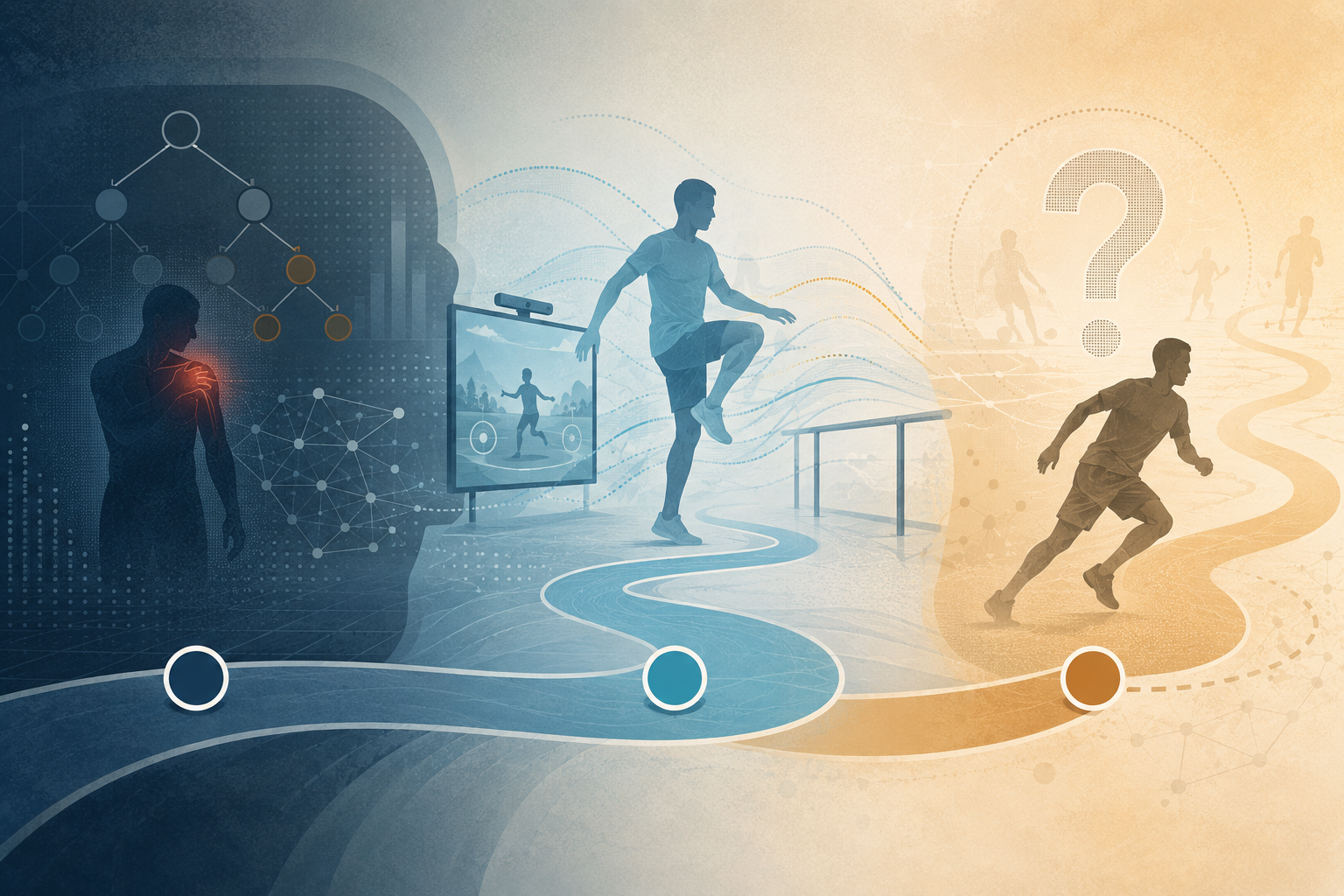
Across the current evidence, the answer is tiered. Injury risk prediction has the clearest comparative model signal, especially for tree-based methods. AI-assisted rehabilitation interventions show the strongest treatment-effect signal, particularly in broader musculoskeletal disorder populations. Return-to-sport prediction and wearable monitoring are more fragile: some models report impressive discrimination, but the targets, datasets, and real-world data streams are still uneven.
| Point in the continuum | Best-supported AI signal | Main clinical caveat |
|---|---|---|
| Injury risk prediction | Random Forest and XGBoost repeatedly rank among top-performing models, with reported AUC values from 0.70 to 0.96 across reviewed studies. | Logistic regression matched or outperformed machine learning in several direct comparisons, so newer models are not automatically better. |
| AI-assisted rehabilitation intervention | Therapeutic and gamified exergaming, and some rehabilitation robotics, rank strongly for pain, function, and range of motion in musculoskeletal disorder trials. | The evidence is not sports-injury-specific by default, and many studies have short follow-up windows. |
| Return-to-sport decision support | Some models achieve high AUC from early performance data. | Return-to-sport definitions vary, cohorts are small, and psychological readiness is often missing. |
| Wearable monitoring | Continuous multimodal sensing is technically feasible. | Device heterogeneity and compliance problems can degrade model performance in deployment. |
That distinction matters because rehabilitation is a chain of decisions, not a single prediction task. A model that helps estimate injury risk before or during a season is not doing the same job as an exergaming system that changes exercise exposure, or a return-to-sport model that may be interpreted as permission to progress. The evidence has to be read at the level of the decision it is being asked to support.
For readers tracking the prevention and diagnosis side of this field, this piece sits alongside the broader evidence on AI in sports injury diagnosis and prevention. Here, the center of gravity is recovery: what happens after risk is recognized, tissue is healing, movement is being rebuilt, and someone eventually asks whether the athlete is ready.
Risk Prediction Has the Cleanest Comparative Model Evidence
Injury risk prediction is the part of the continuum where machine learning has the most coherent comparative evidence. In a 2025 British Journal of Sports Medicine scoping review of 38 studies, tree-based models were the top-performing approach in 60% of studies, and Random Forest and XGBoost achieved AUC values ranging from 0.70 to 0.96 across included studies.[1]
That pattern is clinically plausible. Sports injury datasets often mix force-plate variables, workload histories, demographics, prior injury, training exposure, and biomechanical measures. Tree-based models can handle nonlinear splits and interactions without requiring the analyst to specify every relationship in advance. If an athlete’s risk changes only when several weak signals line up, a random forest or boosted tree may detect that pattern more readily than a simpler linear specification.

The same review also keeps the enthusiasm in check. In the subset of studies that directly compared machine learning methods with logistic regression, logistic regression outperformed machine learning in 4 of 12 comparisons.[1] That is not a footnote; it changes the interpretation. A model can be more complex and still be less useful if the dataset is small, the outcome is noisy, the predictors are weak, or the validation design rewards overfitting.
For a clinician, the practical lesson is not to prefer logistic regression or machine learning as a category. It is to ask what the model was compared against, how it was validated, and whether its output changes anything about surveillance, load management, exercise selection, or referral. A risk model with a higher AUC but no clear clinical action attached may be less valuable than a simpler model that reliably identifies a subgroup needing closer review.
This is where evidence appraisal becomes more important than model vocabulary. The relevant questions are the ones in a clinician-facing AI evaluation process: what population trained the model, what outcome was predicted, what comparator was used, and what happens when the model is wrong. A structured approach such as a clinical AI tool evaluation framework is especially useful here because injury risk prediction can sound precise while still leaving the treatment decision unresolved.
AI-Assisted Rehabilitation Shows Its Strongest Signal in Intervention Studies
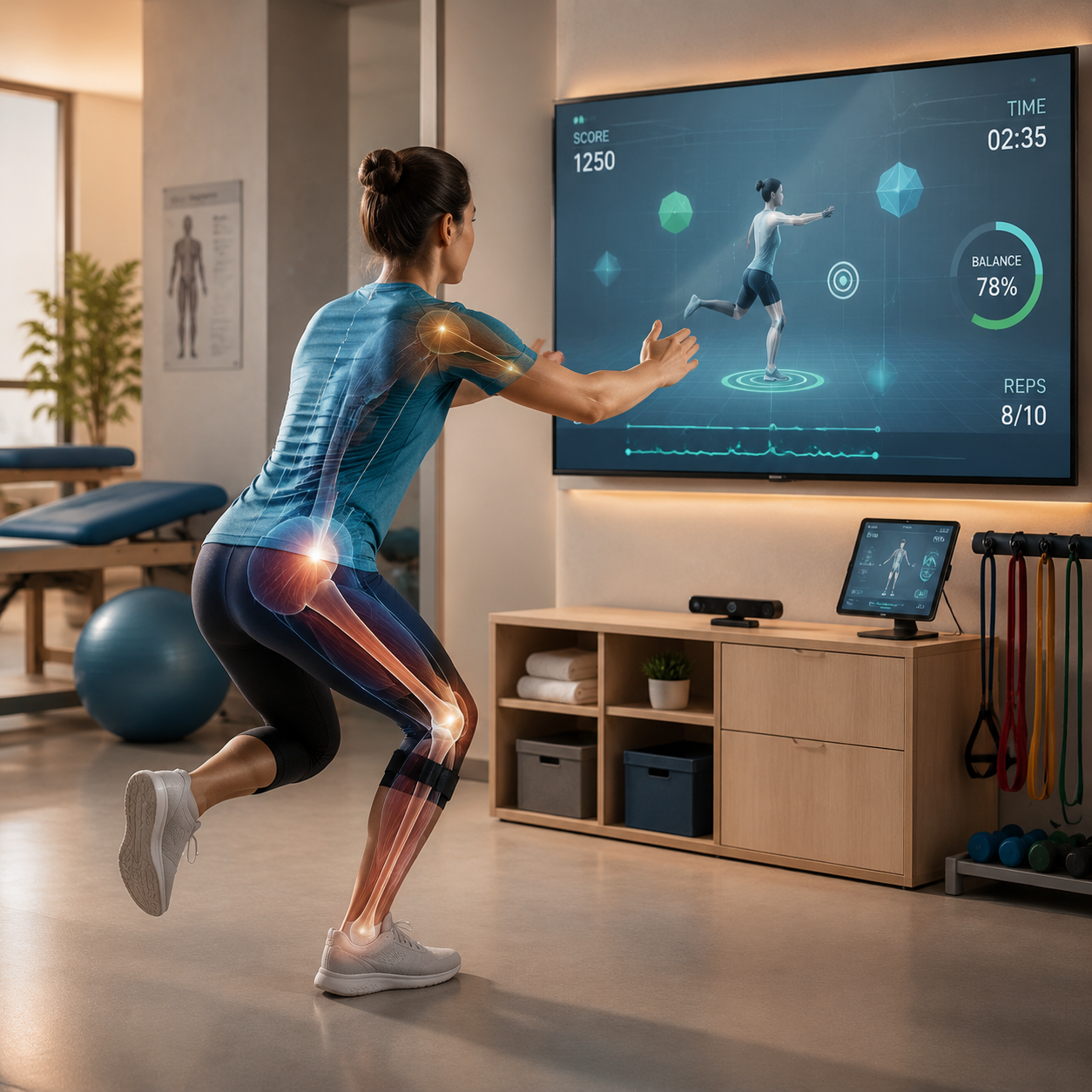
The rehabilitation intervention evidence is different. Here, AI is not only estimating risk; it is shaping the therapeutic exposure. A 2025 network meta-analysis of 33 randomized controlled trials in musculoskeletal disorders found that Therapeutic Exergaming ranked highest for pain reduction with a SUCRA value of 87.6%, Gamified Exergaming ranked highest for functional improvement with a SUCRA value of 99.6%, and Single-Joint Rehabilitation Robots ranked highest for range of motion with a SUCRA value of 84.7%.[2]
Those rankings deserve attention because they point to concrete rehabilitation mechanisms rather than abstract automation. Exergaming can increase repetition, provide immediate movement feedback, and make otherwise monotonous exercise more tolerable. Robotics can standardize movement assistance or resistance in ways that may be hard to reproduce manually across long sessions. The model is not replacing clinical reasoning; it is changing the conditions under which practice happens.
The boundary is just as important as the effect signal. The Luo et al. analysis covers musculoskeletal disorders broadly, not sports injuries exclusively.[2] That means the results are relevant to sports rehabilitation but not automatically equivalent to evidence in competitive athletes recovering from a specific injury under return-to-play pressure. A knee pain trial in a general rehabilitation population, a shoulder mobility program, and a post-operative athletic progression may all involve movement retraining, but they are not interchangeable clinical contexts.
The follow-up window also matters. Many rehabilitation intervention studies have short follow-up, commonly in the 2-to-12-week range. Short-term pain, function, or range-of-motion gains are clinically meaningful, but they do not prove durable sport-specific capacity, reinjury reduction, or readiness for chaotic play. A system that improves adherence or movement quality over several weeks may still need conventional progression criteria before it can be trusted inside a full athletic return pathway.
Still, this is the area where the evidence feels least speculative. The intervention is visible. The patient does something different. The outcome can be measured before and after therapy. If an AI-assisted platform helps a patient complete more appropriate repetitions, tolerate exercise better, or regain motion faster, the clinical value does not depend on pretending that the software can forecast the entire recovery.
Return-to-Sport Models Are Impressive Until the Endpoint Starts Moving
Return-to-sport is where the evidence becomes most tempting and most uncomfortable. A 2026 systematic review of 11 machine learning studies predicting return to sport found that Random Forest was the most common algorithm, used in 55% of studies, and that reported AUC values reached as high as 0.96.[3] On paper, that is the kind of performance that gets attention in a clinic, a research meeting, and a team facility.
But return-to-sport is not a single biological state. It may mean return to training, return to competition, return to preinjury level, return without symptoms, or return without reinjury over a specified period. If studies define the target differently, a model can appear accurate while answering a question that is narrower than the one a coach or athlete is asking.
The psychological gap is especially hard to ignore. In the Yuan et al. review, only 18% of included studies incorporated psychological readiness variables.[3] That omission is not cosmetic. Two athletes can show similar strength symmetry, hop performance, or range-of-motion values and still differ in confidence, fear, trust in the limb, and willingness to expose the joint under fatigue or contact. A return-to-sport model that sees the jump test but not the athlete’s readiness may be mathematically strong and clinically incomplete.

Hwang et al. provides a useful example of both promise and caution. In a 2024 study, a Random Forest model used 3-month physical performance data to predict anterior cruciate ligament return-to-sport status at 12 months, with an AUC of 0.95.[4] That is a strong signal from an early rehabilitation time point. It suggests that performance testing months before the final clearance discussion may contain information worth modeling.
It does not, however, turn a 3-month test battery into a clearance decision. The clinician still has to ask what “return” meant in the study, whether the athlete in front of them resembles the study cohort, what sport demands are missing from the dataset, and whether the model was tested outside its development setting. The closer AI moves toward a decision that affects exposure to contact, speed, fatigue, and competitive pressure, the less acceptable it is to treat discrimination metrics as the whole evidence story.
That is also where decision-support governance becomes relevant. Return-to-sport tools are not just analytics dashboards when their outputs influence clinical recommendations. Clinicians evaluating these systems should read them alongside practical decision-support guidance, including current CDS considerations for AI tools, without assuming that a high-performing model can independently clear an athlete.
Wearables Add Data, and Also Add Friction
Wearable sensor systems are often presented as the natural next layer: inertial measurement units, electromyography, heart-rate variability, flexible electronics, multimodal fusion, and eventually digital-twin-style athlete models. Technically, the direction makes sense. Rehabilitation does not happen only under a clinician’s eye. Movement quality, loading, fatigue, and adherence all change outside the appointment.
The deployment evidence is less smooth. A 2026 review of AI and wearable sensors for sports injury risk prediction reported that data heterogeneity across devices can cause more than 25% performance degradation, and that compliance below 70% is associated with more than 25% higher error rates.[5] Those are not abstract limitations. They are the everyday reasons a model that worked in a study can become unreliable when athletes forget devices, wear them differently, change brands, train in messy environments, or generate missing data during the sessions that matter most.
Continuous monitoring also changes the burden on the rehabilitation team. More data does not automatically mean better decisions. Someone has to decide which signal is actionable, when noise should be ignored, and whether an alert reflects tissue capacity, temporary fatigue, device placement, or a software artifact. If the system increases review time without improving the next clinical action, it has moved friction rather than reduced it.
This is why wearable AI should be judged less by technical elegance than by the bottleneck it solves. A sensor system that reliably captures home-exercise adherence after surgery may be more clinically useful than a sophisticated multimodal platform whose outputs cannot be interpreted consistently across devices. The standard is not whether the technology is advanced; it is whether the information survives contact with rehabilitation behavior.
What Can Be Responsibly Concluded Now
The current evidence supports selective confidence, not blanket confidence. Tree-based models deserve serious attention in injury risk prediction because they repeatedly perform well across comparative studies, but logistic regression remains a live comparator rather than an obsolete baseline. AI-assisted rehabilitation interventions, especially exergaming, have meaningful evidence for pain and functional outcomes in musculoskeletal disorder populations, but sports-specific transfer should be argued carefully rather than assumed.
Return-to-sport prediction is the least settled clinical use despite some of the most eye-catching AUCs. The endpoint is too variable, the cohorts too limited, and the psychological dimension too often absent to let a model’s output stand alone. Wearable systems may eventually make rehabilitation monitoring less dependent on episodic clinic snapshots, but current barriers around device heterogeneity and compliance are large enough to affect model error in practice.
AI is already useful enough to study and selectively evaluate across sports injury rehabilitation. The mistake is treating risk prediction, therapy delivery, monitoring, and return-to-sport clearance as one success story. They are different clinical tasks, and the evidence supports different levels of confidence at each point in the continuum.
References
- Machine learning models for injury risk prediction in sport: a scoping review, British Journal of Sports Medicine, 2025.
- Artificial intelligence-assisted rehabilitation interventions for musculoskeletal disorders: a systematic review and network meta-analysis, PMC, 2025.
- Machine learning for predicting return to sport: a systematic review, PMC, 2026.
- Machine learning prediction of return to sport after anterior cruciate ligament reconstruction using 3-month physical performance data, PMC, 2024.
- Artificial intelligence and wearable sensors for sports injury risk prediction, PMC, 2026.
Comments
Join the discussion with an anonymous comment.