
On December 30, 2019, HealthMap flagged reports of an unexplained pneumonia cluster in Wuhan, China. The signal came one day before China’s official acknowledgment, and it came from a system that used natural language processing across nine languages to scan public information sources for disease events.[1] That is the moment people often reach for when they want a clean example of AI in infectious disease outbreak surveillance: a machine sees something early, humans have not yet named it, and the map lights up.
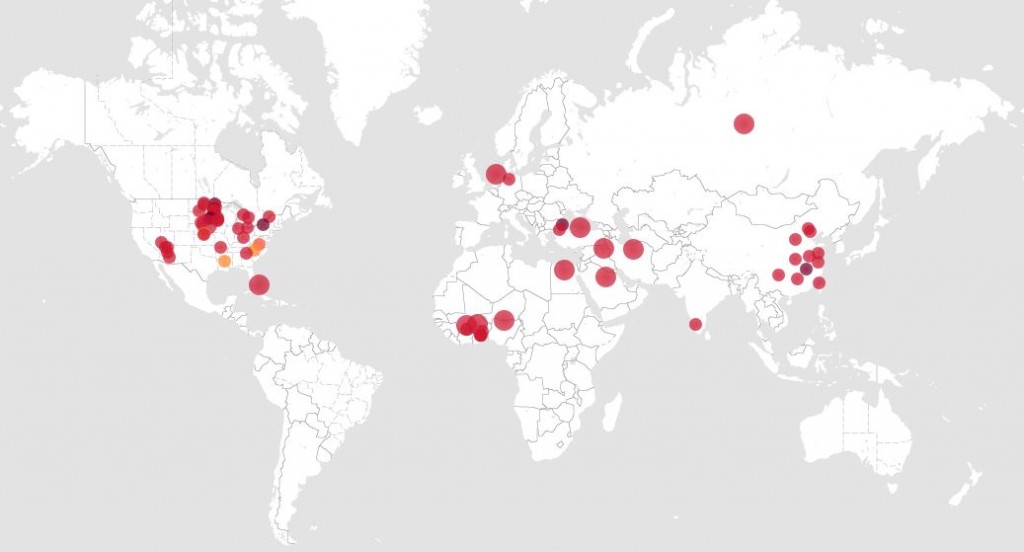
But an early signal is not, by itself, an outbreak surveillance system. Someone still has to decide whether the source is credible, whether the event matches an existing case definition, whether the alert should move into a public health workflow, and whether a local team has enough context to act without chasing noise. Detection is the glamorous part. Routing, verification, standards, staffing, and response are where the signal either becomes useful or disappears into another dashboard.
The modern surveillance stack is becoming AI-augmented at multiple points: clinical and laboratory ingestion, web and media anomaly detection, wastewater and genomic intelligence, compliance monitoring, and forecasting. These layers are not uniformly deployed, and they do not yet behave like one connected public health operating system. Still, the direction is clear enough to examine the stack as a practical workflow rather than as a collection of impressive demos.
The stack begins before the alert
Most outbreak intelligence starts as messy evidence: a lab result, a clinician’s note, an emergency department encounter, a school absenteeism pattern, a news item, a wastewater sequence, or a social post. AI matters when it changes how quickly those materials become structured enough for public health use.
| Layer | Typical data source | AI role | Operational question |
|---|---|---|---|
| Clinical and lab ingestion | Laboratory reports, electronic health records, free-text notes | Extracts, classifies, formats, or prioritizes surveillance-relevant data | Can the signal enter a reportable workflow without manual retyping or missed context? |
| Open-source event detection | News, web sources, official notices, multilingual public text | Detects unusual disease mentions and clusters across sources | Who verifies the alert, and where does it go next? |
| Wastewater and genomic intelligence | Sewage samples, sequencing reads, clinical genomes | Identifies variant patterns, transmission timing, and signals not visible in case counts | Can the model distinguish an actionable pathogen signal from background noise? |
| Monitoring and compliance agents | Internal surveillance queues, reporting logs, data quality checks | Flags missing data, delayed reporting, or workflow deviations | Does the system reduce surveillance burden or create another review queue? |
| Forecasting and situational awareness | Epidemiologic, spatial, policy, genomic, and text data | Projects near-term trends and synthesizes heterogeneous inputs | Does better prediction change staffing, testing, vaccination, or risk communication decisions? |
A 2025 systematic review in Frontiers in Public Health reviewed 67 studies and found that machine learning, deep learning, and natural language processing, when integrated with diverse data streams, were repeatedly associated with earlier outbreak detection.[2] That is useful as a map of the field. It does not prove that any individual tool is ready for routine deployment in a local health department, where the hard questions are usually about data permissions, interfaces, staffing, and accountability.
Layer 1: Turning clinical and laboratory residue into usable surveillance data
Clinical surveillance still depends heavily on whether relevant information is captured in a form that can travel. Laboratory messages, diagnosis codes, emergency department chief complaints, discharge summaries, and clinician notes all carry outbreak clues, but they do not arrive with equal structure. NLP can extract pathogens, exposures, symptoms, travel history, animal contact, occupation, location, and timing from text that would otherwise require manual review.
The value is not simply that an algorithm reads faster than a person. The value is that the algorithm can reduce the number of places where a surveillance signal gets trapped. If an emergency department note mentions poultry exposure, conjunctivitis, and influenza-like illness, the public health question is whether that combination can be elevated into the correct queue before the case is coded generically and forgotten.
That is why free-text extraction belongs in the same stack as outbreak detection. A concrete example is described in How Generative AI Uncovers Undetected H5N1 Exposure in ER Records, where GPT-4 Turbo is used to scan emergency department notes for H5N1 risk factors. The important surveillance idea is not that generative AI belongs in every emergency department workflow. It is that exposure context often sits in narrative text, while public health action depends on pulling that context into a structured review process.
This layer breaks when extraction accuracy is treated as the only endpoint. A public health analyst still needs provenance: which note produced the signal, which terms were extracted, how uncertain the model was, and whether the output maps to the jurisdiction’s reporting rules. Without that, NLP becomes another black box upstream of an already strained surveillance queue.
Layer 2: Detecting weak signals outside conventional case reporting
HealthMap’s COVID-19 signal is still instructive because it did not wait for a harmonized case report. It used multilingual NLP to monitor public sources and surface an unusual event before official acknowledgment.[1] That is exactly where open-source surveillance earns its place: it watches channels no human team can monitor continuously, across languages and time zones.
The operational weakness is equally clear. Public web data can be early, but it can also be duplicated, mistranslated, politically distorted, or clinically vague. A cluster mention is not the same thing as a verified outbreak. For a health department, the useful output is not a beautiful global map. It is a triaged event with source links, confidence indicators, jurisdictional relevance, and a path into existing incident assessment.
Newer systems are trying to make this open-source layer broader and more automated. BEACON, launched at Boston University in April 2025, was reported to have tracked more than 420 outbreaks involving 134 pathogens across 162 countries in its first three months.[3] Those figures are notable, but they come through a news article citing the project’s founder rather than independent performance evaluation. They show early scale and ambition, not settled effectiveness.
Readers who need a platform-by-platform view of systems such as BlueDot, BEACON, EPIWATCH, WHO EIOS, and HealthMap can use Comparing AI-Powered Outbreak Detection Platforms. The more immediate point is that platform comparison should not stop at who detects first. It should ask how the platform represents uncertainty, whether alerts are exportable, how users audit sources, and whether the tool can fit into public health incident management rather than remain a separate intelligence screen.
Layer 3: Wastewater AI is becoming a parallel early-warning system
Wastewater surveillance changes the denominator problem. It does not depend on who seeks care, who gets tested, which clinician orders which assay, or whether a case is reported promptly. A sewage sample can carry a pooled signal from people who never appear in clinical surveillance. AI becomes valuable when sequencing data are too complex, sparse, or noisy for simple threshold rules.
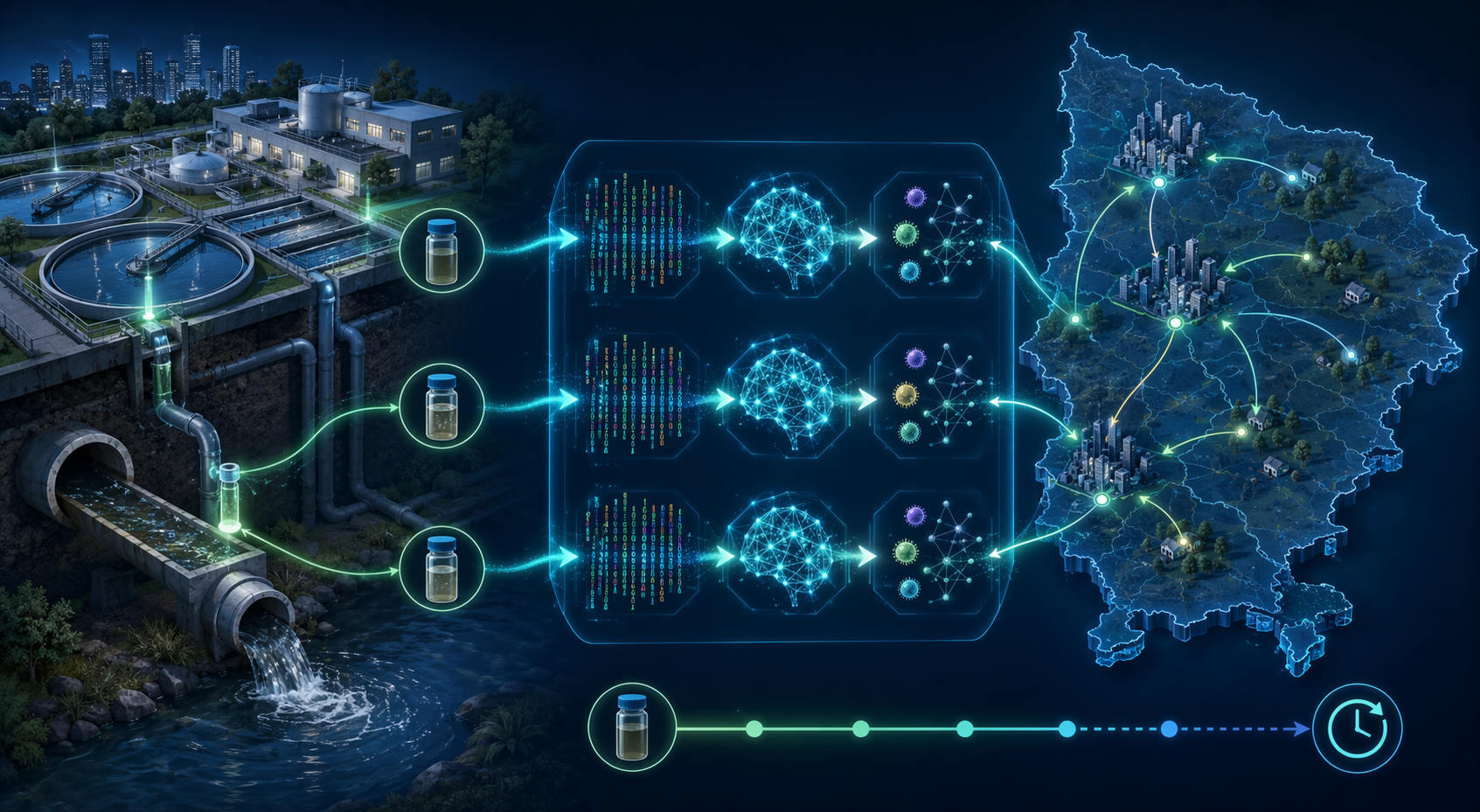
The UNLV and Desert Research Institute wastewater study is useful because it describes a measurable workflow rather than a general promise. The study compared 3,659 wastewater samples with 8,810 clinical genomes over two years, and the AI approach detected SARS-CoV-2 variants without prior genomic knowledge.[4] That last phrase matters: in practice, public health often has to look for pattern changes before it has a clean reference library for the next variant.
The reported sample requirements are also operationally meaningful. The system used about eight samples to establish reference signatures and two to five samples for early detection.[4] Those are the kinds of details that determine whether a method can leave the paper and enter a sampling network. A model that needs dense, frequent, high-quality sequencing from every site may work in a research setting and still fail in a rural county with intermittent collection and limited laboratory contracts.
The study also reported 7-to-9-day urban-to-rural transmission delays.[4] That finding is more than an academic timing estimate. If validated in a jurisdiction’s own network, it could influence when rural hospitals prepare testing capacity, when clinics update risk messaging, and when public health staff start looking for sentinel cases. The model is not just detecting a variant; it is helping describe movement through communities.
There are still unresolved barriers. Wastewater AI depends on sequencing depth, site coverage, sample handling, and enough metadata to interpret what the model sees. Rural gaps matter because a pooled environmental signal is only as representative as the sampling network. Novel signal detection also raises a difficult interpretation problem: the model may notice a sequence pattern before public health can say whether it represents a dangerous pathogen, a benign environmental sequence, contamination, or a transient signal with no clinical consequence.
That is why wastewater intelligence should be treated as a parallel layer, not a replacement for clinical surveillance. It can warn earlier, but it still needs clinical correlation, laboratory confirmation pathways, and a jurisdictional playbook for what to do when the wastewater curve moves before the case curve does. For a deeper look at earlier variant detection pipelines, AI-Powered Wastewater Surveillance Detects Outbreaks 1–6 Weeks Earlier reviews a related machine-learning approach.
Layer 4: Monitoring agents can help, but only if they reduce invisible work
AI agents for compliance monitoring and surveillance operations are less dramatic than outbreak maps, but they may matter more to the people running the system. A monitoring agent can check whether required fields are missing, whether lab reports are delayed, whether a facility’s feed has gone quiet, or whether a queue has cases aging beyond a review threshold.
The risk is that these tools create another layer of alerts for the same understaffed team. A useful agent should close loops: identify the missing field, route the issue to the data owner, document the exception, and make the status visible to the surveillance team. A weak agent merely tells analysts what they already know: the data are late, incomplete, or inconsistent.
This is where interoperability becomes a safety issue rather than an IT preference. If an AI system cannot write back to a case management platform, exchange standard fields, preserve source traceability, or support audit review, then its output stays advisory. Advisory output can be useful, but public health response depends on systems of record.
Layer 5: Forecasting is moving from curves to text-reasoning
Forecasting has always sat in an awkward place in outbreak surveillance. A forecast can be statistically impressive and still not change a decision. The useful question is whether it gives public health leaders enough actionable lead time to adjust staffing, testing, vaccination, supply distribution, or communications.
PandemicLLM is interesting because it treats infectious disease forecasting as a text-reasoning problem rather than only a numerical time-series problem. According to Johns Hopkins’ summary of the June 2025 Nature Computational Science work, the framework integrates spatial, epidemiological, policy, and genomic data streams and outperformed CDC CovidHub models across all 50 states over a 19-month period.[5] The accessible summary is not the primary paper, and the paper itself is behind a paywall, so the conclusion should stay narrow: this is a strong signal that LLM-based reasoning may improve benchmark forecasting when heterogeneous data matter.
The deployment question is harder. A public health department does not act on a benchmark. It acts on a forecast product with assumptions, update frequency, geographic resolution, uncertainty intervals, and a named decision context. If a model predicts rising risk, someone has to decide whether that means extending clinic hours, issuing provider alerts, sequencing more samples, or waiting for confirmation.
LLMs may add real value here because outbreaks are not purely numeric events. Policy changes, school calendars, genomic shifts, mobility patterns, testing behavior, and local news can all change what a curve means. A model that can reason across those inputs is attractive. It also raises familiar governance questions: which sources were used, which assumptions shaped the answer, how errors are explained, and whether users can see why the forecast changed.
The federal direction is toward AI, metagenomics, and integration
Federal strategy is beginning to acknowledge that AI is no longer peripheral to public health infrastructure. CDC’s AI Strategy for fiscal years 2026 through 2030 frames AI as part of the agency’s modernization agenda, including responsible adoption, workforce readiness, governance, and public health impact.[6] Those terms are easy to treat as administrative language, but they are exactly the conditions that decide whether an AI surveillance tool becomes operational.
Metagenomic surveillance is moving in the same direction. A 2025 Global Biodefense report described a proposed Biothreat Radar effort with a $52 million request in the fiscal year 2026 budget, as well as an Institute for Progress proposal for a $100 million-per-year national metagenomic network.[7] These proposals point toward a surveillance environment where sequencing, AI interpretation, and public health alerting are increasingly linked. They do not, by themselves, solve the practical questions of sampling coverage, laboratory capacity, data sharing, or response authority.
Where the stack still breaks
The same failure points recur across the stack. Data quality and bias shape what AI can see. Legacy public health IT systems limit what AI outputs can do. Black-box deep learning models can make it hard to explain why an alert fired. Privacy rules and data permissions determine whether clinical, genomic, and environmental data can be linked responsibly. Equity concerns determine whether early-warning systems cover only the communities with the best sampling networks and digital infrastructure.
Workforce capacity is the constraint that gets underestimated most often. AI can reduce manual review in one place and increase interpretive burden in another. A local epidemiologist may receive earlier signals from web surveillance, wastewater sequencing, and clinical NLP at the same time. If those signals disagree, someone must reconcile them. If they agree, someone must still decide whether to escalate.
Model transparency matters because public health decisions are contested. Closing a school, warning clinicians, redirecting laboratory capacity, or issuing risk communication requires more than a probability score. The system needs to show source data, assumptions, uncertainty, and change history. When it cannot, public health staff become the human credibility layer for a model they may not be able to inspect.
The most realistic near-term future is not a single omniscient outbreak AI. It is a layered surveillance environment in which NLP improves ingestion, open-source systems find weak signals, wastewater models reveal community-level pathogen movement, monitoring agents watch the workflow, and LLM-based forecasters synthesize more context than older models could handle. That is already a major shift. The unfinished work is connecting those layers to the people, standards, governance, and response pathways that make early warning usable.
References
- How AI can make infectious disease surveillance smarter, faster, and more useful, HealthBeat, July 1, 2025.
- Artificial intelligence in infectious disease outbreak surveillance, Frontiers in Public Health, 2025.
- Boston University researchers launch AI biothreat tracker BEACON, WBUR, September 12, 2025.
- Wastewater-based epidemiology study, Nature Communications, 2025; AI in wastewater surveillance, Desert Research Institute.
- Artificial intelligence model improves infectious disease forecasting, Johns Hopkins University Hub, June 6, 2025.
- CDC AI Strategy, Centers for Disease Control and Prevention.
- Scaling Pathogen Detection: AI, Metagenomics, and the Future of U.S. Biosurveillance, Global Biodefense, September 4, 2025.
Comments
Join the discussion with an anonymous comment.