
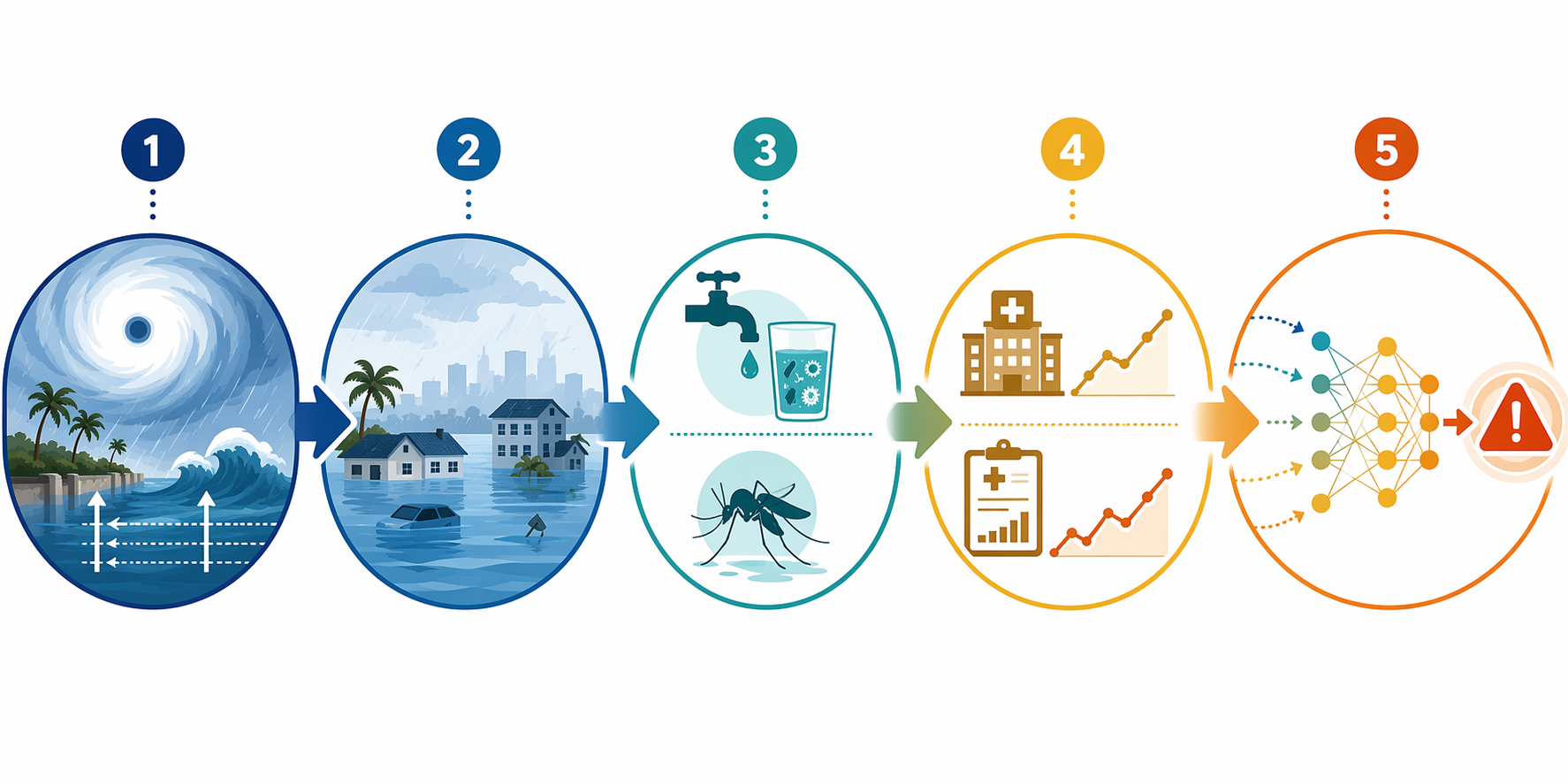
A storm surge forecast only becomes useful to public health when it changes the next decision: who gets called, which clinics should brace, what surveillance line gets watched first, and whether a water event is likely to shift infectious disease risk. That is the practical promise behind AI in tropical storm forecasting for public health preparedness. The current evidence suggests a real bridge is starting to form between hazard models and outbreak detection, but the field is still closer to proof-of-concept than deployable response infrastructure.

What the strongest study shows
The clearest quantitative evidence so far comes from Safari et al. In a retrospective EHR study in Iran, infectious disease prevalence rose from 39.5% before flooding to 47.3% after flooding, with an odds ratio of 1.38 (95% CI, 1.09-1.75). Among the models tested, Random Forest performed best, with an AUC of 0.76 [1].
That is enough to matter, because it shows an AI model can detect a post-flood disease signal before a surveillance team has a complete line list. It is not enough to hand the alert chain over to the model. An AUC of 0.76 is promising, but it still leaves room for false alarms and misses, and the study was conducted in a general flooding context in Iran rather than in tropical cyclone storm surge settings [1].
Where the cyclone-specific bridge is being tested
The most directly cyclone-relevant effort here is still an active project rather than a deployed public health system. At UT Austin, the AIM project is pairing uP-STREAM AI storm surge models with community storytelling data to estimate neglected tropical disease risk in Texas's Rio Grande Valley [2]. That is important less as proof of performance than as a sign that researchers are trying to connect a physical hazard forecast with local context, which is the part public health teams actually have to use.
A separate path shows the kind of lead time these systems are trying to earn. IITM's dengue early warning work uses temperature above 27 C, humidity in the 60% to 78% range, and rainfall patterns to predict dengue outbreaks up to two months in advance [3]. That is not a cyclone-surge model, but it does show that climate-linked AI can move the clock forward far enough to affect surveillance planning.
The broader climate-health AI movement is visible in Oxford's 2025 argument that AI can integrate climatic and socioeconomic data to predict outbreak origins and trajectories, and in Harvard's coverage of machine learning methods that connect weather and human health [4][5]. Those examples matter because they show momentum around the larger problem. They do not close the gap between a forecast and an operational decision.
For now, the defensible use of these tools is to augment existing surveillance frameworks. They can help prioritize syndromic monitoring, guide where to stage field teams, and tell laboratories and local health departments which post-storm signals deserve faster scrutiny. They should not be treated as replacements for epidemiologists, laboratory confirmation, or field investigation, and the current evidence is not mature enough to run outbreak command on its own.
References
- Post-flood infectious disease prediction in Iran using electronic health records and machine learning — Health Science Reports, 2025
- UT researchers use AI models to predict storm surges, infectious disease spread — The Daily Texan, 2025-10-16
- AI model predicts dengue outbreaks two months before they start — Gavi
- New study shows how AI can help prepare world for next pandemic — Oxford University, 2025-02-20
- Machine learning can predict weather and human health — Harvard Medical School
Comments
Join the discussion with an anonymous comment.