
AI in stroke care and recovery has moved far beyond the pilot-project stage in one part of the pathway. Annual publications rose from about 98 in 2015 to more than 1,500 in 2024, and the field now includes more than 30 FDA-cleared imaging tools, although that clearance count should be cross-checked against the FDA AI/ML-enabled device list because one cited count comes from a commercial source.[1][2] This is not an immature field by activity, investment, or deployment.
The harder question is narrower: have these systems improved outcomes patients can feel at 90 days, such as independence, disability, walking, arm function, recurrent vascular events, or safe recovery after discharge? The best answer today is uncomfortable. Stroke imaging AI has credible evidence for faster work. No stroke AI tool has yet shown a statistically significant improvement in 90-day functional independence.
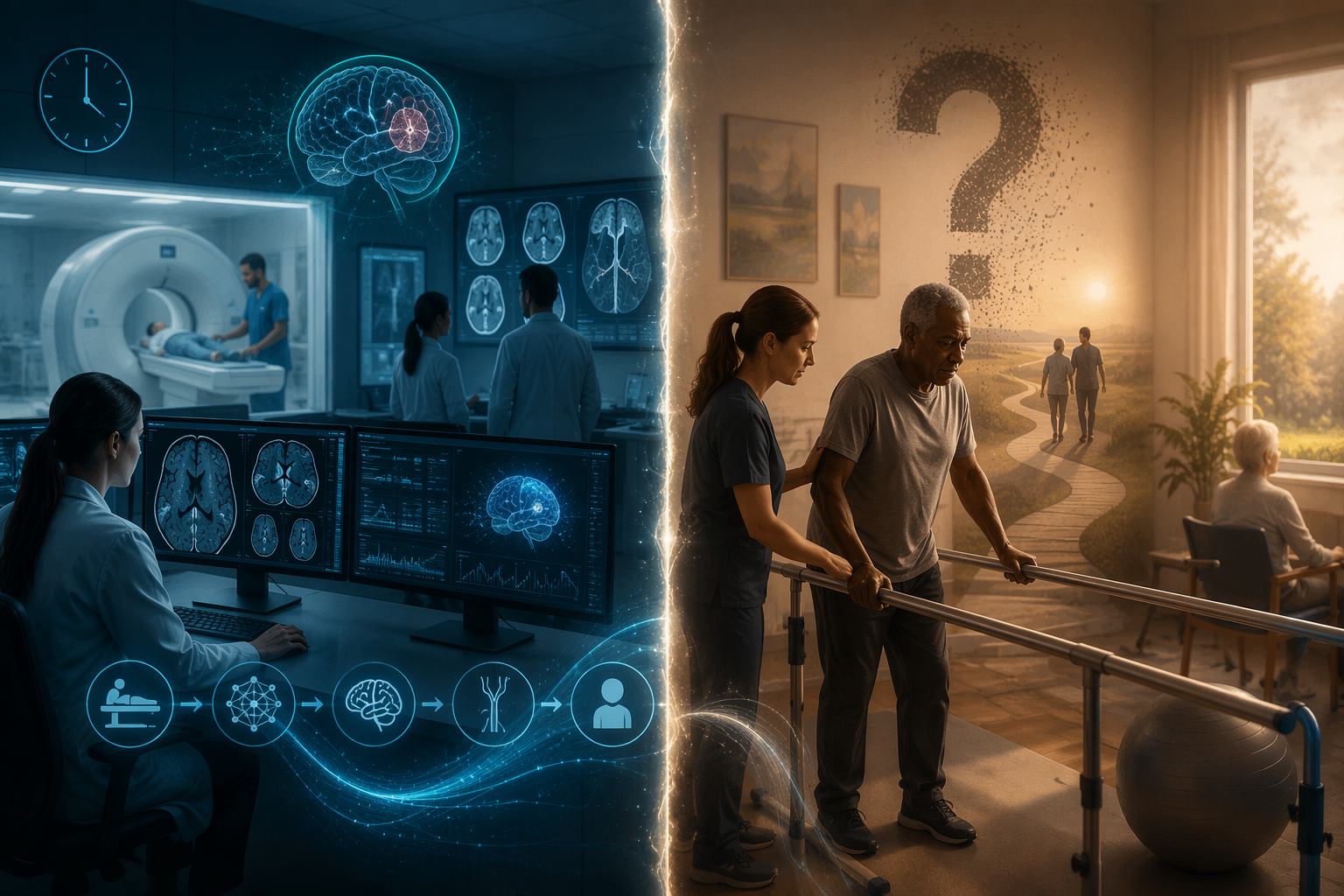
That distinction matters because acute stroke care is built around time, but it is not about time alone. A saved minute can be valuable. It can also be absorbed by transfer logistics, eligibility uncertainty, staffing gaps, post-procedure complications, rehabilitation access, or discharge risk. Workflow evidence deserves respect; it just cannot be treated as a substitute for clinical validation.
The clearest win is diagnostic acceleration
The strongest evidence sits where the task is bounded: read the scan faster, detect large vessel occlusion, estimate early ischemic change, alert the right people, and shorten the interval before a thrombectomy decision. These are not trivial improvements. Stroke pathways are brittle; a delayed read, a missed notification, or a slow handoff can change whether a patient reaches the angio suite in time.
Automated ASPECTS scoring shows why clinicians have taken these tools seriously. In one cited evaluation across 1,987 scans, AI-assisted reading reduced scoring time by 74.8%, from 130.6±61.3 seconds to 33.3±8.3 seconds, and the AUC for AI-plus-physician interpretation improved from 67.43% to 89.76%.[3] That is exactly the kind of friction reduction a stroke team can use: less waiting, less ambiguity, and a faster shared picture of whether the patient is likely to benefit from intervention.
The commercial deployment story is also real. Viz.ai has been cited with 96% sensitivity for large vessel occlusion detection, median specialist notification under six minutes, and use across more than 1,700 hospitals in more than 100 countries.[4] Those figures do not prove better recovery, but they do show that stroke AI has crossed from laboratory performance into operational infrastructure in many systems.
| Stroke AI domain | Evidence maturity | What the evidence mainly supports |
|---|---|---|
| Imaging and triage | Most mature | Faster scan interpretation, faster notification, shorter workflow intervals |
| Outcome prediction | Limited clinical advantage | Moderate discrimination, with no clear superiority over existing clinical scores |
| Rehabilitation and recovery | Research-stage | Promising trial signals in selected interventions, but no cleared rehabilitation AI tool |
| Risk stratification and general GPT tools | Governance-sensitive | Potential utility, but equity and regulatory concerns remain unresolved |
The mature part of the field is therefore not mysterious. It is the part where AI can attach to an existing high-stakes workflow, produce a bounded output, and route that output to a clinician who already knows what decision must come next.
The trial that defines the gap
The central evidence problem is not that imaging AI fails to save time. It is that the best randomized evidence has not shown that the saved time translated into better functional independence.
The Martinez-Gutierrez JAMA Neurology randomized clinical trial is the key study because it is the only published randomized trial of AI triage in this space. The intervention reduced door-to-groin puncture time by 11.2 minutes. Yet the odds ratio for 90-day functional independence was 1.3, with a 95% confidence interval from 0.42 to 4.0, and the result was not statistically significant.[5]
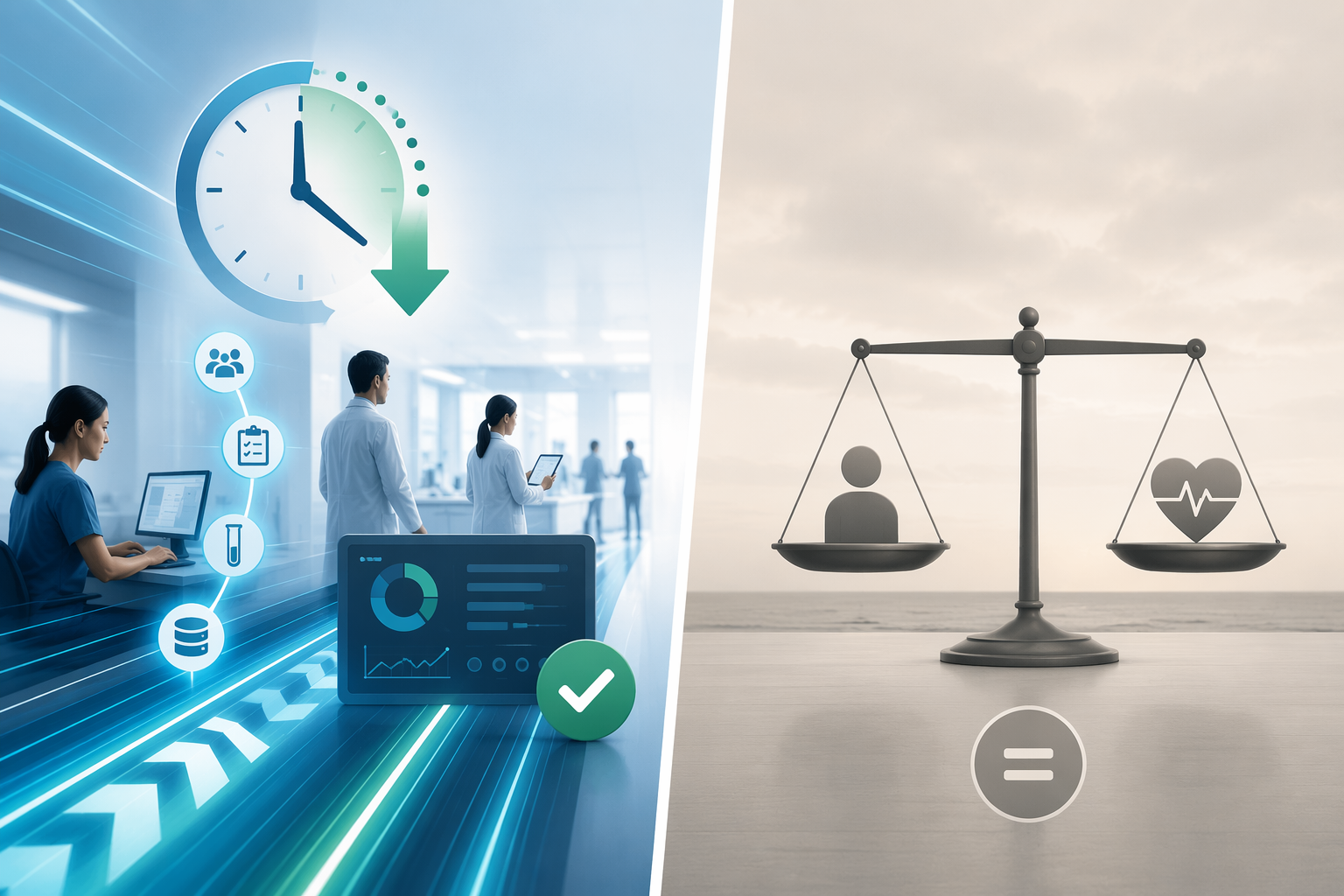
That result should not be flattened into failure. An 11.2-minute door-to-groin reduction is operationally meaningful in a disease where treatment effect is time-dependent. But the trial also shows the boundary of the evidence: a faster workflow interval is not the same as a demonstrated improvement in independent living at 90 days.
Several explanations can coexist. The trial may have been underpowered for functional independence. The time saved may have been too small relative to variation in onset-to-arrival time, transfer delays, collateral status, infarct core, reperfusion success, complications, and rehabilitation access. Or the AI may have improved one link in a chain where other links still determine whether the patient walks out independent.
For technology assessment, the practical implication is straightforward: workflow validation should be priced and governed as workflow validation. It becomes an outcomes claim only when a study follows the patient far enough downstream and measures what changed after the notification.
Prediction has not escaped the old clinical scores
Outcome prediction is where the language around AI can become more ambitious than the evidence. A model that predicts poor outcome after thrombectomy may look useful on paper, especially if it reports a respectable AUC. But the decision question is not whether the model can rank risk in a dataset. It is whether it improves selection, counseling, escalation, rehabilitation planning, or follow-up in a way that patients would recognize as better care.
A 2022 meta-analysis of thrombectomy outcome models reported a pooled AUC of 0.81, with no superiority over existing clinical scores.[6] That finding is easy to underestimate. An AUC of 0.81 is not poor discrimination, but it does not justify replacing familiar bedside tools unless the model changes a decision or reduces harm in external deployment.
The equity evidence makes this more consequential. Hong and colleagues reported worse discrimination for Black individuals than for White individuals across stroke risk models, with C-index values of 0.64–0.69 for Black individuals versus 0.76 for White individuals, and machine learning approaches did not remove the gap.[7] If an AI model is introduced as a risk stratification layer without subgroup performance testing, it can reproduce the same unevenness with a newer interface.
This is one reason the diagnostic–therapeutic divide is not merely technical. Imaging triage tools often assist a time-sensitive team decision that is already underway. Prediction tools can quietly influence who receives attention, how risk is explained, and which patients are prioritized after discharge. The threshold for evidence should rise when the model begins shaping access, intensity, or expectations.
Recovery remains the least mature part of the pipeline
Stroke recovery is where patient-centered benefit should be easiest to describe and hardest to prove. Patients and families care about arm function, walking, communication, fatigue, falls, return home, caregiver load, and the risk of another event. These outcomes unfold over weeks and months, across hospitals, rehabilitation units, outpatient clinics, homes, and family routines. That makes recovery a poor fit for evidence built only around algorithmic accuracy.
There are promising signals. In the largest cited brain-computer interface randomized trial, conducted across 17 centers with 296 participants, Wang and colleagues reported a 3.35-point improvement in FMA-UE score, with p=0.0045.[8] In gait rehabilitation, a Cochrane review of 62 randomized trials including 2,440 participants reported an odds ratio of 2.01 for independent walking with electromechanical-assisted gait training.[9] These are therapeutic signals, but they do not establish a broad class effect for AI rehabilitation tools, and they do not erase the fact that no FDA-cleared stroke rehabilitation AI tool exists in the cited evidence base.
Monitoring tools sit in a related but distinct category. Xue and colleagues reported 94.8% fall detection sensitivity, a 42% reduction in fall-related injuries, and $15,311 in net savings per participant over 24 months.[10] That kind of evidence is relevant to recovery because falls after stroke are clinically and economically important. It still needs careful reading: detection sensitivity, injury reduction, and savings are not interchangeable, and implementation context will determine whether those savings survive outside the studied setting.
Prediction models for rehabilitation outcomes are also emerging, including work from an Italian inpatient rehabilitation cohort with a median age of 80.[11] That is useful for hypothesis generation and local service planning, but it raises the usual transportability questions. A model trained in an older European rehabilitation population may not perform the same way in younger stroke survivors, non-European populations, lower-resource systems, or settings with different therapy intensity.
Decision support is promising, but generalizability is doing real work
The most important therapeutic-adjacent evidence comes from GOLDEN BRIDGE II, not from a general-purpose chatbot or a narrow imaging algorithm. The trial evaluated AI-based clinical decision support for secondary prevention and reported a 25.6% reduction in recurrent vascular events at three months, with event rates of 2.9% versus 3.9%, across 77 hospitals and 21,603 patients.[12]
That result deserves attention because recurrent vascular events are patient-centered and clinically important. It also has a clear pathway: decision support can prompt guideline-concordant secondary prevention, and better secondary prevention can plausibly reduce recurrence. The caution is not about whether the endpoint matters. The caution is that the trial was conducted exclusively in Chinese hospitals, so health systems should not assume the same effect size in settings with different baseline care, prescribing patterns, follow-up infrastructure, reimbursement, or population risk.
This is where AI decision support may be more defensible than many prediction products: it can be evaluated against a concrete care gap. Did antithrombotic prescribing improve? Did lipid management improve? Did follow-up occur? Did recurrence fall? If the answer is measured at the patient level and replicated in the population where deployment is planned, the evidence begins to look different from a standalone model performance paper.
General-purpose health GPTs widen the governance problem
Stroke care also sits inside a broader market of general-purpose health AI tools, many of which are not built for the urgency, liability, and coordination problems of stroke systems. Chu and colleagues identified 1,055 unapproved health GPTs operating without regulatory clearance.[13] The relevance to stroke is not that these tools are all being used for thrombolysis or rehabilitation decisions. It is that health systems are increasingly surrounded by AI products whose regulatory status, intended use, evidence base, and monitoring obligations are unclear.
A general-purpose tool that drafts discharge instructions, answers patient questions, or summarizes rehabilitation goals can still affect care. It may change what a patient understands, what a caregiver watches for, or what a clinician reviews. In stroke, where cognitive impairment, aphasia, medication complexity, and recurrent-event risk are common, governance cannot stop at whether the model sounds fluent.
What a defensible stroke AI investment measures
The investment case for stroke AI is strongest when it stays close to validated imaging workflow integration and makes outcome measurement explicit from the start. A hospital buying an LVO detection or ASPECTS support tool should not only ask whether the algorithm performs in a test set. It should ask what part of the stroke pathway the tool changes and where the benefit could disappear.
- Workflow endpoints: scan-to-notification time, door-to-groin time, transfer acceptance time, specialist response time, and after-hours performance.
- Clinical endpoints: reperfusion timing, complications, discharge destination, 90-day modified Rankin Scale distribution, functional independence, recurrence, falls, and readmissions.
- Equity endpoints: performance and downstream care changes by race, ethnicity, sex, age, language, disability, hospital type, and transfer status.
- Implementation endpoints: alert fatigue, false-positive burden, neurologist and radiologist workload, transfer coordinator workload, documentation changes, and escalation pathways.
- Governance endpoints: intended use, regulatory status, model updates, local validation, audit frequency, override processes, and accountability when recommendations are wrong.
The important move is to connect the alert to the care pathway. If an LVO alert fires faster, who receives it? Who confirms it? Who activates transfer? What happens when the receiving center is full? How often does a false alert pull a neurologist away from another patient? Does the tool shorten time only during weekday hours, or also at night? A deployment that cannot answer these questions may still improve a dashboard while leaving the patient experience unchanged.
For recovery tools, the evidence burden should be even more explicit. A rehabilitation AI product should specify whether it is selecting therapy intensity, guiding exercises, predicting discharge destination, detecting falls, or supporting caregiver education. Those are different claims with different consequences. A model that predicts poor arm recovery should not be treated the same as a system that improves measured arm function in a randomized trial.
The same discipline applies to secondary prevention and risk stratification. A recurrent-event decision support system may be worth serious evaluation if it closes a known treatment gap and measures recurrence. A risk model with a decent AUC but weaker performance in Black patients should not be allowed to quietly govern outreach lists, follow-up intensity, or patient counseling without subgroup auditing and mitigation.
The diagnostic–therapeutic divide is the current reality
Stroke AI has earned a place in the workflow conversation. Automated imaging support can reduce reading time, increase the speed of specialist notification, and help teams coordinate high-pressure decisions. Those gains are clinically relevant because stroke systems depend on fast, reliable handoffs.
The field has not yet earned the broader claim that AI improves functional recovery after stroke. The only randomized trial of AI triage reduced door-to-groin time but did not show a statistically significant improvement in 90-day functional independence. Outcome prediction models have not clearly surpassed existing clinical scores. Rehabilitation AI remains research-stage. Risk stratification carries documented equity concerns. General-purpose health GPTs add a layer of regulatory and governance uncertainty.
That does not argue for abandoning AI in stroke care. It argues for buying and studying the part that has matured, while refusing to let workflow evidence carry claims it has not proven. The most defensible investments are imaging and triage integrations tied to prospective measurement of patient-centered outcomes. Claims about prediction, rehabilitation, population risk, and general-purpose GPT tools require stricter evidence, equity testing, and post-deployment governance before they are treated as outcome-improving stroke care.
References
- A Decade of Artificial Intelligence in Stroke Care (2015–2025) — PMC13117140, Apr 2026.
- How Accurate Is AI Stroke Detection? Speed vs. Doctors (2026) — Articsledge.
- Current Stroke Solutions Using Artificial Intelligence — PMC11674960.
- Transforming Stroke Care and Outcomes Using AI — Mayo Clinic Magazine, 2025.
- Martinez-Gutierrez RCT — JAMA Neurology, 2023.
- Outcome prediction meta-analysis — 2022.
- Hong et al. stroke risk model equity study — JAMA, 2023.
- Largest Brain-Computer Interface Randomized Trial — Med, 2024.
- Electromechanical-assisted gait training after stroke — Cochrane Review.
- AI monitoring after stroke — Digital Health, 2025.
- Prediction of functional outcome of intensive inpatient rehabilitation after stroke using ML — nature.com/s41598-025-00781-1.
- AI-based system to guide stroke treatment decisions may help prevent another stroke — newsroom.heart.org.
- Use of artificial intelligence in the management of stroke: scoping review — PMC12141347.
Comments
Join the discussion with an anonymous comment.